Longterm investment: A better capitalism
Stewardship and engagement will become an integral part of investment in the future, and asset owners need to write stewardship and non-financial objectives into their mandates with external managers, according to Saker Nusseibeh, chief executive international of Federated Hermes.

Because investment- unlike trading the financial markets – is long-term, investee companies’ actions over the long term are crucially important. Speaking at Sustainability Digital, Saker Nusseibeh, chief executive international of Federated Hermes told delegates that assets held in an index fund give investors no connection with the company over the long term. There is no conversation with the company about strategy, how they treat their workforce or mitigate black swans. Investment, by contrast, is about being a responsible owner for the long term.

Nusseibeh told delegates that long term investment also required a different kind of analysis. You need people who can talk in the same language, he said, adding: “It’s very labour intensive.”

He urged delegates to learn about ESG and plough resources into garnering a knowledge that goes deeper than just claiming to integrate ESG.

Regarding engagement, Nusseibeh advised working with companies on the issues that they care and worry about. Run it in a democratic way; ask them what issues concern them, he said.

“If you want to help make the company better, think about the issues we face together.”

He said that changing company behaviour involves measuring performance, including how corporates perform against peers in their sector. Over time those that meet sustainability KPIs outperform their sector substantially because they are simply enhancing their ability to make money over the long-term, he said.

“It is about doing capitalism better. Discussions about ESG and sustainability should always be about investment.”

Nusseibeh, who was awarded a Commander of the Order of the British Empire in the Queen’s 2019 New Year’s Honours list for services to Responsible Business and Finance, said few active managers outperform the benchmark but investing long term leads to outperformance.

However, investing for the long term doesn’t mean holding and then leaving. Being owners of a company involves making sure the business is sustainable and thinking about risk and how to mitigate it. For example, not integrating diversity in a business “halves supply chains” and not acting in the interests of stakeholders like the local community invites regulation.

He said sustainability involved doing long term economics “properly” and that by ensuring society is prosperous, individuals also prosper.

“The companies we own shape the societies we live in, and people want to ensure that the society they retire into is sustainable,” he said.

He told delegates that this belief in stewardship will increasingly impact funds management. All investors will recognise that ownership of public or private companies involves an element of stewardship “to look after their investments over the long term.”

Stewardship and engaging with companies will become an integral part of investment, he predicted. Hermes first started engaging for stronger UK corporate governance in 1983, was a founding signatory of the PRI in 2006, and spearheaded the Climate Action 100+.

The audience, made up of asset owners from 42 countries, was in support of integrating stewardship into the investment process, with 60 per cent saying that stewardship should be mandatory in a live poll at the event.

Nusseibeh said that asset owners need to write stewardship and non-financial objectives into their mandates. You can’t just allocate to passive or active funds without a stewardship target assigned, he said.

He also urged investors to talk about long-term realistic targets that incorporate the value of integrating ESG whereby value is attributed to aspects of a business other than the financials.

For example, COVID-19 has taught people that culture is very important within a company.

“Companies with strong cultures survived COVID but how do you measure culture?” he asked. There should be outcomes that are related to behaviour. “This is the only way to invest separate from betting on the markets,” he said.

He also said that low cost, passive investment would come back to “bite” because of the wider costs incurred by society as a whole. If global warming reaches three degrees the savings investors will have made via passive allocations will be wiped out by the increased costs of water, food and energy.

“The money we save has got to be able to let us retire well,” he concluded.


Longterm investment: A better capitalism

Longterm investment: A better capitalism

Climate Action 100+ illustrates asset owners’ ability to come together to solve the tragedy of the commons, said Anne Simpson, managing investment director, board governance and sustainability at US pension giant CalPERS. Speaking at Sustainability Digital she said because institutional investors own many of the biggest systematically important carbon emitters in the world, together they can influence change. Climate Action 100+ signatories put pressure on corporate boards to commit to net zero and ensure their corporate governance is aligned with the Paris targets in what Simpson called an often “challenging and painful” process.

The investor collaboration monitors and tracks corporate progress, checking companies do what they say. It also includes a reporting framework. Pressure from the investor alliance has seen companies from across the world make board-level commitments to meet targets and integrate them into their financials, said Simpson. She said that the emissions causing global warming don’t stop at national boarders and companies in emerging markets must work just as hard to meet the Paris targets.

“They don’t live on another planet,” she said.

Here success includes progress in India where two of the country’s biggest emitters have committed to net zero. Simpson told delegates that working with local investors and via local partnerships is key to success in many geographies. Many companies are state-owned, so we need to be in dialogue with regulators and government agencies, she said, adding. “You only make progress with partnerships.”

Simpson told delegates that because of its size, the $400 billion pension fund has “nowhere to hide” and faces systemic risk from climate change.

CalPERS’ sustainability journey began after the GFC when in a back to basics approach the pension fund examined where its value creation came from. Reviewing the evidence it “reframed the agenda” to managing three forms of capital: financial, human and natural.

“Once you realise as a fiduciary, risk and return comes from managing these three forms of capital ESG became a fundamental part of how you invest,” Simpson told delegates.

The pension fund has nearly completed carbon foot-printing its whole fund, and is currently in the last stages of carbon foot-printing the private equity allocation.

In public markets the fund tends to pursue engagement strategies. In private equity it has set out sustainable investment practices and engages with managers. In infrastructure and real estate, the pension fund physically maps climate risk while in fixed income the fund has developed a set of sustainable investment guidelines for due diligence.

“We found that taking a sustainable lens to risk and return has made us more intelligent investors,” Simpson said. Around 20 per cent of CalPERS’ assets are in unlisted investments, while 80 per cent of the fund is internally managed.

Simpson also detailed the challenge of balancing the needs of short-term cash generation to meet pension obligations and investing for the long term – the pension fund pays around $25 billion a year in benefits to its members. CalPERS’ 7 per cent return target, in addition to the cash needed to pay benefits, means financial performance “really matters.”

Committing to the Net Zero Asset Owner Alliance, another investor collaboration, goes beyond simply excluding carbon intensive sectors, said fellow panelist Eva Cairns, senior ESG investment analyst, climate change, at Aberdeen Standard Investments.

It involves monitoring carbon within investments and charting how these levels are decreasing over time with short-term and interim targets. It also involves shifting capital to low carbon solutions and transition leaders, as well as engagement.

She said that engagement is key to find out what companies are doing to navigate risk.

“A lot of companies will benefit from the transition,” she said.

Cairns also detailed the process behind TCFD reporting – the climate-related financial risk disclosures used by companies in providing information to investors. Noting it was a “good way to improve internal processes” and she said it required strong internal governance.

She noted, however, that carbon foot printing “doesn’t tell you the whole story” since it only highlights the most carbon intensive companies when, infact, investor also need to know what targets companies have set.

She also noted that different investors define Paris alignment in different ways and said that investors should recognise regional differences and the need for different net zero pathways by sector and region. In regions where policy is not supportive of net zero, achieving real economy decarbonisation is difficult, she said.


For the full recording of this session, all the conference program and white papers and stories visit the Sustainability content hub here.

Key Takeaways

  • In response to the global pandemic, we have already witnessed two stages of state intervention: a liquidity injection, followed by continuing emergency support for struggling economies.
  • Stage three involves government and central-bank support for restructuring economies that are transitioning from old ways of doing business to new ones, and will be the most difficult stage of the recovery.
  • We anticipate that the global recovery is more likely to be shaped like a U-bend rather than in the form of a ‘V’ or ‘W’.
  • We expect to see a deflationary environment over the next 12 months, but beyond that, we believe inflation is more likely to return.

The bounce in markets during the second quarter of 2020 enabled bond strategies to recover most of the losses that they suffered during the initial dislocation caused by the pandemic in March. The second half of the year will be more difficult, however, as we anticipate that low cash and government-bond yields will continue, alongside a rise in corporate defaults and downgrades.

One of our primary investment themes, which plays a key role in fixed-income investing, is state intervention, and we have already witnessed two of the three phases of state intervention in response to the pandemic over the last six months: first, March’s liquidity injection, and secondly, continuing emergency support for the pandemic-induced fall in gross domestic product (GDP). This began in April, but may continue well into the autumn.

Difficult Phase Three

The third phase of state intervention will be more difficult to navigate. It concerns the support from government and central-bank authorities for a restructuring of economies as they transition from an old way of doing business to a new one; the difficulty stems from the fact that some of the emergency measures that are in place roll off before companies and employees can benefit from any new economic direction. In this third phase, we would expect to see more ‘recovery fund’-type fiscal stimulus and less direct employment support. However, this transition is hampered by the need to extend phase two owing to the lingering virus threat, and the politics of getting the stimulus packages approved.

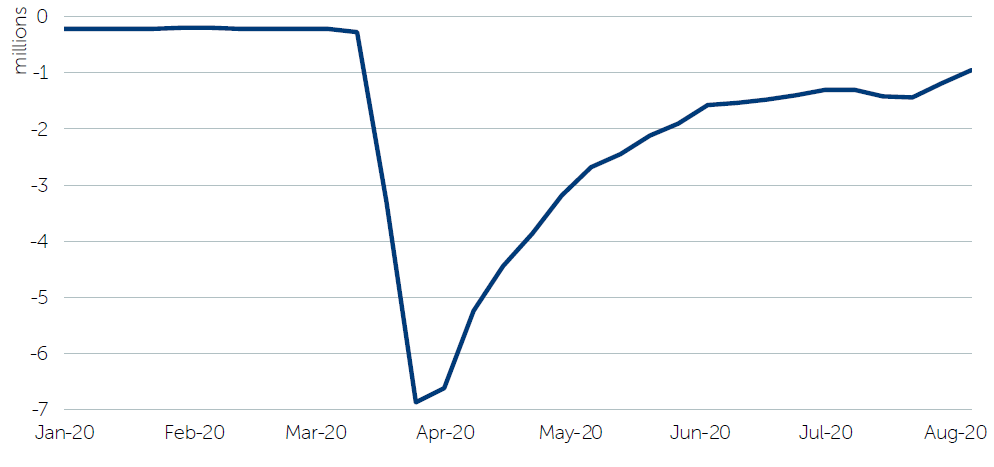
The chart below shows initial US unemployment claims and is a good example of our view that economic data (having bounced from the lows of the March/April lockdown periods) will take a while to get back to pre-crisis levels. While the market has debated a ‘V’ or ‘W’-shaped recovery, we have been talking about a U-bend shape.

US Initial Jobless Claims, January 1 – August 6, 2020

Source: Bloomberg, August 7, 2020

No Immediate Return

There are a few reasons why we think economies will not return in two years’ time to the same pattern in which they were before the pandemic. This is about more than the virus alone, and has its roots in the leverage-distorted system which was in place prior to the pandemic, which helped to create untenable wealth inequality which, in turn, fueled populism and a reversal of the globalization trend.

As always with a crisis, there are reasons why previous trends are accelerated and new trends emerge. The global financial crisis was a good example: economies weakened and then recovered, political parties changed, and some other pre-existing trends accelerated while new ones came into force. The rise of social media, smartphones and technology continued after the crisis, probably helped in part by the low cost of finance and the abundant availability of venture capital. The banking system, however, had to restructure by shrinking balance sheets and reducing staff.

Significant economic turmoil always leads to a change in political parties as new leaders suggest they can do better than their predecessors, and a disillusioned electorate looks for change. The long-term trend of globalization was also a casualty of the global financial crisis; the current calls to bring jobs home and rising trade tensions are a symptom of this.

People Crisis

The new crisis is a people crisis rather than a financial one, and therefore the systems that are in need of a restructure are those that are connected to a change in the way people live, rather than a restructuring of the financial system. Therefore, the prior trends that are not hit by this change should continue, and may receive a boost from the availability of cheaper money and, more importantly, the increasing use of fiscal stimulus rather than just loose monetary policy.

For example, the rise of populism and its negative effect on trade is likely to continue, but crucially, as governments get more involved in the economy, investment in environmental projects is likely to rise and the focus on the social agenda will also pick up; the wellbeing of staff will be a key concern and health-care systems will see more investment too.

ESG Considerations

When it comes to environment, social and governance (ESG) concerns, the increasing focus on the ‘E’ that we witnessed prior to the crisis should continue as the recovery grows. The ‘S’ agenda is more difficult to define, but those employers that look after their staff through greater use of flexible working and wellbeing support may attract the highest-caliber workers. Finally, the ‘G’ consideration should also attract heightened interest, as weak economies tend to flush out bad practice.

In our view, the sectors that need to change or adapt are those that were gearing up before the crisis based on previous trends that are no longer there. For example, the airline industry was constantly focused on expanding passenger traffic, but much of this growth may not now materialize. Many of the deflationary trends that were there in the decades before the crisis had already started to roll off – for example, globalization and demographics. Over the next 12 months as economies restructure, unemployment is likely to remain high, demand weak, and inflation at low levels.

Inflation Lurking Further Out?

Once that transition has passed, there is a real possibility that inflation could end up higher than it was previously. Prior to the crisis we were starting to worry about many of the deflation champions reaching a share of the market where (instead of looking to gain market share at a cheaper price) they would be inclined to raise prices as their market share plateaued. For example, low-cost airlines were steadily increasing prices as their competition was squeezed out of the market. The airlines that survive the current dip in travel demand will be operating with lower capacity and, perhaps as a result, higher costs.

Meanwhile, the ‘baby boomer’ generation is retiring, and thus shifting from saving to consumption mode. Delocalization will receive fresh impetus as supply chains are shortened (but become more inefficient), trade barriers are erected, and politicians try to boost domestic employment. Finally, from their current low levels, we anticipate that energy prices could rise as we shift towards more renewable energy sources – all factors that could lead to higher inflation over the longer term.

Important information and disclosures

Any reference to a specific security, country or sector should not be construed as a recommendation to buy or sell this security, country or sector. Please note that strategy holdings and positioning are subject to change without notice.

Important information

This is a financial promotion. Issued by Newton Investment Management Limited, The Bank of New York Mellon Centre, 160 Queen Victoria Street, London, EC4V 4LA. Newton Investment Management Limited is authorized and regulated by the Financial Conduct Authority, 12 Endeavour Square, London, E20 1JN and is a subsidiary of The Bank of New York Mellon Corporation. ‘Newton’ and/or ‘Newton Investment Management’ brand refers to Newton Investment Management Limited. Newton is registered in England No. 01371973. VAT registration number GB: 577 7181 95. Newton is registered with the SEC as an investment adviser under the Investment Advisers Act of 1940. Newton’s investment business is described in Form ADV, Part 1 and 2, which can be obtained from the SEC.gov website or obtained upon request. Material in this publication is for general information only. The opinions expressed in this document are those of Newton and should not be construed as investment advice or recommendations for any purchase or sale of any specific security or commodity. Certain information contained herein is based on outside sources believed to be reliable, but its accuracy is not guaranteed. You should consult your advisor to determine whether any particular investment strategy is appropriate. This material is for institutional investors only.

Personnel of certain of our BNY Mellon affiliates may act as: (i) registered representatives of BNY Mellon Securities Corporation (in its capacity as a registered broker-dealer) to offer securities, (ii) officers of the Bank of New York Mellon (a New York chartered bank) to offer bank-maintained collective investment funds, and (iii) Associated Persons of BNY Mellon Securities Corporation (in its capacity as a registered investment adviser) to offer separately managed accounts managed by BNY Mellon Investment Management firms, including Newton and (iv) representatives of Newton Americas, a Division of BNY Mellon Securities Corporation, U.S. Distributor of Newton Investment Management Limited.

Unless you are notified to the contrary, the products and services mentioned are not insured by the FDIC (or by any governmental entity) and are not guaranteed by or obligations of The Bank of New York or any of its affiliates. The Bank of New York assumes no responsibility for the accuracy or completeness of the above data and disclaims all expressed or implied warranties in connection therewith. © 2020 The Bank of New York Company, Inc. All rights reserved.

In Canada, Newton Investment Management Limited is availing itself of the International Adviser Exemption (IAE) in the following Provinces: Alberta, British Columbia, Ontario and Quebec and the foreign commodity trading advisor exemption in Ontario. The IAE is in compliance with National Instrument 31-103, Registration Requirements, Exemptions and Ongoing Registrant Obligations.

How investors can address human rights abuses and modern slavery.

  • We believe investors should act to prevent human rights abuses
  • Risks can be buried deep within company supply chains
  • Action is needed to address poverty – the root cause of much abuse

The concept of human rights has evolved and been recognized through various pieces of national legislation, including the UK’s Modern Slavery Act 2015. But the milestone document was the 1948 Universal Declaration of Human Rights which stipulates “all human beings are born free and equal in dignity and rights”, and that these rights are applicable “without distinction of any kind, such as race, color, sex, language, religion, political or other opinion, national or social origin, property, birth or other status.”1

Investors can, and in our view must, play a role in preventing human rights abuses. Ignoring modern slavery, or human rights abuses, poses material risks to companies. It may result in fines or litigation against businesses or adverse reputational impacts. Furthermore, it is now a societal expectation that investors are not complicit in human rights abuses or modern slavery. But investors face several challenges when implementing human rights considerations into investment and stewardship practices.

National governments and supranational organizations, such as the European Union, are often central to upholding human rights, and have a range of legislative, constitutional and judicial tools at their disposal. They also have the ability to enforce the principles of human rights that are internationally agreed. While it is the role of United Nations (UN) member states to uphold human rights, it is also the case that corporate actors and private institutions can infringe these rights. Not all human rights are as obviously related to corporate and business activity as others. Different considerations are required when analyzing a company, where, for example, freedom of association may be a concern, versus sovereign analysis, which may require the consideration of whether citizens enjoy the right to a fair and public trial.

As human rights requirements fall on both states and companies, clearly the best outcomes are likely to occur when both government and corporate actors respect human rights. In a state where the legal infrastructure does not protect human rights, it is difficult for companies and investors to address human rights abuses.

The UK’s Modern Slavery Act sets out corporate responsibilities in relation to human rights and modern slavery, which can be punishable by unlimited fines. This landmark legislation has since been replicated across numerous jurisdictions, including Australia. However, since this law came into force, there has been substantial criticism that companies are not meeting their legal requirements, and that modern slavery persists. Analysis by law firm Linklaters2 suggests just 19% of the more than 7,000 statements on the Modern Slavery Registry meet the core requirements. Without adequate enforcement of legislation by the state, the financial risks to businesses are potentially lower, and it inevitably becomes more difficult for investors to make the case to companies that such risks must be addressed. This is even more problematic where there is a lack of relevant legislation, as the international principles that businesses are required to follow in relation to human rights are not legally enforceable alone.

Risks to People Paramount

A further challenge when analyzing human rights risks is that it requires a different perspective, or lens, to that usually used by companies and investors. The UN Guiding Principles on Human Rights set out how companies should fulfil their responsibilities in relation to human rights. Businesses are required to respect human rights, and address salient human rights abuses. Saliency differs from materiality in that the former focuses on the potential scope, severity and irremediable nature of human rights impacts. It is crucial that this is viewed from the perspective of the impact on people and their human rights, rather than potential business impacts. In effect, this does not look at financial materiality or whether human rights risks also pose business risks. It is solely interested in whether there are risks to people, requiring a different lens through which investors typically view risks.

Risks can be buried deep within corporate supply chains. For example, agriculture and apparel industries may have more obvious exposure to human rights and modern slavery risks, but food retailers and clothing outlets are likely to be some distance away in the value chain from these risks. Supply chains are frequently complex, and lack transparency, making it difficult for businesses to identify and manage risks, and even more so for investors to understand supply-chain risks.

Remediating Human Rights Infringement, Without Creating Adverse Consequences

Should a company find instances of human rights abuses within its supply chain, the simplest solution can be to terminate the relationship with the supplier, which distances the company from the breaches. A company can reduce its financial risk, as the risks of legal action or negative publicity are minimized, via this distancing. However, this action could lead to far worse consequences for the victims, whose human rights have already been infringed, particularly as they are in a precarious position to begin with. As active investors, we encourage companies to engage with suppliers with the intention of remediating human rights infringements, without creating adverse consequences. We also encourage participation in industry-wide initiatives designed to drive higher standards and alleviate human rights infringements at a systemic level.

Designing a program which effectively identifies and remediates human rights infringements is complex. It requires a deep and thorough understanding of the human rights at risk, as well as transparency across the entire corporate value chain. It also requires an understanding of the cultural, political, and socio-economic factors which influence conditions on the ground. Often investors and consumer-facing businesses are so far removed from these conditions that they need education in order to start addressing the root cause of human rights breaches.

Finally, investors cannot address the complexity and scale of human rights abuses alone. National governments and supranational organizations have a crucial role to play, and many other actors, such as NGOs (non-governmental organizations) and charities can support this. In order to make significant progress, there needs to be action to address the underlying causes of human rights abuses, which most often relate to poverty. There also needs to be adequate legislation which is robustly enforced. This sets clear expectations for companies and provides a universal framework that investors can apply to investment analysis and stewardship activities. Ultimately, it also creates a clear financial incentive for businesses and investors to get to grips with this complex issue.

Sources

[1]  https://www.ohchr.org/Documents/Publications/Compilation1.1en.pdf

[2]  https://lpscdn.linklaters.com/-/media/digital-marketing-image-library/files/01_insights/publications/2020/march/gc19276_modern_slavery_act_five_years_on_2pp_a3_flyer_final_screen.ashx?rev=10d94435-9757-4494-95cf-79f2bc039e40&extension=pdf&hash=EC3CB4EA4ACDBB4C739D892329ACDA93

Important information and disclosures

Any reference to a specific security, country or sector should not be construed as a recommendation to buy or sell this security, country or sector. Please note that strategy holdings and positioning are subject to change without notice.

Important Information

This is a financial promotion. Issued by Newton Investment Management Limited, The Bank of New York Mellon Centre, 160 Queen Victoria Street, London, EC4V 4LA. Newton Investment Management Limited is authorized and regulated by the Financial Conduct Authority, 12 Endeavour Square, London, E20 1JN and is a subsidiary of The Bank of New York Mellon Corporation. ‘Newton’ and/or ‘Newton Investment Management’ brand refers to Newton Investment Management Limited. Newton is registered in England No. 01371973. VAT registration number GB: 577 7181 95. Newton is registered with the SEC as an investment adviser under the Investment Advisers Act of 1940. Newton’s investment business is described in Form ADV, Part 1 and 2, which can be obtained from the SEC.gov website or obtained upon request. Material in this publication is for general information only. The opinions expressed in this document are those of Newton and should not be construed as investment advice or recommendations for any purchase or sale of any specific security or commodity. Certain information contained herein is based on outside sources believed to be reliable, but its accuracy is not guaranteed. You should consult your advisor to determine whether any particular investment strategy is appropriate. This material is for institutional investors only.

Personnel of certain of our BNY Mellon affiliates may act as: (i) registered representatives of BNY Mellon Securities Corporation (in its capacity as a registered broker-dealer) to offer securities, (ii) officers of the Bank of New York Mellon (a New York chartered bank) to offer bank-maintained collective investment funds, and (iii) Associated Persons of BNY Mellon Securities Corporation (in its capacity as a registered investment adviser) to offer separately managed accounts managed by BNY Mellon Investment Management firms, including Newton and (iv) representatives of Newton Americas, a Division of BNY Mellon Securities Corporation, U.S. Distributor of Newton Investment Management Limited.

In Canada, Newton Investment Management Limited is availing itself of the International Adviser Exemption (IAE) in the following Provinces: Alberta, British Columbia, Ontario and Quebec and the foreign commodity trading advisor exemption in Ontario. The IAE is in compliance with National Instrument 31-103, Registration Requirements, Exemptions and Ongoing Registrant Obligations.

Unless you are notified to the contrary, the products and services mentioned are not insured by the FDIC (or by any governmental entity) and are not guaranteed by or obligations of The Bank of New York or any of its affiliates. The Bank of New York assumes no responsibility for the accuracy or completeness of the above data and disclaims all expressed or implied warranties in connection therewith. © 2020 The Bank of New York Company, Inc. All rights reserved.

Shardul Agrawala, head, environment and economy integration division at the OECD laid out the challenges and opportunities for governments to build back better. He highlighted the industries and that may undergo transformation and the underlying market failures that need fixing.

With an estimated $10 trillion committed world-wide by governments to help counter the ravages of the COVID-19 via stimulus and bailout, the opportunities for governments to green the recovery are huge. Speaking at Sustainability Digital, Shardul Agrawala, head, environment and economy integration division at the OECD laid out the challenges and opportunities for governments to build back better.

The initial fiscal response to the pandemic was focused on liquidity provision to firms rather than specific stimulus, he explained. Now, businesses face risks to their solvency and fiscal measures have evolved as countries look to boost consumption. At some point the crisis will end, and the vast bill will become due.

Despite the challenges inherent in tracking green commitments and the risk of “double counting,” Agrawala estimated that globally governments have allocated around one trillion to green initiatives. Examples include France’s pledge to invest in hydrogen as part of its €100 billion coronavirus recovery plan – a third of which is going to green investments. Elsewhere, India is tying job creation to an ambitious afforestation scheme.

Governments will also take steps to create green jobs and employment. This could result in public works including cleaning up hazardous waste sites or energy efficient refits with “significant importance to short term growth.”

Longer term he suggested governments could funnel investment and create jobs into renewables and green transport.

“These elements are welcome,” said Agrawala,. However, he also noted other risks, like the fact investing in renewables may create jobs but will also destroy jobs in other areas and he said that green jobs can be “shorter lived.”

“The duration of jobs is important in greening an economy.”

As countries strive to rebuild, they may push back environmental regulation and freeze enforcement and taxes, especially in US. He also noted the unconditional bailouts of sectors that contribute to climate change like aviation and shipping. Investment in fossil fuel infrastructure is another sector that might get a boost as governments seek to rebuild their economies, he flagged.

“Our preliminary assessment is that although green elements are welcome, the response is more brown than green. This is a big concern for all of us.”

Agrawala cast back to how governments rebuilt in the wake of the GFC to offer further insight. Although high profile losses like the massive government loan to US solar group Solyndra made the headlines, many green investments have been successful with money committed to green elements of the recovery reaping returns. For example, Tesla received a government loan that was paid back years early.

But even successful loans hold salutary lessons. The US government received interest on its loan to Tesla, but Elon Musk lent to the firm at a much higher rate that included an option on an equity stake. The message, said Agrawala, is that when governments make risky technology investments, they rarely act like a venture capital investor: they don’t receive VC returns, although they take the same risk.

“This should be a lesson when we design the green COVID stimulus,” he said. “Governments will make bets that don’t pan out and governments find picking winners challenging.”

In another example of previous government efforts to green the economy he cited ‘Cash for Clunkers,’ the US federal scrappage program intended to provide economic incentives to purchase a new, more fuel-efficient vehicles by trading in a less fuel-efficient vehicles. It proved expensive and didn’t create that many jobs said Agrawala, noting that in many cases public money replaced private finance. Cash for clunkers didn’t create new investment, it just bought some investment forward. Governments need to ensure public money is truly additional and better targeted, he said.

He also said that for green stimulus measures to deliver, governments need to fix underlying market failures like emissions trading frameworks with properly designed measures. Elsewhere he flagged the need for “flanking measures” to create the right incentives. For example, governments have a role ensuring people who have made their homes energy efficient don’t just “consume more energy.”

He urged delegates to resist the impulse to simply cut and paste green stimulus measures deployed in the wake of the GFC. We are in a different crisis, the cost of solar and wind has fallen, and society is much more fractured, he said. Here he noted that it is difficult for many people to “worry about the end of the world” when they are battling the financial challenges that come with “the end of the month.”

Finally, he urged for more work to ensure ESG ratings are fit for purpose. Multiple metrics and methodologies make transparency and harmonisation difficult. It’s possible for companies and investors to achieve high ESG scores without being high on environmental issues. The social dimension is very important, but the environmental pillar also needs weight, he said.


For the full recording of this session, all the conference program and white papers and stories visit the Sustainability content hub here.

There is moment driven by the COVID-19 crisis to invest in line with the Sustainable Development Goals, according to chief executive of Robeco, Gilbert van Hassel. But investing in companies of the future, and avoiding risks of the past, requires real expertise and changing mindsets about investment poses one of the biggest challenge for investors.

The Sustainable Development Goals offer a North Star guiding to a better world, said Gilbert van Hassel, chief executive, Robeco.

Speaking at Sustainability Digital, van Hassel urged over 600 delegates from 43 different countries with a collective $16.3 trillion assets under management to follow the SDGs to help solve the grittiest world problems. The 17 SDGs offer a “perfect blueprint” for bigger and bolder action to help solve the interdependent challenges that have seen the health crisis of Covid-19 trigger an economic crisis.

Launched five years ago with the aim of putting capital to work to earn returns alongside helping solve global scourges like the climate crisis, poverty and inequality by 2030, the SDGs reflect the global nature of today’s challenges. They also lay to rest the old belief that sustainability is only an issue for poor countries.

“We in the developed world have climate issues, inequality and governance issues,” he said.

Van Hassel told delegates the SDGs are achievable despite the pace of change, listing Australia’s bushfires and unprecedented temperatures in California and the threat of extinction for millions of species as some of the challenges. He also noted positive change over the last five years like the growth in the number of women elected to Parliament; the fact one fifth of global energy production now derives from renewable sources and more of the ocean is protected. Corporations are weaving ESG and the SDGs into the goals and Europe is leading on introducing new sustainability regulation, he said.

“Doing nothing is going to get us into serious trouble but the momentum is there, and Covid-19 has given us an opportunity,” he said. “Now is time for action and I am optimistic.”

As today’s problems are interconnected so the SDGs are similarly interconnected. It makes solving them more complex. For example, solving hunger (SDG 2) will create better health (SDG 3) but at the same time could impinge on water resources (SDG 6) and influence climate change (SDG 13).

“The SDGs are complex and require real knowledge,” he said.

Solving them requires public and private sectors coming together and van Hassel urged governments to introduce policies that make private sector investment easier. “We need more regulation not less,” he said.

Investing sustainably fits with institutional investors fiduciary duty to maximise returns and minimise risk. “Sustainability has these two components,” he said. He urged delegates to “make sure” that sustainable companies “are winning” noting that clear trends have started to emerged. For example, oil companies are being forced to write down billions of assets.

He also urged investors to increase their academic knowledge of sustainability, saying the Robeco is a “research-driven” organisation: allocating capital responsibly to sustainable opportunities and avoiding transition risk requires a new mind set and expertise, he said. Investing in companies of the future, and avoiding risks of the past, requires real expertise. Indeed, changing mindsets poses one of the biggest challenge for investors.

“We need to take sustainability seriously and incorporate it into our thinking,” he said.

As he urged investors to put their capital to work towards a sustainable recovery he noted that the interest of companies and investors are aligned.

“Let’s make sure we use our capital to invest in a sustainable recovery and make sure we as owners of companies, engage with them,” he said

Noting the importance of cooperation van Hassel urged investor collaboration with similarly minded people working together. For example, investor signatories of Climate Action 100+ has resulted in Italian group Enel appointing a board director with climate experience.

“Engagement is very important, and you can’t do it by yourself,” he said.

He urged investors to “walk the talk” and introduce sustainability within their own practices so that ESG becomes part of their DNA.

He noted that achieving the SDGs is a huge challenge but warned delegates they didn’t have the luxury to pick and choose which ones are achievable. Because they are interconnected we should therefore “strive to solve them all” making progress with “as few negative side effects as possible.”

Finally, he urged for a conversation whereby investors set out their sustainable ambitions and what kind of future they want to invest in.

“It is not only about wealth but also about wellbeing,” he said. “Each individual investor needs to set own goals and contribute to better world.”


For the full recording of this session, all the conference program and white papers and stories visit the Sustainability content hub here.