
Atleast 2023 until ‘normal’ returns

Coronavirus vaccines are being rolled out in various jurisdictions – including the UK and Russia – but it will take at least an additional two years from now to eradicate the pandemic, according to health experts.

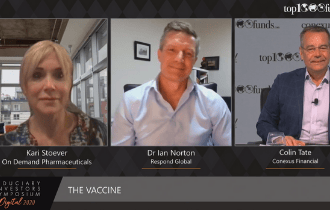
Speaking at FIS Digital 2020 Dr Ian Norton, founder and managing director of Respond Global and the former global head of WHO’s Emergency Medical Team Initiative warned the 185-odd asset owner attendees with a collective $11 trillion assets under management that a long road to normal still lies ahead.

“We’ve never seen a pandemic end in less than two years,” he said.

Now the key challenge lies in the logistical and supply chain challenges of rolling out the vaccine. Moreover, success depends on the vaccine reaching all corners of society, and all countries in the world.

“We can’t just look at one country’s management of COVID; each country is only as strong as global management. International borders won’t open until we have got rid of the bulk of the disease.”

And all the while fresh spikes will occur.

Sponsored Content

“It’s not over; there are several waves to come.”

There are investor opportunities with regard to bio-medicine that have been highlighted by the pandemic, and the innovation around the vaccine development, and the focus should be on ongoing technological innovation, said Kari Stoever chief external relations officer at On Demand Pharmaceuticals.

She also highlighted the need for innovation around cold chain storage and flagged that healthcare supply chains will increasingly onshore.

“The global supply chain won’t go away but we will see a shoring up of domestic manufacturing to meet rapid demand responses to surges,” says Stoever, who recently wrote the document for President-elect Joe Biden on the future of pharmaceutical manufacturing in the US.

Indeed, fierce nationalisation regarding healthcare provision is a key lesson from the pandemic, said Norton who noted how manufactures in the West closed off their supply to developing nations.

“We will see more regionalisation of supply,” he predicted.

Norton, whose experience includes coordinating WHO’s emergency health response to Ebola in West Africa, also forecast a rebound in demand for healthcare away from COVID-19 that stretched governments won’t be able to meet. Expect a hybrid of ethically-driven businesses to fill the gap, he said.

Reflecting on why the US has struggled to contain the pandemic, Stoever said that successful policy depends on both top down and bottom-up strategies.

“In the US there has been a failure at both levels,” she said.

The challenges inherent in mandating behaviour depend on successful public education. Moreover, she flagged that gaps in public education in the US could impact vaccine take up.

“I am already seeing a lot that worries me like unsubstantiated claims about safety; I hope these don’t scare the public,” she told delegates.

Noting the different levels of resistance across the US at a community level to public health messages, she said: “We live in an individualistic society and people are seeing their rights violated.”

Adding again that changing that message to one of interconnectedness won’t ever be heard without top down, bottom-up messaging.

Panellists heard how America’s travails contrast with countries like South Korea, Australia and many African countries which have successfully got their public health message across.

“It is about taking people with you,” said Norton who witnessed first-hand Liberia’s success in containing Ebola. “Liberia invested in a public health message and Liberia got rid of Ebola.”

Similarly, South Korea, which learnt early lessons from MERS, has got the virus under control but he noted that “alternative news” makes public messaging difficult.

Norton also reflected on the challenges facing WHO.

“It is an underfunded agency, and has been for a long time,” he said, also describing how WHO is buffeted by contributing countries trying to control how money is spent. The organisation’s strengths lie in its ability to set standards and manage research; its weaknesses lie in operations and logistics. With this in mind, he warned that WHO should prepare for another wave of criticism in response to its ability to lift the vaccine.

“It will not be able to do this,” he said, adding that the organisation’s window of opportunity to create an operational entity has now passed.

Instead, he forecast that health institutions in regional blocs like the EU, ASEAN and ECOWAS could become the future focus of global health management.

Leave a Comment

The twin forces rewriting the rules of investing

The twin forces rewriting the rules of investing

Portfolios built for the old world will be severely tested as emerging forces rewrite the rules of investing. The Fiduciary Investors Symposium heard that geopolitical and macroeconomic upheaval, together with the disruption wrought by AI, should force asset owners to rethink the structure and composition of portfolios.

Sort content by

Chicago Teachers: Where succession fears put managers on watch

In a recent investment committee meeting, trustees at Chicago Teachers heard how succession risk at external managers can hit not only returns but also managers' ability to bring ideas into the investment process and consistency around portfolio construction and implementation.

NYC Comptroller on corporate stewardship escalation, Israel bonds re-entry

New York City Comptroller Mark Levine says he will leverage the city’s $310 billion pension assets and link arms with other state Treasurers to apply pressure on US corporates. In an interview with Top1000funds.com, he sets out the stewardship agenda while explaining a potential re-entry into Israel bonds.

Iceland’s LV mulls more EM exposures, PE co-investments after SAA review

Iceland’s LV is eyeing more emerging markets allocation and private equity co-investments after conducting an SAA review, which will be finalised in the first half of 2026. CIO Arne Vagn Olsen says the shift is designed to make the $11 billion pension fund future-ready.

Strategy and reporting under the microscope: Denmark’s ATP awaits review

Denmark's ATP is awaiting a review that will report on the strength of its investment strategy, and suggest how to simplify reporting. But additional transparency must not hurt the future returns for members, warns Allan Japhetson, head of investment strategy at ATP.

Texas Teachers’ CIO questions TPA, DAA value-add

Chief investment officer of the $225 billion Teacher Retirement System of Texas Jase Auby has voiced reservations about the total portfolio approach, particularly regarding the robustness of its central feature, the top-down decision-making process. He also outlined why the fund doesn’t consider dynamic asset allocation a durable source of alpha.

Complexity to clarity: How AP4’s tech overhaul slashed risk and costs

A new investment management platform at Swedish buffer fund AP4 has taken almost ten years to come to fruition. Increased efficiency, lower costs and risk make it worth the wait, says head of risk and operations Nicklas Wikström.

Previous



