Sustainability has long been a focus for Mercer. It is one of the five investment beliefs underpinning our advice and the firm established its responsible investment practice in 2004. The components of our sustainable investment beliefs articulate our conviction that:

  • ESG (environmental, social and corporate governance) factors can have a material impact on long-term outcomes and should be integrated into the investment process.
  • Taking a broader and longer-term perspective on risk, including identifying sustainability themes and trends, will probably lead to improved risk management and new investment opportunities.
  • Climate change poses a systemic risk, and investors should consider both the potential financial impacts of the associated transition to a low-carbon economy and the physical effects of different climate outcomes.
  • Active ownership helps the realisation of long-term shareholder value by providing investors with an opportunity to enhance the value of companies and markets.

We continue to work with clients to embed these principles across their portfolios. In this article, we make the case for ESG integration and sustainability-themed investing.

We have been assessing portfolio managers on the extent to which they incorporate ESG issues and active ownership into their decision-making since 2008. The key aspect to our approach is to understand what decision-makers are doing at the strategy level to address ESG issues. Our ratings aim to capture the level of consistency with which ESG factors are assessed in the process and are a measure of intent.

ESG integration is about more holistically understanding the risks in a portfolio that are not necessarily readily apparent. In recent years, this has evolved to place greater emphasis on:

Climate change – Mercer’s study in 2015 on climate change at the asset class, industry, and total portfolio level highlighted the importance of taking a total portfolio approach to assessing climate risks. This has been reinforced by events such as the 2015 Paris Climate Agreement and the 2017 Taskforce on Climate-related Financial Disclosures’ (TCFD) recommendations for market participants to consider climate risks, apply consistent metrics and disclose related information in annual reporting. We are increasingly seeing managers incorporate climate change into their company assessments.

  • Active ownership – There has been greater scrutiny of how asset managers are voting on shareholder resolutions and engaging with companies on climate change, diversity, food, water and other environmental and social issues at annual general meetings. For example, in the US in particular, the Interfaith Center on Corporate Responsibility has found that climate change and inclusiveness/diversity were the top two areas of focus in shareholder resolutions in 2017. We expect these topics to remain priority areas.
  • Social factors – More recently, the industry has turned its attention to the investment implications of social issues, with increased focus on areas such as social inequality, human and labour rights and slavery. While this is not yet apparent in manager approaches, we would expect this to become more prevalent as best practices are developed.

The extent to which portfolio managers integrate ESG and active ownership into their approach is reflected in our ratings. An ESG1-rated strategy is considered a leader; an ESG4-rated strategy is not. We take a similar approach for passively managed equity strategies, placing emphasis on active ownership at a central corporate governance level.


What is the opportunity set for strategies that integrate ESG?

We have seen good progress with asset managers since we started assessing ESG integration at the strategy level. In 2010, less than 9 per cent of investment strategies with an ESG rating were ESG1 or ESG2. At the beginning of 2018, more than 15 per cent of active investment strategies achieved a high rating. This highlights that there is still much room for improvement across the market.
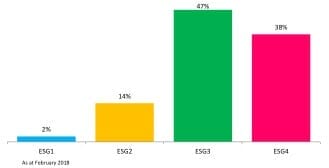
We believe the trend will continue along a similar trajectory as asset managers develop their ESG programs at a firm-wide and investment strategy level, in response to increasing client demand, industry initiatives and regulation.

Over the last few years, we have seen more clients place a greater weight on ESG ratings when undertaking manager selections. The ratings can help identify managers who are genuinely integrating these factors and active ownership practices into their portfolio decision-making. We encourage clients to review the ESG ratings of their investment strategies regularly and aim for best-practice integration.

The investment case for sustainability

It’s not just about incorporating these intangible risks; it is also important for investors to capture the revenue prospects and opportunities sustainability themes present. Such themes aim to identify the growth opportunities of companies that provide solutions to environmental and social challenges. They can offer attractive opportunities, but can also enable clients to hedge portfolios against potential climate-change risks. Mercer’s research has demonstrated that exposure to sustainability-themed equities could improve the resilience of an overall portfolio across various climate-related scenarios. These themes tend to be under-appreciated or under-recognised by the market and, therefore, offer the potential for increased valuations over a long-term horizon.

More recently, there has been greater emphasis in the industry on investing with a social (and environmental) purpose across a range of asset classes and new approaches. This is driving further innovation. The Paris Agreement and the launch of the United Nations Sustainable Development Goals (SDGs), in 2015, are examples of this shift. The SDGs represent a huge business opportunity that can lead to disruptive change as market participants focus increasingly on holistic thinking and systems changes. Research the Business & Sustainable Development Commission published last year shows the 60 fastest-growing sustainable market opportunities related to delivering these goals could potentially generate revenues and savings of $12 trillion by 2030 and have the potential to create about 380 million jobs. More than half of these opportunities are based in emerging markets.

Furthermore, we believe the momentum the Paris Agreement has created around investment opportunities related to the transition to a low-carbon economy has only just begun. For example, research has shown that at the turn of this century, renewable energy represented less than one-fifth of total fuel sources, highlighting that we are in the early stages of this transition. We expect renewables to replace fossil fuels at an increasing pace, as countries increasingly look for and use new sources of energy.

Increasing opportunities in sustainability themes

From our perspective, the investment universe is growing rapidly. A number of long-term opportunities in sustainable themes can be accessed via private markets, ranging from renewable energy to water and waste management, sustainable resource management, environmental consultancies, and agriculture and timber. We have also seen innovative ideas emerging in other asset classes, such as: active listed equity strategies, in which portfolio managers are investing in companies positioned to address the SDGs; fixed income, through green bond strategies; and passively managed strategies tracking a broad range of low-carbon and ESG indices.

These themes represent a small subset of our global investment manager database (GIMD) but there appears to be significant interest from asset owners in understanding the evolving product set. GIMD houses more than 31,000 investment strategies across more than 6000 asset managers. Of this, only about 500 strategies (of institutional quality) have some specific sustainability focus within their investment philosophy. This means less than 2 per cent of all investment strategies listed in the Mercer database actively focus on the revenue opportunities provided by ESG themes. This highlights the diversification benefits of investing in sustainability themes and the opportunity set will continue to grow as demand increases.

Performance of sustainability-themed investments has varied and has tended to be driven by factors such as regulatory and political initiatives, the economic environment, and broad equity market movements, along with sector and style biases. Although the track records for sustainability-themed investment strategies are short relative to those in mainstream listed equities, the best of these strategies have the potential to outperform the broader market while offering diversification from the risk and return drivers underlying mainstream strategies. Over three and five years, performance of broad sustainability and niche themes has ranged widely, which highlights the importance of manager selection. Our focus is on identifying those managers and strategies we believe have the expertise and skillset to find those underappreciated ideas and the potential to outperform the broad market over an economic cycle.

Clients are increasingly allocating to these areas. Between 2014 and 2017, we undertook about three dozen manager selection exercises focused on sustainable approaches, with clients allocating or committing about $2 billion in capital across various asset classes. So far in 2018, we are undertaking a further half-dozen manager selections focused on sustainability themes. Although these are relatively small allocations, the growth potential is huge.

What’s next?

Where Mercer is implementing manager selection and portfolio construction on behalf of clients, we have developed a reporting framework to help them report to their beneficiaries. Our reporting on sustainability includes:

the level of exposure to sustainability themes

the ESG rating of the underlying investment strategy

a snapshot of how managers are engaging with companies and the key themes of engagement

portfolio carbon footprint analysis.

We are working towards implementing additional elements of the TCFD framework, and continue to enhance our modelling of climate change impact under various scenarios.

The SDGs are a framework and common language for mapping activities to the 17 goals and to identifying relevant underlying indicators. Investors are increasingly looking to employ this framework, as it has the potential to standardise the approach to impact investing. We continue to enhance our approach and apply this to a wider audience.

We encourage investors to begin their sustainability journey through updating their investment beliefs and policies to holistically incorporate ESG factors. In building an unconstrained strategy, we encourage clients to develop: an approach to integration of climate change among other ESG risks that incorporates scenario analysis; an active ownership program on their approach to engaging with companies and regulators; and a focus on themed investments (specifically allocating to solutions around environmental and social challenges). While investing sustainably might not yet be mainstream, the direction of travel is increasingly clear.

Sarika Goel is a manager research specialist at Mercer Responsible Investments.

Investing in China is as tantalising as it is challenging. China is the biggest driver of global growth and there is no shortage of opportunity. More households are shifting from low-income to middle-income levels, it has a well-functioning market economy and it is home to some of the most innovative companies, particularly in the tech sector.

“Ideas actually start in China,” said Olga Bitel, a partner at asset manager William Blair. “It is at the forefront of many technological changes.” Yet, against this backdrop of opportunity sits a challenging reality. Chinese markets are volatile, there are still many state-owned companies, access through the A-shares market is expected to be difficult, and investors say disclosure is an ongoing problem.

Bitel spoke at the Fiduciary Investors Symposium at the University of Oxford in April.

China’s technology sector, populated by companies such as Tencent, Baidu and Alibaba, offers some of the most exciting growth, said Chenggang Shi, managing director and head of equities at China’s sovereign wealth fund, the China Investment Corporation (CIC). He attributed this to China’s “long tail” of internet users. He estimated that China had about 700 million internet users and 500 million mobile internet users.

“This is a large consumer base and a tail that is much longer and thicker than anywhere in world,” he said. He also referred to China’s second-mover advantage, which allowed tech groups to benefit from concepts that had already been tried and tested elsewhere. A third characteristic of the Chinese tech market that makes a compelling case for its growth potential is fierce competition.

“To be successful, you must compete, and the tech sector is the most competitive sector in China,” Shi said. “It means the survivors are big and strong.”

Despite such opportunity, none of the CIC’s $100 billion equity portfolio is invested in China because the fund was set up to invest China’s foreign exchange reserves.

“We would have to exchange dollars to renminbi again, which is against central bank polices,” Shi said.

Bitel and Shi spoke at the Fiduciary Investors Symposium at the University of Oxford in April.

The dominance of China’s tech sector is also reflected in a shift amongst most emerging-market equity investors out of raw materials and extractive sectors and into the IT sector, said Egon Vavrek, fund manager, global emerging markets, at Dutch investment manager APG, which has a €38 billion ($46 billion) allocation to emerging-market equity that accounts for about 8 per cent of its assets under management.

Investors will soon have an opportunity to invest in China via new access to Chinese A-shares. These shares, which trade on the Shanghai Stock Exchange and the Shenzhen Stock Exchange, will include some of China’s most exciting and fast-growing companies, Bitel said.

“Shenzhen is where most of the exciting private-sector companies are listed,” she said. “When you are interested in the China growth story, those are the opportunities.”

In June and September, about 235 China A-shares will be included in the benchmark MSCI Emerging Markets Index.

“The initial allocation will be very small. It takes a while to into the index, but once you are in the share increases happen pretty quickly,” Bitel said.

Problems with transparency and the integrity of data are commonly cited by active investors looking at China. A solution would be to embrace ESG as a tool to properly assess companies, Vavrek argued. APG applies ESG rigour to a portfolio that spans China, Russia, Brazil and India, where its strategy includes providing investee companies with templates, frameworks and the data points it wants to know, to help disclosure. Vavrek called active engagement with corporations a vital tool for assessing the true health of companies.

“Ask the company what its ESG qualities are; go beyond data disclosure,” he said, and added that government disclosure rules were a “loose” window through which to gather meaningful data.

Another way investors could navigate sustainability concerns would be to focus on the sustainability of the asset rather than the company itself, Bitel said.

“More electric vehicles are bought in China than anywhere else in the world,” she said. “These vehicles are made by foreign companies, but they are also made by local companies.”

She said recent political changes in China were indicative of the country gearing up for future growth. The Communist Party recently announced its plan to abolish presidential term limits, which would have required Xi Jinping to step down as head of state in 2023. In another change, party discipline is now applied across ranks.

“Disciplinary procedures are no longer subject to local authorities, or rank and tenure in the party,” Bitel said. This underscores a centralisation drive that will take China on a new course.

“It is a realignment and reprioritisation of the government function and objectives towards safeguarding and delivering the growth China is capable of,” she said.

Combining individual pension funds into larger pools brings benefits in scale, governance, certainty for contributors and cost savings. But it is a highly complex process that involves much more than setting up a new asset manager and transferring the assets to a single pot.

That was the message from a panel of chief executives from new asset owners at the Fiduciary Investors Symposium at the University of Oxford in April.

Pooling requires building a new culture and careful management of the relationship between the public-sector pension funds in the pool and the new private-sector asset manager investing on their behalf said experts from the UK, where the government is pooling 89 separate local authority schemes into eight mega funds, and Canada, where the C$60 billion ($47 billion) Investment Management Corporation of Ontario (IMCO) was set up last year and now manages assets for two public-sector pension funds.

In the UK, the £12.8 billion ($17.4 billion) Local Pensions Partnership (LPP) was the first of the eight planned mega funds. It has been operational since 2016, following a collaboration between Lancashire County Council and the London Pensions Fund Authority.

“You are a private-sector animal owned by the public sector,” LPP chief executive Susan Martin said. “This is a strong dynamic that needs managing and the engagement side with stakeholders is huge.”

From the bottom up

Building a new organisation requires a new culture that should be informed by incorporating perspectives gathered from the bottom-up, Martin said.

“We met managers and executives and had a great debate about culture and ideas, but it is also important to get some bottom-up perspective and build something everyone buys into,” she said. “It’s two years of hard work.”

The UK’s Boarder to Coast Pension Partnership is taking a similar approach, calling on staff to help create the culture that will shape the business, chief executive Rachel Elwell notes. Border to Coast comprises 12 partner funds with £50 billion ($68 billion) in assets under management. Elwell is midway through a recruitment drive that will result in a team of 70.

“It’s up to the people we recruit [to help determine] what our culture is, and they need to take ownership of it. It’s a great way to start a new business,” she said.

Balancing the different relationships, as both an investor and an organisation that is ‘owned’ by the funds in the pool, is another challenge. Asset management organisations need to set up processes and forums to manage the different relationships separately.

Panellists also flagged the gap between public- and private-sector thinking on building a brand. New investors need to market themselves to attract human capital, but also to build relationships with other asset managers and market their investment capital to gain access to the right opportunities. Yet public-sector organisations can be “touchy owners” that often don’t see money and time spent on marketing as that important.

Trade-offs

Getting the culture right within a new organisation can sometimes mean turning away potential clients of the pension fund. New clients need to have the same values and ways of thinking as incumbents, and existing clients need to agree that the trade-off between returns and the new capacity and scale that comes with extra capital is worth it. At one fund, these differences were resolved by new clients and existing investors meeting and “identifying similar issues”. Adding new clients to the pool doesn’t always work.

“We walked away from three opportunities to grow because we couldn’t see how we could add value to our current clients,” LPP’s Martin said.

IMCO has two clients but will add more in coming years, targeting $100 billion AUM in the next five years from Ontario institutions like universities and utilities.

“We have to think about what new clients will bring to the table and the work involved in setting them up as a client,” said Neil Murphy, vice-president, corporate communications, at IMCO.

Denmark’s DKK162 billion ($26.9 billion) Industriens Pension has just pocketed lucrative returns after selling off a range of renewable investments in Asia.

Between 2012 and 2015, Industriens invested about DKK600 million ($99 million) in various solar and wind assets in emerging Asian markets and Japan with specialist infrastructure fund managers Equis Funds Group and Actis. Now the pension fund has just sold out, for DKK1.2 billion ($200 million), to infrastructure fund manager Global Infrastructure Partners, making a 100 per cent return. The assets sat in a renewables allocation within Industriens DKK17 billion ($2.8 billion) allocation to infrastructure, part of an alternatives portfolio that accounts for a quarter of assets under management.

There are two seams to Industriens’ infrastructure strategy explains Jan Østergaard, Industriens’ head of unlisted investments, speaking from the fund’s Copenhagen offices. In its core program, Industriens invests directly in low-risk, long-term, buy and hold, often subsidised assets. Examples include its stake in the North Sea wind farm Butendiek and its DKK1.1 billion ($100 million) investment in UK utility Southern Water. For riskier investments, outside Organisation for Economic Co-operation and Development countries, Industriens seeks co-investments with funds allowing it to access investments at the early development and construction stage, something it doesn’t have the in-house capability to do.

“Construction and development is where you get the strong returns, but we would never be able to do this ourselves,” says Østergaard, who leads a 12-person alternatives team. The non-core portfolio comprises assets the fund develops and sells when they reach their core value.

It was this co-investment strategy, and the ability it gives the pension fund to benefit from construction and development risk, that led to the latest bumper returns says Østergaard, who draws on Industriens’ investments in Japan’s renewable sector to show the strategy in action. The Japanese Government changed its energy policy in the wake of the 2011 Fukushima nuclear disaster, pledging to double its renewable energy production by 2030. Spotting opportunity in this transition, Industriens was an early investor in Equis’s Asia Fund 1, which committed capital to eight infrastructure projects across the region between 2011 and 2014, one of which was Japan Solar, an operator of Japanese solar projects. Keen to take on more, Industriens made an additional DKK325 million ($53 million) co-investment alongside Equis in Japan Solar in 2013.

Now Østergaard says the fund will follow this success by pushing the strategy into other emerging markets. Latin America and Africa, where Actis has long track records of investment, are markets he highlights. He also says that, despite the risks, renewable investment in emerging markets can be easier than in developed markets. In emerging markets, renewable or new energy sources often start “from scratch” and do not need to integrate legacy infrastructure.

“It is nice to be part of the transformation to renewables from fossil fuels,” Østergaard says.

Infrastructure investment is also a good way to navigate the risks of emerging markets, he says. Such assets’ returns are based on demand for a service, are not subject to economic cycles, and usually involve working alongside stable, state-run utilities. About 30 per cent of Industriens infrastructure assets are now in emerging markets.

In contrast, less than 10 per cent of the pension fund’s private equity portfolio is in emerging markets, an allocation that won’t get any bigger, despite Industriens continuing private equity commitments to match its continuously growing AUM.

“Private equity in emerging markets involves all the usual business risks that come with a private company, plus emerging market risk and currency risk,” Østergaard explains. Industriens, which has a 9.7 per cent allocation to private equity, has been investing in the asset for about 20 years.

In the liquid portfolio, Industriens has a 43 per cent allocation to fixed income, comprising nominal bonds, emerging-market bonds, high-yield and investment-grade bonds. Danish and foreign equities account for 6.7 per cent and 21.4 per cent of AUM, respectively.

The latest returns in renewables follow on from consistently robust returns across the whole portfolio. The pension fund, which was established in 1992 and covers employees in Denmark’s industrial sectors, reported an 8.2 per cent return on its total investment portfolio for 2017 in preliminary financial results for the year; average returns over the last 10 years come in at 8.4 per cent. Investment assets are split into two sub-portfolios, with high and low risk. Members up to the age of 45 have their entire savings placed in the high-risk portfolio, after which the percentage is reduced gradually as they get older.

Industriens’ internal team manages the allocation to Danish and foreign government and mortgage bonds and Danish and European listed equities, along with overseeing manager selection across international equities, bonds and alternatives; the fund has about 25 manager relationships. An internal team also works on tactical asset allocation.

Eighteen years ago, a small group of climate enthusiasts from the worlds of finance and investment formed the Carbon Disclosure Project, now known as CDP, from a windowless basement in London. Their hugely ambitious aim was to encourage every business worldwide to report climate change-related data, such as their greenhouse-gas emissions, to investors.

Fast forward to last June and the release by financial leaders Mark Carney and Michael Bloomberg of the Task Force on Climate-Related Financial Disclosures (TCFD) recommendations, and one can see how CDP’s ambitious dream is now being realised.

The TCFD recommends that all companies and investors disclose climate-related information alongside their mainstream financial filings. It consolidates climate risk as a key boardroom topic, and its progress in its first year has been impressive. Already, more than 250 companies, with a total market cap of over $6.6 trillion (including more than 160 financial firms responsible for assets of over $86.2 trillion) have publicly expressed support for the initiative.

How TCFD makes a difference

So how has the TCFD changed things for investors? Most already use and benefit from a wealth of environmental and climate-change investment research, with giants MSCI, Bloomberg and Sustainalytics all providing CDP and other ESG data to mainstream investors around the world.

As every investor knows, the more comprehensive and consistent the information, the better one’s ability to make informed decisions when building a portfolio. This is certainly the case when it comes to measuring companies’ exposure to climate change effectively and managing the resulting challenges and opportunities.

The TCFD helps consolidate CDP’s work over the last 18 years with companies and investors, recommending four categories of climate-related financial disclosures (that are applicable across sectors and jurisdictions). By standardising the type of content disclosed across key areas – governance, strategy, risk management, and metrics and targets – TCFD enables investors to make more and more decisions that integrate climate risk into them.

It also enables more informed engagement activity – critical at a time when shareholders are pushing companies to analyse and report on climate risk, especially in the fossil fuel industry. Last year, shareholders of ExxonMobil, Occidental Petroleum and PPL, Pennsylvania’s largest utility, all voted for climate-related disclosure.

What’s more, the integration of TCFD within CDP’s annual climate-change questionnaire (sent to companies worldwide) has made data disclosure a straightforward procedure for businesses.

As a result, we will probably see more than 6000 companies, representing over 50 per cent of global market capitalisation, report on their climate risk in a standardised way this year.

Investors need to report, too

The investment community is not immune from the need to disclose climate data. Among financial firms, there are 160 – responsible for assets worth over $86.2 trillion – that support TCFD, including Amundi, BlackRock and Citigroup. They, like the companies in their portfolio, will be reporting on how they deal with climate-related governance, strategy and risk management, all of which are of increasing concern to pension funds and other asset owners, and feature ever more heavily in requests for proposal.

Investors who are not yet engaged need to get on the bandwagon quickly – or risk getting left behind in mandate selection and portfolio analysis.

A look ahead

TCFD has made great waves over the last year, going beyond corporations and investors to empower cities, governments and regulators to increase the quality and quantity of climate-related financial disclosures. The European Commission, and the governments of Canada, China, France, Sweden and the UK have all made public statements of support and are beginning to explore implementing the TCFD’s recommendations.

There is still some way to go, however, before we reach the tipping point, where all investors, businesses, nations and jurisdictions are using TCFD as a standard tool. In April, Carney announced that the work of the TCFD would continue into the Japanese G20 presidency in 2019, backed by two new initiatives to measure progress on company and investor support.

With the disclosure of climate impact, risk and opportunity increasingly the foundation of both investment accountability and decision-making, initiatives like the TCFD are ever more important. It may take considerably less than another 18 years for CDP’s windowless basement dream to become reality.

Technology is transforming infrastructure and investors need to adapt to new risks and opportunities, said Danny Elia, executive director and global head of asset management, infrastructure, at IFM Investors in Australia.

Infrastructure lies in the ‘set-and-forget’ investment category, but huge changes are under way, visible in the biometrics, new check-in processes and smart cameras now installed across IFM’s 16 airport assets, he said.

Elia spoke during a session at the Fiduciary Investors Symposium at the University of Oxford earlier this month. He outlined the steps infrastructure investors could take to prepare for technology’s impact, informed by IFM’s own two-year journey to meet this challenge in its infrastructure portfolio. The firm began by overhauling its in-house capabilities and culture to embrace technological change. This included engaging Sanjay Sama, vice-president for open learning at the Massachusetts Institute of Technology, to challenge the way the asset manager thought about technology and infrastructure.

“He’s really shaken up our culture and thinking,” Elia said. “When we thought something hadn’t happened yet, he’d say it happened yesterday and it’s already too late.” Other steps included improved data and information gathering, and significant up-skilling of staff.

T-shaped skills

Training employees to better understand the technological challenge ahead was a recurring theme at the session. Investment management requires so-called T-shaped skills. The vertical bar in the T represents the depth of related skills and expertise in a single field, whereas the horizontal bar is the ability to collaborate across disciplines with experts in other areas.

“Experts are not necessarily specialists but apply themselves to technology and understand it from self-study,” said Roger Urwin, global head of investment content at Willis Towers Watson in the UK. “It is an important feature because as we have become more specialised, we have lost our ability to have perspective across the whole ecosystem.”

Recruiting technology specialists into the investment industry is challenging, given the competition from the tech sector, said Eran Raviv, quantitative analyst at Netherlands-based APG Asset Management.

“Tech giants are young companies and asset management is an old industry,” Raviv said. Compliance and regulation in investment make adapting to technology difficult and time-consuming, he added.

Opportunities and dangers

Infrastructure investors comfortable with embracing technology will find opportunities, such as the current trend amongst governments to privatise assets to off-load the risks associated with technological change. But technology can be transient and requires huge investment; introducing expensive new systems in the energy sector, for example, could force electricity prices up, which would be unpopular with consumers and governments, Elia said. Also, because infrastructure is regulated, change involves consultation with governments and workers. Investors should also look at the construction of their portfolios to ensure a diversity of infrastructure assets so they aren’t all at risk of disruption.

New technology is changing infrastructure investors’ relationships with their customers said Elia, who pointed to IFM’s toll-bridge assets as an example to illustrate how lines have been redrawn.

“It used to be a case of sitting there with a transponder and charging your customers,” Elia said. “Now you’ve got Cisco, Google, Apple and credit-card companies coming into that space to charge your customers, too.”

Elia also brought up investors’ responsibility to manage the loss of jobs due to technology.

“Job displacement is about to go on steroids,” he said. “What responsibility do we have to manage this, given where our money actually comes from?”

Technology promises to disrupt more than just individual asset classes; it will affect broader asset management, too.

Neiloy Ghosh, director of client service at Inalytics, argued that artificial intelligence was poised to disrupt traditional investment with new ways of thinking.

“The history of disruption tells us incumbents don’t win – it is the new entrants that win,” Ghosh said. “The Achilles heel of the investment management industry is its cost model; revenues are under pressure and costs are static.”

Ghosh said AI would produce the same results as some traditional asset management but with much lower revenues and fees because the intellectual property is machine based.