When Ash Williams joined the $204 billion Florida State Board of Administration as chief investment officer and executive director in the third week of 2008, the fund hadn’t rebalanced its portfolio. It was the middle of the financial crisis, equity markets were in freefall and FSBA had put off rebalancing until it could find a permanent CIO to fill the post, which had been vacant for a year.

Soon after his arrival, Williams led the rebalancing back to within FSBAs policy targets, trusting the long-term strategy. Meanwhile, the fund’s assets under management continued to plunge, hitting a low of $83.7 billion when the market finally bottomed in March 2009, barely half the $157 billion in AUM the fund had in 2007.

It was an uncomfortable, hairy time but rebalancing positioned FSBA for the recovery that ensued.

“It was the equivalent of having every inch of canvas out and flying so that when the wind came up the boat took off,” is the metaphor Williams chooses, speaking from FSBA’s offices in Tallahassee, Florida’s capital. “If we hadn’t initiated that rebalance when we did, we would have missed it. You’ve got to stay in markets for the long term.”

Template for future downturns

Williams is quick to downplay his helmsmanship’s contribution to an annualised return of 8.2 per cent during his tenure. In fact, he recalls the rebalance only to illustrate how he will navigate any downturn ahead. He’s got no plans to reduce FSBA’s current 80 per cent allocation to risk assets and says he will keep the faith that the fund’s key advantages as a large, liquid, unleveraged investor will be insulation enough for whatever lies ahead.

Indeed, Williams says it is more important than ever to stick with FSBA’s allocation to risk assets versus non-risk assets, because the strategy has been carefully honed and crafted precisely for times like today, or 2008, when the call to stay true to long-term discipline tests investor mettle.

“Our investment policy overcomes the natural human tendency to be driven by fear and greed that makes people chase rich markets and run from bad ones, which is the exact opposite of the ultimate investment advice – buy low and sell high,” he says.

That is not to say that Williams isn’t taking advantage of current pricing by selling certain assets he thinks are expensive and not best-in-class in today’s market. In FSBA’s $10.9 billion private equity portfolio, he’s steadily weeding out mature allocations still to complete final realisations and selling them in the secondary market.

In a process that has accounted for about $3 billion to $4 billion over the last two years, he’s bundled together weaker funds, sold them off and redeployed capital to higher-yielding areas.

“Between today and such time as these tail end funds are finally sold and realised, the [internal rate of return] is not going to be very big relative to what we could accrue on a new allocation,” Williams explains. “On this basis, if the market for private equity secondaries is rich – and it is rich and has been – then it’s a wonderful time to do a disciplined pruning of the portfolio.”

Modernising the real-estate portfolio

He’s applied the same principles to Florida’s $14 billion real-estate portfolio, just under 9 per cent of the fund’s assets under management.

Here, he’s sold off highly sought after but dated apartment blocks and office space in cities including San Francisco, where demand is booming but old-fashioned properties with low ceilings no longer cut it with a new generation. The strategy will allow the fund to buy real estate that will have more value and higher returns, for the next 20 years.

“If an asset is a better fit for another investor’s portfolio, that will be reflected in its value to them and allow us to redeploy those dollars on assets better suited for our portfolio,” Williams says.

In private equity, better fits are coming via new opportunities in Asia, where FSBA’s initiatives include working with Asia Alternatives, a private equity fund of funds. This strategy has also led Williams to a fund investment that includes a portfolio company targeting India’s burgeoning second-hand car market. The founder has developed a sophisticated mobile app that combines car valuations, access to finance and insurance, and matching of buyers and sellers, in a strategy that Williams describes with his characteristic colour and detail, which brings FSBA’s giant portfolio to life.

“It’s the kind of thing that could be a unicorn,” he says. “It shows what an entrepreneur in an emerging economy can achieve with technology and a first-rate education.”

About 80 per cent of FSBA’s AUM belong to the $160 billion Florida Retirement System Investment Plan (FRS). The balance is made up of a raft of other funds, including Florida PRIME, a local government surplus investment fund, and the Lawton Chiles Endowment. FSBA’s assets are split between global equity (56.64 per cent) fixed income (18.58 per cent) real estate (8.79 per cent) private equity (6.83 per cent) strategic investments (7.95 per cent) and cash (1.21 per cent).

Williams’ team manages about 40 per cent of assets in-house, which keeps costs down. All liquid allocations to equity and fixed income are managed in-house; most of these allocations are passive, although the fund does do some active management around factor investment and in the spread and credit space. CEM Benchmarking states that total costs for Florida’s main FRS fund in calendar 2016 were 33 basis points.

About half of the real-estate portfolio is also run in-house, directly owned and controlled by FSBA. Williams likes this because it disconnects the fund from the unpredictable market cycle of fund investment.

“Funds have a life, and that life may end at a time that is inconsistent with the cycle of the market, so it could be that you are selling at the wrong time,” he says.

Some real-estate assets have the potential to become permanent, he notes, referencing a portfolio bought during his first tenure at the fund, in the early ’90s, to illustrate his point. Back then, Williams served as executive director at FSBA for four years. He left to join Schroders and then New York Hedge Fund Fir Tree Partners, until FSBA persuaded him back to his native Florida in the middle of the global financial crisis.

During that first stint, FSBA invested in the European-style apartments and offices that frame San Francisco’s picturesque Corte Madera town centre, one of the wealthiest neighbourhoods in the US, and competing development is rendered impossible by mountains on one side and the San Francisco Bay on the other.

“We’ve owned the asset for decades and have pricing power on the asset due to natural barriers to competition,” Williams says. “We can go in and update it, keep it smart and pretty. Why would we want to sell it?”

Simpler governance structure

FSBA has just three trustees: the state’s governor, attorney-general and chief financial officer. The trio are involved only in high-level policy, namely recruiting a CIO, having that person prepare an investment policy for the whole fund, and monitoring and reviewing performance. It’s in marked contrast to most other US public pension funds, with their large operating boards that pour over every detail and meet regularly.

Additional oversight comes from an Investment Advisory Council, made up of nine people with fiduciary and financial experience who meet quarterly, and an audit committee.

“Oversight from the Investment Advisory Council keeps trustees [confident] that the trains are on time,” Williams says. “But it is only advisory. Responsibility rests with me and my success or failure depends on our investment results.”

He also believes the governance structure has allowed FSBA to build a strong brand and capture the beneficial terms and fees that drive performance, fuelling belief in that flexible governance amongst stakeholders, in a virtuous circle. Slower-moving, “blunt” organisations are open to challenges, he says.

Williams says other factors that give the fund an edge include its ability to attract talent for his 60-strong investment team with an incentive compensation plan introduced in 2015.

In 2010, the IAC first flagged its concerns about the fund’s succession issues and ability to hang onto its best investment staff. Wall Street had begun to recover from the financial crisis and private firms were picking off top talent. The IAC requested a review of remuneration, held public meetings and, together with Mercer, came up with a structure the trustees adopted in 2015. It has proved competitive enough to build an expert team, persuading professionals to relocate from New York to Florida and move out of the private sector.

Just like Williams did.
 

Climate change is the number one threat to the global economy but sustainability is the “single largest opportunity in all of history”, former US vice-president Al Gore told delegates at the Milken Institute Global Conference.

“The sustainability revolution is powered by new digital tools,” Gore said. “It has the magnitude of the industrial revolution and the speed of the technology revolution. It’s the single largest opportunity in all of history. The investor community can, and is starting to, play a key role in this.

“We are in a moment of transformation. The global economy is responding to new conditions and the resources we relied on in the past have delivered unanticipated problems. But there are new opportunities in resources. Growth must become sustainable growth.”

Gore called for policy changes to stop subsidising fossil fuels but said institutional investors adopting long-term horizons was the real key to change, as demonstrated by Norges Bank, which has taken a long view on climate.

“The cultural focus on short-term performance distorts the rational allocation of capital,” he said.

Gore told delegates there were still three questions to be answered on the climate: Must we change? Can we change? Will we change?

He said that every 24 hours, 100 million tonnes of man-made pollution was released into the air. While oil-production practices such as forest burning, land transport and landfill were all large sources of pollution, the biggest by far, was human reliance on fossil fuels, he said.

“Climate change has been a security issue for the country for some time,” he said. “It is the number one threat to the global economy. So we have to change, but can we?”

He said the US was the only country in the world that persistently denied climate change and pointed out that it cannot legally withdraw from the Paris Agreement until after the 2020 presidential election, alluding to the fact a change in president could alter the country’s stance on the issue.

“In the US, we’ve had 14 1-in-1000 events in the last seven years,” Gore said. “We have to solve this. We have the tools. We don’t have to wait for some research-and-development breakthrough, the answers are here.”

He said a volatile climate also set new conditions for growth and pointed to agriculture and energy as two areas to watch.

“The cost of clean new energy is coming down so dramatically,” he said. “In the US, 62 per cent of new capacity was from solar and wind last year. Chile and India have very large amounts of solar energy under construction and, in the US, solar jobs are growing nine times faster than other jobs.”

The session with Gore was chaired by Jim Yong Kim, president of the World Bank, which has a climate action plan that includes helping countries put a price on carbon, which will create incentives for investments in renewable energy and energy efficiency.

The fundamentals of global capital markets have never been stronger, and the world is “OK”, a panel of global funds management executives told delegates at the Milken Institute Global Conference.

Michael Corbat, chief executive of Citigroup, which has 200 million customers in 160 countries, said the drivers of growth in the US – housing and jobs – were both looking good, and the full benefit of its tax reforms was still to come.

“The world is OK,” Corbat said. “We are 106 months into this recovery and it wasn’t until the second half of 2016 that we started to match or exceed the expectations of what growth looks and feels like; 2017 was the first full year of that.”

JP Morgan Asset Management chief executive Mary Callahan Erdoes, who oversees $2.8 trillion in assets, said there were many things to be concerned about, but the longevity of the recovery was not one of them.

“We are at a 44-year low in unemployment in the US, the fundamentals could never be stronger,” Callahan Erdoes said.

She said volatility in markets would return to normal and that the lack of volatility in 2017 was an anomaly.

“On average, once or twice a week the stock market will have a 1 per cent move either way; in 2017, there were only eight of those days in the whole year,” she explained. “The whole market is moving in sync. Volatility won’t upheave markets, it will take them back to normal. But for those who were affected in 2008, there could be some psychological effect. It’s the greatest time ever for active asset management.”

Guggenheim Partners chair and chief investment officer Scott Minerd warned, however, many excesses were building up. He noted that the ratio of corporate debt to GDP was at a record high. He also said US stimulus fiscal policy was colliding with monetary policy and other strategies, such as in immigration, and there would be a breaking point.

“Labour and immigration is interesting; for example, there are shortages of workers in key areas, like painters and carpenters in real estate,” said Minerd, who sits on the Fed’s investment advisory board alongside JP Morgan’s Callahan Erdoes. Investors should be focused on this because it’s going to lead to something serious.”

While the panel agreed, to a large extent, that fundamentals were strong, Joshua Friedman, co-chief executive of Canyon Partners, who is also on the board of the Harvard University endowment and a trustee at Cal Tech, pointed out that there was a difference between the fundamentals of the economy and how markets perform.

“Markets are creatures of moods,” Friedman said. “The inflows into passive have skyrocketed, so structurally it is a very different market. And the mismatch between assets and liabilities is a problem.”

Ning Tang, chief executive of CreditEase, a Chinese fintech conglomerate specialising in finance and wealth management, also sat on the panel, which addressed the outlook for capital markets.

He said a new era was being driven by China’s middle class of 200 million, with education, healthcare, and all services industries doing well.

“Digital transformation is key for small businesses in China,” Tang said. “The new economy financial system is happening. All the bottlenecks can be solved by technology and small businesses can invest and borrow through their mobile phones. We can lend to them in real time.

“China is asking for a new financial system. In the past, it was dominated by banks but it will shift to more direct markets, like private equity and venture capital, supporting innovation and technology. But investors must know that patient, long-term capital is very new to Chinese investors and regulators. In China, long term means the same day.”

JP Morgan’s Callahan Erdoes – ranked the number one woman in finance by American Banker – says cyber-risk is the single most important danger and everyone should be thinking about it.

“[There’s a] need to worry about keeping control; technology can hijack your whole life,” she said. “Cyber-warfare in this world is unknown and uncontemplated.”

Asset management firms are concerned about the trend of companies going, or staying, private, warning that many investors could miss out on growth.

State Street president and chief operating officer Ron O’Hanley said some of the fastest-growing businesses in the 1980s and 1990s were small-cap technology companies, but now those companies don’t go public.

“We should be worried about this,” O’Hanley said. “This will contribute to income inequality, it’s part of the un-democratisation of markets.”

In part, the move to the private side is a way for companies to get out of the quarterly reporting limelight, he said.

“Regulation has had an impact,” MetLife executive vice-president and chief investment officer Steven Goulart said. “The burdens imposed on public companies are pretty significant.”

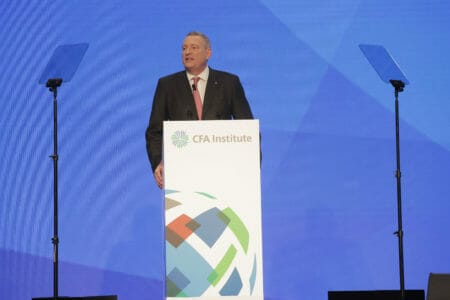
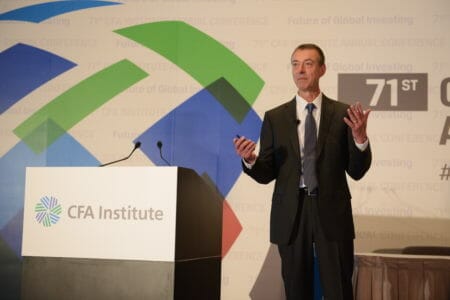
David Hunt, (pictured) president and chief executive of PGIM, which manages more than $1 trillion, said there were now half as many public companies as 15 years ago.

“This is troubling because individual investors can’t get access to high-growth tech companies,” Hunt said.

He predicted that in 2018 there would be an unprecedented number of public companies going private.

O’Hanley said there had also been a boom in private credit and that the ability to oversee that had been limited.

“Systemic risk has been taken out of banks successfully and distributed, but [there has been] massive growth and that needs to be regulated in some way,” he argued.

But Nobel Gulati, chief executive of systematic investment manager Two Sigma Advisers, believes regulators are aware the pendulum may have swung too far and he hopes there will be some balance in public/private assets.

The managers were speaking on a panel at the Milken Institute Global Conference in Los Angeles, traversing many aspects of the outlook for asset management.

They looked at the impact of artificial intelligence on their businesses and agreed the hype was bigger than the reality.

“The expectations are way ahead on what we can deliver on regarding AI,” PGIM’s Hunt said. “It is extremely difficult, and you can spend days coming up with false signals or start with data that is not clean. Technology is not necessarily the answer. Active management is about humans and how they interpret data.”

Two Sigma’s Gulati agreed, and called AI “over-hyped”.

“Our business is constantly evolving, so human context is extremely important,” he said. “We have 1400 people working at Two Sigma. AI has its limitations, we need humans.”

Also on the panel was Ron Mock, president and chief executive of the Ontario Teachers’ Pension Plan.

Mock said, in terms of innovation, OTPP was focused on investing in the “whole world” of technology, in particular buying companies before their initial public offering. But he was concerned with the technology revolution and the impact on the industry’s ability to attract talent.

“In our case, we are actively looking at the next decade of talent acquisition and the value proposition,” he said. “There is huge competition for talent, and if our industry is going to be more technologically driven, how do we compete? Every MIT class is being swallowed by Google and Facebook. How does the asset management industry compete? It’s not an insignificant problem.”

Large pension funds around the globe are being cautious in current markets and are looking to “batten down the hatches”, a panel of investors told delegates at the Milken Institute Global Conference in Los Angeles last week.

Vicki Fuller, chief investment officer of the $209 billion New York State Common Retirement Fund, said the fund is mostly an equity investor, with more than 50 per cent in that asset class. It also has about 30 per cent in alternatives and the rest in fixed income.

“We continue to invest because we have to but we try not to be too cute,” Fuller said. “We are too large to move to 50/50 fixed income and equities, but if I could, maybe I would. Now we look to batten down the hatches and look for information that will inform the next downturn.”

Similarly, the $222 billion California State Teachers’ Retirement System is staying close to its investment targets; for example, its global equities target is 54 per cent and it is allocating 53.7 per cent, and in fixed income it has invested 12.37 per cent against its 13 per cent target.

“We think the world looks like goldilocks – not too hot and not too cold,” CalSTRS CIO Chris Ailman said. “Last week, all the investment staff met, and we didn’t see anything too cheap, so are staying close to our investment targets; if anything, taking a bit of risk off. We are long term and we’re looking out 30 years. Ours is a very mature pension fund, and [has] negative cash flow, so we can afford [to have] only about one-third of the portfolio in unlisted, and we are finding they are priced to perfection.”

Fuller and Ailman spoke at the Milken Institute Global Conference in Los Angeles last week.

They were joined on a panel titled “Long-term value in a short-term world” by Nick Moakes, CIO of the $33 billion Wellcome Trust.

The trust, which spends $1 billion each year funding medical research, doesn’t have a long tail of liabilities, so doesn’t have to own fixed income, but it did recently issue a 100-year bond.

“Our view is everything in fixed income is overpriced,” Moakes told conference attendees. “We’re more focused on cash flows, rather than the price that the market is putting on that.”

Wellcome, like CalSTRS and New York Common, is a true long-term investor and is focusing on companies that have sustainable business models.

“We don’t define it as ESG but as a [company’s] licence to operate,” Moakes said. “We look at how they treat suppliers, customers and employees.”

In a tribute to this process, the fund hasn’t sold a portfolio company for five years.

“We have had zero portfolio turnover,” Moakes said.

He and Ailman are both passionate about influencing public companies to invest more sustainably, and focus more on the long term.

“I am a paid up member of the club to abandon quarterly earnings,” Moakes said. “Some companies, for example Unilever, are doing it, and it’s had zero impact on their share price.”

Similarly, Ailman is working with other investors to steer companies towards information that long-term investors need and want.

“What I want is more forward-looking information,” Ailman said. “It’s not about 90 days, anything in life that is worthwhile is longer than 90 days. I need to invest members’ money for 60 years. I need a long-term perspective and I need companies we invest in to think longer term, almost multi-generational. You’re a bank today, will you be a bank in the future? We will continue to hold your stock, so do us a favour and think long term.”

All of the investors on the panel agreed that divestment was not a strategy they thought worked. Instead, they preferred to hold a seat at the table to change behaviour.

“For many of us that are large, we don’t have a concentrated portfolio and hold the markets as a unit,” Ailman explained. “Divestment has not brought about change. Now we are asking universities to start researching what has brought about change.”

New York Common’s Fuller said engagement is the catalyst.

“There are a whole host of issues on the ‘social’ side; [for example] around guns or prisons,” she said. “If we divest from, say, guns, what do you do about the stores that sell the guns? We don’t change the equation at all. Engagement is key.”