The Irish pension system is set for major reform over the next few years. The general direction of this was set out in the Pensions Roadmap the government published this February. It involves changes to the state pension, the introduction of auto-enrolment and general simplification of the system, with greater emphasis on governance and reliance on master trusts. The European Pensions Directive – Institutions for Occupational Retirement Provision (IORP) II – also has to be transposed into law by January 2019. Some consultation papers has already been issued, with more imminent. We expect to see legislation in the autumn.

Like many systems, the Irish one is a multi-pillar approach. It features a basic state pension, supplementary occupational pensions and personal pensions. While individual employers can make joining a pension scheme compulsory, the general approach is voluntary. Employers have to provide only access to a pension, they do not have to pay contributions. The net result is that only 50 per cent of the workforce has any form of pension savings and will, therefore, be relying on the state for all their retirement income.

The state pension is now €243.40 ($277) a week and is paid to anyone who meets the eligibility requirements, which are based on the number of social insurance contributions paid over a working lifetime. Lower amounts are paid to people who don’t have the required social insurance contributions and there is a means-tested pension for those who don’t qualify for the main pension. It is paid from age 66 but from 2021 that increases to age 67 and the age will rise again, to 68, in 68. This is intended to link the state retirement age to improvements in life expectancy, with regular actuarial reviews.

All public-sector pensions in Ireland – including for central and local government, teachers, health staff and the police – are unfunded and operate on a pay-as-you-go basis. The liabilities of those schemes were recently valued at €114.5 billion ($130.5 billion)

The most recent Irish Association of Pension Funds investment survey, at the end of 2016, found that Irish occupational pension schemes comprised €125.5 billion ($142.7 billion) in pension savings. This was the highest value ever recorded and almost double the €63.5 billion ($72.4 billion) at the end of 2008. Assets in defined-benefit schemes amounted to just over €78 billion (88.9 billion) while defined-contribution schemes totalled €47.5 billion ($54.1 billion).

Shift out of equity

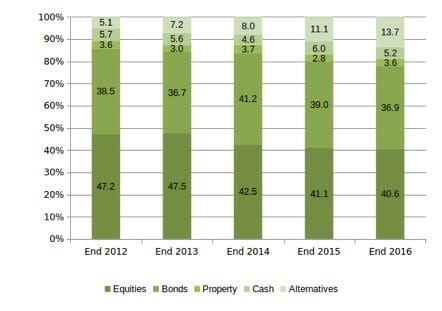
The shift away from equity allocations in DB schemes continues. Just over 40 per cent of assets are in equities and almost 37 per cent are in bonds. Alternatives now total 13.7 per cent compared with 5.1 per cent five years ago. This reflects a general “de-risking” of DB schemes, often under regulatory pressure.

Irish DB scheme asset allocation 2012-16
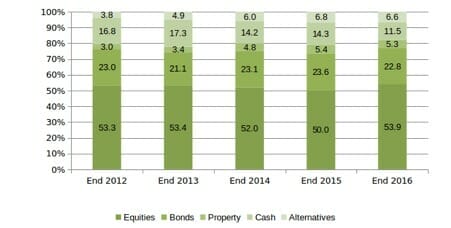
DC assets, in comparison, have a higher equity content but also a high bond allocation – 22.8 per cent. Some of this may be part of life styling strategies but it may also reflect more caution on behalf of individuals.

Irish DC scheme asset allocation 2012-16
Auto-enrolment

With just over half the workforce having any pension savings, the government has decided it is time to introduce auto-enrolment. The success of the UK system probably influenced this decision; however, it has been under discussion in Ireland for many years.

While the full details on how the system might work haven’t been published, the government has indicated that all employees over age 23 and earning more than €20,000 ($22,000) a year would be required to be enrolled in a pension arrangement by their employer. While contributions will probably be phased in, ultimately they will be on a matched basis: 6 per cent from the employer, 6 per cent from the employee and a 2 per cent government contribution, which will replace the current system of tax relief.

Individuals would be able to opt-out after nine months and there would also be an opt-in option for people not otherwise eligible, such as lower earners or the self-employed. The aim is to have contributions start by 2022. Will there be some state involvement or the equivalent of the UK’s National Employment Savings Trust? Or will there be approved providers as in New Zealand?

Professional trustees

The introduction of auto-enrolment will be a gamechanger but there are also regulatory shifts on the horizon, including IORP II and potential rules for master trusts. The directive focuses largely on cross-border schemes, governance and communications. The governance requirements will involve much more formalised focus on risk management and controls. All trustee boards will also have to have prescribed levels of professional qualifications and experience. This will probably mean that at least two trustees will have to satisfy each requirement.

While an increased focus on governance is welcome, it is important that there remains a place for member-nominated and lay trustees. While they may not have the prescribed experience and qualifications when they first become trustees, they do know the members of the scheme and understand the culture of the employer. These can be invaluable traits in determining what will and won’t work for the scheme and its members. Member trustees also have a strong sense of their responsibility towards their fellow members and this guides their decisions.

Master trusts can, in theory, produce better governance and lower costs, due to economies of scale but they don’t have the same connection with members, as they are from multiple employers and there is no direct link to the members. Also, employers often pick up administration and other costs in a DC scheme that, in a master trust, are usually just built into the charging structure. Getting the balance correct will be crucial to ensuring that members experience better outcomes, which should be the goal for everyone involved.

ESG emphasis

IORP II also requires trustees to disclose how they factor ESG considerations into their risk management and investment decision-making. This will be the first-time many trustees will have specifically considered this. While the requirement is relatively benign in that, for example, trustees could merely report that they don’t consider those issues, there are already plans to strengthen the requirements to force consideration and also gather the views of members.

There are many changes ahead for trustees and the role is getting more difficult. It is important that there be a good balance between effective governance and regulation and encouraging the involvement of trustees so that members receive the best outcomes possible.

Jerry Moriarty is chief executive of the Irish Association of Pension Funds, which represents pension savers in Ireland.
There have been occasions over the last few decades when a new concept, investment approach or asset class has suddenly attracted interest and, within a matter of months it seems, everyone is talking about it. A fuse is lit and, in no time at all, the fire catches. So it is with impact investment – it is the 2018 topic of the year. All of a sudden, every investment conference on the block is advertising at least one session on impact investment, with mainstream managers and niche boutiques all vying for attention.

Impact investment is not the same as ESG. Nor is it responsible investment. It is also not philanthropy. Rather, it is an approach in which the investor still receives a financial return but the investments are intentionally chosen to generate a positive social or environmental impact, which is quantified and measured.

The nature of impact investments generates a natural alignment of interest with local authorities. In the UK, local authorities are familiar with many of the social and environmental challenges these investments are looking to address. Indeed, if a local authority can attract private capital to invest in residential property to house the homeless, then that should have a direct impact on the budget that authority requires to address homelessness in its county or borough.

Within the UK’s Local Government Pension Scheme (LGPS), there is likely to be member interest in this type of investment, given that staff have had to deal with residents’ social and environmental issues over many decades. In addition, as a pension scheme, the LGPS can afford to take a long-term view with its investments, thus allowing its fund managers time to maximise both the financial return and the impact. Some social and environmental issues take many years to address.

Given the natural alignment of interests, it is somewhat surprising that, to date, LGPS allocations to impact investment have been relatively modest. Pensions for Purpose, a collaborative not-for-profit platform that aims to raise awareness of impact investment, lists several case studieson its website, and many of these include descriptions of the journeys by LGPS funds such as West Yorkshire, Berkshire, Merseyside, Greater Manchester and the Environment Agency in establishing an impactful investment approach. This journey typically begins with a discussion on ESG, then progresses to a debate around responsible investment, including, for example, the ‘divestment versus engagement’ debate. Eventually, impact investment is on the agenda.

The Pensions for Purpose case studies show that, for some LGPS funds, the desire is to focus on environmental impact; for others, addressing social need is more important. Some may take a global approach, while others specifically try to address a need in the county or borough in which the fund is based. There is no right or wrong answer, provided the financial risk/return characteristics on the underlying investments remain suitable for the pension fund’s strategic investment goals.

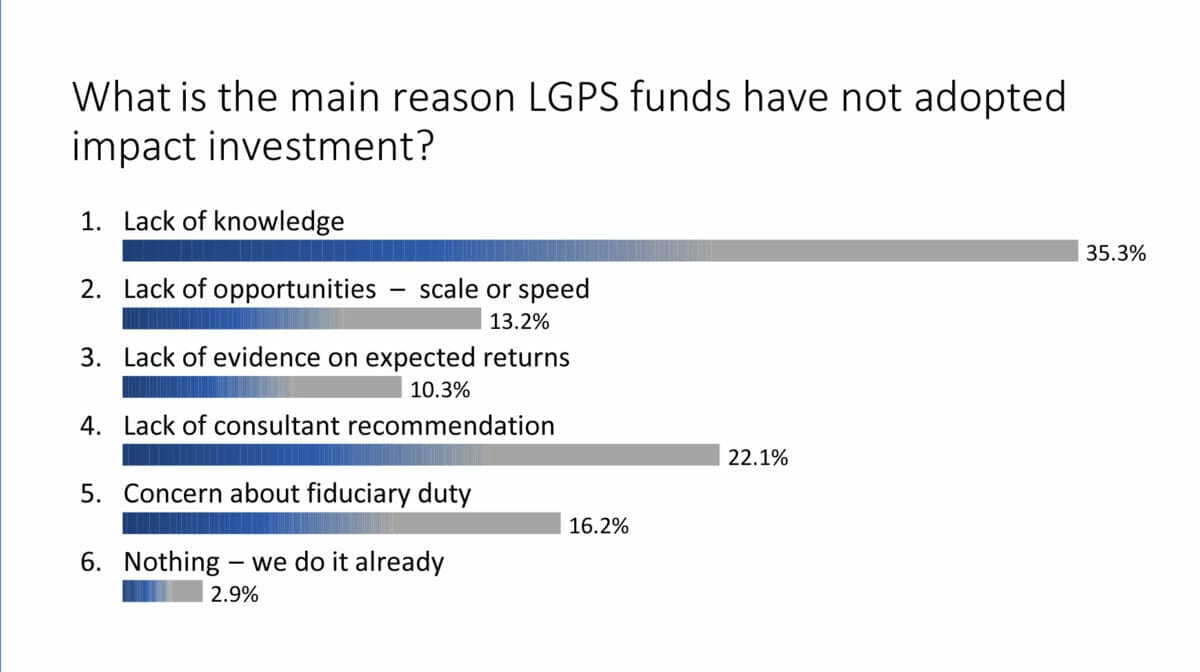
So why haven’t more LGPS funds dipped a toe in the water? This question was put to a group of delegates at a recent LAPF Strategic Investment Forum. The responses are shown in the following chart.

Source: LAPF Strategic Investment Forum

The overwhelming response was, quite simply, that it boiled down to a lack of knowledge about these investments. When analysing responses by delegate type, it became clear this was an especially common stumbling block for investment committee members; just over half of this group said they had not adopted impact investment because they lacked the knowledge to make an informed decision.

It is this stumbling block that Pensions for Purpose is looking to address. The platform has two types of members: influencers and affiliates. Influencers pay an annual fee that allows them to post impact investment-related content on the platform. Influencers include fund managers, lawyers and – soon, it’s hoped – consultants. Affiliates, on the other hand, can join for free; they include asset owners such as pension funds, foundations and charities, along with independent advisers, researchers and journalists.

The Pensions for Purpose content consists of thought-leadership pieces, blogs, case studies, press-related articles and information about impact investment events. No investment products are promoted, so it succeeds in being a genuine information platform. Most of the content on the website is publicly available but some material) is only accessible to affiliate members, at the influencer’s request.

Brunel Pension Partnership’s profile on the Pensions for Purpose website, states: “As an affiliate of Pensions for Purpose, Brunel is able to participate actively in thought-leadership discussions and enhance the general understanding of impact investment within our community and in the wider investment community. In addition, through discussion with other affiliates, including asset owners, government bodies, independent advisers and journalists, we are able to deepen our knowledge of this important topic for Brunel.”

It comes as no surprise, then, that LGPS representatives form a large portion of the affiliate membership of Pensions for Purpose. The group has a noticeable desire to learn more, evidenced by a growing number of invitations for Pensions for Purpose representatives to speak about impact investment at LGPS workshops, conferences, discussion groups and training sessions.


Pooling impact

Yet if interest in impact investment is starting at the grassroots level, what are the implications of pooling LGPS assets? Is making impact investment one step further removed from the underlying beneficiaries of the pension fund likely to help or hinder the level of impactful investment?

As always, there are pros and cons. One advantage of pooling is that it allows the member funds to join forces and invest in a more diversified impact approach. A disadvantage of investing in a fund that will directly tackle assisted living in a given borough, for example, is that the financial characteristics of that investment could potentially result in quite high specific risk (in order words, it would be exposed to property market valuations in that specific area). Yet if the member funds of a pool joined forces and invested in an opportunity that tackled, for example, disability living in the Midlands as a whole, the return profile would be much more diversified, despite the capital still being deployed in each of the member funds’ own counties.

A second advantage of pooling is that it allows specialist resources to be allocated for due diligence of funds or investments. This is a new type of investment for a pension fund, so due diligence and close monitoring are important. Yet this can be a drain on limited resources for an individual authority. Already, pools such as Brunel are developing expertise in impact investment and this is likely to spread to other pools as interest in the approach increases.

The growth of impact investing does, however, levy its own demands on pools. Pool officers are likely to be faced with the challenge of how to scale up their impact investments as their popularity increases. Several underlying investments in an impact sub-fund are likely to be in private-market funds, offered on a smaller scale than pools might be used to having elsewhere in their investments.

There are several ways to address this. First, managers in the listed space are developing their impact expertise. This will allow the pools to offer sub-funds with a mix of public and private markets, and with a spread of different impact goals. One of the concerns about this, raised by private-market managers that have been offering impact investment for decades, is that such an approach dilutes the impact. Listed managers tend to be investing with impact rather than for impact. In other words, the companies in which they are investing are still, ultimately, looking to maximise the return on shareholder capital; the positive impact being achieved is not always the primary driver for them. Unlisted managers, on the other hand, tend to be much more focused on maximising the impact from their investments and many have this embedded into their mission and values.

Second, the unlisted managers are becoming increasingly creative when considering scale. For example, can an impact process that worked in one sector now work in another? Can a regional approach be expanded into a national approach?

Ultimately, capacity constraints will probably be solvable, although it will be harder for a pool than for an individual LGPS, simply because of the larger sums of money involved.

Where to begin?

The best starting place for any pension fund considering an impactful investment strategy should be getting the trustees to re-articulate their investor beliefs. This is no mean feat and may involve soliciting member views. It is important to note that member views may well be influenced by the age profile of the pension fund. A recent survey by Barclays found that 43 per cent of investors under the age of 40 had made an impact investment, compared with just 3 per cent of those aged over 60. A pension fund with a younger age profile could get a very different response on impact investment than a pension fund of largely retired members.

Once member views are known, the trustees should be ready to discuss questions such as:

  • How do we align short- and long-term goals for the fund?
  • How can we best achieve a sustainable pension fund for future members?
  • Do we want to become more impactful in our investments?
  • How do we plan to measure the impact of our responsible/impact investment?
  • Are we more concerned about environmental issues, social issues or economic issues?
  • Do we want to try to solve domestic issues or global challenges?

These are not easy questions to answer but defining investor beliefs at the outset will lead to a far more straightforward exercise when it’s time to articulate a strategy for impact investment, embark on a relevant and tailored training program and direct funds towards investments that are appropriate for the strategic goals of the pension scheme.

Karen Shackleton is director of Pensions for Purpose.

Pension funds weighed down by worsening demographics, and growing deficits they can’t reduce no matter how good their returns, have a clutch of options.

Typically, those options include: increasing passive allocations and sinking assets into equity indices; boosting investment in private assets; and introducing a liability-driven investment strategy.

The Public Employees Retirement Association of New Mexico’s (PERA) new chief investment officer, Dominic Garcia, 40, is taking the $16 billion portfolio in a fourth direction.

Faced with a funded level of only 74 per cent, Garcia is building a risk-parity and alpha strategy in a model informed by his decade of experience at the celebrated $117 billion State of Wisconsin Investment Board (SWIB).

Since taking the reins at his home state’s retirement plan last September, Garcia has swapped old asset buckets for a new portfolio divided into alpha and beta.

In the beta portfolio, he has reallocated risk via a dedicated risk-parity approach, using derivatives and leverage. The board approved a 10 per cent allocation to the strategy last month but the goal is to reach 30 per cent over a multi-year period. Meanwhile, the new alpha portfolio targets outperformance uncorrelated to the beta allocation and will also include a portable alpha hedge fund strategy in the future.

“SWIB uses risk parity and leverage in the asset allocation and I’ve had the opportunity to see what it accomplishes,” says Garcia, who notes that two of the small handful of US pension funds using the strategy are based in Madison – Wisconsin’s capital. The Wisconsin Alumni Research Foundation, a $3 billion endowment, goes even further than SWIB, applying risk parity and alpha across its whole portfolio.

“Maybe there is something in the water in Wisconsin,” Garcia says with a gentle laugh.

Beta

About three-quarters of the volatility in PERA’s previous portfolio came from the 43 per cent equity allocation, Garcia’s early analysis found.

“On an ex-ante basis, we had a volatility of around 10 per cent, which is lower risk than most of our peers, but 70 per cent of that was coming from equity.”

With risk parity, Garcia believes he can increase the Sharpe ratio of the portfolio and returns, while decreasing the contribution to risk coming from equities. Standalone risk-parity volatility is roughly 15 per cent.

“The board has just approved step one of three,” he says. “It won’t get us to full risk parity, but we will have a much better balance, from a risk lens.”

The beta strategy rests on leveraged market exposures. Garcia will maintain the separate risk/return profile of PERA’s bond and high-volatility equity assets by amplifying the low-risk bond exposure using leverage and derivatives.

“Bonds and other inflation-protected assets have a tremendous diversifying impact on your portfolio, but equity is so volatile it crowds it out,” he explains. “When you use derivatives and modest amounts of leverage, you can include all risks and experience true diversification. It’s a way of ensuring that capital diversification really equates to risk diversification.”

Alpha

The alpha portfolio seeks outperformance from three main sources: private assets; an allocation to illiquid active risk, again focused on private assets; and idiosyncratic liquid active risk.

On the liquid side, PERA is using long-only alpha managers for now but will introduce long/short hedge fund managers of a portable alpha strategy once the risk-parity strategy is implemented; Garcia is looking for 1 per cent active return across the three buckets of illiquidity and idiosyncratic or liquid alpha.

He explains that finding the right alpha exposures will involve using an alpha-focused efficient frontier that ensures the highest return in accordance with the level of risk PERA wants.

“We are building an active risk budget based off the efficient frontier of the expected alpha exposures of private assets and liquid assets across every asset class.”

PERA has a total target allocation of 27 per cent to private assets, comprising private equity, private credit and private real assets.

PERA’s new alpha managers need to hit Garcia’s outperformance expectations consistently, from idiosyncratic return streams uncorrelated to the beta portfolio. His new cohort also must be prepared to align fees. He is aiming to take 60 per cent to 70 per cent of the gross alpha profits.

He believes it will be more straightforward finding managers able to meet these criteria in the alpha portfolio’s liquid allocation. Opportunities for active management will go up as central bank liquidity starts to dry up, he argues.

“Once we see liquidity drain away, it will bring more volatility and more dispersion; that means a better environment for alpha.”

He expects more of a challenge finding managers for the private asset allocation and will rely on detailed analysis, rigorous internal due diligence and more flexible and innovative investment vehicles, such as co-investment and separate accounts.

“It will be about asking if this manager, given this fee structure, meets those parameters,” he says.

The return of hedge funds

Garcia has already turned his mind to shaping the future long/short portable alpha allocation. He knows he wants fewer, more concentrated, hedge fund strategies, rather than a wide selection, although he is still unsure of the exact number.

The introduction of these hedge funds will mark a new age at PERA, which once used many of these assets but has reduced that number to only a handful.

The re-start of the program is driven by Garcia’s conviction that, over the long run, hedge funds offer the best and most efficient source of alpha available, outshining all other streams – be they long-only equity, long-only fixed income, private equity, private real estate or private credit.

The key, he says, is not to use hedge funds as a substitute for beta.

“It’s very important to look at hedge funds just through the alpha lens, although it requires a more complex mechanism and structure,” he says.

He adds that if portfolios are structured with the right alpha target and share of gross alpha, hedge fund fees are worth it. Indeed, get it right on the efficient frontier, and hedge fund alpha is priced roughly the same as all other alphas.

“You typically pay a long-only equity manager something like 40-50 basis points, which includes alpha and beta exposures,” he explains. “When you scale that fee only on the active risk, that pricing isn’t that far off the cost of a hedge fund.”

The transformation of the portfolio has run parallel to important changes in New Mexico’s governance structure. PERA’s board now focuses only on strategic issues, the most important of which has been shaping a risk budget for the total plan, broken into beta and alpha risk. It means all implementation is delegated to Garcia’s investment team, which is solely responsible for manager selection in line with the new risk budget – no mean task, given PERA outsources all management.

Still, this part is familiar territory to Garcia, who ran SWIB’s external public market mandates across equites, fixed income, multi-assets and hedge funds. For him, the new challenges have come with his responsibility for big-picture design, enhancing governance and ensuring a budget to attract the talent he needs.

“I learnt at Wisconsin that you achieve a sustainable, fully funded system only with a holistic approach,” he says. “You need a good investment portfolio, good plan design, good governance and the ability to pay the market rate for talent. All those things need to be working to build a long-run sustainable system.”

Garcia says PERA’s edge comes from a focused, mission-centric culture. He will acknowledge that change is difficult but says any institution facing similar changes can also summon the courage to find a solution.

Growing up, I always had dreams of becoming a teacher. My mother was a teacher and I used to spend a lot of time at her school, wearing her oversized heels and pretending to teach imaginary kids mathematics while waiting for her to finish classes.

Becoming an actuary, particularly one who works in the investment sector, was far from my mind. But I was an eager and somewhat focused math student and the rest is history. Like many, I started in the investment industry, very passionate about what I was doing but without a clear idea what my purpose was and why this would even matter for the development of the broader industry.

Having a sense of purpose is important. It is individuals, just like us, who are responsible for setting missions and objectives, driving culture and behaviours, and generally making decisions about how much our businesses contribute (or not) to various stakeholders in society and to the planet as a whole. If we want to drive change in our organisations and broader industry, we need to change what we do as individuals. We need to examine our own motivations and behaviours and understand how they combine to drive the objectives of our firms and the industry.

The purposeful self

Deci and Ryan’s self-determination theorypoints to the fact that we are all influenced by both intrinsic and extrinsic motivations. Intrinsic describes something that is inherently interesting or rewarding, while extrinsic motivations lead to some positive outcome, such as high pay or avoidance of punishment.

Several bodies of research question whether extrinsic motivations produce positive long-term results. Princeton academics Roland Bénabou and Jean Tirole note: “In well-known contributions, [Amitai Etzioni, 1971] argues that workers find control of their behaviour via incentives ‘alienating’ and ‘dehumanising’, and [Edward Deci and Richard Ryan, 1985] devote a chapter of their book to a criticism of the use of performance-contingent rewards in the work setting. And, without condemning contingent compensation, [James Baron and David Kreps, 1999] conclude that: there is no doubt that the benefits of [piece-rate systems or pay-for-performance incentive devices] can be considerably compromised when the systems undermine workers’ intrinsic motivation”.  (See “Modern organisations”, Amitai Etzioni, 1971; “Intrinsic motivation and self-determination in human behaviours”, E Deci and R Ryan, 1985; and “Strategic human resources”, J Baron and D Kreps, 1999.)”

In short, being driven by self is a vital ingredient in achieving positive long-term results.

Purpose-driven motivations

At a Thinking Ahead Institute event earlier this year, the top three responses to the question, “What motivates you to perform in your current role?” were: interesting and enjoyable work, helping clients and helping to do something meaningful with societal purpose.

The lowest-ranked responses were ‘pay’ and ‘helping my organisation to achieve its financial goals’.

Attendees were also asked to choose which of two statements about their organisation they valued more: 94 per cent of attendees chose “my organisation produces more societal wealth and wellbeing”, while only 6 per cent chose “my organisation produces more profits”. These results suggest that intrinsic motivations linked to a positive purpose (such as improving societal wealth and helping clients) are highly valued.

Purpose-driven motivation is important. A study by State Street Centre for Applied Research and the CFA Institute, Discovering Phi: Motivation as a hidden variable of performance, argues that individuals who have a mindset of delivering performance that is driven by purpose, habits and incentives (collectively, ‘phi’) contribute to better organisational performance and client satisfaction, and also are better engaged. These results suggest that connecting the mission, values and culture of an organisation with an individual’s sense of purpose is vital.

The purposeful self → the purposeful organisation

Institutional investment is a team game. Through teams, strategic investment decisions are made, value is added to portfolios, or destroyed, and a progressive, or regressive, culture is built. In a Thinking Ahead Institute paper – How to Choose: A primer on decision-making in institutional investing –we note that collective judgement can be superior to that of any individual within a group as long as diversity, independence and an effective means of aggregating views are present. (We do note that groups introduce biases of their own. James Surowiecki’s three conditions are expressed more clearly in his 2004 book The Wisdom of Crowds. They are critical to the intelligent design of groups.)

Individual purpose is validated by a strong team culture and a strong team culture is built through the aggregation of individual purposes to drive towards a common objective. Effective aggregation requires a keen awareness of social dynamics; perceptiveness by leadership and group members is key. In short, investment professionals need to be technically and emotionally capable.

The purposeful self → the purposeful organisation → the purposeful industry
We need a coalition. A purposeful industry can emerge only if enough organisations’ individual purposes are aligned, just as an organisation is only as good as the people within it. The purposes of people, organisations and the industry must all be aligned or the system will be suboptimal at best and, at worst, parts of it can break down – think the global financial crisis. We believe positive change can be effected only through a coalition of individuals with a common mission to ensure that the investment industry drives positive social value.

The investment industry cannot thrive without the trust of wider society – that society will obtain fair and sustainable results from the industry’s services. To gain this trust, we as building blocks of the industry need to agree on the broader purpose of investment and better understand how our actions connect with this purpose. We need to shift the balance to improve the value proposition to society. Without that, we are in danger of losing our social licence to operate.

Marisa Hall is a director of the Thinking Ahead Group, an independent research team at Willis Towers Watson, and executive to the Thinking Ahead Institute.


Last week, investors managing more than $5 trillion in assets, including institutional giants such as APG and Legal & General Investment Management (LGIM), called for zero deforestation in Brazil’s sensitive Cerrado region – a forested area the size of Mexico next to the Amazon region. What is behind the interest in supporting deforestation in general and in the Cerrado in particular?

Supply-chain risk: See the wood for the trees

Tropical rainforests occupy a crucial place in the supply chains of many of the world’s largest companies. Commodities such as cattle, soy and palm oil are heavily exposed to deforestation yet are also central to the viability of sectors from food and beverages to biofuels. For example, palm oil is found in about half of all packaged goods in supermarkets worldwide.

This exposes investors to a wide set of regulatory, operational and market risks. A 2017 report by the environmental non-profit CDP states that as much as $941 billion of turnover in publicly listed companies depends upon commodities linked to deforestation.

We saw an example of the regulatory risk this summer as European Union negotiators agreed to phase out the use of palm oil in transport fuels by 2030,dramatically affecting the prospects of major palm oil importers.Brazilian rural real-estate firm BrasilAgro, which is active in the Cerrado region, offers an example of the operational risk: recent analysis from Chain Reaction Research suggests that 21 per cent of BrasilAgro’s equity value is at risk because more than a quarter of the company’s agricultural commodity sales go to two soy and corn customers, which have both recently made zero-deforestation commitments.

Deforestation’s contribution to climate change also makes it a market-wide risk. The Climate Disclosure Project states that forest degradation accounts for about 10 per cent to 15 per cent of the world’s greenhouse gas emissions. This threat to the global economy seriously undermines the ability of pension funds and other institutional investors to pay their future liabilities. As Farm Animal Investment & Risk Return (FAIRR) founder Jeremy Coller recently put it, “What is the point of a pension fund, if beneficiaries face a world too hot to retire into?”

Finally, increasing investor concern about the inability of the global livestock and meat industry to manage its ESG risks is one reason deforestation has become a focal point for investor action.Earlier this year, an ESG risk assessment of 60 of the largest, listed global livestock and aquaculture companies by the Coller FAIRR Protein Producer Index found that despite soy and cattle being the most significant drivers of deforestation, 84 per cent of the companies in the index do not have targets or policies to address deforestation risk.

Why Cerrado?

Brazil’s Cerrado region is one of the world’s most biodiverse savannas. It is considered the birthplace of many of Brazil’s great water systems. It is also a vital carbon sink, estimated to store the equivalent of 13.7 billion tons of carbon dioxide, the Cerrado Manifesto states. Losing the forestation in the region would release emissions equivalent to what more than 3300 new coal-fired power plants produce every year.

Furthermore, native vegetation in the area plays a crucial role in regulating rainfall. Losing it could put productivity throughout the entire supply chain at risk. A fall in productivity has been recorded in the soy, maize and coffee industries in Brazil since 2000.

Despite the risks, about half of the Cerrado’s forests and native vegetation has already been cleared, largely driven by the need for soy in the livestock industry. This despite the fact that over 38 million hectares of alternative available land has been found in the region, so soy production could sustainably expand without causing any further loss of forest assets.

What investors can do

For investors looking to take action, signing a new investor statement, co-ordinated by the FAIRR Initiative is a good place to start. By adding their weight to a coalition that includes global retailers, manufacturers, livestock producers and feed companies, investors can send a clear market signal to cattle and soy firms about the growing demand for zero-deforestation products.

For the Cerrado, it is an especially important time to send this signal, as discussions are due to start in Brazil this month to draft an agreement for eradicating deforestation in the region.

Beyond the statement, we are also seeing investors such as LGIM actively engaging with some of the world’s largest food retailers and producers. They are asking for deforestation issues to be put on board agendas and for companies to disclose both their exposures to forest-risk commodities and how they are managed.

Many investors are also involved in a collaborative engagement run by the PRI and Ceres to eliminate deforestation from the food sector.

Increasingly, investors are linking the protection of ecosystems such as Cerrado’s with sustaining long-term value. That is good news for both global rainforests and the global economy.

Aarti Ramachandran is head of research and corporate engagement at FAIRR, co-ordinator of the Cerrado investor statement.

With its assets under management forecast to double in the next five to seven years, Canada’s Healthcare of Ontario Pension Plan has begun exploring new assets for its C$77.8 billion ($59.8 billion) portfolio.

President and chief executive Jim Keohane says he is assessing whether HOOPP’s existing allocations can evolve to absorb forecast growth, or if he needs to add new and different strategies to re-allocate risk. Firm decisions are still a way off, but new allocations could include assets such as infrastructure, where HOOPP doesn’t currently invest, or reinsurance, which Keohane favours because its risk/return trade-off is similar to that of credit.

If HOOPP were to invest in infrastructure, it would sit within the fund’s matching portfolio, and be treated in a similar way to real estate. Assets could include local toll roads or water infrastructure, both areas where Ontario’s Government is busy currying more investment and where Keohane sees advantages because they don’t come with foreign exchange or sovereign risk.

Still, his enthusiasm for the asset class is lukewarm. He is unconvinced that infrastructure rewards investors enough for tying up their liquidity.

“Right now, the risk/return trade-off still looks pretty unattractive to me but that might change at some point in the future,” he says. “We would do something in infrastructure if the pricing was better.”

Celebrated strategy

Last year, HOOPP returned 10.8 per cent and its funded status swelled to 122 per cent. This has allowed the pension fund to increase member benefits and keep contribution levels from its 540 employers unchanged from 2004 levels – largesse most pension funds can only dream of.

Its robust health is owing to a celebrated investment strategy that Keohane, who joined the fund in 1999 and became chief executive in 2012, has done much to shape.

It rests on two portfolios: one comprises a liability hedge allocation with physical investments in nominal bonds, real-return bonds and real estate that has a high correlation to inflation; a second portfolio, designed to boost returns is made up of public and private equity, corporate credit, long-term option strategies and other return-seeking strategies that mostly use derivatives to gain exposure. HOOPP estimates that about 75 per cent of pension benefits it pays are derived from investment income.

The liability hedge portfolio is dynamically managed in accordance with interest rate and inflation risk. Witness how HOOPP reduced its bond weighting a couple of years ago when interest rates fell, lowering the interest rate sensitivity of the portfolio. The substantial rise in bond yields since has caused it to restore some of those bonds.

“There is a notion with [liability-driven investing] LDI that you buy a bunch of bonds and leave them, but this isn’t the case at all,” Keohane says. “We have brought our inflation sensitivity down and managed it more effectively.”

Recent strategy in the return portfolio has included positioning the equity allocation defensively with an options strategy that protects on the downside but also gives the fund some upside exposure.

“If we had a big sell-off in equities, we would try to increase our weighting to equity and credit, but we are being cautious at the moment,” he says.

Managing partnerships

New investments could be via partnerships with external managers or in funds, to begin with, before moving management in-house. HOOPP manages all its assets itself, apart from a portion of the private equity and real-estate portfolios.

In partnerships and co-investments, Keohane aligns interests with managers by making sure they have a significant amount of their own capital tied up in the transaction.

“We tend to be in groups where we have a dominant position; it means we have a bigger say in how things get done,” he adds.

HOOPP’s manager due diligence includes talking to the companies in which a potential investment manager has invested, and to other investors that have invested in the manager’s funds; it’s a process that can take up to a year.

“We like to hear from companies about how the manager helped them, what insights they’ve brought and the nature of the relationship they’ve had.”

At the end of 2017, HOOPP had $7 billion invested in private markets, in addition to $5.5 billion of committed capital.

Having internal management saves on fees, but Keohane manages costs in other ways, too. He says HOOPP has a deliberately narrow focus, investing only in assets that the fund “really needs to meet its obligations”, which excludes some allocations – like infrastructure.

While Canadian peers have opened offices internationally, HOOPP’s biggest move in recent years has been moving its Toronto headquarters a few blocks. But staying put doesn’t crimp access to the best deals.

“We are still seeing good access to deal flows and keeping costs down; it’s expensive running an international office,” Keohane says.

HOOPP’s 2017 operating expenses were $224 million, representing 0.29 per cent of net assets; that included management fees and performance fees related to investments in real estate and private equity.

Advocate for diversity

Going forward, Keohane says the pension fund will continue to use its muscle to influence board diversity. Canada’s resource sector is a particularly bad laggard.

“Board gender diversity is best among larger cap companies in Canada, but when you get into the resource sector it’s still quite poor,” he explains. “Corporate boards in the resources still have the idea that everyone needs to be a mining engineer, but boards with better diversity make better decisions.”