The Wuhan coronavirus is still spreading, but investors should also stay calm. The virus remains less deadly and more contained than the SARS outbreak of 2002–03. Looking at other epidemics, history suggests that after an initial sharp hit, economies and markets typically recover quickly.

In just two months, the 2019-nCoV has infected nearly 8,000 globally (and perhaps more than 15,000 once unconfirmed cases are added, according to World Health Organization estimates). SARS spread more slowly, with 8,096 confirmed cases over eight months from November 2002 to July 2003. However, the mortality rate of the Wuhan coronavirus is 2 per cent to 3 per cent, compared to 10 per cent for SARS. Furthermore, while 35 per cent of SARS cases were outside of mainland China, 99 per cent of confirmed Wuhan coronavirus cases are inside China (mostly in Wuhan and Hubei province).

In stark contrast to how SARS was handled in 2002, Chinese authorities have taken drastic measures to halt the spread of the virus, quarantining roughly 60 million Hubei residents and imposing strict restrictions on travel and public events on the rest of the country during the Chinese New Year holiday, the peak travel and spending period for China. While the virus could mutate and become deadlier, heightened vigilance and global cooperation should help contain this outbreak.

The Chinese economy will clearly take a large hit in the first quarter. During the SARS outbreak, Chinese GDP growth fell by more than half in the second quarter of 2003 but fully recovered by year end.

Today, China’s vastly expanded service sector (more than 50 per cent of GDP) could hit GDP harder if consumers stay home amid a continued outbreak. Moreover, China is more deeply integrated into the global economy than it was in 2003.

Thus, reduced Chinese economic activity will likely undercut global manufacturing activity, and the longer the outbreak, the greater the global impact.

Nevertheless, few economists have meaningfully downgraded full-year GDP growth forecasts, assuming the hit will be concentrated in the first quarter and growth will rebound as Chinese authorities continue to ease monetary policy and increase fiscal stimulus.

The economic and human impact of the Wuhan coronavirus outbreak is still increasing, and markets may decline further in the coming weeks.

But, investors should not overreact. Indeed, further downside in Asian and Chinese equities may provide a compelling buying opportunity once the fear subsides.

Aaron Costello is regional head, Asia, at Cambridge Associates.


Managing a pension system is a complicated task that requires a fund’s board of trustees establish the strategic direction of the system, hire necessary staff and consultants, adopt investment policy, understand governance and ensure the fund conforms to new and changing laws. Pension system trustees and administrators must also stay current with the latest industry developments. Trustees and administrators of public pension plans aren’t expected to be know-it-alls, but they need a solid education that provides and improves their core competencies as fiduciaries.

At the Texas Association of Public Employee Retirement Systems, (TEXPERS), the largest provider of pension trustee training and continuing education for pension system trustees and administrators in Texas, we believe the trustees and administrators behind Texas’s 93 retirement systems illustrate how board education pays off. Most recently that expertise was reflected in the highest number of Texas state and local pension funds achieving state recommendations for their overall financial health than ever before.

Board education isn’t an easy task. But in Texas it is helped because it is backed up by the law. Under new laws introduced in 2013 the Pension Review Board established a Minimum Educational Training Program for trustees and system administrators of Texas public retirement systems.

The state’s minimum requirements include core and non-core topics spanning fiduciary matters, governance, ethics, investments, actuarial issues, benefits administration, and risk management. Education on topics that go beyond the basics include compliance, legal and regulatory matters, pension accounting, custodial issues, plan administration and the finer details of the Texas Open Meetings Act, and the Texas Public Information Act.

We believe education around these key topics sets Texas apart. It provides trustees with the tools necessary to build a solid foundation to be a successful fiduciary. That said, pension funds, trustees and administrators shouldn’t be lulled into a false sense of security because they have “ticked the box.” It is just the foundation: pension funds need to continuously look for opportunities for continuing education beyond the minimum requirements.

Lay trustees

Much of our work is supporting lay trustees. A lay trustee may, will, and should ask questions that may seem rudimentary to a seasoned professional. However, there will always be trustees that aren’t comfortable asking certain questions because they feel they are too basic. We believe trustees should ask any, and all, questions that come to mind no matter how elementary the question may sound. Nor should they be uncomfortable asking the same question again until they fully understand the subject matter.

Training can’t cover every possible scenario – there will be issues that arise that all the training in the world wouldn’t have prepared for. That is when the trustees’ experiences in their field of expertise comes in handy. We believe pension funds should track the educational hours their trustees obtain and align their educational goals with state training requirements.

All public pension system boards should consider establishing a trustee training policy that affirms the importance of education to the success of fulfilling their fiduciary duties and prudently administering the retirement system. Policy should also begin with ensuring individual trustees have continual access to education. An entire board should be exposed to continuing education. Otherwise the result is a handful of players driving all the decisions, defeating the point of reaching decisions by board consensus. Boards that are strong on education are in a better position to be successful.

Art Alfaro is executive director of the Texas Association of Public Employee Retirement Systems. Prior to working with TEXPERS, he served the City of Austin for 31 years. He worked as the city’s treasurer for the last 13 of those years. 

Australia’s A$168 billion Future Fund is looking to add more money to its A$22.6 billion hedge fund program where it can find managers with spare capacity, to help protect the portfolio against a sell-off in the equity market.

This comes as the sovereign wealth fund reduced risk across the portfolio in the final quarter of 2019, sending cash levels to the highest level in a year, according to a statement. Chief investment officer Raphael Arndt said that with investment risks rising, the fund wanted to free up capital to take advantage of a downturn, whilst also look for uncorrelated returns to the stockmarket.

“Low interest rates are supporting risk assets, but assets are expensive by their own history, so we would expect forward looking returns to be lower than in the past,” the CIO said in an interview. “We don’t want to take on more equity risk but we are looking for equity-like returns… and the primary way we are doing this is through hedge funds.”

The fund, which returned 1.4 per cent in the three months through December and 14.3 per cent for the year, has trimmed its holdings in Australian and developed market equities, private equity, property, debt and even alternatives. Cash jumped to 13.7 per cent of the portfolio, up from 11.4 per cent in September, and was at the highest level since December 2018.

More risks

“The background to all of this is at the margin we are trying to increase flexibility in the portfolio,” Arndt said. “It’s really about the future. With more and more risk in the world, if you are locked into positions, it’s hard to change. But we aren’t running for the hills, we are continuing to invest.”

Arndt said the fund did not take a top-down approach to its hedge fund allocation, but would look to get capacity with a preferred manager depending on fees and the terms. “If we can (add more money) we will,” he said, before conceding that there was not much flexibility on fees with some of their more successful managers.

Like some of its institutional peers including the Employees Retirement System of Texas, the Future Fund has also allocated money to start up hedge funds via seeding managers where they have been able to negotiate better fees and seen some of their investments grow into the “$1 billion region,” according to Arndt. He said they were not just allocating money to quantitative strategies but had also given money to some discretionary macro strategies.

The Future Fund’s strategy sits at odds to other asset owners who have pulled money from hedge funds in favour of lower-fee strategies or to reallocate to private markets. A recent EY survey of institutional investors with a combined $1.8 trillion in assets, showed hedge funds made up 33 per cent of their allocation to alternatives in 2019 versus 40 per cent the previous year. The same survey showed an increase in private equity and real estate.

Chief executive David Neal said in the quarterly statement that his investment team were “carefully positioning the portfolio to navigate the challenging investment environment.” He said at a conference in November that the fund was looking to sell off a “large slice” of private equity assets on the secondary market to free up capital. At the time, they were struggling to make a dent in the portfolio because prices kept going up.

“We continue to prioritise flexibility to ensure we can adjust the portfolio quickly,” Neal said in the statement. “We are also focused on identifying and taking advantage of our managers’ skill so that we can add additional return or reduce risk.”

Still Selling

With overall risk now sitting “around the middle” of the fund’s expected range, private equity makes up 14.9 per cent of the portfolio versus 15.8 per cent in September. Even after the recent sales, Arndt said the fund still had a “substantial” A$25 billion private equity portfolio which had continued to grow.

He added that there were about 20 private equity managers he would be happy to further reduce the fund’s exposure to out of the 30 or so that it is invested with. The CIO added that they were still very active in the space, with some transactions still ongoing and indicative bids on the table.

Selling assets is “not necessarily a challenge as long as interest rates stay low, assets will stay expensive,” Arndt said. “As we mature our existing positions, rather than wait for managers who seem to be less willing to sell assets, we can recycle off the capital into other private assets.”

Developed market equities still make up the fund’s largest allocation at 19 per cent, followed by private equity and then emerging market equity at 10.2 per cent. The fund’s allocation to alternatives including hedge funds makes up 13.4 per cent of the portfolio, slightly down on the previous quarter which was at 13.7 per cent.

Debt securities make up 8.6 per cent of the fund compared to 9 percent at the end of September. Arndt said the overall exposure to the asset class was slowing reducing because credit was expensive as more liquidity is pumped into the asset class.

“We see allocation from top down and the opportunities are becoming less attractive,” he said. “So we prefer private credit, it’s slightly more attractive.”

Easy money

The Future Fund’s overall assets increased A$2.3 billion in the final quarter of 2019 and over the last decade has returned 9.9 per cent per annum.  Former Australian treasurer and chair, Peter Costello, said in the statement that managing risk was “paramount” after the fund beat its benchmark target across all time horizons thanks to a rally in the equity markets and easy monetary policy.

“It is important to assess which asset values are supported by earnings as opposed to those supported merely by cheap money,” he said. “A number of risks remain. Global debt levels and demographic pressures will shape economies and markets over the medium to long term. We maintain our long-held view that prospective returns will be lower.”

The Future Fund, including the main fund with the same name, oversees $212.4 billion in assets.

On the back of a healthy annual growth rate of well over 20 per cent, last week we welcomed our 500th asset owner signatory.

This is a hugely significant milestone. Asset owners sit at the top of the investment chain, so there is now a powerful collective force committing to further mainstream responsible investment and lead PRI signatories’ $90 trillion in AUM towards more sustainable returns.

Impact on investment managers

Important steps have already been made in this community. Seventy percent of asset owner signatories now actively include ESG criteria in their RFPs to select investment managers. Though a range of approaches exist, our first Leaders’ Group put a spotlight on leading practices in how asset owners select, appoint and monitor their investment managers.

In addition, asset owner signatories tell us that PRI reporting data is useful as part of their evaluation of their investment managers’ activities.

This has clearly had the desired result and gained the attention of more and more managers across the globe. At the launch of the PRI there were more asset owner signatories than investment managers. Today, due to the requirements of many asset owners, over 2,000 investment managers have joined the PRI. In fact, whilst the PRI remains an asset owner-led organisation, investment manager signatories now represent over 70 per cent of the signatory base, and more than 50 per cent of the AUM of the Willis Towers Watson top 500 investment managers globally.

Geographically diverse

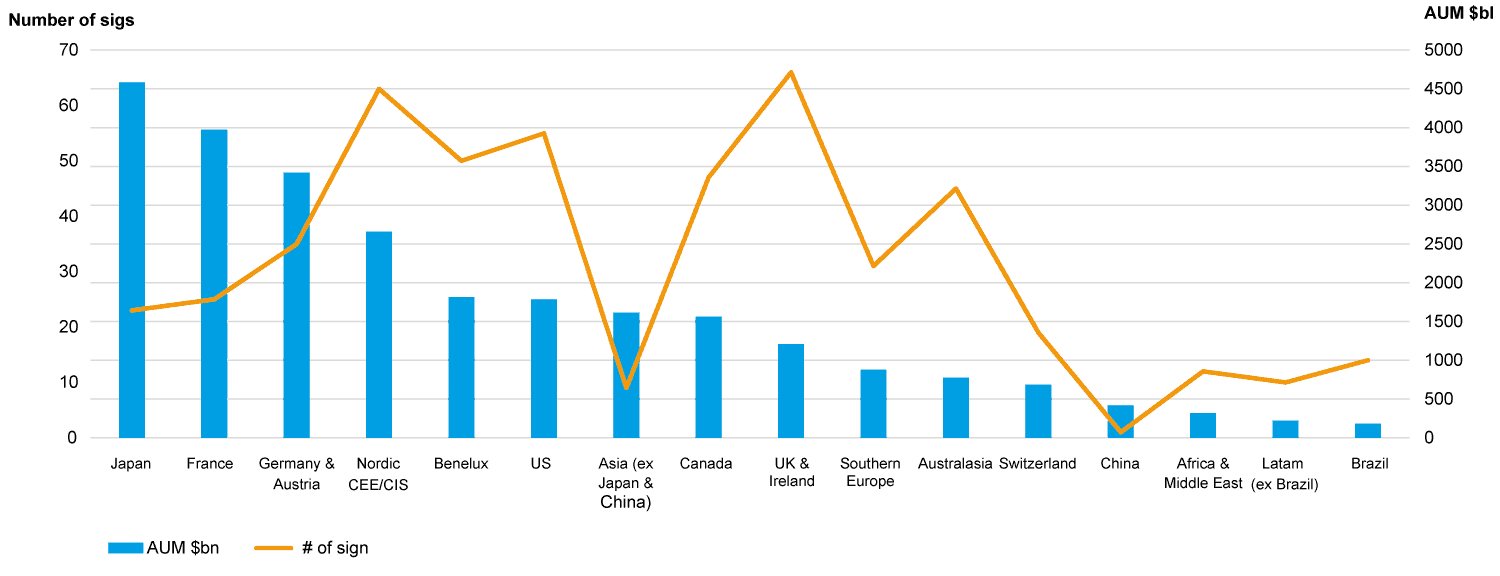
Growth in numbers has also been accompanied by increasing geographic diversity. Our 500th asset owner is Protección SA, a corporate pension fund based in Colombia, reaffirming how responsible investment is now inarguably global. In fact, the largest asset owners at the PRI by AUM are based in Japan, France, Germany and Austria. Our largest amount of asset owners are based in the Nordics, the US and the UK/Ireland.

Asset owners by AUM and size

More recently, the PRI has seen significant growth in markets with a traditionally lower presence, such as Latin America, Southern Europe and Asia. Some of Asia’s big asset owners – Japan Post Insurance, the Hong Kong Monetary Authority, Ping An Insurance Group (China) and the Employee Provident Fund (Malaysia) – are all new signatories.
It’s not just about pension funds

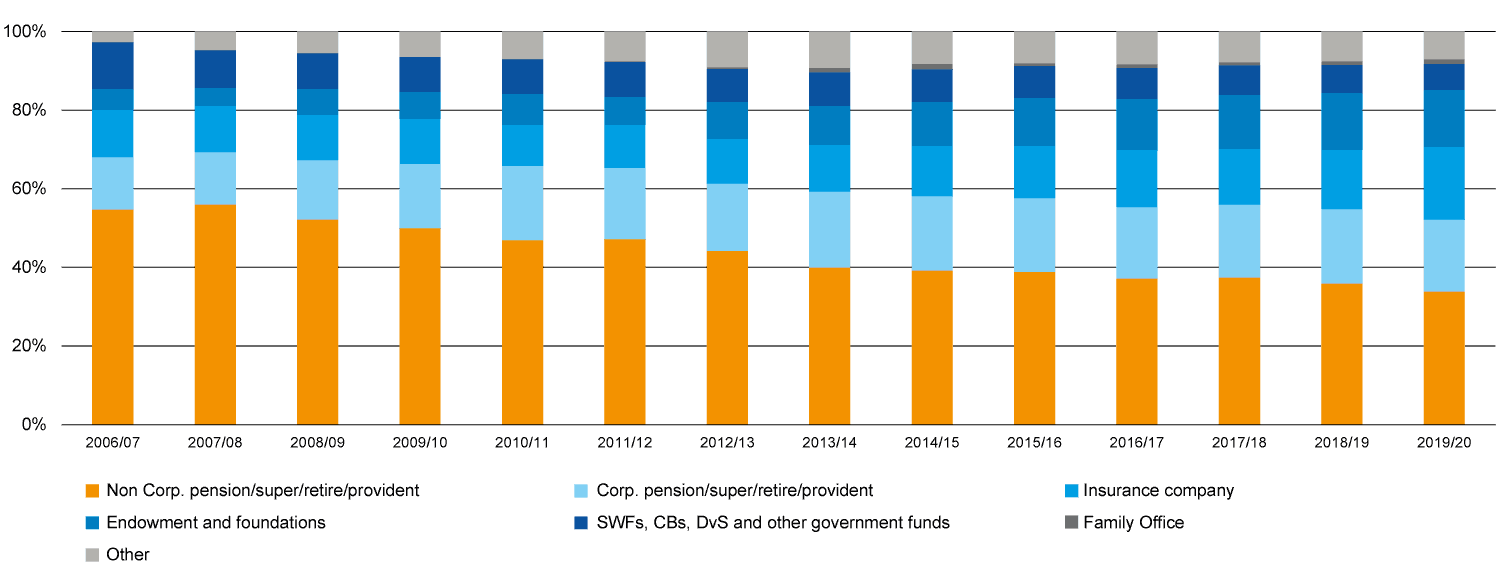
In 2005, the PRI’s founding signatories primarily came from the world’s largest public pension funds. Though public pension funds continue to be the largest group of asset owners, other types of institutional investors are increasingly demonstrating their commitment to responsible investment by signing the Principles.

For example, over 30 insurers became signatories in 2019. In Europe large players like Talanx Group (Germany), Poste Vita (Italy), and Ageas (Belgium) joined. In Asia, Meiji Yasuda Life Insurance Company, Sumitomo Life Insurance Company (Japan) and Ping An Insurance (China) also signed up. The PRI’s first US insurer – Re-Insurance Group of America – has also joined.

Endowments and foundations are another growing category, especially in the UK and North America. They now represent around a third of asset owner signatories in North America. PRI signatories now include the Harvard University Endowment, University of Toronto, University of Manchester, London School of Economics and Political Science, and University of Tokyo, whose interest in RI is often driven by student activism on sustainability.

Governments are also recognising the role capital markets must play in promoting social and environment goals. The EU’s Action Plan on Sustainable Finance is maybe the most visible example of this trend. This is spilling over to activity at sovereign wealth funds, central banks and DFIs; in 2019 our first central bank members, De Nederlandsche Bank in Holland and the Bank of Finland joined the PRI.
Working together in a decade of action

The UN’s calls for a “decade of action” should be a stark reminder of the urgent need for asset owners to step up their responsible investment efforts. And the PRI’s 10-year Blueprint puts asset owners at the heart of our response to key sustainability issues.

How do we support asset owner signatories? Since inception we have released practical guides and tailored tools to help asset owners invest responsibly. In our recent signatory survey, 84% of asset owners agree that these resources are useful in meeting PRI Principles I and II.

The PRI’s asset owner resources

We have released a number of introductory guides for asset owners, with the Introduction to responsible investment for asset owners at the forefront. Other introductory guides include discussions on what responsible investment is; introducing a responsible investment policy and process; and asset class-specific guides on fixed income; listed equity; and private equity.

In 2020 we will be releasing three separate guides on selection, appointment and monitoring of external managers, as well as useful tools to underpin these practices, building on existing resources such as the RI review tool for trustees.

A full list of asset owner material can be found at unpri.org/asset-owners.

Asset owners can also use the Data Portal to monitor and assess their managers, if they are PRI signatories, on a range of ESG issues.
Improving internal processes is one important step. But another is taking collective action. For leading asset owners, there are collaborative initiatives such as Climate Action 100+ (CA100+) and the recently launched UN Net Zero Asset Owner Alliance. Members of the CA100+ include over 430 PRI signatories, of which 225 are asset owners. Here leading asset owners such as the Government Pension Investment Fund (GPIF) in Japan, Aegon, Allianz SE, AXA Group, ABP, Generali Group, Ping An Insurance Group, Aargauische Pensionskasse (APK) and CalPERS are looking to drive change on climate across their portfolios. The UN Net Zero Asset Owner Alliance takes this one step further with a focus on aligning portfolios to net zero by 2050 – clearly a key goal in the light of our climate change crisis.

We would like to thank all the 500 asset owners who have now joined the PRI and whose collective ambition is driving responsible investment forwards. There is still so much to achieve, but there is power in numbers, so let’s roll up our sleeves and move forwards together.

Lorenzo Saa  is chief signatory relations officer at PRI.


The overarching theme at last week’s 50th anniversary of the World Economic Forum’s annual shindig in the Swiss alpine resort of Davos was sustainability. Against a backdrop of rising climate risk caught in the WEF’s own Global Risk Report which, for the first time, found the top five risks related to the environment, the cohort of bankers, politicians, investors and business leaders (only 24 per cent of whom were women) jostled hard to espouse their green credentials.

Amongst all the pledges, aided and abetted by the conference organisers discouraging single use plastic, offering protein alternatives to meat and rebates for its 2821 delegates (among them 116 billionaries) who chose to arrive by train and bus rather than private jet, a few stood out.

Italy’s €488 billion ($538 billion ) Generali, the world’s third biggest insurer, and the Church of England’s three National Investing Bodies (NIBS) representing over £12 billion in assets ($13.2 billion), announced they will join the Net-Zero Asset Owner Alliance. Investor members in the Alliance, which already includes US pension giant CalPERS and the insurance group Allianz, agree to push and engage (rather than divest) investee companies to be carbon neutral by 2050.

“We are proud to be part of the Net-Zero Asset Owner Alliance. It is about walking the talk and further aligning our investment portfolio to our long-term commitments. As a financial services operator we feel the responsibility of contributing to achieving carbon neutrality by 2050,” said Tim Ryan, group CIO and chief executive of asset and wealth management at Generali.

Elsewhere, repeated calls for a global carbon tax added to the growing momentum around the debate on how it might work, something the IMF explored in a paper, issued last month. Ursula von der Leyen, president of the European Commission sketched out how tariffs could be used on imports into the EU from regions that don’t penalise carbon usage. All part of an initiative that is now a central part of the commission’s European Green Deal, designed to protect European businesses under pressure to reduce their own footprint from “carbon dumping” outside the continent.

“There is no point in only reducing greenhouse gas emissions at home, if we increase the import of CO2 from abroad,” she told delegates. “It is not only a climate issue; it is also an issue of fairness towards our businesses and our workers. We will protect them from unfair competition.”

Illiquid

Away from climate concerns, pension chiefs flagged their key priorities.

Illiquid assets are one potential hazard, warned Mark Machin, chief executive of Canada Pension Plan Investment Board.

“I do ring the alarm bell on illiquid assets,” he said during a Bloomberg TV interview. “We are very comfy with our risk models and what we would do in various lurches down in markets, but I worry about the expansion of a lot funds like us around the world into private, illiquid assets.”

Machin said investors should be wary of the huge shift of assets from public to private markets because it could trigger steeper sell offs and exacerbate a crisis. Half of the $313 billion fund is in illiquid assets, he said.

“You have to be very careful to make sure that you truly understand the liquidity positions, that you truly understand if that thing turns out to not be liquid you can still cope, and if you can still pay the university, the pensioners,” he said.

He also flagged risks around trade tensions. “Our view is that these global trade tensions will continue and create some weight on global trading and supply chains and technology. There is nowhere to hide from that, so you need to diversify,” he said, suggesting cash or some physical commodities.

CPPIB, which currently holds about 85 per cent of its assets outside of Canada, plans to boost exposure to better-yielding emerging markets, lifting that allocation to one-third of its portfolio in the next five years. The pension fund still sees private equity as a good asset class from a risk return point of view and is relying on venture capital to participate early in the next market trends, he said in the interview.

Other noteworthy comments picked up by newswires came from Anshu Jain, president at Cantor Fitzgerald who warned institutional investors of the perils of negative yielding debt.

“Of greater concern for me is repercussions for insurers and pension funds that will be felt for years to come,” he said in an interview. A theme taken up by Eurozone bank executives lobbying regulators and ECB chiefs at Davos.

In an interview with CNBC Jamie Dimon, chief executive of JP Morgan, said he viewed negative rates with “trepidation” describing them as “one of the great experiments of all time,” and warning “we still don’t know the ultimate outcome.”

Elsewhere Ray Dalio, who oversees Bridgewater’s $160 billion in assets with Bob Prince and Greg Jensen, urged investors not to miss out on opportunities in today’s strong markets.

“Cash is trash,” he said in a CNBC interview. “There’s still a lot of money in cash.”

He also warned against speculative investments like bitcoin. “There’s two purposes of money, a medium of exchange and a store hold of wealth, and bitcoin is not effective in either of those cases now,” he said.

The UK’s £30 billion Brunel Pension Partnership is taking investing in a carbon zero future to a whole new level. The asset manager for 10 local authority schemes, already well-known for its investment track record and expertise in this area, has just published a far-reaching Climate Change Policy filled with actions and deadlines linked to the goals of the Paris Agreement.

The initiative goes beyond Brunel just readying itself for the future. At its heart lies a bold ambition to shape and push the whole investment industry to prepare for a carbon zero future.

“Our central thesis is to systematically change the financial system. This is the bit that is thwarting and aggravating the achievement of our aspirations,” says Faith Ward, chief responsible investment officer at Brunel.

Policy

First up is a commitment to work with policy makers, helping shape regulation like carbon pricing, the removal of fossil fuel subsidies or new frameworks to measure progress. Brunel already lends its resources and expertise to a long list of regulatory advisory groups (the Environment Agency Pension Fund, one of its client funds, helped set up the Transition Pathway Initiative) but has promised to put more resources and expertise to behind-the-scenes work that will change the economics of a particular investment, or make climate risk more explicit. It is the only way to force investment to “shift at scale” and give policy makers “the confidence to be truly bold,” says Ward.

“It’s not just a case of moaning about policy makers but lending our time and energy to supporting those regulators. People often criticise policy makers but when policy makers reach out and say can you be part of this working group, or can you help us, there are not always as many volunteers as needed.”

Product governance

Next Brunel promises to encourage and stimulate the roll-out of more investable, climate-orientated products. “The products don’t always exist for investors wanting to invest in a below 2-degree portfolio across all asset classes,” she says arguing that managers need to see more demand and encouragement from asset owners to develop more innovative, climate-related products. New benchmarks are a prime example. “We currently measure success relative to underperforming or outperforming a market cap weighted benchmark, but that isn’t the right framing if that benchmark is going to take you to four degrees.” New benchmarks need developing to incorporate traditional risks in parallel with climate risk and place climate in the broader risk framework, she says.

Brunel will be increasingly “mindful” of climate change in its own product offering to its client funds, avoiding strategies that are inherently carbon intensive. For example, she plans to explore “smart” ways to navigate the UK-listed equities space given the FTSE hosts companies inherently more carbon intensive than other indices. “The carbon footprint of UK equities is higher than the MSCI ACWI.”

Elsewhere, value factors in smart beta allocations also tend to have a higher carbon exposure. “We are seeing solutions emerge around being carbon smart; it’s about innovating and working with the market to fill some of the gaps particularly in fixed income and alternative liquid assets.” One of the biggest challenges is actually knowing what a 2 degree portfolio looks like so that Brunel’s client funds can see how far away they are from their objectives. Here Brunel is working with the Institutional Investors Group on Climate Change (IIGCC) on a project to examine what a Paris-aligned pension fund looks like.

Manager relationships

Portfolio management comes next, with Brunel promising to ensure its 23 external managers (a number that will grow under the pooling process and ensuing re-tending of portfolios) integrate climate change and alter the way they work. Rather than a surprise, for long-standing managers this amounts to an articulation of a priority they alrady know well given Brunel’s rigorous due-diligence process. Ward has just carbon footprinted all 20 managers shortlisted in its global high alpha mandate, from which five won mandates.

That is not to say it won’t be challenging. None more so than for the new cohort of four US and five North American managers, recently awarded mandates. It is a rigour and oversight she believes these managers will welcome as they seek to gain a foothold in the European market. “They can see that their historical approach has been a barrier to getting new business,” she says. Their biggest challenge will be grasping the detail of what is being asked of them and keeping abreast of the conversations that are happing in the European market: US investors don’t necessarily demand the same level of transparency and reporting, she says. “We wouldn’t have appointed them if we didn’t feel that they were able to do it. They want to do it. It’s just nobody ever asked them before.”

She also believes that Brunel’s systematic approach is important for managers. “We are looking at the system rather than just challenging our managers. It is about recognising that asset managers are responding to the framework they have and that this is about working with them to change that framework.” That said, she is resolute that if managers don’t pull their weight, they will be dropped. “We are very unambiguous in our expectations – we are serious: if managers do fall short it will jeopardise their long-term contractual relationship with us.”

In another gauntlet to managers, the policy won’t extend to rules on divestment. It’s too simple to just give managers a list of what they can’t invest in because they won’t be compelled to develop capacity or drive changes in corporate behaviour, she explains. “We want managers to see our policy and for them to then show us their data and analysis, and how they thought it through.”

Progress will be marked in a Q3 2022 stock take, coming down on manager and corporate behaviour particularly. However it will also amount to a review of the whole Policy and take place in collaboration with client funds in a process, she says, reflective of Brunel’s member funds commitment and ownership of the Policy that extended to them wording much of the detail.

Positive impact

The fourth P is Positive Impact, whereby Brunel will endeavour to invest in assets like public transport and energy grids. This policy is also engrained at Brunel’s own behaviour. “We are also looking at our behaviour too,” she says. “We are on a renewable tariff and use glass bottles for our office milk. These are only tiny things, but it is about genuinely aligning the whole organization.”

Of course Brunel won’t change the financial system alone. The final P is Persuasion, and a promise to engage and cajole not only investee companies but all seams of the financial industry spanning other asset owners, managers, auditors and regulatory organisations to plan for the transition. “It is about bringing the whole thing together,” she concludes.