In 2018, sustainable investing worldwide eclipsed $30 trillion in assets under management, according to the Global Sustainable Investment Alliance, with $12 trillion originating in the United States.

In the recent market downturn Morningstar’s Jon Hale says that mutual funds that integrate environmental, social or governance (ESG) factors registered record growth in the first quarter of 2020, beating the previous record in Q4 2019.

Clearly, sustainable investing is no longer on the margins, it’s gone mainstream in a big way.

With this in mind it is important to look at the research that is behind the investments, and the funds, and the different approaches taken to analysing data.

The battle between man and machine, that has played out in various arenas – such as Garry Kasporov versus IBM’s Big Blue, and when IBM’s supercomputer Watson out-dueled Jeopardy champions Ken Jennings and Brian Rutter – is now taking place in sustainability research.

Arguably the two leaders from each side of the global market for corporate sustainability research and ratings are Sustainalytics, now owned by Morningstar, which represents the analyst-based sustainability research and ratings approach; and Truvalue Labs, which harnesses AI, machine learning and natural language processing (big data) to provide investors and companies with corporate sustainability performance insights and assessments.

The differences between Sustainalytics and Truvalue Labs’ methodology are depicted below.
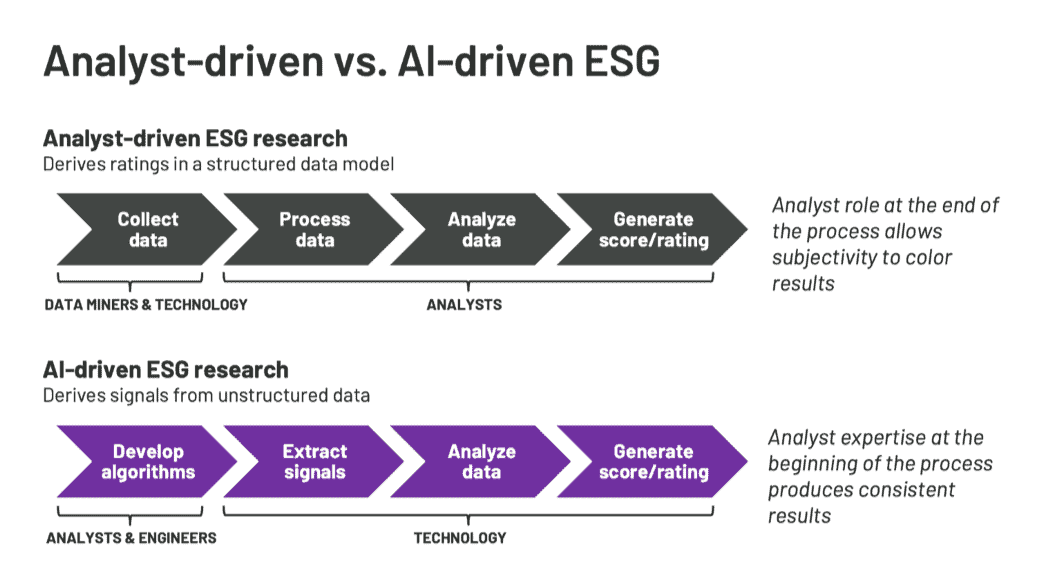
About the machine: Truvalue Labs

Al Gore, former Vice President and co-founder and chair of Generation Investment, said “The sustainability revolution is powered by new digital tools. It has the magnitude of the industrial revolution and the speed of the technology revolution. It is the single largest investment opportunity in all of history.”

Truvalue Labs, has harnessed those digital tools, and applies AI to uncover opportunities and risks hidden in massive volumes of unstructured data, including ESG behavior that can have a material impact on company value.  It also integrates SASB’s materiality guidelines, which is the gold standard for investors seeking to evaluate a company’s performance from a financial materiality prism.

“The world is awash in unstructured data,” wrote Thomas Kuh, head of index at Truvalue Labs. “Roughly 90 per cent of the data in the world was generated over the last two years alone.”

This super-abundance of unstructured information provides an important source for ESG signals and makes it imperative to incorporate an outside-in view of ESG data to complement companies’ inside-out reporting.

As such, Truvalue Labs made the strategic decision to exclude from its analysis a company’s self-produced ESG information in order to obtain an unvarnished impression of companies’ performance.

“Many sustainable investors are skeptical of AI and the idea that we can trust machines. We make a point of emphasising that the role of AI is to do things humans can’t do efficiently in order to make humans work smarter. And good AI depends on being deployed intelligently by humans. Not all AI is created equal,” Kuh said.

Truvalue Labs’ sustainability performance assessments take into account the sentiments of a wide array of corporate stakeholders. Its coverage of ESG research and ratings spans more than 16,000 companies and it applies its proprietary, customizable AI algorithms to more than 100,000 sources.

An example of the value add it can produce is its coronavirus ESG monitor.

The analyst-based approach

Sustainalytics, a globally recognised provider of ESG ratings and research, has 25 years of experience covering more than 40,000 companies on hundreds of ESG performance indicators.  Its 650 employees provide sustainability ratings for more than 20,000 companies that can be customised to clients’ specifications.

Last month Morningstar acquired Sustainalytics for an estimated EUR170 million.

“Modern investors are demanding ESG data, research, ratings and solutions in order to make informed, meaningful investment decisions.  From climate change to supply-chain practices, the nature of the investment process is evolving and shining a spotlight on demand for stakeholder capitalism. Whether assessing the durability of a company’s economic moat or the stability of its credit rating, this is the future of long-term investing,” said Morningstar’s chief executive Kunal Kapoor.

Morningstar and Sustainalytics have worked together to provide investors and companies with new ESG analytics, including: the industry’s first sustainability rating for funds, based on Sustainalytics’ ESG ratings; a global sustainability index family; and sustainable investing analytics that includes carbon metrics and controversial product involvement data.

Implications for corporates and investors

Warren Buffet said famously several years ago: “It takes 20 years to build a reputation and five minutes to ruin it.  If you think about that, you’ll do things differently.”

Today, with the proliferation of social media, a company’s reputation can be bolstered or tarnished in a matter of seconds. Against this backdrop, what are savvy investors and corporations to do to prepare for the new normal?

Truvalue Labs’ AI approach provides several advantages:

  • AI reduces the potential for ESG analyst biases to tilt assessments and ratings.
  • AI can be applied to more companies more quickly, while analyst-based ESG information is generally updated quarterly or even annually, depending on the provider.
  • Because Truvalue Labs’ AI does not rely on self-reported data, it is not as constrained by uneven availability of company-provided data.

Sustainalytics’ analyst-based approach provides its own advantages:

  • It enhances company’s disclosed ESG information with third-party insights.
  • Experienced analysts can provide invaluable judgement on a company’s culture and trends over time.
  • A company’s ESG information can be validated by an assurance provider to enhance accuracy and reliability.

The optimal future state: Best-of-both approach

So which approach works best today?  I believe the truth, as with most things, is in the middle.  What works best in today’s market is a side-by-side comparison between analyst-based research and ratings such as those from Sustainalytics alongside AI technology from Truvalue Labs.

My bet, however, is that within the next 24 months, the machine will again prevail over the human touch and AI will become the industry standard for assessing a corporation’s sustainability performance and impacts.

This will, in turn, have broad implications for the future of corporate sustainability reporting and performance measurement.  It’s indeed a brave new world.


Mark Tulay is the founder and chief executive of Sustainability Risk Advisors


In this Fiduciary Investors Series podcast Amanda White talks to Professor Cameron Hepburn,  Professor of Environmental Economics, and the director of the economics sustainability programme, at the University of Oxford.

They discuss: some of the more recent energy innovations; and the ideal price on carbon; as well as what is needed to move to a net-zero carbon economy.

Importantly Professor Hepburn discusses the role of finance and the need to recognise that both the finance and climate environments are complex adaptive systems, and that backward-looking analysis is not appropriate for adequate risk management.

“We need to get out of the old paradigms,” he says. “Even the concept of the Black Swan, doesn’t really help us to capture the fact these distributions are not bell shaped, or fat tailed or non-normal distributions. These are interactions between parts of the economy that are shifting the distribution altogether. So these things that are supposed to be a 1 in 10,000 event become the mean because you’ve shifted the distribution.”

He ends by offering some advice to institutional investors on how they should be including climate risks and opportunities into their investment decision-making, and the best way of doing that.

Cameron Hepburn is the Director of the Economics of Sustainability Programme, based at the Institute for New Economic Thinking at the Oxford Martin School. He is also Director and Professor of Environmental Economics at the Smith School of Enterprise and the Environment, a Fellow at New College, Oxford, and a Professorial Research Fellow at the Grantham Research Institute at the London School of Economics.He has published widely on energy, resources and environmental challenges across a range of disciplines, including engineering, biology, philosophy, economics, public policy and law, drawing on his degrees in law, engineering and doctorate in economics. He is on the editorial board of Environmental Research Letters and is the managing editor of the Oxford Review of Economic Policy. Cameron’s research is often referred to in the printed press, and he has been interviewed on television and radio in many countries.Cameron provides advice on energy and climate policy to government ministers (e.g. China, India, UK and Australia) and international institutions (e.g. OECD, UN organisations) around the world. Cameron began his professional life with McKinsey, and has since had an entrepreneurial career, co-founding three successful businesses – Aurora Energy Research, Climate Bridge and Vivid Economics – and investing in several other social enterprises, such as Purpose and Apolitical. He also serves as a trustee for Schola Cantorum of Oxford.

Amanda White is responsible for the content across all Conexus Financial’s institutional media and events. In addition to being the editor of Top1000funds.com, she is responsible for directing the global bi-annual Fiduciary Investors Symposium which challenges global investors on investment best practice and aims to place the responsibilities of investors in wider societal, and political contexts. She holds a Bachelor of Economics and a Masters of Art in Journalism and has been an investment journalist for more than 25 years. She is currently a fellow in the Finance Leaders Fellowship at the Aspen Institute. The two-year program seeks to develop the next generation of responsible, community-spirited leaders in the global finance industry

Harvard Management Company is re-positioning its $40 billion portfolio to invest in line with net-zero greenhouse gas emissions by 2050 following instructions from the president of the university, Larry Bacow last week.

A number of significant changes have occurred at HMC, under the stewardship of CEO Narv Narvekar and CIO Rick Slocum, including moving the portfolio to external investment management and recalibrating its illiquid asset exposures.

A key focus of implementing a net-zero goal will be to work with external asset managers. Currently HMC works with around 100 investment partners with a preference for “investors not asset gatherers”.

It has said it will work with current and prospective asset managers to emphasise GHG emissions reduction outcomes in the real economy.

It’s also going to work closely with peers, which have made or are making similar commitments, and acknowledges it can’t achieve these commitments in isolation. A key focus is to develop tools that monitor the carbon footprint of its investment managers.

When HMC signed up to the PRI it was the first endowment to do so, and it already actively expects its external managers to report regularly on ESG integration, shareholder engagement, proxy voting activity and outcomes.

HMC, which is about half-way through a five-year transition that includes moving from internal to external investment management, has shifted its internal investment resources to generalists, and aims to operate as one team, not siloed specialists.

In the past few years HMC has spun out four internal investment platforms including its large internal real estate platform, to Bain Capital, and its credit platform.

The fund’s exposure to real estate is about half of what it was in 2017, the majority of which stayed with the team from HMC when it spun out.

The exposure to natural resources has also been more than halved from 9 to 4 per cent. It was forced to write down or write off about $1 billion in “deeply troubled assets”; and has sold a further $1.1 billion in assets it thought were misaligned with the risk, return, liquidity profile of the fund.

An early investor in venture capital the fund has had a healthy allocation to illiquid assets and has actually increased allocations to private equity from 16 to 20 per cent since 2017, a significant increase from the 13 per cent allocation a decade ago. Public equity exposures have decreased from 31 to 26 per cent in the past three years.

The fund has been repositioning the portfolio by reducing exposure to certain illiquid assets and building exposure to others. In the 2019 annual report, Narvekar wrote that buyouts, growth and venture capital is low relative to what makes sense for Harvard.

A new liquidity framework was developed in 2018, and last year saw the endowment distribute $1.9 billion to the university, the highest amount since its inception in 1974.

HMC and the university

A key part of the net-zero plan is to also collaborate with the university’s faculty and other experts to calculate emissions, and work with asset managers to examine the portfolio’s transparency and emission levels.

The Harvard Corporation — the University’s highest governing body, which approved the new standard — has asked HMC for an update by the end of the year to outline how it plans to achieve net-zero emissions.

The university has also create a Presidential Committee on Sustainability, which will advise Bacow and other university leaders by creating a comprehensive sustainability vision. The committee is co-chaired by Rebecca Henderson, the John and Natty McArthur University Professor, who spoke at www.top1000fund.com’s Fiduciary Investors Symposium at Harvard last year on inequality, warning the impact of inequality is equal to the impact of climate risk. Henderson teaches the Reimagining Capitalism course as part of the MBA alongside Professor George Serafeim.

Henderson will co-chair the committee with John Holdren, the Teresa and John Heinz Professor of Environmental Policy at Harvard Kennedy School; and executive vice president Katie Lapp, and will draw on Harvard’s knowledge and expertise to develop solutions for energy and emissions reduction, around both the university and the world.


At the end of June 2019 the endowment’s asset allocation was:


ASSET CLASS ALLOCATION RETURN
Public equity 26% 5.9%
Private equity 20% 16%
Hedge funds 33% 5.5%
Real estate 8% 9.3%
Natural resources 4% -12.4%
Bonds / TIPS 6% 5.7%
Other real assets 2% -8.3%
Cash and other 2%
Endowment 6.5%


The HBS Global Policy Tracker is an initiative to collect and standardise economic policies implemented around the world as a response to the COVID-19 pandemic. It focuses on fiscal policy, monetary policy, and lockdowns. The data is updated in real-time with the efforts of several dozen students and staff at Harvard Business School and other Harvard Schools.

Access the tracker here

The scale and severity of the unfolding COVID-19 pandemic has emphasised the need to put people centre stage. While the climate emergency has been the top issue for the responsible investment community over the last couple of years, and rightfully so, the current reality is prompting a stronger investor focus on the social dimension of ESG.

The virus itself doesn’t discriminate, but our social and economic arrangements do. For example, workers in the ‘gig economy’ on zero-hour contracts are significantly affected by the shut-down of economic activity linked to COVID-19. Some will be let go overnight, often without wages or severance, many of whom support households, lack savings, and have no access to a governmental social safety net.

Equally, we see strong disruptions in supply chains having immediate consequences for workers. From brands cancelling orders with short notice or delaying payments to suppliers, to materials shortage from exporting countries – all have negative impacts on people and their livelihood. It is clear that COVID-19 disproportionately impacts the poor and most vulnerable, in part because they lack the resources to take adequate precautions.

Many are now calling for a more human-centric model, or perhaps a ‘new social contract’, to address the economic, health and general negative human rights impacts and inequalities of our current system. We believe that international human rights standards are the best universal framework for the necessary economic recovery and reform.

The role of the private sector

While governments are instrumental in responding to the current crisis, we should not forget the role of the private sector and the financial system. Their influence has increased as a result of the globalisation of our economies in which efficiencies in transport, communication and the flow of capital, for decades, have allowed private companies and investors to shift activities and investment to where domestic laws, labour standards, and tax regimes were most favourable.

The Universal Declaration of Human Rights – the historical document crafted in 1948 – calls on “every organ of society [to ensure the] universal and effective recognition and observance of human rights”. The finance sector is a key contributor to the fulfilment of this aspiration.

As often in a time of crisis, we need to shift our mindset and recognise that “business as usual” is no longer viable. COVID-19 has made this clear. We now need to better understand the negative impacts of the business community and ensure that respect for people’s dignity is at the core of our decision making.

The expectations outlined in the UN Guiding Principles on Business and Human Rights, unanimously endorsed in 2011 by the UN Human Rights Council, are particularly helpful for this. They emphasise the duty of states to protect human rights, but also emphasise the responsibility of business enterprises to respect them too.

Companies, whether big or small, are now faced with a range of unprecedented challenges that require an even stronger focus on their corporate responsibility to respect human rights. Eyes are on those showing leadership in protecting their employees, their suppliers and business partners, customers and the communities they serve. But those who fail to do so are also being watched. And, the UN Office for the Higher Commissioner for Human Rights in 2013 made clear that this corporate responsibility also extends to institutional investors.

The role of investors

The financial system will play a critical role in enabling economic recovery, development and contributing to wider societal well-being. We need to emphasise the responsibilities of institutional investors, our signatories, to respect human rights more broadly to ensure that the financial sector contributes to, not detracts from, more inclusive societies.

Institutional investors have a responsibility to respect human rights more broadly to ensure that the financial sector contributes to, not detracts from, more inclusive societies

While there is growing investor leadership and momentum on respecting human rights, many institutional investors are still unaware of or unclear on how to fulfil this responsibility. We are faced with an implementation gap. But this serves as an opportunity for investors – recognising the leverage they have to influence better societal outcomes.

Next steps

The PRI’s position, grounded in international standards, is that institutional investors have a responsibility to respect human rights. Later in the year, we will publish details and guidance on how we expect our signatories to meet this responsibility, including reporting on it. We will work with signatories to address collective challenges and to improve the practices of the investment community to ensure respect for human rights.

So, as we contemplate a world post COVID-19, we need to ensure that the recovery respects both the boundaries of the planet and the rights of its people. As the recent Statement by the UN Working Group on Business and Human Rights highlights ”making real progress in implementing the Guiding Principles will better prepare us for the next crisis”. These values must inform our response to avoid environmental disaster, safeguard the dignity of people, and build the resilience needed for managing disruptions, now and in the future.

Bettina Reinboth is head of social issues and Nikolaj Halkjaer Pedersen is senior specialist, responsible investment at PRI.

A risk management strategy that measures the resilience and fragility of markets, protected portfolios from the wild February downswing in equity markets and predicts there is more potential weakness to come.

Windham Capital, a Boston-based risk management firm and a founding partner of State Street Associates, looks at the world according to a proprietary investment risk cycle, which describes how financial turbulence and systemic risk interact with each other and how that impacts asset values.

This measure of systemic risk helps separate a fragile market from a resilient one and while it doesn’t tell you about an individual tail-risk event, it can indicate when one may be approaching so portfolios can be positioned to cushion the blow. Similarly, if the systemic risk measures shows that markets are resilient, portfolios can take advantage of that.

Chief executive of Windham and a professor of finance at Massachusetts Institute of Technology, Mark Kritzman, says implied systemic risk, or the absorption ratio, is a measure of how tightly coupled or unified the markets are.

This absorption ratio, or concentrated risk measure, was developed in response to the global financial crisis, but the most recent market activity is the first time it has had a chance to really shine since then.

“We came up with absorption ratio as a result of the financial crisis, to measure systemic risk and back tested it through the GFC,” Kritzman says. “Since then we have seen only one drawdown greater than 10 per cent, this is the first live test. Our expectation is it will provide the most value in large sell offs by helping investors to avoid those sell offs.”

Combining the absorption ratio with a measure of financial turbulence or risk similarity, which looks at how unusual the market is compared to historical norms, provides an index of market fragility versus resilience.

Using a measure of zero to 100, the index hit 48 the day the market peaked on February 19. By February 24, it was at 64 and jumped to 76 the following day. This triggered a shift into what Kritzman calls a fragile environment. Two days later it measured 99 and has been there ever since.

“This is the fastest increase we have ever seen, including in our back testing,” Kritzman said.

As a result, Windham quickly moved client portfolios into their most defensive posture, taking into account their different governance requirements, and helped protect against a large part of the market decline.

“The sell off since the peak in February was 21 per cent,” Kritzman says. “Since the indicator moved into the fragile regime on February 25, the market has been down 18 per cent. So, we were in the most defensive position for clients for a large part of the sell-off. This indicator is not going to pick the peak but it did a good job of giving an exit signal early in the sell off.”

“For some clients neutral is 70:30, for others it is 50:50, and some clients only allow movement within narrow bands,” he says. “As soon as the indicator showed that markets had transitioned into that fragile state, we moved all clients into their most defensive position within their guidelines. For one of them that was 0 per cent in equities.”