In this Fiduciary Investors Series podcast Amanda White talks with Geoffrey Rubin, chief investment strategist at CPP Investments, which manages the investments of Canada’s largest pension fund with about C$410 billion of assets. They discuss scenario planning, the benefits of total portfolio management, rebalancing and liquidity as well as the forward-looking view of the global economy and opportunistic investments for long-term investors.

About Geoffrey Rubin
Geoff Rubin is responsible for overall fund-level investment strategy and heads the total portfolio management (TPM) department – the operational arm of CPP Investments’ investment planning committee, with overall management accountability for the oversight and management of the fund’s investment portfolio. He joined CPP Investments in 2011, with the inception of TPM, and has helped shape its growth and evolution, and to define and execute CPP Investments’ total portfolio approach. Previously, he held finance roles with Fannie Mae and Capital One Financial where he managed the global balance sheet. Rubin also ran a consulting practice and was Adjunct Professor at American University’s Kogod School of Business in Washington, DC. He holds a BA in Economics from the University of Virginia and a PhD in Economics from Princeton University.

About Amanda White
Amanda White is responsible for the content across all Conexus Financial’s institutional media and events. In addition to being the editor of Top1000funds.com, she is responsible for directing the global bi-annual Fiduciary Investors Symposium which challenges global investors on investment best practice and aims to place the responsibilities of investors in wider societal, and political contexts. She holds a Bachelor of Economics and a Masters of Art in Journalism and has been an investment journalist for more than 25 years. She is currently a fellow in the Finance Leaders Fellowship at the Aspen Institute. The two-year program seeks to develop the next generation of responsible, community-spirited leaders in the global finance industry.

Angela Rodell, CEO of the Alaska SWF, looks into a post-COVID future and what investors, such as APFC, with an investment horizon of five years or longer, should be considering.

Alaska is fortunate. Forty-three years ago, leaders had the foresight to create the Alaska Permanent Fund, thus establishing a permanent, renewable resource to benefit current and future generations of Alaskans. Over time the fund has grown into a multi-billion dollar investment portfolio, providing more than $30 billion to the Alaska economy through payment of dividends and funding for state government. Given Alaska’s current reliance on this financial resource, the Alaska Permanent Fund Corporation (APFC) has reached a point in history where the fund and our long-term strategy for investing matter more than ever before.

The economic crisis generated by the novel coronavirus is sweeping the world, and many governments are scrambling for the means to take care of our constituents. It would be easy to get caught in a short-term mindset: How do we help? Should we use some of the Permanent Fund for grants or loans to businesses? Should we be generating a lot of cash right now in anticipation of it being needed for the state? Will we have enough “dry powder” to invest as valuations of good companies hit lows and opportunities become available?

It is imperative never to underestimate the impediment of short-term thinking on investing.

Here is what we do know. The short-term crisis generated by the coronavirus will come to an end, and the world will be different and yet familiar. The economic crisis will potentially last significantly longer as businesses recalibrate based on a new reality.

For APFC’s investment horizon of five years or longer, what factors should we be considering?

First, working from home by millions of people will fundamentally alter how we value labour and its contribution to earnings and returns.

We have learned how to exchange and collaborate on ideas without being in the same physical space. Investing in technology, labour, and commercial real estate may require a lens that reflects the concept that not as many people need an office, as was assumed prior to the shutdown. Also, we have learned that we value what is contributed to a company’s bottom line—not how it is contributed. We have had a service-based economy for years but still required professionals to be structured under manufacture-type paradigms. Today, we work and communicate differently.

Secondly, millions of children educated by online resources should alter how we think about education. Does an August to May school year continue to make sense, and can we have a real conversation about how educators should be remunerated under very different education models? The obligation to home school millions of children has awakened in us the real value of our educators, the needs of our students, and the demands on millions of working parents. As a long-term investor, the opportunity again lies with technology and added infrastructure. Future opportunities will lie in delivering internet and broadband service to support student education throughout the world.

Thirdly, consider the delivery of public services. Government has yet to be a sector disrupted by technology. Now the opportunity to truly reform government institutions and think about how the public is supported is before us. Public service is about serving our communities, and the ties that make us unique will continue to matter. The ability to stay in place and not move for a job will create incredible economic stability and community stability. This crisis has allowed many of us at APFC to understand it’s not about where we are located, nor is it about the specific time of day we work. Rather it is about having the relationships, technology, and resources to continue to invest the fund and serve the people of Alaska.

Long-term investing success is about having a view of where you think the world may be headed.

I see a world where we once again treasure our communities, large and small, and we have an opportunity to flourish with new technologies alongside traditional values. It is in the profound experience of immense challenges that we realise it’s more about valuing all contributions, large and small.

Rather than being a crisis of isolation, our cumulative contributions and long-term thinking will lead to the creation of a new and vibrant economy – bringing us together in ways previously unimaginable.


Angela Rodell is the chief executive of the Alaska Permanent Fund Corporation. This essay first appeared in the Milken Institute’s Power of Ideas collection focused on building and rebuilding lives in the face of the #COVID19 pandemic. The essay series features insights from thought leaders across industries.


In this Fiduciary Investors Series podcast Amanda White talks to Professor Cameron Hepburn,  Professor of Environmental Economics, and the director of the economics sustainability programme, at the University of Oxford.

They discuss: some of the more recent energy innovations; and the ideal price on carbon; as well as what is needed to move to a net-zero carbon economy.

Importantly Professor Hepburn discusses the role of finance and the need to recognise that both the finance and climate environments are complex adaptive systems, and that backward-looking analysis is not appropriate for adequate risk management.

“We need to get out of the old paradigms,” he says. “Even the concept of the Black Swan, doesn’t really help us to capture the fact these distributions are not bell shaped, or fat tailed or non-normal distributions. These are interactions between parts of the economy that are shifting the distribution altogether. So these things that are supposed to be a 1 in 10,000 event become the mean because you’ve shifted the distribution.”

He ends by offering some advice to institutional investors on how they should be including climate risks and opportunities into their investment decision-making, and the best way of doing that.

About Cameron Hepburn
Cameron Hepburn is the Director of the Economics of Sustainability Programme, based at the Institute for New Economic Thinking at the Oxford Martin School. He is also Director and Professor of Environmental Economics at the Smith School of Enterprise and the Environment, a Fellow at New College, Oxford, and a Professorial Research Fellow at the Grantham Research Institute at the London School of Economics.He has published widely on energy, resources and environmental challenges across a range of disciplines, including engineering, biology, philosophy, economics, public policy and law, drawing on his degrees in law, engineering and doctorate in economics. He is on the editorial board of Environmental Research Letters and is the managing editor of the Oxford Review of Economic Policy. Cameron’s research is often referred to in the printed press, and he has been interviewed on television and radio in many countries.Cameron provides advice on energy and climate policy to government ministers (e.g. China, India, UK and Australia) and international institutions (e.g. OECD, UN organisations) around the world. Cameron began his professional life with McKinsey, and has since had an entrepreneurial career, co-founding three successful businesses – Aurora Energy Research, Climate Bridge and Vivid Economics – and investing in several other social enterprises, such as Purpose and Apolitical. He also serves as a trustee for Schola Cantorum of Oxford.

About Amanda White
Amanda White is responsible for the content across all Conexus Financial’s institutional media and events. In addition to being the editor of Top1000funds.com, she is responsible for directing the global bi-annual Fiduciary Investors Symposium which challenges global investors on investment best practice and aims to place the responsibilities of investors in wider societal, and political contexts.  She holds a Bachelor of Economics and a Masters of Art in Journalism and has been an investment journalist for more than 25 years. She is currently a fellow in the Finance Leaders Fellowship at the Aspen Institute. The two-year program seeks to develop the next generation of responsible, community-spirited leaders in the global finance industry

What is the Fiduciary Investors series?
The COVID-19 global health and economic crisis has highlighted the need for leadership and capital to be urgently targeted towards the vulnerabilities in the global economy.
Through conversations with academics and asset owners, the Fiduciary Investors Podcast Series is a forward looking examination of the changing dynamics in the global economy, what a sustainable recovery looks like and how investors are positioning their portfolios.

The much-loved events, the Fiduciary Investors Symposiums, act as an advocate for fiduciary capitalism and the power of asset owners to change the nature of the investment industry, including addressing principal/agent and fee problems, stabilising financial markets, and directing capital for the betterment of society and the environment. Like the event series, the podcast series, tackles the challenges long-term investors face in an environment of disruption,  and asks investors to think differently about how they make decisions and allocate capital.


For further reading go to The Smith School of Enterprise and the Environment, Oxford University

To respond to the current and urgent threat of COVID-19, and to lay the groundwork to deal with what may be permanent changes for the industry after the crisis, real estate leaders must take action now.

To access the report click here

As economies around the world grind to a halt in reaction to the COVID-19 crisis, equity markets have predictably tumbled. The crash has been rapid and while there are inklings of a recovery on the horizon, it is fair to say that nobody knows when it will truly come or what it will look like. Market crashes have happened before, and in lieu of a model for how portfolios recover from the current crisis, it is a useful exercise to look back and see how institutional investors performed over other challenging periods.

The CEM Benchmarking database provides a look back at both the slow-burn dot-com crash between 2000-2004 and the Global Financial Crisis (GFC) which defined 2007-2010.

The time periods capture both the crash and recovery of each event, and the dataset represents over 220 US pension funds with average holdings of $12.1 billion.

The investors were separated into quartiles based on their overall performance through each event. For both events, top quartile returns were more than 2 per cent higher than bottom quartile returns.

Analysing differences in asset allocation between the two groups revealed three drivers of return differences. First, having a defensive allocation going into the crash was a common factor in the best performing portfolios. Second, these investors rebalanced to a significant degree over both events. Third, top quartile performers in the dot-com crash actually ‘bought the dip’ and increased their equity allocations beyond their pre-crash levels. In contrast, in the GFC there was an acceleration of trends that helped going into the crash.

The Dot-Com Crash, 2000-2004

Top quartile performers (the solid lines in the graph below) in the dot-com bubble had defensive allocations going into the crash but transitioned to more aggressive asset mixes coming out of the recovery, capturing more of the upside than their allocation at the start would have suggested.
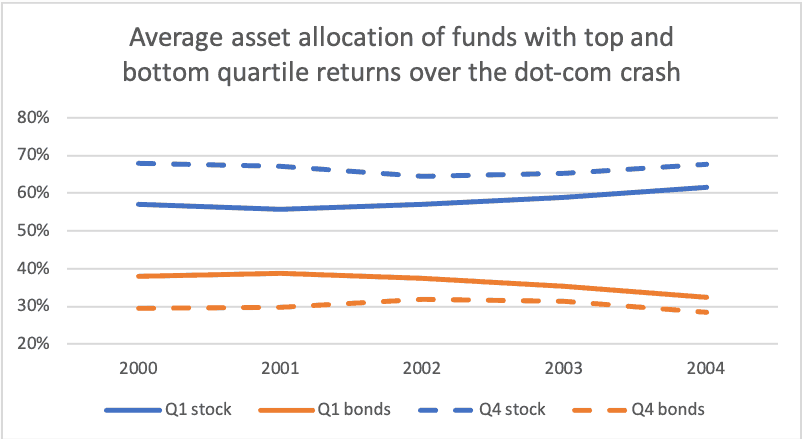
During the crash, stock prices tumbled while bonds outperformed, especially long duration bonds. In the recovery, stocks outperformed.

As you would expect, funds with high stock-to-bond ratios crashed the hardest and recovered the most. Conversely, investors with higher bond allocations (long bonds in particular) weathered the crash well but lost out on some of the upside during the recovery.

Top quartile funds over the three-year period had higher initial bond allocations: 38 per cent bonds in 2000 versus 30 per cent for the bottom quartile performers. The downside protection during the initial crash was more valuable than having more upside capture in the initial years of the recovery. By the end of the recovery however, top quartile funds sold bonds down to 32 per cent of their portfolios, while bottom quartile funds held steady at 28 per cent.

The fact that both top and bottom quartile investors’ asset allocations either trended towards stock or stayed level suggests that funds rebalanced through the market event.

If they had not rebalanced, the stock allocation for the average bottom quartile investor would have fallen from 67 to 54 per cent between 2001 and 2002 due to market return, rather than to 65 per cent.

The 65 per cent allocation to stocks demonstrates a high level of rebalancing. This degree of rebalancing was expected given that the large institutional investors in the dataset tend to be more disciplined in their investment approach. It was certainly a tailwind for performance, as rebalancing to stock helped in the ensuing market rally.

Over the entire five-year period, top quartile performers did more than merely rebalance – they bought back into the stock market at a discount. These funds increased their stock holdings to levels above their pre-crash allocation, which resulted in higher upside than would have been expected from their starting allocation.

The Global Financial Crisis, 2007-2009

Top quartile performers in the GFC also had defensive allocations in the crash. Investor portfolios that performed the best were heavier on long bonds initially and continued to allocate towards less risky assets coming out of the recovery.
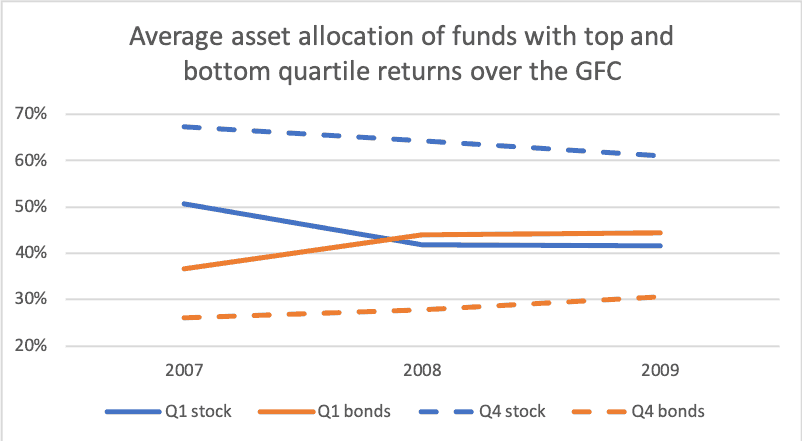


Similar to the best performers in the dot-com crash, top quartile funds had higher bond allocations on average compared to the bottom quartile funds. Top quartile funds over the three-year period had 37 per cent in bonds in 2007 versus 28 per cent bonds for the bottom quartile performers.

In line with the earlier crash and as would be expected, investors across the quartiles continued to rebalance throughout the GFC. Using the same example, the average stock allocation for the bottom quartile funds would have fallen from 67 per cent in 2007 to 50 per cent in 2008, rather than the 64 per cent that is seen.

Funds continued to be disciplined in their rebalancing. In neither time period was there a low performing group who started with high stocks, did not rebalance after the crash, and then missed the recovery.

There was notable movement towards bonds through the three-year GFC period however, but it was more likely a strategic shift rather than a failure to rebalance. Top quartile funds in 2007 started at a 37 per cent allocation to fixed income and ramped that up to 45 per cent over the next three years. Even bottom quartile investors modestly increased their bond holdings over the three-year period, from 28 to 30 per cent. This looks to be a continuation of a trend towards LDI and diversification that began before the GFC, but the crash seems to have accelerated this movement. In fact, the average asset allocation of every quartile moved towards the strategy that helped the most in the initial downturn.

What can be learned from these market events? Two themes were common among top quartile performers in both events.

First, top quartile performers consistently had more defensive allocations pre-crash. Second, investor discipline in rebalancing allowed more upside capture in the recoveries and was widely rewarded across both market events.

One theme was different. Top-quartile investors captured even more upside in the dot-com recovery by ‘buying the dip’ and increasing their equity allocations. In contrast, top quartile investors in the GFC increased their allocations to bonds.

Chris Flynn and Franco Wang work at CEM Benchmarking.

In this Fiduciary Investors series podcast Amanda White talks to Princeton University’s Professor Stephen Kotkin about the fragility of the global political economy and the potential end of globalisation.

The podcast discusses the limitations of risk management systems used by many investors and the need for a new risk framework that looks beyond a linear construct to enable investors to better grasp the complexity of investing.

It discusses the fragility of the environment and the economy due to:

  • The underlying paradox of globalisation
  • The lack of recognition of adaptive complex systems
  • And a stagnant political organising framework.

About Stephen Kotkin
Stephen Kotkin is the John P Birkelund Professor in History and International Affairs at Princeton University.
He is the co-director of the program in history and the practice of diplomacy and the director of the Princeton Institute for International and Regional Studies. He established the Princeton department’s Global History initiative and workshop, and teaches the graduate seminar on global history since the 1950s.
He also holds a joint appointment in the Woodrow Wilson School for Public and International Affairs at Princeton and is a research scholar at the Hoover Institution at Stanford University.
He has authored many books including his latest Stalin: Waiting for Hitler.

About Amanda White
Amanda White is responsible for the content across all Conexus Financial’s institutional media and events. In addition to being the editor of Top1000funds.com, she is responsible for directing the global bi-annual Fiduciary Investors Symposium which challenges global investors on investment best practice and aims to place the responsibilities of investors in wider societal, and political contexts.  She holds a Bachelor of Economics and a Masters of Art in Journalism and has been an investment journalist for more than 25 years. She is currently a fellow in the Finance Leaders Fellowship at the Aspen Institute. The two-year program seeks to develop the next generation of responsible, community-spirited leaders in the global finance industry.

Suggested reading:

Spillover: Animal Infections and the Next Human Pandemic (2012). David Quammen

The Butterfly Defect: How Globalization Creates Systemic Risks, and What to Do About It (2014). Ian Goldin and Mike Mariathasan,

The Rules of Contagion (2020): a mix of biology, mathematics, history, behavioural science, and anecdote, exploring how disease, ideas and behaviours move about and then cascade. Adam Kucharski.