Robeco chief executive Gilbert van Hassel opened the ‘Sustainability Digital: A Planet in Trouble’ conference with a reminder of the opportunities in sustainability and the importance of working with others. At Robeco this now includes engaging directly with sovereign governments.

Influential investors are increasingly working with sovereign governments on sustainability. In a new initiative, Dutch asset manager Robeco is engaging directly with the Brazilian government on deforestation. The asset manager has held two meetings with Brazil’s vice president and other government members in an investor policy dialogue focused on better implementation of the country’s environmental laws so that companies that break them are suitably punished.

“Brazil has very good laws on deforestation,” said Gilbert van Hassel who has been chief executive at Robeco since 2016. “It is about applying them, and we want to make sure criminal behaviour gets in the courts.”

Speaking during the opening session of ‘Sustainability Digital: A Planet in Trouble’ van Hassel explained that sovereign engagement is now a key tenet of Robeco’s strategy. Working with the PRI, the asset manager is exploring how best to influence sustainable policies at government level: next on the list is Indonesia, where van Hassel plans to engage on deforestation and fires. To encourage other investors to follow, Robeco is drawing up a sovereign engagement framework that will detail which countries to contact and which SDGs to engage on.

“When the policy is ready, we will share it. Engaging with sovereigns is the next level of engagement,” he told delegates.

The CEO urged attendees of the two-day digital conference to embrace the complexity of sustainability. This means grasping the many different angles to sustainable investment, extensive research and not “pushing away” from the challenges. Partnerships and acting in unison are also central.

Above all, he urged for less talk and more action to reverse climate change, calling on investors to integrate ESG into their investment decisions and look for outcomes and financial gains that also create wellbeing which he called “as important” as wealth creation.

“If we embrace complexity and act together, we can reverse these trends. As investors we really need to stop talking about these issues and start acting. It has to be mainstream, and it has to have scale,” he said.

Action should include investing in sustainable companies and divesting from unsustainable companies, as well as finding innovative ways of investing in sustainability by evaluating a company’s contribution to ESG.

“Companies that make progress on ESG should have access to the capital markets,” he said. In a next step investors need to measure and report impact “in a whole different game.”

Opportunities

He also espoused the opportunity sustainability holds for investors. Despite the frightening evidence of the consequences if the natural world can no longer support humanity, he said it also presents opportunities that are clearly enshrined in the UN’s SDG.

“The issues of the future are no different,” he said. Of the 17 goals he said climate, labour rights and inequality are mentioned most by Robeco clients.

“In the next 10 years there will be tremendous innovation to ensure we reverse the trend,” he forecast.

Partnerships also lie at the heart of Robeco’s sustainability strategy. Alongside working with sovereign governments and the PRI on how best to influence climate policy, the asset manager has partnered with others to bring about change at oil giant Shell, and also works with universities like Cambridge and Erasmus. And partnerships with clients on appropriate strategies are another central seam. Most recently this has included looking at ways to use clients’ risk budgets to ensure portfolios have better ESG integration than the index, or put another way, using the risk budget not to deviate from the index.

“Alone is alone, together is more powerful,” he says.

He concluded by saying the asset manager’s offices remain closed, with long-term consequences on culture, innovation and employee connection worrying and unknown.

“It is much better to sit and work together,” he said. “We will only see what the consequences are in the long-term.”
Investors from Schroders, Trillium and PensionDanmark discuss how a changing regulatory picture and the economics of sustainable investment are coming together to create a tipping point in ESG, but they warn their peers to look beyond the label to what is on the inside.

In keeping with being one of the first investors in wind energy years ago, Denmark’s PensionDanmark was also an original investor in the country’s state of the art energy island in the North Sea. Matching the energy output of 25 traditional wind farms, the island is one of two recently ratified by Parliament with the promise of transforming Europe’s energy sector.

“We are on the brink of the next step in offshore wind development,” enthused Torben Möger Pedersen, chief executive of Denmark’s PensionDanmark speaking at ‘Sustainability Digital: A Planet in Trouble.’

“I encourage colleagues in the pension fund industry to be aware,” he said, espousing the risk-adjusted returns that will come from investing in the pioneering infrastructure that connects to the grid and will see green power integrated into transport systems.

In a panel session chaired by PRI’s chief executive Fiona Reynolds, Pedersen also highlighted the investor opportunity in the EU’s giant €750 billion stimulus plan, around 30 per cent of which will go towards green endeavour. “Thirty per cent is linked to investments in the green transition and climate-related projects. Most of them will be a source of interest to private investors,” he predicted, adding that the pension fund has been involved with the EU on shaping the taxonomy that will introduce common standards on ESG and which is designed to stop green washing.

Elsewhere he said the pension fund is focused on engagement over divestment and is a proud founding partner of the Asset Owner Alliance under which it targets a carbon neutral portfolio by 2025. “Members of the Alliance have reduced their carbon footprint. If you can’t fulfil targets, you can’t be a member.”

Sustainability policy in 2021

Policy is having a mixed impact on driving sustainable investment.

Although panellists highlighted progress under the EU’s sustainable finance bill, policy in the UK is evolving in “fits and starts” according to Sarah Bratton Hughes, head of sustainability, North America at Schroders. However, she predicted initiatives will ramp up ahead of COP26. Elsewhere she noted Brazil’s plans for a taxonomy.

But it is the US where most change is afoot.

“We are not the black sheep on the team anymore,” said Bratton Hughes who is based in New York.

Department of Labor rules, introduced at the end of last year under the Trump administration, have discouraged pension plans from considering ESG issues when choosing investments. Bratton Hughes told delegates the rules had thrown a “cold shower” on ESG progress with some pension plans stalling sustainability searches although she noted “others have ploughing forward.” Now however the hope is Marty Walsh, Biden’s labor secretary, will overhaul the rules.

Fellow panellist Matt Patsky, who is chief executive of Boston-based Trillium Asset Management told delegates that getting US public sector pension funds on board with ESG would require a rewriting of the rules.

“Pension funds need to see they are “violating” their fiduciary duty if they ignore ESG, and that ESG improves alpha. The government should edit the rules to be factually correct and put every plan on notice that they are in violation of fiduciary duty if they don’t consider these factors,” he said.

In other encouraging signs of change, Patsky told delegates that his firm is seeing a broad shift into ESG from traditional investment firms, notably on a portfolio-wide basis rather than via isolated ESG products. He said he hoped regulation would increasingly put pressure on companies to report on ESG and said more standardisation highlighting what and how companies should report on ESG is now crucial.

“This is the critical next step for real momentum,” he said. “Everyone looks at ESG data as material. This year and next we will hopefully see movement towards broad adoption and agreement on these standards.”

The conversation also centred on the importance of impact, whereby the externalities of an investment are measured and seen as material to future earnings.

“Impact is a third dimension and we need to measure and manage that risk,” said Bratton Hughes, adding Schroders integrates impact via engagement and stewardship, and providing investment products to measure the real world impact.

Meanwhile PensionDanmark is integrating the impact of its investments relative to the SDGs.

“We measure our outputs; how we are impacting healthcare provision or equality,” said Pedersen. He also said it was important pension funds explored alternative investments, and underscored the move from listed to private assets.

“As long as interest rates are kept low we see opportunities in listed stock markets, but stock markets will be challenging for the next few years. Increasing allocations to non-listed assets is our way forward.” Pedersen said.

Bratton Hughes told delegates that the economics of green power do work and is superior to legacy fossil fuels. This, combined with regulation, gives her reason to believe the world is at a tipping point. Citing MSCI’s data that tracks regulation, she said the amount of regulation is sharply increasing.

“If you looked in 2018 there were about 100 regulatory polices, that’s now doubled,” she said.

Patsky concluded with advice to investors to pay attention to what they are investing in – cautioning against chasing labels but looking carefully at what is inside.

“Be willing to be sceptical,” he advised. “Ask if this is really sustainable.”

“In order to be successful we need every owner to be active and behave as an owner. A big part of change is a realisation of the power of ownership and its opportunity.”

With great power comes great responsibility. As institutional investors exercise their power to invest their clients’ money, they have a responsibility to act as stewards of the capital. Stewardship does not end with buying or selling a stock, but includes the engagement by institutional investors with publicly listed companies to generate long term value for shareholders. Such engagement increasingly requires consideration of environmental, social and governance (ESG) issues.

As put forth in the CFA Institute report titled “Stewardship 2.0: Awareness, Effectiveness, and Progression of Stewardship Codes in Asia Pacific” published in 2020, stewardship is vital to the healthy functioning of markets, supports market integrity, improves capital allocation, and helps deliver good outcomes for clients and ultimate beneficiaries.

The 2008 global financial crisis threw the need for engagement into sharp relief. By acting as responsible stewards of capital, and by addressing company underperformance, institutional investors can check and curb short-term behaviours and excessive risk taking. This was especially pertinent in the UK where it gave rise to the first regulatory-backed stewardship code in 2010.

The adoption of the first Stewardship Code in the UK inspired a number of other markets to follow suit. In Asia Pacific, at least nine markets have since established their own codes to encourage institutional investor engagement.

While the codes share many similarities, such as the requirement to establish and disclose a stewardship policy and a conflicts of interest policy, each market has its own unique objectives. The main driver of the UK code was to prevent a recurrence of the banking crisis, but in Japan, for example, the motivation was to reduce the equity market discount by placing an emphasis on shareholder value creation.

Despite their short track records, stewardship codes have already been getting makeovers to reflect new  challenges. While the focus to date has largely been on disclosure of voting and engagement policies, there is a move toward disclosure of voting records, and disclosure of reasons for such votes. Disclosures of conflicts are also high on the priority list.

One notable trend is in the elevation of sustainability and ESG issues on the stewardship and engagement agenda which encompasses not just voting but also active, constructive dialogue between investors and their companies regarding sustainability and ESG themes. By encouraging companies to pay greater attention and provide more information on material ESG issues, these companies would be better positioned to deal with such challenges and improve their performance, which in turn, would help value creation for shareholders. This is also in-line with the Principles of Responsible Investment in which signatories pledge to be active owners and incorporate ESG issues into ownership policies and practices.

This heightened attention of ESG issues is being reflected in several code upgrades.  The updated 2020 UK Stewardship Code, for example, asks institutional investors to take ESG factors, including climate change, into account and to ensure their investment decisions are aligned with the needs of their clients. In Asia Pacific, similar upgrades took place in 2020 in Japan and Taiwan. Codes in Australia, Malaysia and Thailand also emphasise the importance of ESG factors.

While engagement and monitoring are worthwhile activities, they must also be outcome-oriented and serve a clear purpose. In the past, it may have been sufficient for institutional investors to pay lip service and report on a list of stewardship activities, without drawing attention to how effective those activities were, and how fiduciary duties were fulfilled.

However, as expectations evolve, there is a growing desire for clients to understand better how their money is being invested. The institutional investors which are most advanced in this space undertake thorough research to identify those companies that have the most potential, set well-defined objectives and measurable targets for their engagement activities, and would report to clients the outcomes of their efforts as well as revised action plans, where appropriate. This is effectively a multi-stage, iterative process. In the event that constructive engagement does not deliver the desired outcomes, escalation measures may be considered, including, for example, collaboration with other investors, and even divestment for active investors.

As a result of these trends, adjustments are being made to operating models. Some institutional investors have supplemented their bench strength by hiring dedicated ESG analysts or by providing relevant training to raise the level of knowledge in the investment teams. While there is no one-size-fits-all approach, it is important that the investment professionals stay current and remain effective in this important area.

As sustainable investing continues to gain prominence, so is the expectation of institutional investors to exercise their stewardship for purposeful outcomes. The focus is also shifting from the amount of engagement to its quality. This presents a unique opportunity for institutional investors and companies to elevate the way they engage and create long term, sustainable value for shareholders.

Mary Leung is head of standards and advocacy, Asia Pacific for CFA Institute.

While data suggests that the ESG and impact investing markets are growing rapidly, concerns abound about how financial services firms are measuring and managing their ESG and impact investing performance.

Most performance is measured based on relative benchmarks, with success defined as performance being stronger than peers.

However, as a new report from the World Benchmarking Alliance (WBA) highlights, it seems impossible to even make incremental progress without measuring performance relative to planetary boundaries and social norms.

Moreover, measurement and management frameworks are primarily focused on portfolio company operations and ignore the role of investors, lenders, and underwriters, including the impacts of their own financial structures and practices.  Yet these financial systems and structures can systemically undermine positive impacts at the enterprise level – and themselves contribute to ESG and financial risk.

The WBA report launches a scoping phase for a new initiative – the Financial System Transformation Benchmark – which aims to address these critical gaps.  WBA invites stakeholders to engage and provide input.

The project specifies internationally defined goals such as the United Nations Sustainable Development Goals (SDGs), the Paris Agreement, and the UN Guiding Principles on Business and Human Rights and, through its proposed publicly accessible benchmark, “aims to present a clear image of how the world’s most influential financial institutions (asset owners, asset managers, banks, consultants and insurance companies) contribute – positively or negatively – to achieving the global goals.

At the core of this is the need for financial institutions to avoid and address the negative impacts associated with their activities. This initiative is critical because the benchmarking approach is intended to help incentivise ‘a race to the top’ among keystone financial institutions, “influencing systemic change towards the achievement of globally agreed sustainability goals.”

As we at the Predistribution Initiative (PDI) have emphasised in the past, Building Back Better and a sustainable economy cannot occur with responsible investment tools limited to the portfolio company level.

Prior to COVID-19, $5 to $7 trillion of annual investment was deemed necessary to address the SDGs.  Post-COVID-19, these numbers are likely even higher.  As one interviewee in the report notes, “Frankly, if more companies avoided harm through their operations, we would likely need fewer [investments that contribute to solutions that address identifiable social and environmental challenges].”  We will never achieve the SDGs if we are consistently creating new negative impacts through the financial system and systematically undermining the positive impacts at the portfolio company level.

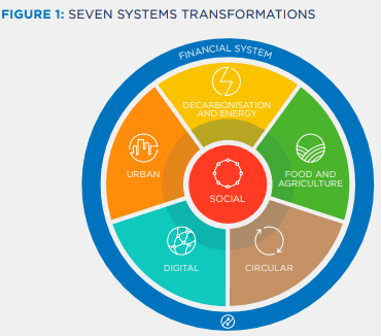
As illustrated in the below WBA diagram, the economy consists of both companies – that have impacts on other key ‘systems transformations’ critical to achieve the global goals – as well as the financial system that fuels it.

Building Back Better is thus a two-part equation, with accountability needed at both the portfolio company level, but also at the investor, lender, and underwriter levels.

For instance, we need measurement and management tools that can capture whether fund manager compensation exacerbates economic inequality, whether domiciling investment vehicles in tax havens depletes tax funding for essential public services, how excess leverage in capital structures can leave companies and their workers vulnerable, and how lobbying and political spend by the financial services sector can clash with stated ESG goals.

Indeed, the very fundamentals of finance may need deep evaluation and adjustments – most investments, financial performance, and therefore incentives, are evaluated based on time-value-of-money performance metrics, whereby finance professionals are motivated to make as much money back as fast as possible – a concept that seems inherently at odds with long-term sustainable investing and ESG integration.  Valuation methodologies and incentive structures themselves may need to change.

The WBA Scoping Report highlights these systemic issues, stating, “The dual role of the financial system puts it in a unique position: it must undergo its own transformation while also operating as a vital enabler of the other six systems transformations.”

However, it is hard to change existing practices when we do not measure and manage them and their impacts.  There is currently little accountability for the investor, lender, and insurer side of the equation. Thankfully, there are emerging initiatives, such as the Top1000funds.com Global Pension Transparency Benchmark (GPTB), which ranks 15 countries on public disclosures of key value generation elements for the five largest pension fund organisations within each country. The fact that the GPTB is the first global standard for pension disclosure highlights the need for new levels of analysis and accountability across the financial system.

WBA notes that, “Although some have complained about a proliferation of corporate sustainability disclosure initiatives, many financial institutions fail to hold themselves to uniform standards of disclosure. There are fewer frameworks for assessing the progress of financial institutions specifically, and hardly any for measuring progress that use the denominator of the global goals.”

Through its analysis, WBA finds only one initiative – the UNEP FI Positive Impact Tool – meets its five proposed criteria, enabling “a holistic materiality assessment of the impact on people and the planet across all SDGs. The remaining handful of initiatives that meet all five criteria are singularly focused on climate mitigation…”

Critically, a key goal of WBA’s benchmark is to, “encourage the acceleration in development and uptake of frameworks that can help close the gap in measuring performance against the global goals.”

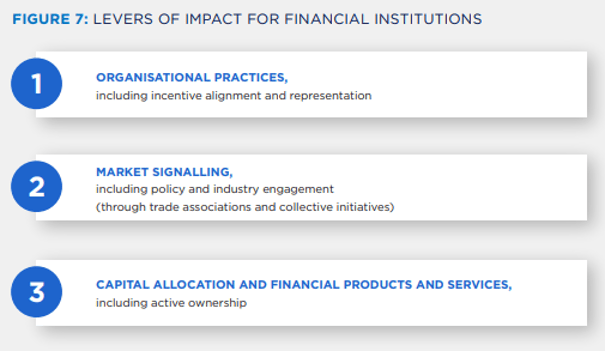
This emphasis comes from WBA itself being an Alliance, of over 200 public, private and civil society organisations (including Predistribution Initiative), so the project recognises that input from diverse stakeholders is imperative – including from actors in the financial system itself.  It breaks down categories through which improvements can be made, as illustrated in the following diagram, and solicits feedback.

It is important for industry practitioners to participate, since the benchmark will impact them, and they are some of the best equipped in terms of knowledge and experience to help guide changes.

Moreover, collaboration with other stakeholders in shaping the benchmarks facilitates dialogue and understanding of other views and helps builds trust – another necessary ingredient to Building Back Better.  Such interactions with diverse stakeholders also help investors stay ahead of the curve on “dynamic materiality.”

At the Predistribution Initiative, we are enthusiastic that WBA’s proposed benchmark will be part of the essential toolbox needed to start shifting the current paradigm from self-definitions of sustainability and towards sustainability in the true sense of the term.

Delilah Rothenberg is founder and executive director of the Predistribution Initiative.

The climate-impact dashboard is part of a 3-D investment framework that balances risk, return and impact. This includes total portfolio thinking, long-horizon investing, impact investment strategies, system-level engagement and strategic partnership between asset owners and asset managers. Here Tim Hodgson lays out eight guiding principles to help shape a climate-impact dashboard.


We believe the idea of 3-D investing – risk, return and impact – will be hugely significant for the industry. And in terms of climate impact reporting we lay out some fundamentals we believe should be used by investors.

But first, we should make an important distinction between climate-risk reporting and climate-impact reporting. The former importantly addresses the impact of climate change on investment portfolios while the latter focuses on helping investors understand the extent their investment activities are affecting the climate (for better or for worse).

Climate-risk reporting is already well catered for by the risk and return dimensions and so, here, we focus on the impact of investment portfolios on climate change.

When it comes to climate-impact reporting, we believe a dashboard comprising multiple measures should always be used, because no single metric can tell the whole story. To this end we have developed eight guiding principles to help shape a climate-impact dashboard. We start with purpose (#1).

There are many reasons why investors might commit resources to measuring and reporting on the climate impact of their portfolios and most, but not all, of them are good. Some investors do it because they want to proactively report their impact to key stakeholders or address client demand for this information. It can be about better understanding whether there has been sufficient progress towards some pre-agreed goals such as Paris alignment or net-zero emissions. Or, it could be simply adhering to government regulations to measure and report impact. Whatever the purpose is, the impact report should be explicit about it. We see this as the first safeguard against greenwashing.

Thereafter, it is logical that milestones or interim targets (#2) – both level and time scale – should be clearly defined. Many countries and, increasingly, institutional investors have set net-zero emissions by 2050 as their primary climate goal. The fact that this goal is three decades away can lead to a lack of urgency for action. Interim targets are therefore necessary for keeping track of the shorter-term progress, and examples could include a percentage reduction in emissions by [date], a percentage allocation to climate solutions by [date], and/or a temperature rating of [X] degrees Celsius by [date].

The actions taken (#3) to achieve the targets should be documented and the metrics and evidence (#4) reported should allow a simple assessment of progress towards targets. We group these two principles together so as to not conflate investor contribution (ie investor actions) with investee company impact (the metrics). It is important that investors document where they have sought to influence investee company behaviour, but claiming causality between that influence and changed behaviour will be the exception rather than the rule.

There is no doubt that the complexity of this subject requires multiple and complementary metrics (#5), so in constructing a climate-impact dashboard, we suggest investors consider the following:

  • A balance between backward-looking and forward-looking metrics and between absolute and relative measures
  • Use as few metrics as possible, but not too few
  • Ensure the dashboard is user-friendly and design techniques should be used where behavioural issues can be anticipated (eg colour coding as signposts)
  • Qualitative metrics can be as valuable as quantitative ones.

When it comes to measurement, there is often a trade-off between validity and materiality. A classic example is past performance returns: they have very high validity as independent experts would calculate the same value, but very low materiality as they do not predict the future returns and therefore are not decision useful. We suggest that a climate-impact dashboard can include the following three categories of metrics:

  • Portfolio emissions footprint – these metrics report the amount of greenhouse gas emissions released by the portfolio companies, in absolute terms and/or normalised by some measure (eg $ invested, volume of production, $ revenue etc)
  • Portfolio alignment – the purpose of these metrics is to provide an indication on the likely/projected carbon pathway of portfolio companies relative to a carbon budget consistent with a net-zero transition
  • Portfolio contribution to climate solutions – the metrics in the above categories could (will?) look poor if the portfolio companies are actively building climate solutions. The metrics in this category should be selected to show investor actions in a true light. They should also encourage investors to engage actively with their portfolio companies to create solutions and grow new or undersupplied capital markets in line with impact goals.

Being transparent (#6) about any limitations inherent in what is being reported addresses the challenge that many metrics currently used in climate-impact reports have relatively low validity. Portfolio temperature ratings are a clear example. Given the forward-looking nature of the metric, the warming potentials for each portfolio company are naturally an estimate. It is an intuitively attractive concept that disguises the compounding of many poorly constrained uncertainties, assumptions and implicit value judgements. While we believe it has its use as part of a holistic dashboard, it needs to be interpreted with care by explicitly acknowledging its limitations. The same principle should apply to all metrics presented in a dashboard.

It follows that a climate-impact dashboard is incomplete without a supporting narrative (#7). Metrics are simply data, which still need to be interpreted and processed before they become something meaningful to the people who receive them. Narratives provide context, and aid interpretation and evaluation of achievements and progress. The rationale is simple: from a behavioural perspective, human brains process narratives and storytelling much better than data. The narrative helps the reader make sense of the metrics, and the metrics allow the reader to challenge the narrative.

Finally, investors need to be willing to evolve (#8) their climate-impact dashboard over time to ensure that it remains relevant and appropriate as new data and better techniques become available. We are at the very beginning of climate-impact reporting. It is inconceivable that we will not get better at it as we learn more.

The climate-impact dashboard is a valuable building block of a grander vision – a three-dimensional (3-D) investment framework that balances risk, return and impact. This framework is an amalgamation of various elements including total portfolio thinking, long-horizon investing, impact investment strategies, system-level engagement and strategic partnership between asset owners and asset managers. In all of these areas, thinking and practice have advanced in recent years. However, the successful creation and mass adoption of the 3-D investment framework hinges on integrating them all seamlessly at the organisation and system level. Operating well-designed climate-impact dashboards at portfolio level would undoubtedly help realise this grand but essential ambition.

Tim Hodgson is co-head of the Thinking Ahead Group, an independent research team at Willis Towers Watson and executive to the Thinking Ahead Institute.

The world’s largest sovereign wealth fund says that voting is one of the most important tools to safeguard its assets. Ahead of the AGM season getting underway, NBIM – which owns the equivalent of 1.5 per cent of every listed company – plans to publish its voting decisions five days ahead of corporate meetings in a bid to increase transparency.

As corporate boards begin to prepare for the 2021 AGM season, one of the most important investors in the world is also preparing to up the pressure on issues close to its heart. This year, Norges Bank Investment Management, investment manager for Norway’s giant $1.3 trillion oil fund, plans to publish its voting intentions five days ahead of AGMs in the 9,000 plus companies it owns in a bid to increase transparency in its influential voting strategy – and encourage other investors to become more active owners.

NBIM, which has 70 per cent of its assets in stocks, 28 per cent in fixed income and the rest in property is only allowed to deviate slightly from its reference index of stocks and bonds. But it is developing an increasingly active ESG strategy.

“We want to give more information to the market and encourage all large shareholders to be open about how they use their voting rights,” said Line Aaltvedt, a spokeswomen for the fund, adding that the latest move is the fruit of a prolonged strategy. “In 2008 we started reporting on individual voting decisions on an annual basis. In 2013, we started reporting our voting decisions the day after the meeting and in 2019, we started offering a rationale for every vote against the board’s recommendation. Now in 2021, we have started to announce our votes five days in advance of the meeting.”

NBIM has developed a systematic approach to its voting strategy based on clear principles.

“This is the only way to handle voting at 9,000 companies in a consistent and predictable manner,” said Aaltvedt.

The process has involved rewriting NBIM’s public voting guidelines to boost detail, and building a proprietary system that processes all voting decisions and publishes them on NBIM’s website ahead of shareholder meeting. Last year NBIM voted on 121,619 resolutions at 11,871 shareholder meetings and began publishing an explanation whenever it voted against a corporate board’s recommendation. It’s a heavy workload for the small team.

“We have five people who are involved in shareholder voting, with the support of our portfolio managers who have a deep understanding of our largest holdings,” she said.

Data is key to the process. NBIM is “constantly expanding” its database with governance and sustainability data that is then used to analyse and monitor risks across the portfolio, selecting companies for further research or follow-up. “We use this data to calibrate our voting in different regions and markets. With better data, we are able to make better voting decisions.”

Issues-based engagement

A key issue through 2020 has been engaging and voting to push investee companies to improve sustainability reporting. NBIM carried out more than 4,000 assessments of companies’ governance structures, strategy, risk management and performance metrics regarding sustainability last year, and is encouraged by companies improved sustainability reporting.

“We see a significant improvement in companies’ climate reporting compared with 2019. The improvement is in all sectors”, says chief governance and compliance officer, Carine Smith Ihenacho, commenting after the publication of NBIM’s 7th report on responsible investment last week. Other key milestones last year include NBIM stepping up its engagement with banks (16 through 2020) to integrate climate risk into their lending and financing decisions.

Audit quality has become another focus, particularly in the UK.

“We are already using our voting rights to hold boards to account for their relationship with the auditor,” said Aaltvedt. “In 2020, we voted against the appointment of an auditor in 195 cases, or 3.3 per cent of the total. The main reason for voting against an auditor was that we had not received sufficient information to assess the auditor’s independence.”

The future of the AGM

As to whether the prospect of another season of virtual AGM’s will harm investors’ ability to engage and vote, NBIM’s view of digital meetings is positive. Moreover, travel restrictions have actually made corporate boards and management more available for dialogue, said Aaltvedt. “We welcome the attention given to virtual and hybrid formats for holding shareholder meetings. Virtual meeting formats and efficient voting chains can increase the information available to shareholders and ensure equal treatment of all shareholders regardless of their location.”

That said, the cancellation of many investor conferences led to fewer meetings in 2020 than in the year before. “The pandemic also lead to many companies’ postponing their shareholder meetings in 2020, particularly in markets requiring physical meetings,” she concluded.