Insights into private markets and venture may provide a real competitive edge for asset managers in demonstrating to investors an understanding of innovation and disruption and how this affects public market portfolios. As AI becomes more advanced and we approach the era of quantum computing, we are at a critical turning point. Understanding this, climate change and ESG factors will have a tremendous effect on existing portfolio exposures and expected returns.

This can range from understanding how AI and ML may positively impact the returns of pharma companies whose R&D returns have fallen to 9 year lows , to the impact of blockchain technologies on banks and payments systems.

Often the insights and implications are more subtle. At the launch of the first iPhone in 2007, little did we understand what the impact might be on the oil price – 13 years later, teenagers don’t go out to date, preferring to use social media. They don’t go to the movies as they can watch Netflix and they don’t go out to restaurants as they can order in with Deliveroo/home delivery. The secondary and tertiary consequences have become clear. So too, the value of a venture portfolio to a shipping company may be less in supply chain management and logistics innovation, and more in understanding how Precision Fermentation (PF) may lead within 5 yrs to the bankruptcy of the livestock industry, and the attendant implications for shipping beef.

We are already seeing Asset Managers build this capability – Wellington, Coatue, Baillie Gifford, Schroders.

Antler has a global network of 475 expert advisers to offer perspectives on this disruption and change. In addition, we will convene twice yearly sector specific days with relevant founders, advisers and select LPs to extract valuable insights from our platform on trends and new technologies.

Last, venture creates tremendous impact – lowering the barriers to entry to entrepreneurship, levelling the playing field, solving real problems and creating hundreds of jobs. We believe anyone can change the world with the right focus and grit. Our deeply held belief that talent comes from all backgrounds is reflected in our founder profiles – 40% of which are female, 80% of which are CEOs with 60 nationalities represented. We believe talent is very broadly distributed but not necessarily well served. In addition, ESG is an important feature of our portfolios and Antler is an official signatory of the United Nations Principles for Responsible Investments.

Driven by active return, AP4 produced a stellar 9.6 per cent in 2020. But its chief executive, Niklas Ekvall remains cautious about the economic outlook and its impact on the portfolio, especially with regard to inflation.

AP4, the SEK449.4 billion Swedish fund, returned 9.6 per cent in 2020, a figure that included 2.4 per cent of active return.

The fund does not have one source of active risk but has a broad asset allocation and engages in active stock picking and tilting to drive returns.

This active return from a broad base has served the fund well in the past 12 months but also historically, with 10 and five year returns also well above the benchmark. Over the past five years it has added an active profit contribution of SEK30.8 billion.

“We have a number of different mandates and take active risk on different dimensions,” says Niklas Ekvall the fund’s chief executive.

But in particular he points to two areas that have done well in the past 12 months: Swedish equities and fixed income.

“In Swedish equities we have a very strong team who are bottom-up stock pickers and very long term. We’ve had very strong results,” he says.

More than half of the fund’s assets are invested in Swedish and global equities, and an asset liability matching analysis in 2020 maintained the equities allocation at 50-70 per cent of the portfolio. Interest-bearing investments account for a third of the capital and real estate, and other alternative investments (real assets) make up 13 per cent of the portfolio.

Last year the decision was also made to lower the fund’s 40-year long-term real return target from 4 to 3.5 per cent, effective from 2021.

The return for Swedish equities in 2020 was 30.2 per cent with excess return of 15.3 percentage points. The SEK 75 billion Swedish equities is entirely managed in house with a simple investment philosophy based on knowledge about the companies it invests in. It seeks out long-term sustainable business models built on structural trends such as efficiency in healthcare, energy and food production.

An example of this long-term approach is the turnover in the portfolio, or lack of. Per Colleen who is head of fundamental equities and manages the Swedish equity portfolio joined AP4 in 2013 and in that time has invested in just under 40 companies. Of these, AP4 still has holdings in 30 (with five being bought out from the stock exchange).

The fixed income portfolio is liquid and creditworthy with AAA bonds accounting for slightly nearly 70 per cent. The excess return for fixed income investments in 2020 was 0.7 percentage points and an average of 0.2 percentage points per year over a five-year evaluation horizon.

Tactical moves

According to Ekvall the fund was an active buyer of risk last year, once it recovered from the shock of the market fall and short-term illiquidity.

“As a manager early in the Spring we were buying risk into the portfolio and bought as much equities and credit bonds as we could. Credit we bought quite early and we also did some private debt investments in the spring and summer,” he says.

“We started quite early started to buy equities as well as credit risk but we couldn’t buy as much as we wanted. But we acted in a way that makes me very proud, how the staff behaved, they were very focused and doing things that were right. Strong and good things.”

While the return for the year was robust, Ekvall is quick to point out that it doesn’t reflect the activity and pressure that investors faced.

“Just looking at the numbers you can get the feeling the year was very easy, but it was not. It was a very volatile year and what happened in the Spring… no one has experienced that fall in the market and the poor liquidity. We couldn’t buy or sell anything for a few weeks there. Then from mid April there was a very sharp rise which was almost as surprising as the fall. It was an interesting year for sure but, we are very pleased,” he says. “We proved as well that we were able to utilise our long term mandate – we had the possibility to carry risk and poor liquidity.-

Forward looking outlook

In the ALM study last year, AP4’s basic presumption was the global economy is successively adapting to a re-emerging trend of economic activity following a turbulent downturn and rebound.

“In general when we look at the economy as it is today we are fairly surprised at its resilience given the restrictions put in place,” Ekvall says. “But the lockdowns are not preventing industry from being up and running and people working so the economy is developing fairly ok.”

His view is the pandemic didn’t create any completely new trends but has strengthened trends already underway. He’s interested to see the impact on travel and hospitality and what the future of work might be.

But while the economy might be humming away for now, Ekvall says the larger question mark is what will happen in years to come given the stimulus.

“Will stimulus support the economy long term? Debt is building up and will need to be dealt with somehow. We are constructive on our outlook for 2021 but question whether risk is coming in 2022.”

Similarly while AP4’s outlook for inflation is relatively unchanged in the short term, it says it obscures relatively large underlying risks.

The assessment is that inflation will remain a good bit below target levels in emerging and developed markets during the 10-year period, after which it is expected to lie slightly above the target levels for a couple of years before stabilising around the target level. But AP4 believes that going forward there is latent inflation risk.

“Owing to the combination that the response to the Covid-19 pandemic has not only been greater but also was put into action faster while the economic downturn may be relatively short-term – albeit deep – there is reason to fear that inflation will pick up within the course of a few years,” it says in its annual report.

Against this background AP4 has decided to continue increasing the strategic weight of real assets to 15 per cent, with a corresponding decrease in global fixed income investments.

New legislation has come into play which allows the fund to invest more capital and with more flexibility in unlisted assets. Together with AP1 and AP3 the fund can now also invest in infrastructure.

For the past few years AP4 has focused on strengthening the team in alternative assets with more people in private equity, private debt and infrastructure in particular.

Ekvall expects the fund to increase allocations to assets with stable real cash flows in the coming years, and divest in nominal bonds which are not as attractive.

Other areas of focus include modernising and upgrading the portfolio IT system; and increasing the focus on sustainability.

Sustainability leadership

AP4 has been a leader in sustainability for a long time, pioneering decarbonisation in 2021 and co-founding the portfolio decarbonisation coalition in 2014.

In 2020 it cut its carbon footprint by an additional 15 per cent in 2020, which it had already halved since 2010.

The fund has an aim to be net zero in 2040 and Ekvall says this year will see it get more explicit in its aims around that.

“We will have more clear targets with how to decrease carbon emissions from our investments in years to come,” he says. “We have also improved our low carbon strategies substantially, using more forward looking measures. Data is quite tricky with regard to sustainability not least in carbon emissions and can be old. In the last year we looked into new possibilities in more forward looking data focused on company’s plans for aligning with Paris. We’ve integrated into the low carbon strategies how robust companies will be with an increase in the carbon price.”

That low-carbon lens was also expanded from 40 per cent of the global equities portfolio to all of the portfolio last year.

The global equities portfolio has typically been more quant oriented, but Ekvall said that presented a gap in analysis for the most carbon intense sectors. So a small fundamental stock picking team was recruited for fundamental stock picking in the most intense sectors starting with the energy sector, and then utilities.

Fundamental thematic management is an active investment strategy that combines thematic analysis of long-term societal and sustainability trends with quant and fundamental equities selection. An important starting point is AP4’s thematic analysis, which identifies sectors and value chains based on the climate transition. The fundamental thematic management then focuses on identifying specific companies within these themes that are either winners or losers in these long-term trends. During 2020 an analysis of the climate transition and its impact on fossil-based companies was conducted. As a consequence of this, companies whose plans and goals are not considered to be aligned with the Paris Agreement have been divested from the portfolio.

This has resulted in quite a change in the holdings in the energy sector – of 55 energy companies in the MSCI the fund only holds nine. This same analysis will be done in the materials and utilities sectors next year.

Ekvall says because the process has resulted in a more concentrated portfolio the engagement efforts will also be increased.

“We have larger investments in fewer companies so there is larger potential to impact them. The issues will depend on company by company, but it will be to support and ensure they are progressing with plans for Paris and efforts into renewable energy sources – climate and transition to carbon free society.”

We have all seen super teams in action on the sports field, usually winning because they have mastered the art of combining diverse talents to produce exceptional performances.

But surely this concept has equal validity for investment organisations, where a lot of the principles are similar and because, fundamentally, investment is a human-talent endeavour.

In the shift of knowledge and power from the individual to the collective, the investment industry has increasingly preferred teams over stars and has developed a dependency on these teams’ collective intelligence.

However, investment organisations have not focused enough on the important dynamics of teamwork and team thought, or cognitive diversity, as part of this shift when building more diverse workforces. This is surprising, given the industry’s challenges are becoming increasingly complex, multi-layered and inter-connected, and in need of multiple insights in order to be successful.

The critical starting place should be with diversity in its sophisticated form of diversity, equity and inclusion (DEI). And with an understanding that diversity is the presence of differences; equity is the respect for differences; and inclusion is the leverage of differences.

To reiterate, there can’t be a better place to start the quest of building exceptional teamwork than with DEI because it can form a cultural bedrock that embeds belonging and a strong group identity. And it provides a promising contribution towards the cognitive diversity that can unpack those tough challenges.

In this context it is helpful to think of collective intelligence as the experience and expertise across a diverse team and the combination and dynamics within such a team. This collaboration and the collective efforts of teams, through their design and practices, is a portfolio concept where team combinations matter more than individual contributions. Cognitively diverse teams can explore issues creatively and innovatively by employing depth on certain critical subject matters, alongside breadth in more lateral areas of context and connection. Such teams will be curious, will stop to develop their thinking when they lack perspective, will see experimenting as critical, and will explore multiple solutions before reaching conclusions.

So-called T-shaped people have natural advantages as contributors to cognitive diversity. Their mix of subject depth (the vertical bar of the ‘T’) and subject breadth (the horizontal bar of the ‘T’) suits the profile of cognitively diverse teams through their wider perspectives across many fields and disciplines.

Talented T-shaped people will contribute positively to cognitive diversity with a growth mind-set, integrated thinking and problem-solving ability. They are naturally in the majority in the line-ups of cognitively diverse teams.

But to address the most challenging industry issues, more specialised people with unique knowledge will be needed. The need here is for I-shaped people who are deep subject-matter experts. They can either be in the team or accessed by the team. Teams, if they want to play in the super leagues, need to have flexibility to deal with specialised demands that may be time-specific rather than recurring.

In cognitively diverse teams each member must be a team player, understand their role and play that part, and have the adaptability to be the player, player-coach and coach at times. In addition, they take personal accountability for their actions while at the same time participate in a collective respect for team over individual.

While these competencies and characteristics are the raw ingredients, a cognitively diverse team needs leadership that draws on the power of organisational culture and is adept at the composing craft of governance to turn this sum-of-parts potential into a super team. These typically T-shaped leaders will build such a team through small gains over time achieved by consistently applying inclusion, exercising trust, building frameworks and enforcing rigour.

These leadership capabilities and attributes deserve extra scrutiny.

Applying inclusion involves building a culture where there is a shared identity and purpose and equality of voice is a key objective. On a practical level, this requires providing role clarity and respect; having an open and flexible attitude; practicing effective chairing disciplines; and pro-actively coaching – and constructively challenging – team members’ behaviours and skills.

Trust, like a muscle, benefits from exercise and strength is the result. The main way for leaders to style this virtuous cycle is primarily by promoting self-awareness, which helps build team identity and reinforce culture. In addition, by showing appreciation for colleagues via personal interaction they can secure social capital and, by ensuring a safe psychological space, openness and innovation can thrive.

It is helpful to think of the importance of building frameworks by comparing them to the scaffolding needed in the construction of an impressive cathedral. For the super team, think of this scaffolding as all the codified intelligence required to ensure the very best interactions such as the use of beliefs and principles as fundamental frameworks to shape the critical thinking needed for accurate decisions. Other examples include tabulation of responsibilities and authorities; goals, inputs and outputs; measures and incentives like KPIs. Together these make up the playbooks that prepare for future situations and exploit comparative advantages.

The virtual working environment has reminded us of the importance of structure and disciplines and that rigour in these areas produces the best team interactions. This attitude also fosters problem-solving versatility, cognitive exploration and a socialising mindset. It also extends to a disciplined use of data, evidence, argument and narrative as well as taking the holistic view of soft and hard data. And when it comes to meetings – increasingly via screens – super team leaders should apply rigour to surfacing all team members’ perspectives, recognising any biases and being alert to groupthink.

Teams with all these characteristics will be innovative. But where innovation is especially critical, leaders need to promote and reward creativity and allow the culture to comfortably accommodate experimentation, risk-taking and learning from failures. Also, they have to balance nimble innovation with patient innovation that embraces long time horizons and deals well with ambiguity.

In summary, a super team is a team led to success through combining a diverse and talented array of humanity that is unleashed by great culture and governance. There are parallels here with the most successful professional sports teams. In sports teams, playbooks matter, in investment teams likewise. In sports teams and investment teams, effective culture is absolutely critical.

And investment teams, like sports teams, can ‘get in the zone’ by delivering not just exceptionally strong results, but also exceptionally rewarding experiences for those team members. With all the current challenges on all of our shoulders, this is the prime time for investment leaders to invest in their teams.

Roger Urwin is co-founder of the Thinking Ahead Institute.

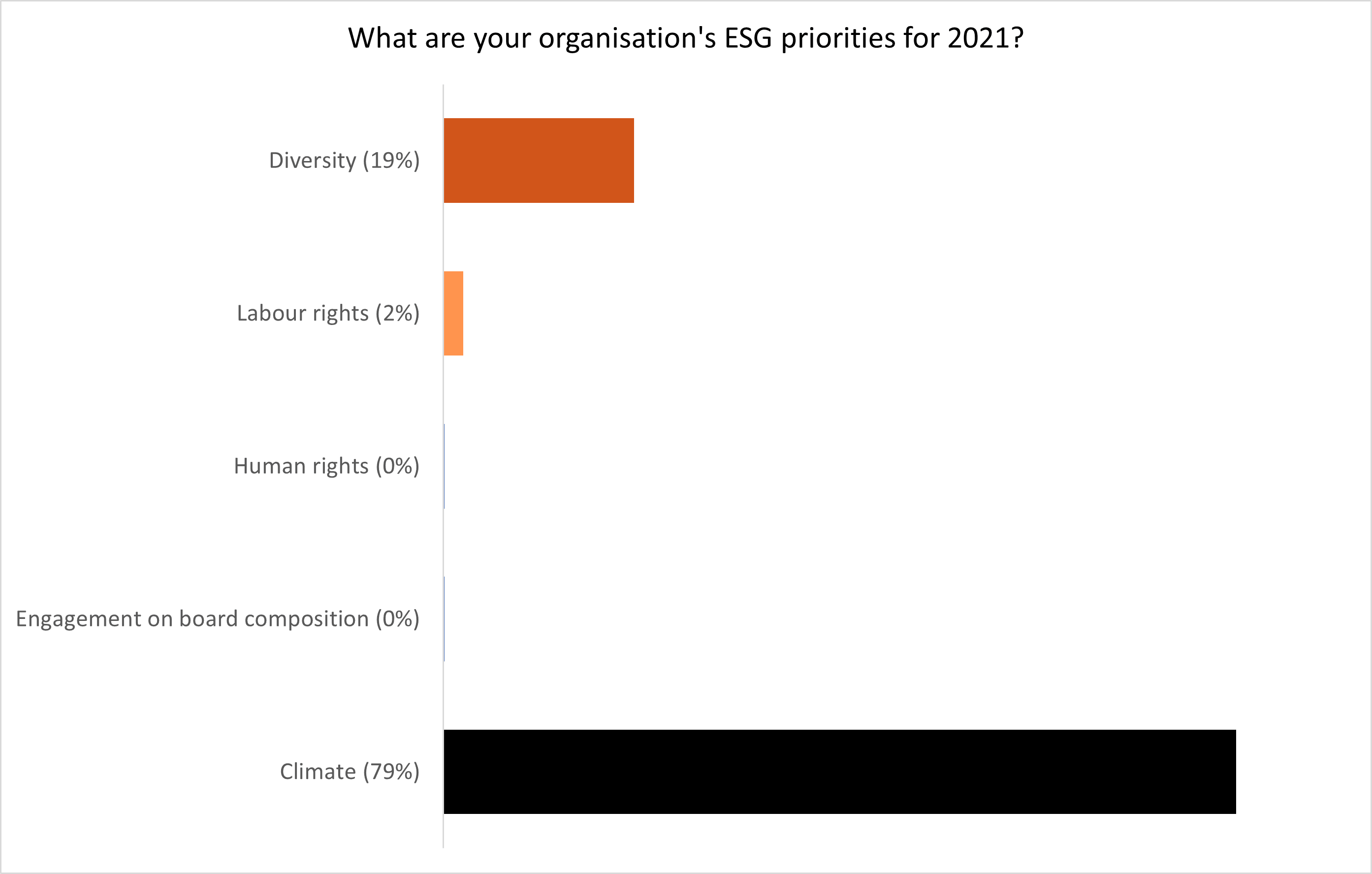
Climate is by far the number one sustainability priority for investors in 2021 according to a poll of asset owners from more than 32 countries which came together for the Top1000funds.com online Sustainability event in March.

According to the polling at the event, 79 per cent of investors say climate is their number one ESG priority for the year, followed at a large distance by diversity (19 per cent) and labour rights (2 per cent).

The investors resoundingly said they thought the COVID-19 crisis had accelerated the need to address the sustainable development goals, with 87 per cent of investors agreeing this. This is up from the Sustainability conference six months earlier in September last year when 74 per cent of delegates said the crisis had been a conduit for addressing the SDGs.

The conference heard that sustainable bonds in emerging and frontier markets could unlock the growth in emerging markets, and could override volatile electoral cycles and target funds in social areas like education and climate change that have held back development with a material impact on growth.

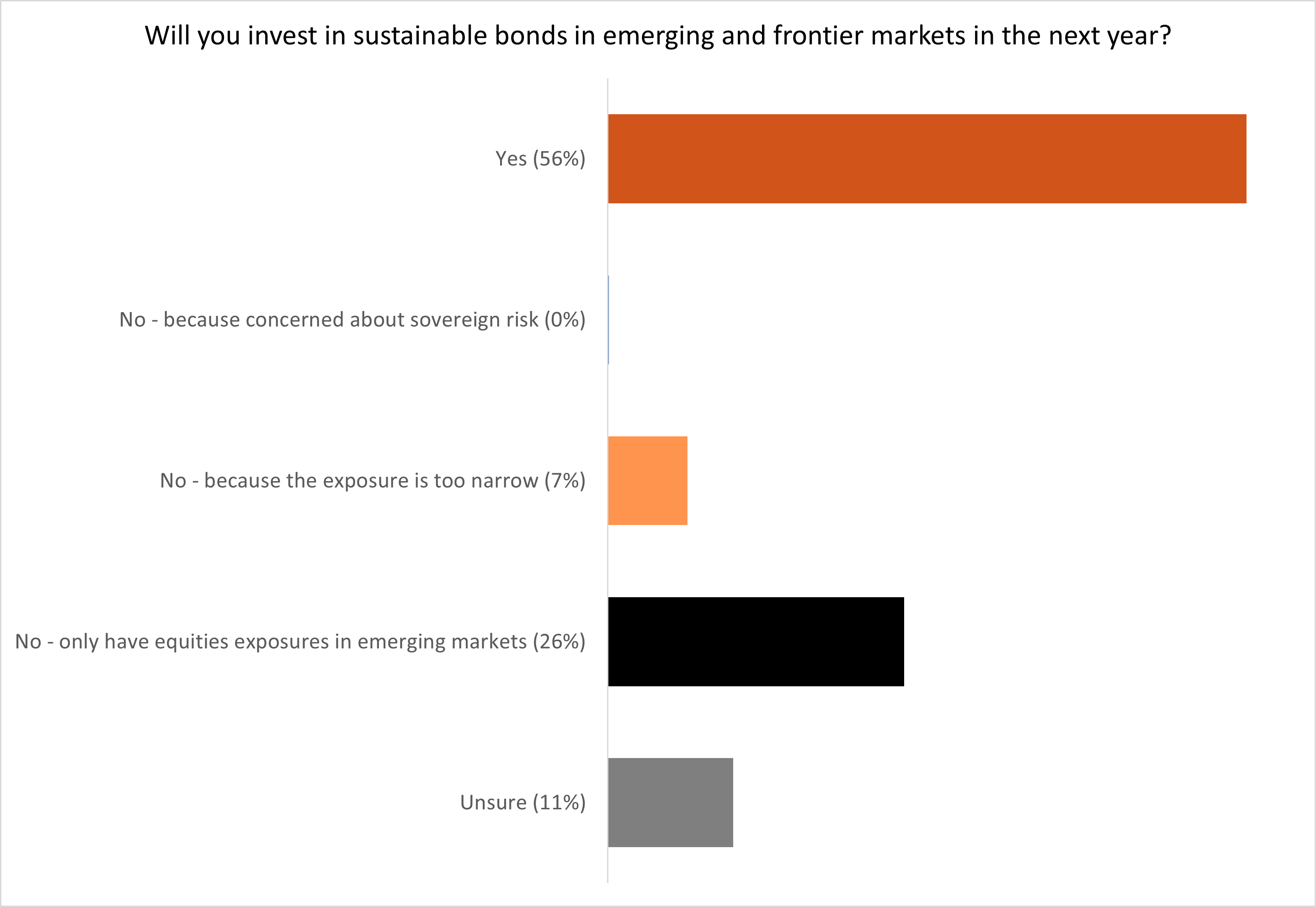
Of the investors surveyed at the conference, 56 per cent of investors said they would invest in sustainable bonds in those markets in the next 12 months.

Of those that won’t, it was predominately due to only having an equities exposure in those markets, but also some investors were concerned the exposure would be too narrow (7 per cent).

The conference looked at diversity, equity and inclusion, with much attention being paid to DEI both internally and externally among asset managers by the investors attending the conference.

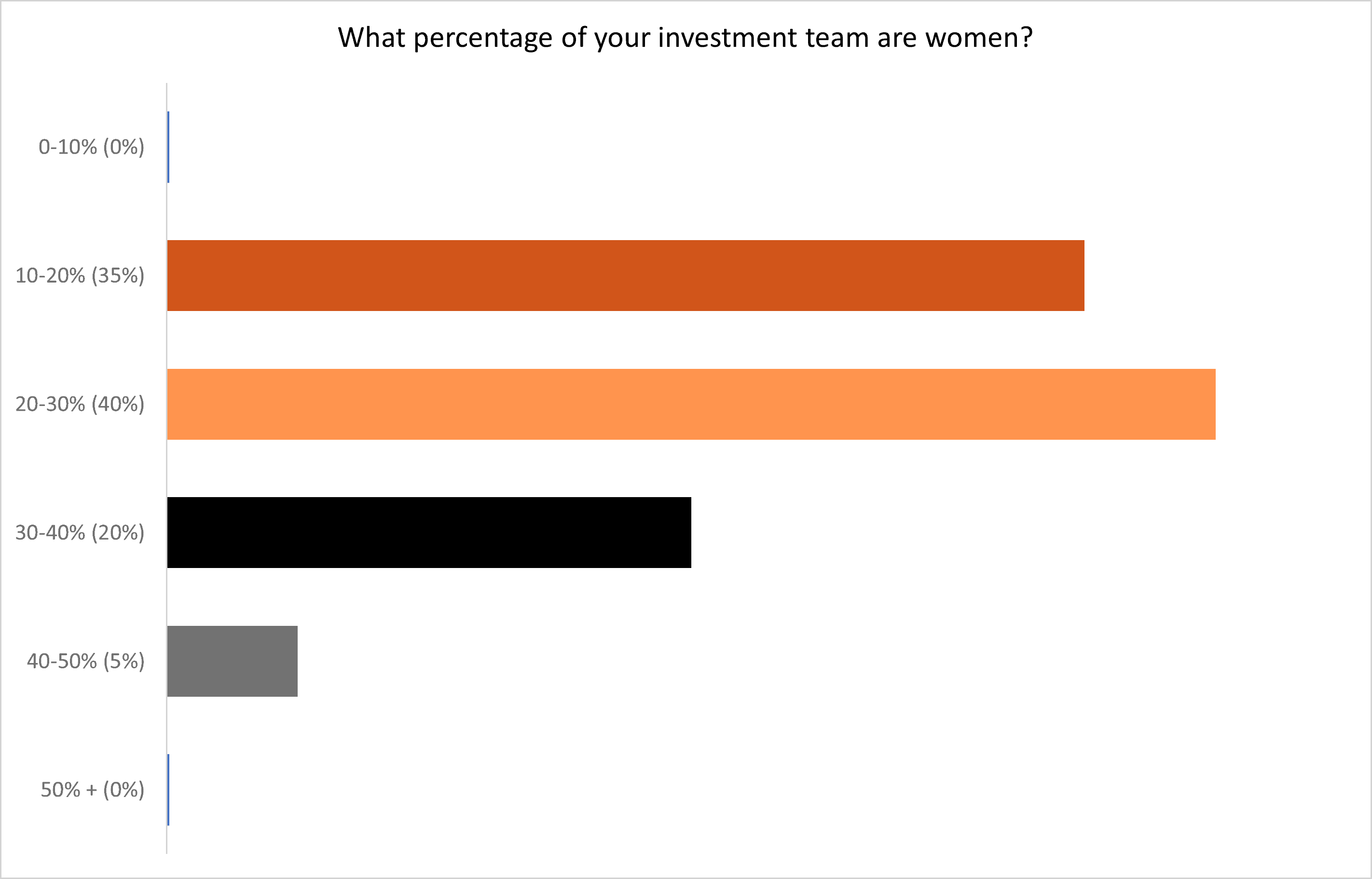
According to polling 75 per cent of investors have between 10-30 per cent women in the makeup of their investment teams. 20 per cent had between 30-40 per cent, and only 5 per cent had 40-50 per cent. None of the investors at the conference had more than 50 per cent women in their investment team.

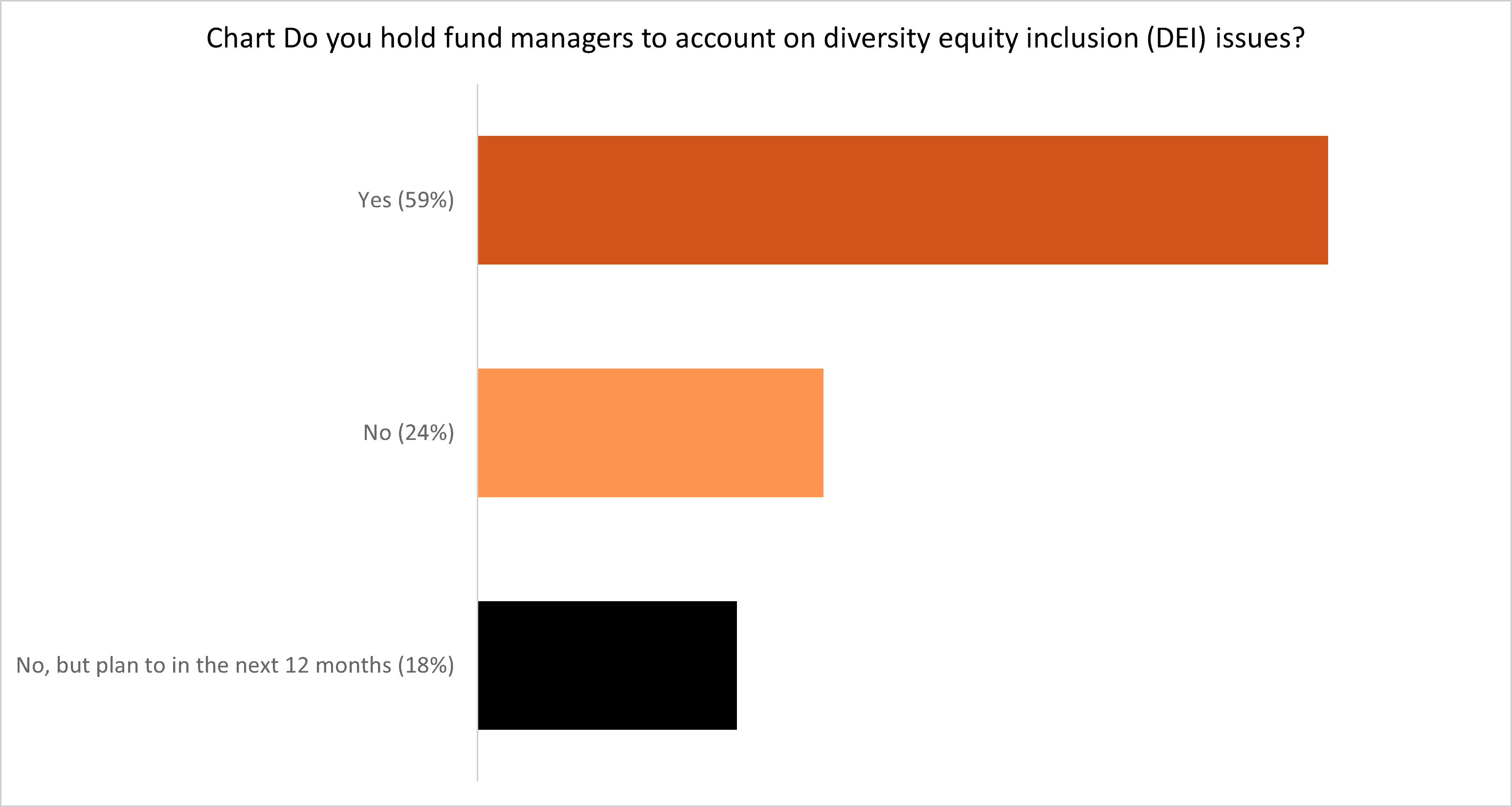
Externally however, 59 per cent of the investors said that they hold their asset managers to account on DEI issues, with a further 18 per cent revealing they plan to in the next 12 months. A further 24 per cent just said they don’t.

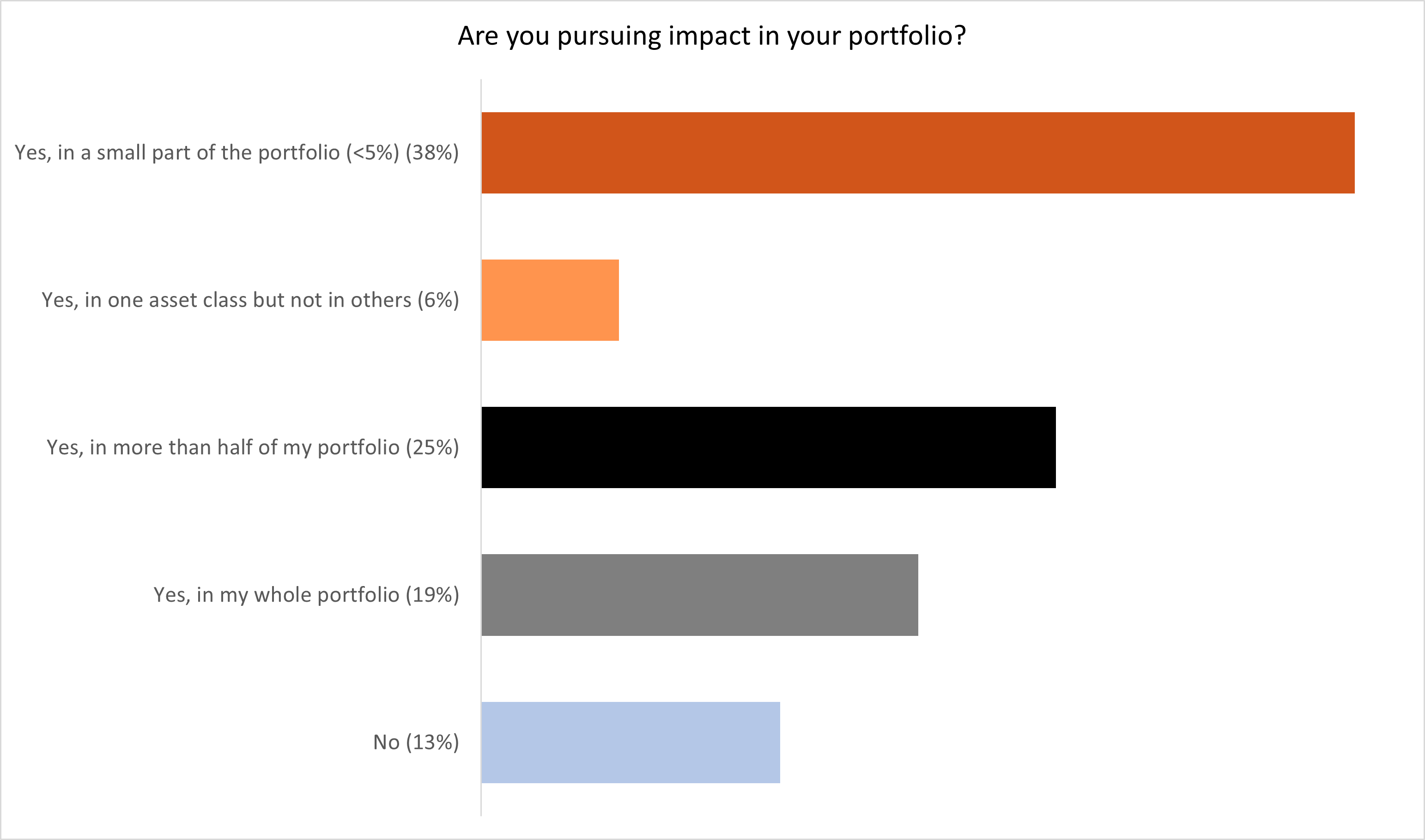
Impact investing and the evolution from a risk/return to risk/return/outcome framework was also a theme discussed at the conference.

Investors were asked what percentage of their portfolio also looked at impact alongside risk and return and 38 per cent said 5 per cent of their portfolio, 25 per ent said in more than half of their portfolio, 19 per cent said in their whole portfolio, while 13 per cent were not pursuing impact at all in their portfolio.

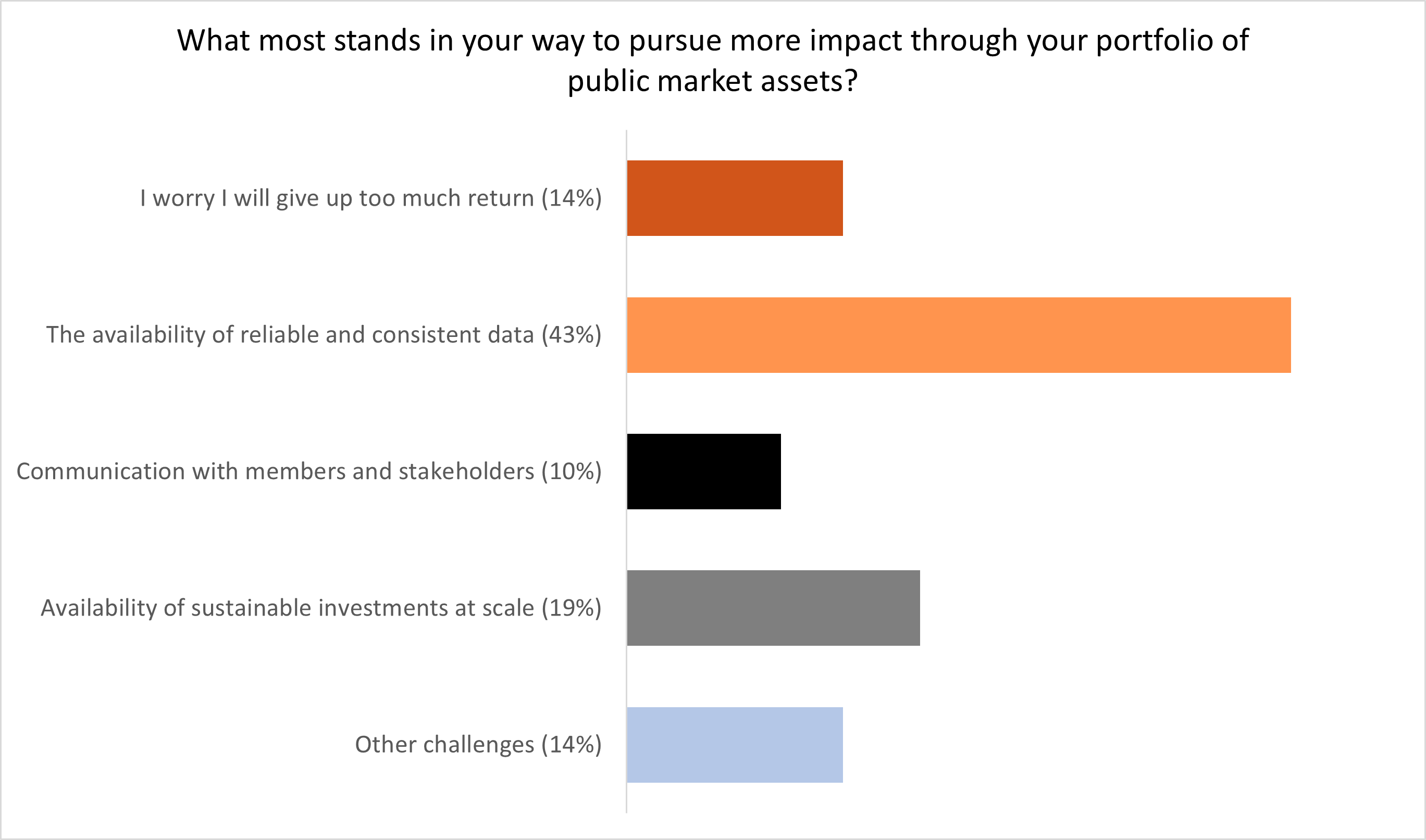
The polling of investors revealed the importance of data when it comes to decision making in sustainability.

Investors were asked what most stands in their way to pursue more impact through their portfolio of public market assets, with 43 per cent said the availability of reliable and consistent data was standing in their way.

Others said it was the availability of sustainable investments at scale (19 per cent), a concern about giving up return (14 per cent) and communication with members and stakeholders (10 per cent).

For more coverage of the Sustainability Digital conference, including session recordings and stories, visit the content hub.

Scott Kalb and CalSTRS’ Aeisha Mastagni discuss what is next for investor action in sustainability. They reflect on the dangers of funding sedition following the 6th January riots. Investors rarely consider the risk of investee companies financing extreme groups, but it threatens the very system on which institutional investment relies.

Asset owners face the uncomfortable prospect that the companies in which they invest could be funding extremist groups, some engaged in sedition. Speaking at “Sustainability Digital: A Planet in Trouble,” Scott Kalb, director of the Responsible Asset Allocator Initiative (RAAI) at think tank New America, told delegates that they might have unknowingly invested in companies funding the siege of the capital. ESG doesn’t address political spending risk, he said.

Kalb said it was a risk that asset owners need to take seriously. He said screening out political risk required better asset owner education and investors using their proxy voting power to improve corporate disclosure on political spending.

“Asset owners should adopt policies on political spending as part of an ESG framework and put their asset managers on watch to the risk, notifying them that they won’t tolerate investment in companies spreading disinformation or engaged in violent activity.”

Moreover, he said these groups threaten the very system on which institutional investors rely like the rule of law.

“If you are a good steward of capital, investing in companies that have poor transparency regarding political funding contravenes good governance.”

He said that political spending poses a systemic risk to capitalism if companies can influence an election result “to get the rules in their favour.” Adding that it is incumbent on investors to protect capitalism and the institutions that underpin it and to think about “how portfolio companies are impacting the world and externalizing costs onto stakeholders.”


Fellow panellist Aeisha Mastagni, portfolio manager at US pension fund CalSTRS agreed that funding sedition was something investors should be looking at, adding that the events of January 6th had cast political spending and contributions into the spotlight, and necessitated strong corporate board oversight.

CalSTRS directs its active stewardship to four key areas that it believes are relevant to the long-term performance of its portfolio – targeting policy makers to promote sustainable markets, corporate board effectiveness, the low carbon transition and responsible firearms.

Tools include proxy voting and engagement in a strategy that Mastagni described as a “continuum,” with CalSTRS increasingly deploying more resources to influence change.

“We pair our role as an engaged, constructive shareholder with deep financial analysis and a path to value creation,” she said.

For example, CalSTRS will support an alternate slate of board members at ExxonMobil being put forth by active ownership organization Engine No. 1, explained Mastagni.

Activists want the oil giant to ramp up investments to clean energy and adapt to the rapidly changing energy landscape.

Although CalSTRS is not part of this solicitation, she said the pension fund plans to vote and support the alternative slate.

“Now is the time to change, and we need significant change in this boardroom,” she said.

Reflecting on the work of the RAAI Kalb explained that the initiative identifies the top 25 institutional investors leading responsible investment. Asset owners are rated based on 10 principles and 30 criteria like integration, transparency and disclosure.

“We are looking for evidence of real action, trying to create a standard of excellence people can aspire to,” he said. He explained to delegates that most of the cohort is focused on climate change.

“There is an understanding that as long-term investors they have an obligation to savers and stakeholders to not invest in companies that might harm their interests,” he concluded.

Gloria Steinem tells institutional investors it is time to ditch the labels that describe our gender, class or ethnicity and urged the investment community to look at investments through the lens of gender, class and racial equality.

“We need to become individuals without adjectives that describe our gender or class,” says celebrated feminist and social political activist Gloria Steinem.

Speaking at “Sustainability Digital: A Planet in Trouble,” 86-year-old Steinem stressed the importance of understanding that each human being is unique.

“Humanity is the point,” she said, urging delegates to see the individual behind the label – to look at our substance and content.

The ‘unfinished business’ and ‘human rights challenge’ of gender equality is rooted in long held racial and gender divisions viewed as desirable.

“It’s taken us a long time to realise that money is just one form of value,” said Steinem who said the tide began to shift with social justice movements that saw the quality of life not just measured on a financial scale.

She noted a new energy to gender equality under the Biden administration. She also drew delegates attention to the sweeping transition underway in the US population from “majority white” to “majority people of colour.”

She said that among a percentage of the population, this transition was sparking insecurity and rebellion, witnessed on the 6th of January storming of the Capitol by a white minority.

“Trump wasn’t elected by a majority but by a fluke of the electoral college,” she said.

Steinem played down polarisation in the US, arguing that resistance to multiculturalism only comes from a minority. She said that Trump represented that minority (white and male) that is resisting the fact the US is about to become a non-white country – alongside other changes.

“We are now back to majority democratic rule,” she said.

As to how diversity sits within the broader sustainability debate, she said it comes down to “the common sense” principle of the importance of releasing all talents, not just the talents of some people.

She said inequality has its roots in colonialism, hierarchy and European religions and values. Besides, the original inhabitants in the US lived by a circular model “before Europeans came along.” Adding: “In a sense we are trying to get back to this.”

It led her to reflect on the fact women are less hierarchical in leadership roles stemming from models of behaviour and leadership rooted in the family. It reflects a “concern for the welfare” of each person regardless of where they are in a family, in contrast to the corporate model. She also noted more men working from home as being one of the positives to come out of the pandemic.

“Men are more likely to be at home and take care of children and be present in the household,” she said. “It is equalizing what until now has been a female experience.”

She urged the investment community to look at investments through the lens of gender, class and racial equality.

“There is not simply just one measurable number,” she said.

Dropping labels allows “instant communication” amongst strangers. She also espoused the importance of laughter. Although social movements are often viewed as serious and full of anger, laughter is powerful source of free emotion.

“You can compel fear or love; laughter can’t be compelled.”

She said this was the “undervalued” element of a social justice movement and embodied freedom and enjoyment.

“You can’t live in the past or future, you can only live in the moment and the ability to laugh is proof of that.”

She concluded that retirement is another label to ditch. She said as long as individuals can “still function,” and their advice is useful, we should dispense with retirement. Moreover, young people should be encouraged to work much earlier.

“There are teenage geniuses that are functional; the idea of functionality should surpass ideas of age, race and class,” she said.