Inflation is the number one investor concern and whether it is here to stay was the subject of much debate at the Fiduciary Investors Symposium. While its longevity is contested it was agreed that its presence has important implications for the correlation between bonds and equities which creates problems for portfolio design. Investors at PGIM, QMAW, CPP Investments and NEST discuss.

Inflation has become the number one investor worry according to a poll of delegates at FIS Digital 2021 with 51 per cent of respondents naming it above any other risk.

Today’s inflation is a consequence of a powerful surge in growth coming out of the pandemic, bottlenecks in certain goods and changing consumer preferences, said Robert Tipp, chief investment strategist and head of global bonds at PGIM Fixed Income which manages more than $900 billion.

He said that although it is unclear how long it will last, the idea that it is here to stay could be ill-founded. Country by country and demographic drivers are disinflationary, he told delegates, arguing that today’s robust economic activity will tail off and the economy could well return to its sluggish 2019 state.

In contrast, Sushil Wadhwani, chief investment officer at London-based investment firm QMAW, urged investors to prepare for uncertainty. He counselled that although “clever people at the Fed” are saying inflation will be transient it is far from clear if it will pass through or hang around. Although he said it is likely to be lower in the next few years compared to current levels, it could still be “uncomfortably high.”

Even transient factors can take a while to unwind – particularly a labour shortage. Structural changes in today’s labour market triggered by the pandemic could take years to pass through and trigger higher inflation for a while yet. Moreover, he said mood music around the minimum wage has changed with many companies suggesting they will increase what they pay. The longer inflation stays high, and the less pre-emptive central banks are in trying to curb it, the greater the risk.

Recalling his own experience as a member of the monetary policy committee at the Bank of England, he said central banks never make decisions on one single, “noisy” data point. Instead, they seek to distil the essence of what is going on. If the data begins to get uncomfortable through 2021, the Fed will likely bring forward tapering and change its signalling on short term interest rates, not currently expected to rise until 2024. However, he caveated that any change in tone or policy is unlikely to happen until a new chair is appointed in 2022 when Powell’s four-year term at the head of the central bank ends.

Tipp said a current challenge for investors is keeping to strategic asset allocations, and navigating the impact of lost diversification between stocks and bonds. He said very little is priced-in regarding rate hikes over the next two years, and noted that inflation in Europe is still well below the ECB’s target 2 per cent which could put rate hikes on hold for years. As for opportunities in emerging markets off the back of inflation, he said hard currency returns in developing markets are challenging to capture.

One popular inflation proofing strategy comes via increased allocations to commodities, said Wadhwani reflecting on QMAW’s 35 per cent exposure to the asset class. However, he steered away from recommendations and said agility is the key to success in the current climate. For example, central bank policy changes would quickly alter the investment landscape.

“In an uncertain environment you need to be agile rather than get fixed on a particular hedge,” he said.

Indeed, QMAW is tactically long commodities because inventories are low and more than half of commodity markets are in backwardation – whereby the future price is lower than the current price because of scarcity. Looking ahead however, he said factors like China prioritising financial stability over growth could quickly change the picture. Moreover, if central banks turn hawkish, it bodes badly for industrial metals.

Mark Fawcett, chief investment officer at the United Kingdom’s NEST is also circumspect if inflation will rise further. Working as head of Japanese equities based in Japan in the 1990s has given him experience with regarding to inflationary signs. He said governments have turned on the fiscal taps to fight the economic impact of the pandemic, but people know it will all have to be paid for. Taxes will rise and this means deflationary forces could hold back the demand side.

He also added that systemic forces will also drive down inflation – taming inflation won’t just be the responsibility of central banks.

For Geoff Rubin, chief investment strategist at the C$475 billion CPP Investments in Canada, the real danger is a policy mistake from central banks.

He said the giant pension fund’s portfolio is not designed for unanchored inflation. Adding that central bank credibility has provided an extraordinary backdrop to investment decisions – and any sense that discipline might be eroding could end badly for the portfolio.

Insurance assets like inflation linked bonds or commodities are good in the short-term but don’t fit easily in a long-term portfolio.

Rubin added that uncertainties around inflation will threaten the negative correlation between bonds and equities that investors have long benefited from, posing a real problem for portfolio design. He also noted that the consequences of inflation would differ for different investors. For example, CCP Investments has a liability structure that is supported by a rise in inflation.

Tipp added that today’s positive correlation between bonds and equites would change if the economy stutters.

“If we drop out, we will see a bond rally,” he said.

At NEST, the (negative) correlation is less pressing: Fawcett said NEST doesn’t hold long-term developed market bonds in its portfolio. It is in these assets, he said, where most of the money printing has happened.

Wadhwani concluded that inflation spikes particularly in certain monetary regimes. For example, the UK could well “wake up and smell the coffee” given the high level of public debt, little appetite to raise taxes and forecast increase in public spending. It could point to a “catalytic” (inflationary) event that might not translate outside the UK.
In an unequivocal message to boards that climate inaction could cost them their positions, Exxon shareholders voted this week to replace atleast two of its directors with those that have experience in climate transition. It is a win for CalSTRS which has been vocal in its support of Engine No.1, the activist hedge fund that put forward the alternative directors. The proposal was also supported by CalPERS and New York State Common Retirement Fund.

Gregory Goff, former CEO of Andeavor oil refining company and Kaisa Hietala, former executive vice president of renewable products at Neste are two new directors.

Aeisha Mastagni, portfolio manager in CalSTRS sustainable investment and stewardship strategies unit who led the charge for the fund said it will not be the last time that energy transition will be on the agenda.

“While the ExxonMobil board election is the first of a large US.company to focus on the global energy transition, it will not be the last. We believe change is necessary for companies that do not have a long-term strategy for a responsible transition to a net-zero emissions  economy.”

“This is an unprecedented action by investors, putting all companies on notice that climate inaction can cost a board member their job,” says Andrew Logan, senior director, oil and gas at Ceres.
Climate Action 100+ the world’s largest investor engagement initiative, flagged the vote as worthy of shareholder consideration. Chair of Climate Action 100+ Anne Simpson, managing investment director, board governance and sustainability at CalPERS called it a day of reckoning.

“The votes for change by Climate Action 100+ signatories show the sense of urgency across the capital markets. Climate change is a financial risk and as fiduciaries, we need to ensure that boards are not just independent and diverse, but climate competent.”

Shareholders also voted to support other climate-related proposals at Exxon including a proposal asking the company to report how its climate lobbying aligns with the goals of the Paris Agreement and a proposal seeking disclosure of the climate change risks the fossil-fuel dependent company faces.CalSTRS and other investors want change to happen so that these companies succeed.

“This hits on all our stewardship priorities and how we make these companies more resilient,” Mastagni, who leads CalSTRS stewardship activities said. “We are not trying to argue with them about when this low carbon transition will happen, but it will happen. The biggest risk for Exxon is assuming the status quo – that is a very risky bet for us. Most companies should be preparing for multiple scenarios.”

Our February interview with Aeisha Mastagni outlines the background of the engagement with Exxon and  how CalSTRS plans to incorporate activist stewardship and take on large companies with the credibility of its argument for change.

Mastagni spoke at the Top1000funds.com Sustainability conference earlier this year and the session can be viewed here.

Liang Yin from the Thinking Ahead Institute examines omission bias as an explanation for vaccine resistance, and underweighting investments to China. He suggests a framework for overcoming this bias.

Recently, I had my first COVID-19 vaccine (Oxford / AstraZeneca) and excitement soon turned to concern as the media linked a small number of deaths to this vaccine and the EU’s medicines regulator announced that unusual blood clots should be listed as one of its side effects.

This focuses the mind on the importance of perspective and understanding biases. While this side effect is very rare (roughly one in every 100,000 people) and the risk of dying is even smaller (significantly lower than the risk of dying from COVID) knowing this doesn’t necessarily make my experience less unsettling. After all, I am only human and suffer from a cognitive bias that many people are prone to: omission bias.

Omission bias describes our tendency to focus more on risks related to our actions (me actively choosing to take a vaccine) while giving less attention to risks as a result of our inactions (me doing nothing to protect myself from a potentially deadly virus). Omission bias can cloud our judgement. It is often discussed as one of the plausible explanations for vaccine resistance while the science is very clear that the benefits of any approved vaccines far outweigh the risk, including the one produced by Oxford / AstraZeneca.

We researched this topic as part of the Institute’s work on asset classes of tomorrow which also revealed that most institutional investment portfolios are highly concentrated from a geographical standpoint. Indeed the MSCI ACWI index currently weights the US at around 58 per cent, while China – the world’s second largest economy – is weighted at less than 5 per cent.

In our above-linked paper on Chinese capital markets, we show that over the 31 years since two major stock exchanges were established in 1990, China’s capital markets have grown at a rapid rate, underpinned by fast economic expansion. Today, China is home to the world’s second largest stock market and also the second largest bond market. Since the beginning of the 21st century, barriers to foreign ownership have been gradually reduced. Recent programmes such as Stock Connect in 2014 and Bond Connect in 2017 are viewed by some investors to have revolutionised accessibility to this enormous market. Trillions of dollars’ worth of Chinese onshore assets are now within reach for foreign investors.

As such, there is a strong case for global investors to add or increase exposure to Chinese assets in their portfolios, based on:

  1. Its role as a diversifier and return enhancer in a global portfolio
  2. Opportunities for active managers to add value, and
  3. Improving portfolio resilience with respect to an evolving, albeit uncertain, world order.

With respect to the last point, over recent years, there have been increasing concerns about setbacks in globalisation and rising trade / geopolitical tensions between the US and China. These events were often perceived to be negative for China’s economic prospects and led to elevated market volatility.  Some investors view them as reasons not to invest in China. This could be omission bias at play.

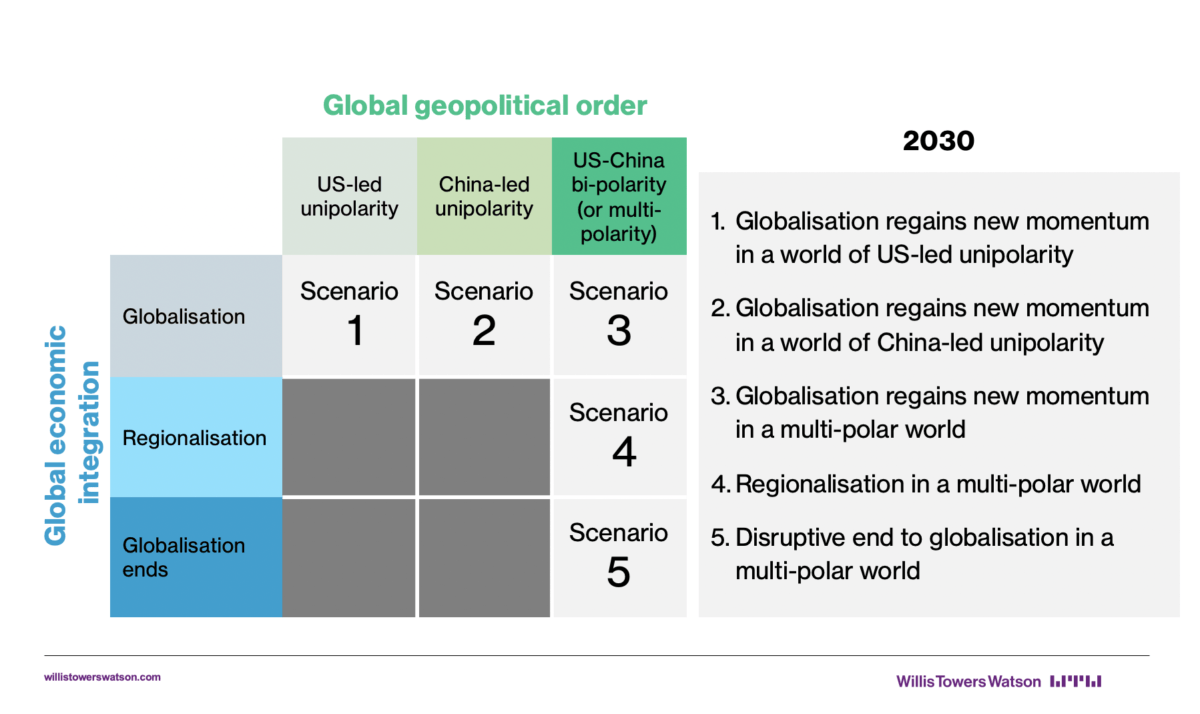
While the future is impossible to predict, indications are that we are moving into a new world order and, as we do so, using scenarios can be helpful in dispassionate decision making and overcoming omission bias. Here is a simple thought experiment where the world is shaped only by two key dimensions: global economic integration and global geopolitical order, and from which we can build five future (2030) scenarios.

We can then assign an estimated likelihood to each scenario, and also a portfolio weight to Chinese assets that would make sense in that scenario (see our paper for our probabilities and weights). Only in scenario five would it make sense to have a 0 per cent weight to Chinese assets. And in all other scenarios we think a significantly higher weight than the 5 per cent implied by the MSCI index, or current average exposures, would be appropriate. Combining across the likelihood of all five scenarios and we end up with an allocation to Chinese assets that is a multiple of current levels.

The usefulness of this simple construct is that it is flexible and helps investors with their omission biases.

A useful historical perspective is that US economic output overtook that of the entire British empire for the first time in 1916 and, if investors hadn’t seen that coming and diversified accordingly the United Kingdom’s underperforming capital market should have been an enduringly strong clue.


More than 100 years later, the world could be at another point of similar flux and yet many investors today hold highly concentrated portfolios built for the past, rather than thinking about incorporating asset classes of the future.

Liang Yin, CFA, PhD  is a senior investment consultant in the Thinking Ahead Group, an independent research team at Willis Towers Watson and executive to the Thinking Ahead Institute.

The definition of what it means to invest is changing, according to Jon Lukomnik and James P. Hawley, which means examining the limitations of the 75-year old legacy of modern portfolio theory.

It’s difficult to spot a paradigm shift while it happens, but we believe the definition of what it means to invest is changing.  Increasingly, investors are acting to affect the feedback loops between the real society and economy where value is created, and the capital markets, where it is priced.

Evidence is everywhere.

Environmental and social proxy resolutions in the United States are racking up numbers never seen before.  The PRI has pushed its members to look at stewardship in terms of systemic risks. Money is flowing into ESG- and sustainability-themed products. We read of investor-led efforts to mitigate real world risks to the environmental, social, and financial systems virtually daily. Investors are tackling issues as disparate as climate change, fair taxation policies, income inequality, gender and racial discrimination, anti-microbial resistance, deforestation, biodiversity, and the governance of technology as well as traditional governance concerns like executive compensation.

Even regulators around the world are contributing: The chair of the Securities and Exchange Commission in the US has said he anticipates rule-making on climate and human capital management  issues; the European Union has published its disclosure regulations on “green” funds and is working on its dual materiality framework; and the UK stewardship code asks asset managers about systemic risk.    Even the nature of who is a regulator is changing: In the UK the chief markets regulator just hired the most high-profile head of stewardship in the country, Sacha Sadan, to helm its ESG efforts.

All this is a welcome refutation and reversal of the 75-year old legacy of modern portfolio theory (MPT) that suggests investors focus only on trading and portfolio construction.

MPT is brilliant in providing the maths to diversify and therefore extract the most efficient risk/return portfolio from the extant market but provides no tool or theory to improve the market’s return.

Yet diversification only works on idiosyncratic risks, whereas overall market movements – non-diversifiable systematic risk – determines 75 – 94 per cent of return, depending on which academic study you want to cite.  This is the MPT paradox: MPT provides a powerful tool to affect that which matters least.

The result has been the development of a self-referential school of investing.  Returns are relative, benchmarked against market indices divorced from real world needs of investors.

If the market is down 10 per cent, and your account is only down 8 per cent, your portfolio manager is a star, despite the fact that you have less money to fund retirement, buy a home, or whatever.

Risk is similarly siloed. To MPT, risk is volatility, and the cause of the volatility (often systemic risk in the real world that becomes non-diversifiable systematic risk in the capital markets) is irrelevant.

Academic theories have facilitated this imaginary, self-contained world: By assuming 1) rational investors, 2) efficient markets, and 3) random walk theory, MPT does away any need to deal with the messy feedback loops to the real world.  Together, they create the perfect myth. They enable the math. They are easy to understand. They are explanatory. They are wrong.

Fortunately, practitioners increasingly reject the paradox.

Think of it this way: If the market itself were a portfolio, investors are trying to improve its Sharpe ratio by mitigating risks to the real world’s financial, social and environmental systems before those risks enter the capital markets.  And, at last, theory is finally catching up to practice.

Three years ago, we wrote a paper that foreshadowed these arguments. It was controversial, to say the least.  But in just the month of April, three important publications have examined various aspects of these issues and progressed the arguments for investors seeking to mitigate real-world risks, rather than just moving electronic dots on a trading terminal.

Bill Burkart and Steve Lydenberg’s 21stCentury Investing shows investors how to think about systems, the Predistribution Inititative’s “ESG 2.0” paper looks at the impact of institutional investors and investment structures on various ESG issues, and our book, “Moving Beyond Modern Portfolio Theory” provides the first coherent finance theory of why investors confront the MPT paradox.

When paradigms shift, they can shift quickly.

Jon Lukomnik and James P. Hawley are co-authors of Moving Beyond Modern Portfolio Theory: Investing That Matters” (Routledge, 2021)

The latest annual CIO Sentiment Survey, a collaboration between Top1000funds.com and Casey Quirk, part of Deloitte Consulting, finds asset owners on track to hit return targets as risk on and active strategies reap rewards. Elsewhere, after consecutive years of cutting back on manager and consultant relationships, investors want more partners in 2021.

Click here to explore the findings

Keith Ambachtsheer responds to an article on the negotiations by CalSTRS’ outgoing chief executive, Jack Ehnes, to achieve fully funded status by 2046.

Dear Amanda,

I was surprised to see the recent article titled “CalSTRS’ CEO achieved fully-funded status”.

In fact, CalSTRS’ own 2020 funding report states that its DB plan is only 70 per cent funded using an aggressive 7 per cent liability discount rate. The funded ratio would drop to 55 per cent if a more realistic 5 per cent discount rate were used. In comparison, Ontario Teachers’ Pension Plan reported an almost double 103 per cent funded ratio with a 5 per cent liability discount rate at the end of 2020.

It is true that CalSTRS reached agreement in 2014 with California employers and the State to target 100 per cent funded status for the DB plan by 2046 by making additional contributions.

While this agreement clearly represents progress, its importance is easily overstated for two reasons.

The first is the assumption that fund assets (including the additional contributions) will earn an aggressive net investment return of 7 per cent per year over the next 25 years.

The second is that the agreement will actually stay in place that long. While this is not impossible, many things can happen over a 25 year period, including in the State of California. For example, a recent CalSTRS review document noted that California employers and the State are looking for COVID-related relief from making additional CalSTRS contributions.

Despite this problem and possible future ones, the CalSTRS report noted somewhat hopefully “we still expect to make progress towards full funding”. However, its authors clearly recognise there can be material gaps between hope and subsequent reality.

I thought your readers might appreciate this additional information on CalSTRS’ funded status.

Yours truly,

Keith Ambachtsheer

Director Emeritus, International Centre for Pension Management, Rotman School of Management, University of Toronto and President, KPA Advisory Services Ltd.