Hands on investment experience overseeing a large, a mostly internally run investment program, AUM with layers of complexity that targets a 7 per cent rate of return; leadership skills and ease under the media spotlight and monthly board scrutiny plus the ability to commit for at least five years. The role of CalPERS next CIO isn’t for the faint-hearted.

The $469.8 billion pension fund has been without a permanent CIO for a year following the resignation of Ben Meng in the wake of regulatory filings disclosing he had invested in shares of private equity managers with which the pension fund had invested in the past. A search last year was abandoned because of challenges inherent in recruiting during the pandemic and issues with the compensation package – since resolved to now include a long-term incentive approved by the board. Still, discussions at the July board meeting on the key characteristics the board seeks in its new CIO offer a revealing window into the task and trade-offs that lie ahead.

Drawing on CIO data from 100 global asset owners in CalPERS’ peer group, Charles Dore, chief executive and founder of executive search agency Dore Partnership tasked with filling CalPERS empty CIO seat, highlighted the challenge afoot.

Dore’s analysis of the world’s top 100 institutional investors finds 82 have incumbent CIOs – out of those that don’t five have an open vacancy while 13 (mostly SWFs in the Middle East and Asia) don’t follow a traditional CIO structure.

Of the incumbent 82, around 54 per cent were appointed in the last three years; 63 per cent were appointed internally and the overwhelming majority are men. Over two thirds of incumbent CIOs hail from the asset owner community with the rest split between asset management and other backgrounds like banking or government.

Delving further into the data, Dore’s analysis found only 31 per cent of the sample 100 asset owners have, like CalPERS, a 7 per cent rate of return – and two of these funds (Yale and Washington State Investment Board) are without CIOs.

Of this ever-smaller cohort, the average AUM is just $158 billion, and the typical CIO tenure is just over five years. Again, CIOs in this handful of highly performing asset owners are also, overwhelmingly, white and male. Of the top performing CIOs in CalPERS’ immediate peer group, 50 per cent managed less than $25 billion and one third managed less than $10 billion in their prior role, indicating that scale is not a factor in predicting long-term investment success.

Still, the CalPERS board will have to reconcile that with some members’ priority that the new CIO has experience managing a large AUM.

Cue Dore’s counsel on the importance that the board keep an open mind, considering candidates with experience of managing small AUMs and mindful of the benefits of hunting for talent among current deputy, or rising CIOs, rather than only fish from a pool of proven CIOs.

“Around 48 per cent of performing CIOs were recruited internally – they were not CIOs before their current role,” he said, adding that assets under management is too rudimentary a proxy and that many of this group have also come from overseeing a single asset class. That said, all agreed that direct investment experience was vital.

“We are looking for a big I in CIO,” said CalPERS CEO Marcie Frost.

Diversity

Any trade off regarding diversity will be just as difficult for CalPERS board. Board member Margaret Brown flagged that the data points to this being one obvious casualty of the process.

“It’s very clear this is going to be challenging,” she said, arguing that pushing for female candidates or historically underrepresented groups will make the candidate pool even smaller.

“While we are all big on DEI, the most important thing we are looking for is qualified candidates.” This might mean not hitting on the diversity piece, she said.

“If that’s what we are searching for, no wonder that’s why we came up empty first time around.”

Against Dore’s insistence that the search company would “lead a systematic A-Z search” and “if the market has diversity to offer” the firm would capture it, other board members pleaded for diversity to be a centre piece in the search.

“It is incumbent on us to ensure we have diversity at the highest level of investments,” said Stacie Olivares. “We have seen time and again when there is diversity there is outperformance.”

Dore will conduct a data and reference-led process that will include people on career breaks targeting end of September for the first round, and an early March 2022 joining date. Dore added that the search process will also seek candidates with a succession plan, able to build continuity and with a track record of elevating others.

“It is very important we find someone aligned to the mission of the organisation.”

Once the latest criteria are approved, board president Henry Jones will select a committee to conduct the first round of interviews along with Frost. Final interviews will be conducted by Frost and the full board. The board and the CEO share the hiring of the CIO who will report to Frost.

CalPERS’ next CIO must be just right – but it remains to be seen whether the fund will get its fairytale ending.
A review of the legal barriers to investing for sustainability impact in 11 jurisdictions gives confidence to investors wanting to re-think old investment paradigms and include impact alongside risk and return.

The report commissioned by PRI, UNEPFI and The Generation Foundation was conducted by global law firm Freshfields Bruckhaus Deringer provides the first ever comprehensive analysis of how far the law requires or permits investors to take deliberate steps to tackle sustainability challenges in discharging their duties, described as investing for sustainability impact

It brings much needed clarity on the legal framework for sustainability impact investing, and also looks at the opportunities for policy reform that would better enable investors to have coherence on the legal frameworks to invest sustainably.

Some of the suggested policy reforms include changing investors’ legal duties and discretions, such as allowing the pursuit of sustainability goals as long as financial return goals are prioritised, and a presumption in favour of investor collaboration in tackling sustainability challenges.

“This report is the first of its kind. This detailed legal analysis shows investors they should feel empowered to rethink old investment paradigms by considering risk, return and impact as the pillars of successful investment practice,” said David Blood, senior partner, Generation Investment Management.

The research will provide insights on how far investing for sustainability impact is legally required or permitted across 11 jurisdictions: the EU, Australia, Brazil, Canada, China, France, Japan, South Africa, the Netherlands, United Kingdom and the United States. The project reference group of experts will also support and test the legal analysis.

The PRI’s chief executive, Fiona Reynolds, said that Freshfields has identified a diverse spectrum of actions that investors and policymakers could take to better facilitate investing for sustainable impact.

“These are based on an extensive analysis of the unique legal and regulatory conditions they face in their respective jurisdictions,” she said.


To access the report click here.


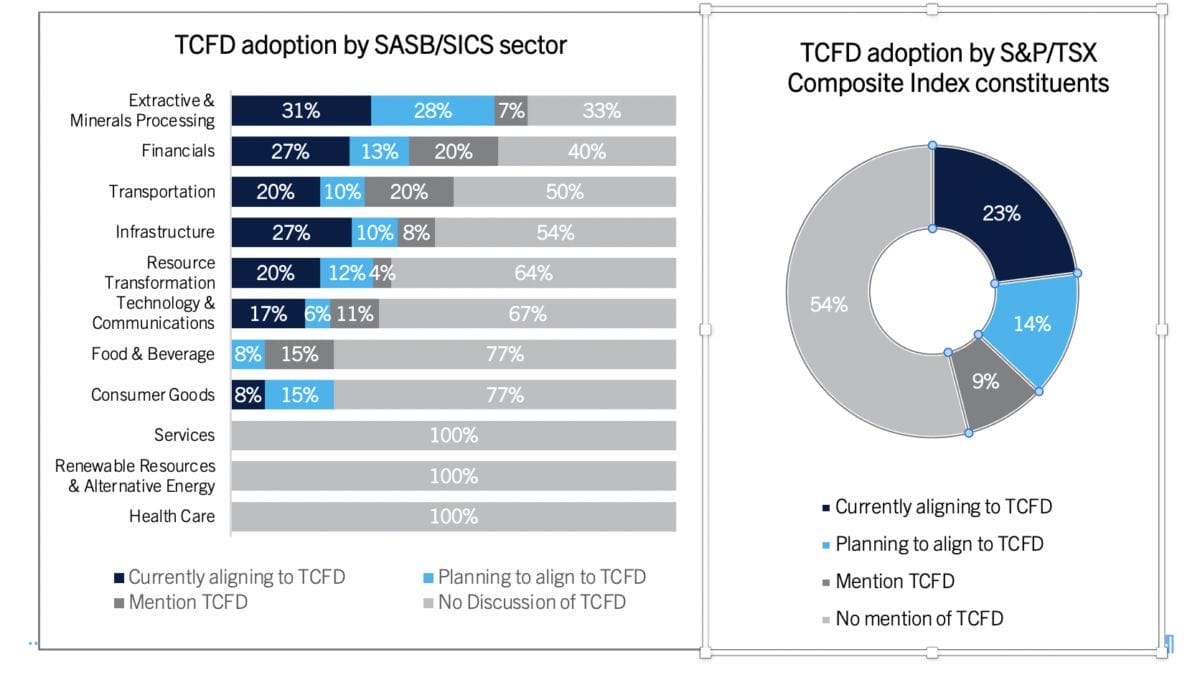
In June, G7 nations endorsed mandatory climate-related financial disclosures based on the Taskforce for Climate Related Financial Disclosures (TCFD) framework recommendations. A recent report identified that only 23 per cent of Canadian listed companies are reporting in alignment with those recommendations, exposing its public entities to the risk of diminishing their access to capital while limiting investors’ access to their returns.

Although late in 2020 Canada’s largest pension funds made news by publicly declaring that they wish to see issuers disclose to both the SASB and TCFD frameworks, of the 228 companies listed on Canada’s S&P/TSX Composite Index only 23 per cent provided a clear statement indicating that their climate reporting align with the TCFD recommendations, with an additional 14 per cent expressing a desire to align with those recommendations and 54 per cent with no mention at all.  Although, the extractives and minerals processing and the financials sectors led the way in terms of TCFD-aligned reporting, the study discovered that there were no TCFD-aligned reports found in the healthcare, renewable energy resources & alternative energy, and services sectors.

And how are investors responding to this lack of climate reporting?

To get a pulse, Canadian ESG Advisory firm Millani Inc. focused its recent Semi-Annual Institutional Investor ESG Sentiment Study on climate reporting, and more specifically, on investors’ expectations for issuers disclosures to the TCFD framework*.

The study concluded that the Canadian investment community is mindful of the challenges of reporting in line with the TCFD, with most respondents suggesting that issuers start their reporting now but to consider that ­reporting will need to be iterative and progressive going forward.  However, regulators and investors are expected to become less forgiving with time.

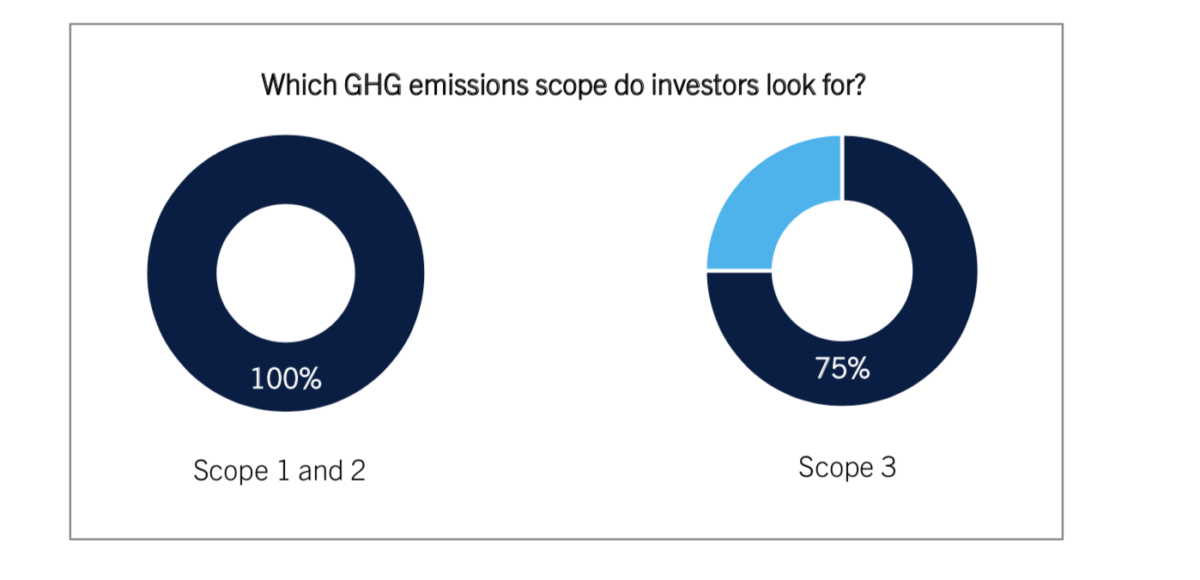
Regarding emissions disclosures, 100 per cent of investors surveyed said they are assessing scope 1 & 2 and 75 per cent are looking to assess scope 3. Meanwhile, 90 per cent of those issuers who have TCFD-aligned reports, provide scope 1 and 2 emissions, and 50 per cent report scope 3 emissions.  Much of this sentiment aligns with the proxy voting trends that the market witnessed in 2021, with multiple shareholder resolutions asking for climate strategies or disclosures to scope 3, surprisingly getting mainstream investor support.

But the study also highlighted those investors find that TCFD disclosures are less insightful than most had anticipated. Given that issuers can choose which climate scenarios they can use, investors expressed that companies are putting forth scenarios that provide positive results, and not providing a thorough disclosure of potential risks and opportunities to their business strategies.

Early in 2021, there were many organizations that made net-zero commitments.  While these announcements were initially well-received, the investor community quickly realized that for some, there was little substance behind the targets.  The report collected investor’s sentiments to issuer target-setting and noted that they are most interested in seeing interim targets and an articulation of how the organization plans to get there.

The study outlines those investors themselves were surprised by the accelerating pace of change in ESG regulations and at the rate at which investors and corporates are progressing on this topic.   A well-articulated climate strategy is becoming a necessity for any issuer, and investors alike.

While having been driven by Europe until recently, North America is about to undergo seismic shifts as the new US administration begins to focus its regulatory and legislative agenda towards climate change. As much as the markets are already feeling pressures, several new regulatory initiatives are expected to be announced to drive the markets forward.

As the world, and its regulatory and its financial systems prepare for COP26, one thing is certain. Further changes are expected, and the stakes are increasing with each passing day for issuers, and investors alike.

*Millani’s Semi-Annual Study was published in two distinctive reports which can be read in conjunction with one another and can be found on our website

  • TCFD Disclosure Study: A Canadian Perspective
  • Semi-Annual Sentiment Study of Canadian Institutional Investors: Climate Change & TCFD-Aligned Reporting

Milla Craig is the founder and president of Millani.

Conexus Financial, publisher of Top1000funds.com, further cements its position as a global influencer with the appointment of Fiona Reynolds as chief executive.

For the past nine years Reynolds has been based in London as the chief executive of the Principles for Responsible Investment a UN-supported network of investors that she has grown to more than 4,000 signatories, representing $121 trillion in AUM and 180 staff around the world. During her tenure sustainable investment has become mainstream and the PRI has become one of the most important investment institutions in the world.

Conexus Financial already has a strong footprint in the global pension market particularly through its influential Fiduciary Investors Symposium and Top1000funds.com publication which focuses on leading the global investment industry to continuous improvement.  The appointment of Reynolds, a global influencer, will expand this.

Reynolds said she was attracted to Conexus as a purpose-driven organisation and platform for change and was passionate about contributing to solutions focused on the end member.

“How do we really build a financial system that works for the many not the few?” she said. “We need to think about the world into which people are going to retire, not just annual returns. People, profit and planet must go together. For me personally I’ve always worked in areas and with people I believe are mission driven and that is evident at Conexus Financial.”

Through Conexus’ global footprint it has pushed the industry to question whether status quo processes and behaviours to tackle risks and opportunities will be sufficient in the future, and actively campaigns for diversity, sustainability, transparency, innovation and better alignment of fees in the investment industry.

Reynolds’ achievements as chief executive of the PRI for the past nine years brings further kudos to these campaigns and a focus on better outcomes for members and the better allocation of capital.

In addition, as the Australian superannuation market further professionalises with new legislation and consolidation among funds, Reynolds will be able to bring her global view to the domestic landscape and hold superannuation funds and providers accountable for global best practices. Prior to joining the PRI, Reynolds spent seven years as chief executive of the Australian Institute of Superannuation Trustees where she played an active role advocating for superannuation policy changes for working Australians.

Founding CEO of Conexus Financial, Colin Tate AM, will become executive chair of the business focusing on expanding its global offerings and its domestic impact through The Conexus Institute.

“I am proud of what we have achieved at Conexus Financial so far and we have much growth in front of us,” he said. “I’m looking forward to working with Fiona and to building Conexus to become an even more influentialplatform for change.”

Reynolds also serves on the board of the UN Global Compact, the council of the International Integrated Reporting Council (IIRC), the Global Advisory Council on Stranded Assets at Oxford University, the UN Business for Peace Steering Committee and the Steering Committee for Investors on Climate Change, Climate Action 100+ and the Finance Against Slavery and Trafficking global committee, the Advisory Board of the UK Green Finance Institute and the Advisory Board for Greening the Belt and Road – a UK/China Initiative.

Conexus Financial is the publisher of Top1000funds.com, Investment Magazine and Professional Planner, and host of more than 20 annual events in the global and Australian institutional and wholesale markets.

Reynolds will take up her position as CEO of Conexus Financial in February 2022.


The COVID disruption to work has made investment industry leaders and employees think more carefully about what work might look like going forward.  The consequences of the forced experiment of remote work, the lessons learned along the way from the changes in work patterns and practices, and the social changes in worker attitudes and expectations have set the stage for a new model of working. Leaders must develop a deeper understanding of the dimensions and implications of hybrid work to sustain their firm’s edge in a world of accelerating workplace change.

The latest CFA Institute Future of Finance report, Future of Work in Investment Management, is an in-depth study examining how these trends will develop in the investment industry, using input from 4,600 investment professionals globally and leaders at investment organizations representing more than 230,000 employees.

We explored the changes investment organizations and investment professionals are likely to make as they reassess the context of careers, the content of work, and the culture of organizations, both in the near term and in the next five to 10 years.

The following is a list of key lessons for leaders, particularly related to the shift to hybrid working (generally meaning a mix of remote and in-person work), as well as the desire for more flexible working (meaning adjustable working hours).

  1. Know your people. Many organizations are assessing their employees’ interest in a hybrid working model, and 81 per cent of investment professionals we surveyed said they would like to work remotely part of the time. Among women, the level was 87 per cent, compared with 80 per cent of men.  Attitudes vary somewhat across geography and years of experience. Those with less than two years of experience in the industry were least likely to want to work remotely since it is more difficult to learn from others in a remote or hybrid environment, especially without the benefit of a robust professional network. Interest in hybrid work was highest in France (93 per cent) and lowest in China (45 per cent).
  2. Assess the effectiveness of your organization’s remote work experience. Among those we surveyed, 53 per cent said remote working increased their efficiency, and investment professionals across all roles now believe they can do a greater percentage of their job from home, supported by the experiences of the past year.  Even roles that were previously thought to be largely incompatible with remote work – such as chief investment officers, chief financial officers, and even traders – have proven to be adaptable and resilient to the remote work experiment.
  3. Consider the suitability of roles for hybrid or flexible arrangements. We found that the structure of investment professionals’ work seems to support a hybrid model. Most roles have a balance of uninterrupted time needed and time when teamwork is required. Chief executives and chief investment officers need the most teamwork. Credit and research analysts and economists are among those who need the most uninterrupted time. The least predictable jobs are analysts, economists, consultants, and CEOs, and are the types of roles that might be expected to be always accessible even in a flexible working environment.
  4. Provide managers with training on how to lead in a hybrid environment. Although a majority of investment professionals said they were more efficient when working remotely, only a third of managers thought those who worked for them had increased efficiency. Our research shows that having good leaders has always been important to retain people, but now it is also a primary motivator. Leaders’ responses—whether good or bad—to the stresses of the pandemic in their employees’ lives will have lasting effects on relationships and employee engagement. Among investment professionals we surveyed, 58 per cent are confident in the ability of leaders to manage teams in a hybrid work environment. Inclusivity in hybrid team settings and empathetic cultures will be key.
  1. Adapt client management approaches. Client-facing roles were least likely to report effectiveness gains from remote work, and there is a need to adapt communication practices and refine skills to establish new trust models with clients.  Expectations are that business travel will be permanently reduced by 25-50 per cent, and while video calls have replaced some travel, firms must think strategically about how to maintain trusted client relationships. Travel will be most needed when strategic decisions are to be made and at the start of a relationship or at major transition points. Client communication options will grow in complexity, and with this will come opportunities for firms to differentiate themselves.
  1. Learn from others. Most organizations we surveyed indicated that their policies will be changing to be more supportive of remote and flexible working as they recognize the feasibility and desirability of such policies for attracting and retaining talent. What had been case-by-case exceptions to the rule will become accepted practice by three-quarters of organizations. 
  1. Beware of the inclusion pitfalls. An all-remote environment evened the playing field in many ways, particularly in situations where meetings would have consisted of a full meeting room in the headquarters and a few people in satellite offices on the phone who were rarely acknowledged. This was not a positive for all employees however, and as different personal situations pulled some into constant multi-tasking, a two-tiered system emerged between those with the freedom to be on camera without interruptions and those whose audio-only presence limited their ability to engage. A hybrid approach will be more difficult to manage in terms of being inclusive, but this must be prioritized by leaders to create the right conditions for effective and engaging teamwork. 
  1. Remember your ESG promises. As investment organizations seek to demonstrate their alignment with ESG principles, investors are likely to note what workforce policy changes are made to support flexible work arrangements. This is a signal of the importance of managing their workforce well and considering employees as key stakeholders.
  1. Counter burnout with purpose. During the heights of the COVID pandemic, burnout became widespread, and the number of those working more than 60 hours per week nearly doubled, from 8 to 15 per cent. This was true across regions and gender and was especially prevalent among those with less than 10 years of work experience. Meanwhile, the pandemic has prompted more attention to positive organizational purpose, and there is a greater focus on outcomes that are bold and inspiring and that support belonging and motivation. While short-term business results are always in view, it is the longer-term vision that creates and sustains purpose. 
  1. Re-imagine your organizational culture. Organizations should take this opportunity to better understand the core elements of what makes their culture work and ensure they can adapt without harming their organizational identity. Learning to work in a hybrid work environment will take time, and it will likely be an iterative process for organizations. It will be worth the effort since it can be a differentiator in terms of attracting and retaining top talent.

The where, what, and how of work are undergoing simultaneous transformations, and this will be a defining leadership challenge and opportunity in the coming years.  With attention and intention, the industry can emerge stronger as a result.

Additional reports in this series will be published though 2021.

New research by Norges Bank, which manages the assets of the $1.39 trillion Norwegian sovereign wealth fund, examines how the increased focus on ESG issue can affect asset prices.

It looks at two modelling frameworks to explore how the the increased focus on ESG issues can affect asset prices, showing that when investors incorporate ESG into their portfolios as a non-financial considerations this leads to lower expected returns on higher ESG-scoring “green” assets and higher expected returns on “brown” assets.

It also shows that as more ESG-motivated investors are in the market, increased flows in to green assets can lead to outperformance.

Important the research by Norges, which owns 1.5 per cent of all the world’s stock, also considers how asset prices are affected when ESG measures reflect risks to assets’ expected cash flows. It looks at how the pricing of assets reflects how their payoffs relate to the state of the economy in different climate scenarios.


To read the research on asset pricing implications of the increasing consideration of ESG issues in investing click here.