The £9.2 billion portfolio managed for the Church Commissioners for England has returned 9.7 per cent over 10 years through a focus on sustainability and a willingness to try things early, such as forestry and venture capital. Amanda White spoke to CIO Tom Joy about where the fund looks for alpha and the need for a non-traditional allocation.

The Church Commissioners of England invests 90 per cent of its portfolio in risk assets and doesn’t own any bonds except for 1 per cent invested in an eclectic emerging market debt portfolio. It counters that aggressive allocation with a 10 per cent allocation to cash which acts as a liquidity buffer.

“Holding nominal assets, which are often viewed as defensive, is a path to wealth destruction,” says the fund’s chief investment officer, Tom Joy. “I’m not a big worrier about inflation but it will be higher so holding nominal assets today is a sure fire way to destroy your wealth, I wouldn’t label them defensive. When people wake up to that fact and yields rise it will lead to capital losses. This comes back to the fragility of markets and the fact that a traditional portfolio won’t meet the needs of investors.”

Instead of a 60:40 the fund looks to enduring diversification which has meant a diverse and long-standing allocation to real assets that includes rural, timberland and strategic land allocations.

In 2020 timberland, which makes up about 5 per cent of the portfolio, returned 41.3 per cent partly due to the sale of a number of forests in Scotland and the US.

“We saw a tremendous increase in valuation last year. We made some sales because investor demand was so big and that was incredibly fruitful,” Joy says.

“We started investing in forestry a decade ago and it’s a core part of the portfolio. With the huge rise in the importance and thinking of the E in ESG and the role that sustainable forestry can play and the rise of the importance of biodiversity, we think that will be the next big leg in thinking about the environment.”

Joy believes the genuine diversification that the real assets portfolio provides – across farmland, forestry, UK residential and strategic land – has been beneficial in the periods where there have been big meltdowns in equities.

“2020 was the 12th year in a row we have delivered positive returns including 2018 when equities were down and other asset classes were negative,” he says. “It sits well with our stakeholders and clients and we have never had to cut distributions. I’m pretty happy with how the portfolio is positioned.”

Private equity and venture capital, which makes up 10 per cent of the portfolio, was also an outstanding contributor to the fund’s return with 33.6 per cent for the year. Nearly half a billion pounds in further private equity commitments were made in 2020 and the fund also committed venture capital to seven managers across 20 funds in the year.

Joy is aware that unlike many other asset classes where manager returns are bunched, the dispersion of manager returns in venture capital is enormous.

“It’s the one asset class where there’s a persistence of returns but you have to be with the best managers. It’s all about securing access to the best managers,” he says.

With that in mind the fund recently hired Michelle Ashworth, who Joy describes as “one of the best investors in venture capital outside of Silicon Valley”, with the purpose of gaining access to the best venture managers.

“She has been tremendously successful at that and we have made good allocations to the best managers who have deployed quite quickly,” he says.

All of the portfolio is managed by external managers and the fund continues to support active management.

In public equities active management was a big contributor to the return of 18 per cent in the asset class verses the index of 13 per cent.

“That wasn’t achieved by avoiding the value space and being long large cap technology, which was the pandemic winners. It was achieved with good balance in the portfolio and we’ve done that over a decade,” Joy says. “Everyone else had given up on active management we think we have a process where we can access good managers.”

The fund employs only a small number of managers it thinks can beat the market over time.

“Over a decade we have delivered 1.5 per cent above the market, compounded over time adds a lot of value,” he says.

Backing best ideas

But perhaps one of the more innovative things Joy and the team have implemented over the past five years, with complete transparency and agreement of its external managers, is a best ideas portfolio.

“We think that managers over-diversify their portfolios and if they just backed their best ideas they would do better. They can’t do that because of career and business risk reasons., so what we have done in agreement with them is we are loading up or buying more of what we strategically believe is their best ideas.”

This best ideas fund, which consists of a small number of best ideas from each fund manager, is managed in an internal systematic process with reduced fees and has been very successful.

“We were always going to do it in a transparent way and if our managers said no we wouldn’t do it. We only put together a small number of best ideas from each manager, less than 10,” he says. “It’s not a huge allocation at the moment (about £100 million), but we do want to grow it, it’s been quite successful.”

Outside of the front office there are a lot of other areas where Church Commissioners seeks to add alpha.

“We have done other things that are more nuanced,” Joy says. “Middle and back office and operations functions can genuinely deliver alpha. If that is a very well-resourced part of your business it can lead to much better control over the custody and legal spend for example.”

Portfolio efficiency also adds alpha, he says, with the fund adding 30 basis points of return at total fund level.

“In 2018-19 I became increasingly aware of the view that markets are fragile, being able to hedge your portfolio was more difficult because of where bond yields were and the 60:40 model was broken,” he says. “I felt markets would be vulnerable because we had a massive growth in algorithmic trading and when volatility hits, that pool of liquidity evaporates and markets are prone to shocks. We looked at how to capitalise on that and protect our portfolio.”

The team decided this was a job better done in-house as tail risk hedging is defined largely by inaction due to the associated fees.

“External managers want to earn their fees so they’re always doing things but 90 per cent of the time you don’t want to be doing anything. Insurance costs you,” he says. “In markets if you’re contrarian you can add incremental return to the portfolio but you have to do it yourself.”

James Barty, a former hedge fund manager and expert in global markets and derivatives, was hired as director of investment strategy and he came to the fund from Bank of America to build models that would give signals to when markets were stretched and prone to a setback. An internal derivative overlay strategy was set up to manage equity risk.

“We do that in a time varying contrarian way and it was quite fortuitous as we were able to add risk in March and April and have added a useful amount of return,” he says. “Because we had invested so much in our operational and backoffice functions we could bring that capability internally and that will be increasingly important for us.”

Responsible investment alpha

Not surprisingly, given its stakeholders, Church Commissioners has an ambition to be at the forefront of responsible investment globally. This ambition has been vindicated with the inclusion in the PRI’s Leaders Group for the past two years.

Joy believes that responsible investment alpha is going to be the “area of the future and the next leg of our journey”, and he continues to invest in building out a team which now consists of seven people – almost as many as in the manager selection team.

“A team of seven dedicated RI professionals is quite a big team but if you have ambition you have to resource it properly,” Joy says.

At the start of 2020 the fund’s head of RI, Edward Mason, left to join Generation Investment Management, considered to be the leading manager in responsible investment and one of the fund’s managers.

Bess Joffe was hired as head of responsible investment and in a sign of the lockdown times Joy is still yet to meet her in person.

“She’s been fantastic and has a wealth of experience working for managers and an asset owner which has been really helpful in looking at what works from an engagement perspective and has given us an advantage.”

The fund has just completed a natural capital baseline assessment across the portfolio and was the first asset owner to sign the taskforce on nature related frameworks.

“That’s the big next discussion and focus on the environment side,” he says.

In 2020 it also joined the net zero asset owner alliance and has just released its target for carbon reductions of 25 per cent by 2025. Last year it also released its impact investing framework measuring the real world impact of its investments.

Through tracking and analysing the portfolio through the real world impact, it can see for example that it has £600 million dedicated to climate solutions.

“The integration of the RI team with the investment team means that the RI team are spotting themes before the investment team sees them from a risk perspective, then we are able to think about what our exposure is and should we make changes. We have come up with ideas that are win win investments, they have good impact and good returns, like energy charging infrastructure. The symbiotic integrated approach is paying dividends.”

Joy says the fund is really focused on making sure all initiatives it is involved in focus on the real world impact.

“We don’t want to lose sight of the fact the critical focus needs to be on real world impact. It’s easy to adjust your carbon footprint via a few sales in your portfolio but selling shares does not make impact in the real world.”
Two asset owners explain how working with asset managers is central to reaching their net zero targets.

Climate change is not only perceived as the biggest risk to the $65 million David Rockefeller Fund, it is also a potential source of opportunity to lean into, said Nili Gilbert, investment committee chair of the David Rockefeller Fund which supports non-profit groups working in the environment, criminal justice and the arts.

Speaking at an ‘Investor Agenda’ webinar hosted by the PRI, UNEP-FI and CDP on how investors can climb the ladder to net zero Gilbert, who focuses on the fund’s relationships with its investment consultants, manager selection and overall asset allocation, said tackling climate change has a double materiality given the foundation also makes grants in the climate space.

Motivated by its fiduciary duty, the fund which was founded in 1989 and separate from the $5 billion foundation, published net zero targets for the first time this year. It also committed to decarbonise the portfolio by 25 per cent by 2025 in alignment with government goals of net zero emissions by 2050 under the Paris Agreement.

In addition, the fund plans to invest 10 per cent of the portfolio in investments to finance the transition in the next five years.

“The biggest risk is the world missing the mark on climate change,” said Gilbert. “This is why we’ve put the investment of the endowment at the centre of our climate strategy.”

The fund’s decarbonisation strategy comprises engagement with portfolio companies and sectors, engagement with external asset mangers and policymakers, and collaboration with peers in the Net Zero Asset Owner Alliance which it joined last year.

Gilbert also advised webinar attendees on the importance of not just tinkering with integrating net zero but focusing on engaging with companies and sectors in the real economy. Rockefeller embarked on a huge engagement program with its asset managers to drive integration working alongside its investment consultants.

Jake Barnett, director, sustainable investment services at Wespath Institutional Investments (WII) explained how his focus is also on engaging with asset managers. WII, a not-for-profit subsidiary of Wespath Benefits and Investments (WBI) which together manage $28 billion in assets rooted in the principles of the United Methodist Church, is also targeting net zero in the portfolio by 2025.

Asset managers are often better positioned to take on stewardship roles with portfolio companies; they have larger holdings and make the buy sell decisions and also have more capacity and resources when it comes to stewardship, he said.

“We are direct clients of asset managers and should lean into this,” he said.

This year Wespath asked its asset manager cohort to answer how they would support the organisation in its net zero goals to ensure alignment.

Elsewhere, collaborative engagement is increasingly incorporated into the asset owner’s selection of managers, said Barnett.

“This is a market signal you should pay attention to,” he advised managers.

Board buy-in

The conversation also centred on how best to build a case for change within an organisation. Bringing an organisation’s leadership and governance arms together around net zero targets is one of the most challenging elements of a net zero strategy.

“Our commitment emanated from board and executive level,” said Gilbert explaining that this built energy for change across the organization that has been crucial for success.

Another component of success is working with other asset owners, she said. Large US pension funds also on the road to net zero presented to the fund’s own investment committee. These conversations led to the committee making a formal recommendation to the board on net zero commitments.

First steps

Amongst the proliferation of initiatives helping investors reach net zero emissions in their portfolio, the Investor Climate Action Plans (ICAPs) Expectations Ladder stands out, offering comprehensive guidance towards achieving a net-zero carbon economy by 2050.

The ladder defines opportunities for investor action on climate across four interlocking areas – investment strategy, corporate engagement, policy advocacy and investor disclosure and governance.

The ICAPs approach helps investors no matter where they are in their journey to better integrate climate change risks and opportunities into their investment process, and climb up the ladder to net-zero, explained Rahnuma Chowdhury, investor climate action lead at UNEP FI.

She concluded that the tier process is also meant to be inclusive, regardless of where individual investors are on their net zero path. It allows investors to see where they sit on the ladder and how to scale up their ambition, she said.


How asset owners are implementing net zero targets in their investment portfolios will be a key focus of the Sustainability in Practice event to be held online on September 8 and 9. To find out more or register click here. 

Key takeaways:

  • Failure to address climate change will have severe economic and social repercussions.
  • Pressure for a just transition, a systemic and ‘whole of economy’ approach to sustainability, is growing.
  • The human causes of climate change are now firmly established, but the human response, and impacts, are still very much to be determined.

Climate change is a human issue. There is now scientific consensus that the greenhouse-gas emissions causing climate change are predominantly man-made. This means that climate change is unequivocally a human issue – as a society, we can influence the course of that change, by adapting our individual and collective behavior. There are, of course, many uncertainties about the potential impacts of climate change but the choices that we make also add to this uncertainty.

Failure to address climate change will have economic and social repercussions. Global action, or indeed inaction, will affect the global workforce, human wellbeing, and society at large. No one expects these impacts to be equally distributed; some estimate that 75% of climate change damage may affect developing countries, despite the poorest half of the world’s population contributing to just 10% of global carbon emissions.1

The Role of the Just Transition

The phrase ‘just transition’ refers to the balancing of these interests: addressing the environmental risks that climate change presents, while ensuring that workers and communities are not left behind, and that the ‘green’ solutions deployed do not carry an ugly human cost. As a society, how we address this complex and increasingly politicized issue will be a considerable challenge in the coming years.

The ILO (International Labor Organization) defines just transition as … a bridge from where we are today to a future where all jobs are green and decent, poverty is eradicated, and communities are thriving and resilient. More precisely, it is a systemic and whole-of-economy approach to sustainability.2

The role of the just transition, and questions of fairness and equity, also have the capacity to undermine attempts to meet the Paris Agreement on climate change. The transition to a low-carbon economy could not only lead to ‘stranded assets’ but also ‘stranded workers’ and ‘stranded communities’. Higher levels of social trust enable institutions to undertake policy reforms that are in the general long-term interests of society. Where there is no societal buy-in, there are often adverse impacts on the overall impacts that policies seek to achieve. This can have significant economic and human costs too, as was seen with the gilets jaunes (‘yellow vest’) protests in central Paris. These started in late 2018 over substantial fuel-tax increases to tackle climate change and the resulting impact on lower-income workers.

What Does This Mean in Practice?

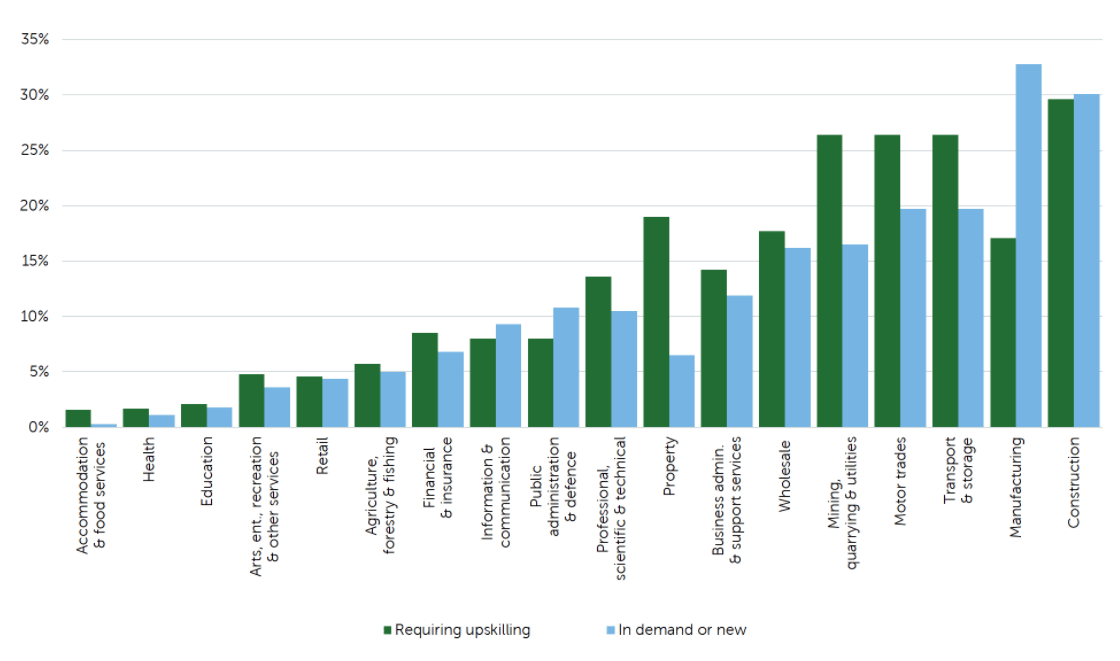
A key requirement of addressing climate change is changing our energy system, and reducing the use of fossil fuels. Understandably, workers in fossil fuel-related industries may feel vulnerable and oppose the changes that threaten their jobs, livelihoods and communities, as we have seen within the European Union. Taking the UK as an example, it is estimated that one in five UK workers could be affected by climate change – 10% of jobs may have less demand, and 10% may have more, with significant changes in structural employment. There will also be changes in the types and locations of jobs across and within these economic sectors.

Employment Implications of the Transition on Different Sectors in the UK

An additional challenge is that these impacts will often be concentrated in specific communities reliant on industry, and new employment opportunities may not be created in these regions. Some workers may easily adapt – an engineer at an oil and gas company may be well suited to being an engineer at a renewables company. But not all skills are transferable. For example, it is estimated that the north of the UK may see 28,000 direct job losses resulting from the closure of coal-fired power plants alone.3 In less clear-cut cases, there will need to be research and investigation to understand the net impact of jobs, in order to manage this.4 Subsequently, there will be the need to generate new jobs in regions affected and to retrain and reskill workers.

Moreover, the transition is not just away from fossil fuels but also towards renewables. We need to consider the social implications of renewables technology, construction and operations as their role in our energy system increases. There have been numerous allegations of human-rights abuses at renewables companies, primarily related to project construction, ranging from intimidation, to indigenous rights and land-rights disputes. More recently, we have also seen this with increasing scrutiny over the use of forced labor of minorities in solar industry supply chains. This is material for our transition to a lower-carbon society: for those whose human rights have been adversely affected, and also for investors, as project delays and cancellations can have financial consequences. With increasing discussions of mandatory human rights due diligence requirements, this is only likely to become more salient.

The human causes of climate change are now firmly established, but the human response, and impacts, are still very much to be determined. There are no silver-bullet solutions, nor is there clear responsibility for any single actor. For example, who should be accountable for the reskilling of employees, and who should bear this cost? As always, collaborative action between all stakeholders – governments, corporates, investors, NGOs (non-governmental organizations), trade unions, and employees – would be ideal. But what does this mean in practice? And how can this collaboration be facilitated? It is clear that this will not be a simple task, nor one that any single stakeholder can achieve individually. It is a deeply political, cultural and social challenge, but it is a challenge which must be addressed as we continue to shape the way climate change develops, and the human impacts it will have.

Important information and disclosures

Important Information

Any reference to a specific security, country or sector should not be construed as a recommendation to buy or sell this security, country or sector. Please note that strategy holdings and positioning are subject to change without notice.

This is a financial promotion. Issued by Newton Investment Management Limited, The Bank of New York Mellon Centre, 160 Queen Victoria Street, London, EC4V 4LA. Newton Investment Management Limited is authorized and regulated by the Financial Conduct Authority, 12 Endeavour Square, London, E20 1JN and is a subsidiary of The Bank of New York Mellon Corporation. ‘Newton’ and/or ‘Newton Investment Management’ brand refers to Newton Investment Management Limited. Newton is registered in England No. 01371973. VAT registration number GB: 577 7181 95. Newton is registered with the SEC as an investment adviser under the Investment Advisers Act of 1940. Newton’s investment business is described in Form ADV, Part 1 and 2, which can be obtained from the SEC.gov website or obtained upon request. Material in this publication is for general information only. The opinions expressed in this document are those of Newton and should not be construed as investment advice or recommendations for any purchase or sale of any specific security or commodity. Certain information contained herein is based on outside sources believed to be reliable, but its accuracy is not guaranteed. You should consult your advisor to determine whether any particular investment strategy is appropriate. This material is for institutional investors only.

Personnel of certain of our BNY Mellon affiliates may act as: (i) registered representatives of BNY Mellon Securities Corporation (in its capacity as a registered broker-dealer) to offer securities, (ii) officers of the Bank of New York Mellon (a New York chartered bank) to offer bank-maintained collective investment funds, and (iii) Associated Persons of BNY Mellon Securities Corporation (in its capacity as a registered investment adviser) to offer separately managed accounts managed by BNY Mellon Investment Management firms, including Newton and (iv) representatives of Newton Americas, a Division of BNY Mellon Securities Corporation, U.S. Distributor of Newton Investment Management Limited.

Unless you are notified to the contrary, the products and services mentioned are not insured by the FDIC (or by any governmental entity) and are not guaranteed by or obligations of The Bank of New York or any of its affiliates. The Bank of New York assumes no responsibility for the accuracy or completeness of the above data and disclaims all expressed or implied warranties in connection therewith. © 2020 The Bank of New York Company, Inc. All rights reserved.

In Canada, Newton Investment Management Limited is availing itself of the International Adviser Exemption (IAE) in the following Provinces: Alberta, British Columbia, Ontario and Quebec and the foreign commodity trading advisor exemption in Ontario. The IAE is in compliance with National Instrument 31-103, Registration Requirements, Exemptions and Ongoing Registrant Obligations.

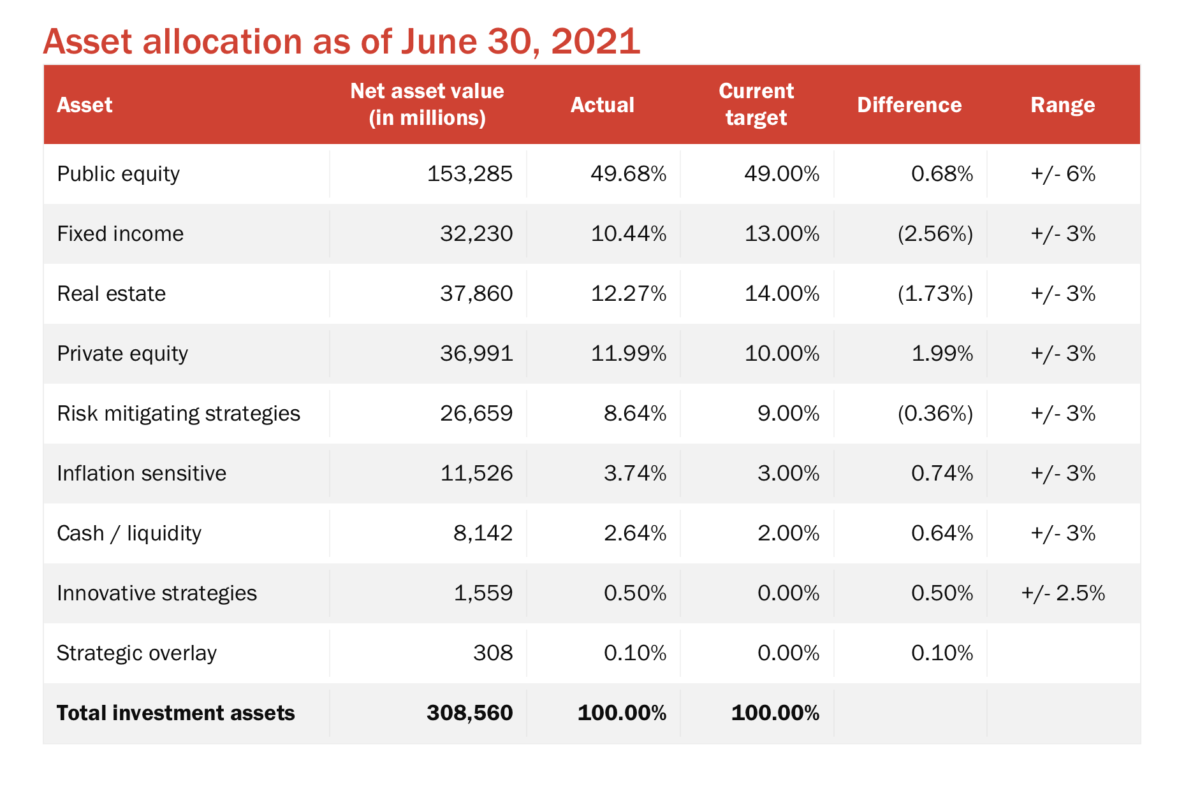
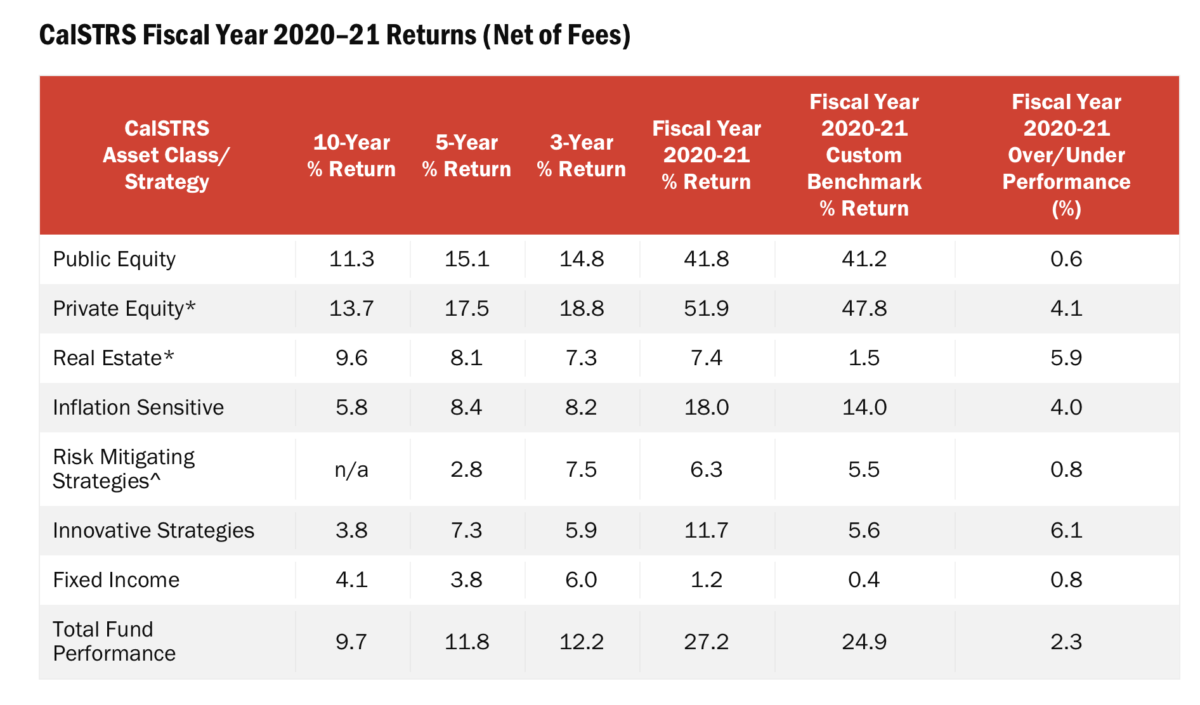
The $308.6 billion CalSTRS has outperformed its custom benchmark in every asset class to deliver a historic fund performance of 27.2 per cent for the year against a return assumption of 7 per cent.

Global equities, which makes up the bulk of the asset allocation at nearly 50 per cent, returned 41.8 per cent for the year.

But the standout performers against their benchmarks were private equity, real estate and innovative strategies returning 51.9 per cent, 7.4 per cent and 11.7 per cent respectively. The outperformance over the benchmark for these asset classes ranged from 4.1 – 6.1 per cent for the year.

The fund’s chief investment officer, Chris Ailman, says the returns were outstanding but what is more pleasing is that every asset class outperformed.

“Our returns are astonishing and we knew that would be the case because of the government stimulus, and in the US fiscal and monetary stimulus has been off the charts,” he says. “I’m astonished at our results because every asset class outperformed. We haven’t had that happen for years, I’m sure it’s been decades.”

CalSTRS currently has a 12 per cent allocation to private equity, against a target of 10 per cent, and the asset class was a stellar performer with 51.9 per cent for the year.

The fund has hundreds of relationships in private equity with vintage years going back to 1999, but Ailman gives full credit to the team for this year’s performance.

“We had some really smart co-invesmtents that later on in the pandemic became unicorn investments,” he says.

CalSTRS has an investment bucket called “innovative strategies” that was created after 2008 to push for innovation and study new, interesting areas. It currently includes aircraft leasing, private credit and other kinds of debt. It makes up only a very small portion of the portfolio, currently 0.5 per cent.

“It is literally an asset class laboratory and we tried some things that did well. Some things that didn’t do well we got rid of,” he says. “It will always swing in performance because we are testing things.”

One of the success stories of the testing laboratory is the risk mitigating strategies portfolio which has grown to 10 per cent of the overall portfolio and $30 billion in assets.

“The goal for that team is to add value and diversify. And the question is not whether you can get a one-year return but can you scale it to our size and do it over multiple time periods?” he says. “We are always looking for something new and different, we studied tail hedges a lot but still not decided to use them.”

Ailman says the risk mitigating portfolio looks at how to hedge for differences in downturns. To deal with different phases of a downturn shock the portfolio includes 30-year US government bonds, global macro, CTAs, and momentum portfolios which are diversified between three-week momentum and three-month momentum strategies.

“Bear markets don’t come wrapped in the same package,” Ailman says. “From February 2020 to March 2020 we had a bear market lasting 20 days and was down 15 per cent so fast nothing could react. Our RMS portfolio did well. The question is what is the cost of the insurance? In our case RMS had a positive return so it justifies the cost of the portfolio.”

The fund’s giant equities allocation, half of which is managed inhouse using passive and enhanced indexed strategies, was a big contributor to the annual return.

“We captured everything global equities was giving,” Ailman says. “And with our internal team we are capturing the beta of the market at a very low cost.”

Ailman says he expects the returns of his global peers will vary widely due to asset allocation differences.

“We will see wide dispersions. Even within the US there is a full 10 per cent dispersion in returns because it comes back to the equities and fixed income weightings,” he says.

CalSTRS has been reducing its fixed income allocation for 30 years, and when Ailman arrived at the fund as CIO 20 years ago it had a 40 per cent allocation.

“When I got here we had $30 billion in fixed income now it’s still $30 billion but its 12 per cent of the fund not 40 per cent.”

Ailman says the fact all teams were working in isolation in remote environments in the past year is testament to the culture of the team.

“This is a year where culture and team helps separate people, if you’re working remotely and don’t have a team culture then it’s even worse,” he says.

Looking forward Ailman says he is more cautious than his team regarding the investment environment.

“I’m so worried the government’s put out so much stimulus, the US has built up such a debt load eventually we have to pay that back,” he says. “I’m looking at that deficit and the transition from remote back to the office and I don’t know what will happen. Personal income in the US will go down as people go back to work, it’s crazy.”

The official CalSTRS’ investment view is cautiously bullish and the fund is at market weight in equities.

“We’re all looking to the fall and trying to figure out what’s going on,” he says.

One thing Ailman can commit to is the fund’s positioning regarding climate change.

“I’m really committed to turning our portfolio around in terms of climate change and this is not a one-year thing. At COP26 we need to see something happen and commitments to come out. It is such a profound change, it won’t be smooth on the economy and it is also a very long-term impact.

“We want to concentrate on actually doing stuff. We’re going to do some investments, change the portfolio and do things to be an example for others, to get the portfolio set up to be prepared for 2030 and beyond.”


Asset owners that are PRI signatories had higher returns and lower costs than non-PRI signatories over a five-year period according to analysis by CEM Benchmarking.

Analysis of the PRI signatories in the CEM database in the five-years leading up to 2018 showed that not only did being a PRI signatory not hurt performance, but those funds performed better than their non-signatory peers with a 52 basis points difference net of fees.

CEM has 340 funds in its database, 68 of which are PRI signatories. The research compared the performance and costs between the PRI and non-PRI signatories, with being a PRI signatory a proxy for funds that implement responsible investment.

The analysis found that PRI signatories had higher average total fund net value added than non-signatories: 0.53 per cent for PRI signatories versus 0.01 per cent for non-signatories over the period. 2018 was chosen for the completeness of the data set.

Kam Mangat, vice president at CEM and one of the co-authors of the research, said that on average the funds that were PRI signatories were larger in size and had more internally managed assets than non-PRI signatories.

PRI signatories in the database on average manage 35 per cent of their assets internally, compared to 11 per cent for non-PRI signatories. Previous CEM research has shown that funds with internally managed investments have lower costs.

Value added by large institutional investors the research which examined this attributed 12 basis points of return to the “characteristics of large and internal”.

Mangat said when an adjustment was made for this it leaves a 40 basis points outperformance by PRI signatories versus their non-signatory peers.

“There has been a lot of talk about whether ESG really impacts performance, and the initial indication is that it doesn’t negatively impact performance,” Mangat said. “It doesn’t hurt performance, but we want to be cautious in making that statement because we only looked at a five-year period and ESG is long term in nature and so we need a longer time frame to be definitive on ESG investing.”

Lower costs

Further, being a PRI signatory did not increase total fund cost. In fact, on average, PRI signatories were lower cost than non-signatories on both an absolute basis, and relative to a benchmark that adjusts for each fund’s size and asset mix differences.

The average total investment cost for PRI signatories in 2018 was 44.8 basis points compared to 52.1 basis points for non-PRI signatories.

Again, Mangat said that implementation style was a reason for the reduced cost, because the PRI signatories had a larger share of internal investments.

“There is also a governance angle to it,” she said. “The PRI signatories were larger asset owners and had more internal investing and they also probably have the capabilities and capacity to build out ESG investing and have a better governance discipline.”


Regional differences

PRI signatories had a higher five-year average net return in USA, Canada, and the UK. In the Netherlands, PRI signatories had lower returns, but this is due to larger fixed income allocations and investments focused on their liabilities.

Mangat said there was further research to be done.

“When we take a step back and look at what we have done we are only using being a PRI signatory as a proxy. How those funds are implementing ESG could be very different across the board, we don’t know how they are implementing it beneath that headline of being a signatory.”

PRI signatories made up 20 per cent of the 2018 CEM database and accounted for 60 per cent of total AUM in the 2018 CEM database.

Broken down regionally, the US was an outlier. Only 18 per cent of the PRI signatories were from the US. But US funds made up 58 per cent of the non-signatory funds.

The $160 billion Teacher Retirement System of Texas (TRS) has a long and celebrated prowess when it comes to investing in energy yet enduring underperformance in the asset class was a key focus during a recent board meeting.

TRS, whose beneficiaries live in the state responsible for around 40 per cent of US oil production, increasingly sets itself apart from other public pension funds grown wary of investing in fossil fuels as the world begins to tackle climate change.

A 10-strong internal team of GP, engineering and industry expertise runs a 6 per cent target allocation (currently 4.9 per cent) to private energy, natural resources and infrastructure assets in the ENRI portfolio, set up in 2013 with fossil fuel investment at its core in the hunt for inflation protection and uncorrelated returns.

Despite infrastructure (only added to the allocation in 2017) now accounting for more than energy (43.4 per cent vs 50 per cent with a 40 per cent weighting to energy in the benchmark) the poorly performing energy allocation continues to drag returns.

“It really is a tale of two cities,” explained Carolyn Hansard, senior investment manager, ENRI. “Energy has consistently underperformed since the portfolio was started. We had 14.5 per cent negative returns last year, we have seen negative returns of 7.1 per cent over three years and a negative return of 3.4 per cent since we started the portfolio.”

In contrast, infrastructure, which includes energy infrastructure assets in the midstream sector alongside other infrastructure assets, has delivered “pretty consistent” returns of close to 10 per cent on average over the same time periods. Returns from energy have been even tougher for public market investors, noted Hansard.

“If we had invested our portfolio in the public markets, the S&P1500 in energy over a one-year time period would have been a -35 per cent return versus our -14.5 per cent, over three years it would have been -19.6 per cent versus our -7.1 per cent.”

ENRI investments are split between funds and principal investments, which include direct and co-investments and are a key focus in the fund’s drive to cut fees. However, poor performing energy investments have also knocked the shine here. Principal investments have underperformed relative to funds because most of them have been in energy in line with TRS’s historical energy focus, said Hansard. Today 39 per cent of the ENRI portfolio is currently invested in principal investments, with a target of 40 per cent versus funds.

Opportunities

Yet while more investors flee fossil fuels, TRS sees opportunities and is ploughing on. Despite the underperformance of the allocation, Hansard believes unique opportunities still lie ahead for skilled investors because of the lack of capital now flowing into the sector.

“As one of few public investors with an energy focus, we think this is an opportunity as a sophisticated energy investor to provide capital,” she said.

The shortage of capital – exacerbated by the exodus of public investors in the sector too – is forcing energy companies to boost efficiencies, cut costs and only produce the best assets. It is also spurring an endless trail of M&A transactions in the space.

“It seems like one is announced every other day,” she told the board, describing the corporate scramble to combine and cut out excess cost in the US.

Elsewhere, the traditional cash infusion via the IPO route is increasingly blocked.

“There are very few new IPOs into the market,” she said. “Investors are leaving this space in the public markets. When we started this portfolio, energy accounted for over 10 per cent of the S&P500, now it’s less than 3 per cent.”

Difficult IPOs is one reason for the sharp fall in private equity investment in the sector. Private equity managers have failed to return any significant capital to investors in a sharp drop off most noticeable from 2017.

“Over a 10-year period private equity (in broad energy) has seen no appreciation of capital,” she said.

Meanwhile, managers trying to raise private equity energy focused capital are facing a difficult time – TRS only considered one fund last year.

“Our portfolio currently has $4 billion invested in the energy markets and we put in $2 billion of new capital every year. This far exceeds the last two year of private equity capital that was raised and was on par with 2018.”

It is not only efficient, cash-short producers with the best assets she sees as an opportunity. There is also a need for capital in rig financing where private equity investment now accounts for 50 per cent of total rig financing in the US. That said, the rig count in the US is down by half compared to several years ago as producers grow increasingly more disciplined about bringing oil out of the ground.

“With less supply there is a better price,” she countered.

Hansard concluded that the only sector of the energy industry not starving of capital is high yield where more risky producers can still access capital.

“There is still capital here, but only for the best producers with free cash flow,” she said. “Most of the capital is being used to shore up balance sheets.”