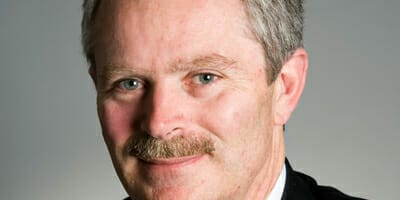
Nobel Prize winner, Robert Merton, has thrown down the gauntlet. He claims that by focusing on a retirement income goal he can beat any competitor that is managing a 70:30 portfolio that has wealth accumulation as the goal. Do you dare take him on?

The defined contribution pension management industry has it wrong, according to Professor Robert Merton.

“There is so much competition over getting alpha, but everyone has access to the same hedge funds. Give up! That’s not what is important,” Merton says.

Instead the focus should be on goals-based investing, he says. And the right goal for most people is an inflation-protected income at retirement, not wealth accumulation. It’s something Merton talks about with a passion that has supported a 45-year career researching risk and lifecycle investing.

Conventional retirement fund investments focus on wealth accumulation and measure risk as volatility of the portfolio, he says. In this context success looks like maximising the size of each individual’s account balance.

Instead, Merton proposes a new generation defined contribution plan – called Managed DC – which puts retirement income squarely in focus as both the investment goal and as the measure of success. Risk then becomes falling short of achieving the income you need. Managing retirement funds in such a way will provide a much higher degree of certainty of actually succeeding, he argues.

“The secret sauce of Managed DC is that if you are willing to agree on a goal, say for example $58,000 per year protected against inflation in retirement, and my competitors and I start with the same Sharpe ratio, but I use dynamic strategies based on the goal versus a 70:30 portfolio, then I promise you I’ll beat them,” he says. “Focusing on the goal is like having 20 per cent more assets.”

Merton, who has spent his entire career writing and researching lifecycle investing first publishing in 1969. These days he is the School of Management Distinguished Professor of Finance at the MIT Sloan School of Management. He is also the University Professor Emeritus at Harvard University,

In his opinion the retirement management industry should change its language, and techniques, to focus on income, and to look at earnings for spending and lifestyle.

“For people outside the financial services industry that is normal, but for the entire history of defined contribution the language is about portfolio returns, not income.”

Most lifecycle products use age as the only trigger for investment allocation differences, but Merton argues income is an essential piece of information.

“Adding income a big step up from age alone,” he says. “For example, a 34-year old woman earning $168,000 is very different to a 34-year old man earning $56,000. Age doesn’t tell you nearly enough to make a sensible asset allocation.

With target date funds the investment mix is such that as you get older you get more conservative because of age alone. That’s wrong. Actually the prime drivers of fund asset allocation are the risk composition of total retirement assets. That includes future contributions and how close you are to fully funding the income goal.”

In this way Merton argues that what drives the asset mix is not age, but the amount of remaining human capital and the funding ratio.

“Although they are correlated why go on a correlation? Go to the primary drivers including income and account balance., Those give you all the answers.”

He believes that defaulted defined contribution funds can get that income information from the administrator, and that getting that information is really important.

Merton who co-founded Long-Term Capital Management, is currently resident scientist at Dimensional Fund Advisors, where he is developing this next-generation, integrated pension-management solution system that addresses the deficiencies associated with traditional defined benefit and defined contribution plans.

He says the motivation for the Managed DC concept came out of the 2000-02 crisis when worldwide stock markets fell and interest rates fell at the same time, an experience repeated in the global financial crisis of 2008-09.

“Traditional DC was not well set up to serve as the core retirement product,” he says, adding in the US defined contribution was originally a supplement to the Employee Retirement Income Security Act (ERISA) as a footnote for higher paid executives motivated by tax.

As corporate funds were struggling with their offering, Merton saw an opportunity.

“What would a CFO rather hear from a manager – a 17 per cent return alongside a 10 per cent fall in the funding ratio, or a 3 per cent return alongside a rise in the funding ratio? The CEO wants to hear that they don’t have to contribute. The funding ratio looks at the income.” Traditionally defined contribution plans only looks at one side of the balance sheet, the asset side. In contrast Merton’s Managed DC borrows some of the elements of defined benefit schemes and takes into account the liabilities side in asset allocation.

To put his ideas into action, Merton chose Dimensional, an independent, transparent firm founded on financial science, something dear to his heart. (Merton received the Alfred Nobel Memorial Prize in Economic Sciences in 1997 for a new method to determine the value of derivatives.)

“For innovating you need the right culture, and Dimensional has the quality people, it’s transparent and has had great success,” he says. “I want to succeed at this, I don’t like the idea of failure, I don’t plan on failing.”

The basic premise of “Managed DC” is income for life adequate for a good retirement, rather than unlimited risk taken in static wealth maximisation strategies. And the investment strategy is the dynamic management of each member’s asset allocation.

“You have to stay live, not fixed, and continuously innovate on a cost benefit basis. It is the art of the science,” he says. “Believe in better not best. It is not realistic to be perfect.”


Robert Merton’s work can be accessed here


Because it’s nearly Christmas, and conexust1f.flywheelstaging.com will close down for the holidays, we thought this research piece was apt.

Elroy Dimson, Peter L. Rousseau, and Christophe Spaenjers, have looked at the impact of aging on wine prices and the performance of wine as a long-term investment, using a unique historical database for five long-established Bordeaux wines that they construct from auction and dealer prices.

The findings suggest that the non-financial “psychic return” to holding wines that are substantially beyond maturity is at least 1 per cent.

Using an arithmetic repeat-sales regression, the researchers estimate an annualised return to wine investments (net of insurance and storage costs) of 4.1 per cent between 1900 and 2012.

Wine underperforms equities over this period, but outperforms government bonds, art, and stamps. Wine and equity returns are positively correlated.

To access the research (open a bottle) and click here The price of wine

Nobel Prize winner, Robert Merton, has thrown down the gauntlet. He claims that by focusing on a retirement income goal he can beat any competitor that is managing a 70:30 portfolio that has wealth accumulation as the goal. Do you dare take him on?

The defined contribution pension management industry has it wrong, according to Professor Robert Merton.

“There is so much competition over getting alpha, but everyone has access to the same hedge funds. Give up! That’s not what is important,” Merton says.

Instead the focus should be on goals-based investing, he says. And the right goal for most people is an inflation-protected income at retirement, not wealth accumulation. It’s something Merton talks about with a passion that has supported a 45-year career researching risk and lifecycle investing.

Conventional retirement fund investments focus on wealth accumulation and measure risk as volatility of the portfolio, he says. In this context success looks like maximising the size of each individual’s account balance.

Instead, Merton proposes a new generation defined contribution plan – called Managed DC – which puts retirement income squarely in focus as both the investment goal and as the measure of success. Risk then becomes falling short of achieving the income you need. Managing retirement funds in such a way will provide a much higher degree of certainty of actually succeeding, he argues.

“The secret sauce of Managed DC is that if you are willing to agree on a goal, say for example $58,000 per year protected against inflation in retirement, and my competitors and I start with the same Sharpe ratio, but I use dynamic strategies based on the goal versus a 70:30 portfolio, then I promise you I’ll beat them,” he says. “Focusing on the goal is like having 20 per cent more assets.”

Merton, who has spent his entire career writing and researching lifecycle investing first publishing in 1969. These days he is the School of Management Distinguished Professor of Finance at the MIT Sloan School of Management. He is also the University Professor Emeritus at Harvard University,

In his opinion the retirement management industry should change its language, and techniques, to focus on income, and to look at earnings for spending and lifestyle.

“For people outside the financial services industry that is normal, but for the entire history of defined contribution the language is about portfolio returns, not income.”

Most lifecycle products use age as the only trigger for investment allocation differences, but Merton argues income is an essential piece of information.

“Adding income a big step up from age alone,” he says. “For example, a 34-year old woman earning $168,000 is very different to a 34-year old man earning $56,000. Age doesn’t tell you nearly enough to make a sensible asset allocation.

With target date funds the investment mix is such that as you get older you get more conservative because of age alone. That’s wrong. Actually the prime drivers of fund asset allocation are the risk composition of total retirement assets. That includes future contributions and how close you are to fully funding the income goal.”

In this way Merton argues that what drives the asset mix is not age, but the amount of remaining human capital and the funding ratio.

“Although they are correlated why go on a correlation? Go to the primary drivers including income and account balance., Those give you all the answers.”

He believes that defaulted defined contribution funds can get that income information from the administrator, and that getting that information is really important.

Merton who co-founded Long-Term Capital Management, is currently resident scientist at Dimensional Fund Advisors, where he is developing this next-generation, integrated pension-management solution system that addresses the deficiencies associated with traditional defined benefit and defined contribution plans.

He says the motivation for the Managed DC concept came out of the 2000-02 crisis when worldwide stock markets fell and interest rates fell at the same time, an experience repeated in the global financial crisis of 2008-09.

“Traditional DC was not well set up to serve as the core retirement product,” he says, adding in the US defined contribution was originally a supplement to the Employee Retirement Income Security Act (ERISA) as a footnote for higher paid executives motivated by tax.

As corporate funds were struggling with their offering, Merton saw an opportunity.

“What would a CFO rather hear from a manager – a 17 per cent return alongside a 10 per cent fall in the funding ratio, or a 3 per cent return alongside a rise in the funding ratio? The CEO wants to hear that they don’t have to contribute. The funding ratio looks at the income.” Traditionally defined contribution plans only looks at one side of the balance sheet, the asset side. In contrast Merton’s Managed DC borrows some of the elements of defined benefit schemes and takes into account the liabilities side in asset allocation.

To put his ideas into action, Merton chose Dimensional, an independent, transparent firm founded on financial science, something dear to his heart. (Merton received the Alfred Nobel Memorial Prize in Economic Sciences in 1997 for a new method to determine the value of derivatives.)

“For innovating you need the right culture, and Dimensional has the quality people, it’s transparent and has had great success,” he says. “I want to succeed at this, I don’t like the idea of failure, I don’t plan on failing.”

The basic premise of “Managed DC” is income for life adequate for a good retirement, rather than unlimited risk taken in static wealth maximisation strategies. And the investment strategy is the dynamic management of each member’s asset allocation.

“You have to stay live, not fixed, and continuously innovate on a cost benefit basis. It is the art of the science,” he says. “Believe in better not best. It is not realistic to be perfect.”


Robert Merton’s work can be accessed here


The city of New York spent $472.5 million on asset manager fees in 2012/13. The allocation of these funds is part of the $68 billion annual budget the City Comptroller has to run the city of New York.

The bureau of asset management that oversees the $137.4 billion in pensions fits within that budget, but the money it spent on asset manager fees has increased more than the returns it generated. How it reins in those fees will be one of many challenges for the new Comptroller Scott Springer.

What would you do with a $68 billion annual budget?

For the full New York city financial report click here

The $91 billion Australian Future Fund’s approach to investing is to get even more sophisticated as it borrows ideas and techniques from other investors, including the risk management and portfolio construction techniques of multi-strategy hedge funds. David Rowley speaks to CIO David Neal.

Many will quickly tell you there is greater return to be made from smart asset allocation than from manager selection, but few investors will jump to expand on this theory the way the Future Fund does.

The journey down that path has been so rewarding it is encouraging them to take what David Neal describes as the “most exciting chance” facing his profession.

For Neal, strategic portfolio construction is typically done at too high a level. For example, he says an allocation to property that is split 60 per cent Australian and 40 per cent international is like taking a view of the world at 20,000 feet. To him, it can be done on a more granular basis.


Current state of play

The Future Fund’s process is to seek the most interesting risk-adjusted return opportunities available anywhere. The goal is to build a total portfolio from these best ideas. So, diversification of risk is sought across the whole portfolio rather than within an asset class.

Opportunities are often sub-sector themes – such as multi-family property or opportunistic energy-related infrastructure in the US.

Each such theme is examined for the levels of premia it delivers from equity risk, illiquidity risk, credit risk, inflation risk and real yield exposure.

This enables it to be compared like-for-like on a risk-adjusted basis with an opportunity in other sectors which are competing for the same capital.

Neal believes there is another level of analysis it can reach. He describes this process as determining the “systematic generators of value”.

For example, this would entail asking of a potential private equity investment, how much of it is a small cap bias? How much of the return comes from leverage? How much value is added from buying off-market?

“Doing that across the portfolio would be interesting to understand the risks a bit more and could lead to a further evolution in our investment philosophy,” he says. “We are not there yet, but that is part of the research we want to do. To get finer grained in understanding our portfolio’s risk exposure. The challenge of looking across all those opportunities, which are totally disparate, and making a decision on where to put the marginal dollar, is significant.

It’s a different way of constructing the portfolio and demands a quite different combination of skills and mindset for an investment team. It is one of the most exciting challenges for the asset-owner profession,” he says.

Neal contrasts this with a more broad-brush approach. “Comparing property and equities in terms of their 10 year characteristics is not the same thing as comparing that building versus that airport versus something else,” he says.

He admits that many aspects of this thinking have been informed by studying others.

He is impressed, for example, with the risk management and portfolio construction techniques of multi-strategy hedge funds.

“We have this incredible privilege of being exposed to the best investors in the world all the time,” he says. “One of the most fascinating things about my job is to get exposure to those and reflect on them, so ‘why are those people doing it that way? That is not the way we do it. See whether there is a tweak or an overhaul required in the way we do it.”


Professionalisation

Neal says new thinking such as this is part of the growing speed of improvement by institutional investors, a process which he likens to professionalisation. The way the very best Australian, Canadian and European funds have shared ideas over the last few years is a key contributor to this change.

Neal says until recently the global institutional fund management industry did not face the same commercial pressures that force private sector businesses to constantly evolve and question their activities.

Low performance, he says, did not mean you went out of business, and change happened slowly.

“It feels to me that the cadence of the asset-owner industry change, especially here in Australia, has really picked up now. You are starting to see much more activity,” he says.

One mark of the need for change was the poor way funds communicated their risk tolerances to fund managers, leading to inefficient relationships and funds often not knowing what they were buying.

“You had investment managers doing their thing very close to markets – very sophisticated, very highly paid, lots of information,” he says.

“Then you had [people within] funds who were quite distant from that; they were not full time, not well paid not that sophisticated from an investment sense; so you had a marked asymmetry in the relationship.”

Neal says the Future Fund, like many other institutions, has sought to narrow the gap. This means being closely engaged with fund managers to the point that they can test, challenge and explore opportunities and drive genuine alignment of interest.


Management style

The Future Fund’s processes are run by a 40-strong team that sticks to tailored principles to work as one. For a fund of its size, this is quite a lean team.

The philosophy it follows is termed “one team, one portfolio” and as part of this, all new investment ideas are debated against each other regardless of asset type.

Moreover, performance remuneration is determined on the basis of performance for the fund as a whole, rather than reflecting the performance of individual asset classes.

Underneath the board the key investment decision-making body is the investment committee which includes the sector heads of each asset class together with the CIO, managing director, director of emerging markets and director of strategic risk management.

Each sector head is responsible for coming forward with their best current ideas and to say what they like and don’t like about their current portfolio.

This is also reflected in the other decision-making structures that are used to assess, filter and review opportunities and existing investments.

It is “an incredibly stimulating environment”, says Neal.

Professionals are exposed to the full breadth of opportunities beyond their own specialism – for example, those in the listed equities team find themselves on the asset review committee understanding the detail of buying a property or an infrastructure asset.

Also, if a sector head has an under-performing contributor to the overall portfolio they are encouraged to get rid of it, rather than empire building.

“Everyone came in on the basis of the contest for capital between ideas and not between people,” Neal says.


People management

When asked whether the process could be prone to individuals using psychological technqiues to subvert, perhaps by getting their ideas chosen over others, Neal replies “absolutely”. He uses the same word in reply when asked whether certain personality types would be better off in another organisation.

“You do not want people who are in it for themselves,” he says.

Similarly, this team-based system will not work if members only offer praise to their colleagues, perhaps as a means of gaining favour or promotion.

“It is a balance between being a real team player and sometimes telling your colleagues that they have got it wrong – and you need to tell them fast frankly and openly,” Neal says.

“The person receiving that information needs to be a team player in the sense that they say ‘thank you for telling me that – I appreciate that, I will go away and think about it some more’.”

He caveats this quickly by stating it does not always happen as sweetly as that, but it is the fund’s aspiration. And if it does not always go down well, it is better than having team members feel like they cannot be bothered to raise concerns.

Neal says that so far this approach has worked pretty well but that it requires ongoing attention and effort, and it means the organisation puts a premium on finding good cultural fit in recruitment.

A more extreme version of this approach comes from global hedge fund giant Bridgewater Associates, which has around 240 business principles in handbook written by the founder and CIO, Ray Dalio. It’s compulsory reading for all staff. (link)

Neal describes this as “an extraordinary codification of a culture and process” and the encouragement of “incredibly frank feedback all the time”, which he admits is challenging for most people, but shows the importance of clear rules of engagement if you want to get to the top.

(A 2011 New Yorker article on Bridgewater gives a good insight.)

Neal’s place in this structure is not that of a typical chief investment officer.

Indeed he suggests that the notional roles of chief risk officer and chief culture officer are more important aspects of his role at Future Fund.

“I would consider myself primarily the engineer of the process and the culture,” he says. “The team does the investing – they are the smart people going and finding great opportunities. A big part of my role is that of chief culture officer – a monitor of the rules of engagement.”


Distractions

Neal has helped create a finely tuned machine and he is grateful for the brief the Future Fund has not to manage assets in house, other than some infrastructure assets.

“Different funds have different approaches and contexts when it comes to in-house management versus an outsourced approach,” he says. “For us, we see a particular advantage in focusing on the total portfolio while bringing our investment expertise to bear through deep relationships with our external managers. It helps us avoid getting dragged in to implementation issues in a way that can be distracting and take us away from what we believe we really need to think about.”

He acknowledges the model is more expensive but it is also part of the distinctive approach to investment and provides a comparative advantage.

This is useful, for example, in an analysis of the current investment outlook, in which he says his fund is positioned neither aggressively or in defensive mode.

“We spend a lot of time making sure we have the best possible understanding of the context that markets are operating within,” he says.

Neal believes the current market, which he acknowledges has large structural imbalances caused by quantitative easing in the US, Europe and Japan, is “reasonably” supportive for asset prices.

“We are neither aggressive or very defensive. We are not afraid of investing in this environment,” he says.

Not that he is over-confident, he realises the weaknesses in the system could easily lead to markets dropping back again.

In the meantime, the fund is taking the keenest looks at the best opportunities given the environment.

“We want to be sold to by people who have great ideas. The life blood of good investing is good ideas,” he says.


Wall Street’s leaders are largely unrepentant for the immense harm their institutions inflicted on the U.S. economy during the financial crisis, and their outlook nd behavior have not changed in any significant way since the crisis, according to a George Washington University Law School paper.

However the lengthy and detailed paper argues there is hope.

“It remains possible that continued revelations of excessive risk-taking and other abuses on Wall Street could finally shif thte weight of public opinion against our new financial oligarchy.”

Author Aurthur Wilmarth argues that critics of Wall Street must presevere in their efforts to persuade the American people to demand fundamental reforms…. that could finally end too big to fail subsideis for megabanks and therefor break Wall Street’s seemingly invincible power.


To access the paper click here Why Washington keeps giving into Wall Street