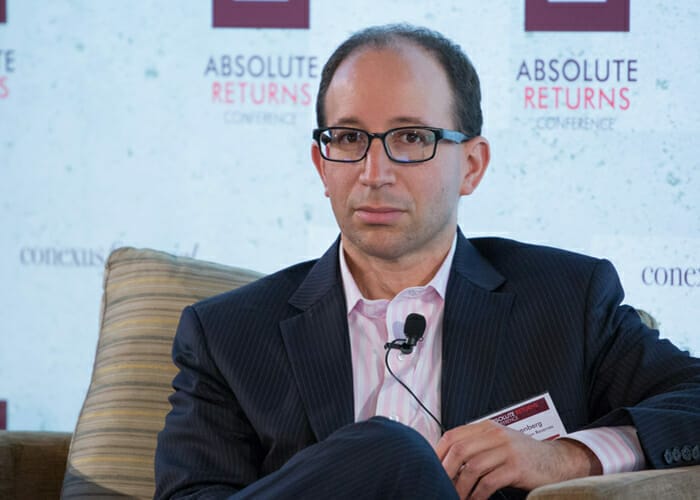
James Grossman, chief investment officer of the $50 billion Pennsylvania Public School Employees Retirement System, PSERS believes disintermediation offers the most important opportunity for investors in coming years.

This global trend towards the reduced role of banks as middlemen, is an opportunity for pension funds to move into high yield corporate debt, he says, insisting that institutional investors are perfectly capable of directly lending to businesses to fill the gap left by banks.

“Pension funds can work with partners who understand how to underwrite credit and who have close relationships with corporate treasurers and know the companies well. In addition there will be no bank infrastructure costs eating away at returns,” he says, in reference to the securitisation process whereby banks’ corporate loans are repacked for institutional investors into lower yielding investments, reducing returns.

It’s just the kind of alternative opportunity that Grossman favours.

PSERS’ 60.6 per cent total funded ratio, as of June 2015, heavily informs investment strategy and his pre-eminence at the fund where he says “he has been around for a while” since joining as a compliance and risk officer in 1997, and becoming chief investment officer in 2014, has engendered many of the changes.

Volatility and risk have been steadily phased out with the reduction of the equity allocation to today’s 37.5 per cent target. While diversification has come with a range of strategies including a 20 per cent target allocation to fixed income, a 21 per cent target for real assets and a 10 per cent target for absolute returns – one portfolio, along with real estate and non-US equities, that did well in 2015.

It prompts Grossman into a robust defence of PSERS’ hedge fund allocation, up 4 per cent for the year, “right on target net of fees,” at a time when hedge fund performance and fees are under increasing fire.

“There is a misunderstanding of what hedge funds should or shouldn’t be doing in a portfolio: they aren’t meant to beat the equity market. If you’d like equity returns, hire a low cost equity manager. For us, hedge funds are a diversifying asset class with low beta and low correlation to equity markets, so that if equity markets fall, hedge funds are expected to do better.”

Casting a look back over PSERS’ 20 worst ever months in the equity market since 2005, hedge funds outperformed every time, with positive returns in 12 of those 20 months.

A new approach

New strategies will include PSERS increasing its allocation to diversified infrastructure from today’s one per cent allocation.

This will entail a more active, view spotting strategy focused on infrastructure within the private debt and private equity markets, rather than simply indexing global public market infrastructure equities.

“We believe the asset class has attractive characteristics and that it is less sensitive to economic cycles. There is lots of competition in infrastructure today but then there is competition for all assets with yield at the moment.”

Of the total fund, 22 per cent is in passive mandates. The 9 per cent allocation to US public equity is entirely indexed and 50 per cent of the non-US equity allocation is also in passive strategies; 80 per cent of the commodity allocation is passive.

Grossman does believe that there are opportunities to add value in non US small cap and emerging market equities where there is “less information flow,” and that active management also pays in fixed income.

Approximately one third of the portfolio is managed in-house with the rest with external managers.

“We don’t have the core competency or staff for private equity or direct real estate,” he says. Allocations to private credit and high yield are also outsourced.

“I believe there would be a cost benefit for the fund in bringing in more staff, but this decision lies with the Commonwealth,” he says, in reference to the State of Pennsylvania.

The decisions Grossman can control are manager selection and here he has persistently trimmed away. PSERS has terminated 19 managers over the past two years (101 mandates have gone over the past 10 years).

Other recent changes include bringing US equities in-house, and investment expenses fell over 18 per cent between 2014 and 2015.

“We are very aggressive when it comes to negotiating our fees, although in certain markets, namely private real estate and private equity, negotiation can be more difficult because of the increased capital going into these spaces. We maintain close relationships with all our managers, all the time. We certainly don’t give them $100 million and say we’ll see you in five years’ time. We meet and get to know them, sit on all of their advisory boards, and we are quick to spot any strategy drift.”

Tougher times for hedge funds means that negotiating fees with hedge fund managers has become easier, he says.

PSERS is also cutting costs by pursuing a co-investment strategy, begun in 2011.

Challenges include successful co-investment being dependent on the deal flow from managers – and managers having an excess deal flow they are prepared to co-invest out. It also requires a strong internal team able to do the due diligence and at PSERS Grossman has to rely on his existing staff to manage co-investments although he says he says he is “working hard” to illustrate the benefits of more staff in this area.

Co-investment, without any management fee or carried interest attached, layered alongside a standardised two and 20 private equity investment can effectively slash costs, he says.

“It can drive the all-in private equity and private real estate management fee and carried interest down, which amounts to co-investment being a considerable fee-saving vehicle, while at the same time enhancing net of fee returns.”

In 2010 PSERS had to sell 8 per cent of its assets to meet its pension obligations. Since then the fund’s negative cash flow has improved and reforms under the so-called Act 120 are gradually increasing the employer contributions to actuarially required levels. It makes for a stressful job but Grossman still enjoys it.

“We have a great staff and a good board of trustees who are supportive and open to ideas. I like mixing with some of the smartest people in finance and I’m definitely not doing the same thing every day.”

As new historical databases are opening up, there are great opportunities for out-of-sample tests of market anomalies. Research shows that the volatility effect also existed in the 19th century. Read more »

In discussing the fees paid by asset owners to investment managers, ‘alignment of interests’ is the objective most commonly stated.

But, in practice, almost all fees are structured either on the basis of a percentage of assets (such as 0.50 per cent), or a performance-related basis (with a base fee of for example 0.25 per cent of assets and a share of outperformance of say 20 per cent above a benchmark or target level).

But are there other ways in which fees could be structured which might, just possibly, be of benefit to both parties, which would surely represent an improvement in the alignment of interests?

Asset-based fees have obvious flaws.

They incentivise managers to grow their asset base by the greatest amount in order to maximise fee revenues (this is not a criticism of the behaviour of managers, it is just a logical view of the effect of these fee structures).

Growth in assets ultimately creates diseconomies of scale and the potential for reduced added value (‘alpha’) delivered by the manager.

Asset-based fees, particularly in volatile asset classes such as equities, also create volatility in levels of fee income for the manager and fees paid by the investor.

For some investors, this volatility can be a material issue, for example when fees are paid by a parent organisation or where fees have to be publicly reported.

For asset managers, it makes their business difficult to manage because their costs are predominantly fixed yet their income is highly variable for reasons outside their control or ability to forecast.

The problem could be addressed by having a fee structure which is a fixed monetary amount which could at outset be based on percentage of assets under management with agreed annual uplifts (for example based on inflation).

This would give both the asset owner and the asset manager a high degree of predictability as to the level of fees on a year-on-year basis, and, for the asset manager, there might be a willingness to accept a slightly lower level of fees than otherwise, because the predictability of this particular stream of income would give it additional value in terms of business planning, budgeting for expenditure and so on.

Performance-related fees are the conventional way in which alignment of the interests of asset owners and fund managers is meant to be achieved.  But as generally structured (base plus share of performance over benchmark) they are not without flaws.

First, to avoid the issue of asset growth leading to diseconomies of scale, performance fees should generally be combined with strict capacity limits for a strategy.

If the manager’s capacity is fully used up, then ‘success’ for the manager will solely be a function of performance through the mechanism of performance-related fees.

But what asset owners are happiest to pay for is not just ‘raw’ performance against benchmark, they want to pay for the added value created by manager skill.

And these are not necessarily the same: it is possible to generate outperformance of benchmarks by taking additional risk, such as by owning credit in a government bond-benchmarked mandate.  Leverage is another risk that can be used to enhance (or rather amplify) returns.

Managers can also adopt persistent ‘beta’ positions (i.e. overweights to an equity factor such as small cap) which may be more effectively captured via an explicit small cap mandate.

If one thinks about private equity mandates, these usually have a performance-related fee element in terms of ‘carry’ above a specified hurdle rate, say 8 per cent p.a.

At its simplest, returns from private equity can be thought of as having (potentially) three elements – a return from investing in equity-type assets, the leverage that is generally used in private equity investing, and the skill that managers use to create value in the businesses they buy and own for a period of time (we ignore for the purpose of this discussion other factors, such as value or size, that may also be driving returns in private equity).

This ‘idiosyncratic’ alpha, value creation by managers, is a really attractive source of return – it is probably fairly scarce and certainly diversifying relative to other sources of return.

Unfortunately, the ‘carry’ approach over a fixed hurdle rate is a very crude way of rewarding a manager for the skill they employ because the total level of return generated in a private equity fund will be heavily influenced by the performance of equity markets during the period of capital being invested ‘in the ground’, exacerbated by leverage, and skill applied will only be a third element on top of these two.

So 8 per cent p.a. will be too low a hurdle if equity markets are buoyant (managers who have demonstrated no skill will collect big performance fees) while it will be too high a hurdle in a period of weak equity markets and really skilful managers may not earn performance fees.

The way to address this is not simple, but it would be for the asset owner and fund manager to agree on a way of isolating the ‘idiosyncratic’ alpha that the manager has generated, and rewarding this well, because it is valuable.

This process might involve (in the private equity example) stripping out what returns the asset owner would have seen if the same capital had been deployed in listed equity markets at the same time (and adjusting for the effect of leverage and other persistent factor exposures).

If this could be done with a reasonable degree of accuracy and robustness, then the manager would be confident in his skill being rewarded (regardless of the market environment) and the asset owner would be confident that performance fees were being paid for genuine added value, not market returns or leverage.  Both sides ought to be happy with this approach.

In what many are describing as a ‘low return world’ investors will quite rationally seek to control fees and other costs. We believe that it is in the asset management industry’s own self-interest to think creatively and engage proactively with asset owners in order to achieve a better alignment of interest in fee structures.


Nick Sykes is the director of manager research at Mercer.

“It looks like a beautiful day!” greets Vijoy Chattergy, chief investment officer of the $14.1 billion Employees’ Retirement System of the State of Hawaii, HIERS, speaking from his office in Honolulu. Chattergy is in the final stages of constructing a new risk-based asset allocation at the fund.

It’s the culmination of a process of reform and regeneration to build a more robust portfolio that began after the GFC, and hastened by the alarming increase in the fund’s unfunded liabilities.

“If you go back 15 years, HIERS had a strong funding status but it has deteriorated to where we are today at 62 per cent. We realised that what we were doing was not going to take us forward. It was a bit of a wake-up call,” he recalls.

Chattergy has led the overhaul at the fund since he was appointed chief investment officer in 2012, having initially joined as an investment specialist. Previous roles included working for the Federal Reserve Bank of New York, and recommending investments in a fund of hedge funds for Japanese asset manager SPARX Group in Tokyo and Hong Kong.

Returning to live and work in Hawaii after two decades away was always his dream, but the challenge of getting the state’s largest pension fund back in the black is the day-to-day reality.

“Lots of my family and friends are members of the plan,” he says. “Mum and Dad are retired professors. My brother is a public sector teacher. If the fund has a bad quarter we have a difficult Sunday dinner!” he says, only half joking.

The new risk-based asset allocation divides the portfolio into a 76 per cent allocation to broad growth, 12 per cent to principle protection, 5 per cent to real return and a 7 per cent allocation to real estate.

Broad growth includes US and global equity, private equity – targeting 10 per cent of the broad growth bucket – and covered calls, first introduced as an asset class in 2011; a less volatile equity exposure comes through credit strategies.

Although broad growth currently accounts for three quarters of the portfolio, this will fall to 63 per cent by 2020.

“We are actually re-making the equity portfolio under new policy guidelines. We’ve completed the passive manager, options-based equity manager, and low volatility global equity selections; and are now finalizing a global equity large/mid-cap and small-cap searches.” The real return portfolio comprises inflation-hedging allocations to timber, agriculture, infrastructure and TIPS.

Crisis Risk Offset allocation

As the outright allocation to long-only equity managers falls, the slack will in part be taken up by a new Crisis Risk Offset (CRO) allocation expected to rise from 10 per cent at the end of 2016, to 20 per cent of the portfolio by 2020.

Here the allocation will be split between tilts to systemic trend-following strategies, alternative risk premia and long duration treasury bonds.

It’s a strategy especially designed to counter equity risk, resulting in a more stable return pattern for the overall portfolio over time. Its crisis-period focus means returns from the allocation may be challenged during non-crisis periods, but Chattergy is convinced of the benefits.

“The CRO is designed to be a line of defence in a major market crisis and should absorb prolonged shocks,” he says. “Success may hinge on our ability to maintain a disciplined approach. When equity markets go up in a bull market we do not want to abandon these principles, as we lag our peers and market indexes. If you believe that periodically there will be crisis events, this approach can work through a full cycle. This is the way we now see the world.” Chattergy plans to go to the market in early summer with a Crisis Risk Offset search. “We need managers that are experienced and knowledgeable for the allocation.”

The readjustments and turnover in the portfolio has resulted in a bidding process that is allowing HIERS to renegotiate better fees with its managers.

“We are substantially bringing down our costs,” he says. HIERS, which has grown under Chattergy’s leadership to have five investment professionals, has “no desire” to build the infrastructure for “an investment shop” at this time.

However, the fund may build an in house capability to better participate in private market investments.

“We will seek opportunities in the private market where we can outperform public markets,” he says.

A bigger in-house team would potentially allow the fund to be more responsive to co-investment opportunities and one off projects.

Chattergy hopes to have increased assets under management to around $20 billion by 2020. Long-term his aim is that the fund is fully funded by the mid-2040s, estimating that by then HEIRS will have $45 billion assets under management.

Should investors start to consider the emergent opportunities in high yield and distressed debt? We think so. The market stress that arose in late 2015 resulted in a significant widening in credit spreads as price moves were exacerbated by severely reduced liquidity.

As the credit cycle continues to mature, we believe that stressed and distressed credit (especially in the US) could offer investors a rare opportunity to generate attractive returns in today’s low (or negative!) yield environment.

Fundamental and technical headwinds

Much of the poor performance of corporate credit in recent years has been due to losses in energy and commodity-related issuers, as weaker worldwide demand and excess supply sent oil and commodity prices down.

The other big problem has been reduced liquidity, as tighter regulations have discouraged banks from holding credit. Without the banks, there were often no willing buyers, spreads widened and the absolute price of many corporate credit securities plunged. This, in turn, exacerbated volatility, leading to dramatic swings in prices.


Number of US HY Bonds experiencing more than a 10 per cent price loss in a month
graph01_opt


Credit fundamentals have also shown signs of deterioration as 2015 company earnings reports came in weaker alongside rising debt levels.

The low default rates of around 1 per cent to 2 per cent in recent years may be due to low interest rates masking the weakness of many company balance sheets. In this environment, idiosyncratic risk is heightened and dispersion in performance at the security level more likely.

The proportion of corporate credit trading at distressed prices now surpasses the levels set in 2011. The illiquidity in credit markets has had a disproportionate effect on lower-rated credits which have significantly underperformed higher-rated credits. The ratio of spreads on global CCC-rated debt to B-rated debt (a measure of stress in credit markets) has become wider than at the worst point in 2008.

Many macro risks are likely to persist, and the stability of capital markets depends on effective management by central banks. Geopolitical risks abound and China’s gradual slowdown will continue to place pressure on emerging markets. Default rates will eventually rise and volatility is unlikely to abate.

The opportunity for investors

It is often at the darkest hour that opportunities present themselves. We therefore believe that it is now time to consider how to take advantage of the structural changes and dislocations arising in credit markets.

Having highlighted many of the negatives in the current environment, it is worth noting that we believe we are unlikely to be in a 2008-style scenario.

Leverage is manageable and although some industries are stressed, it is likely that access to capital will remain relatively accommodative.

Federal Reserve policy along with easier underwriting may extend the cycle and postpone the uptick in defaults. It is now, more than ever, a “market of credits” rather than a “credit market”, affording those with rigorous research coupled with patience, capital and flexibility the potential to generate attractive returns.

Any further deterioration in economic conditions, combined with rising default rates as the credit cycle matures, could create significant opportunities for investors willing to tolerate a degree of volatility and illiquidity.

While investors will need to take into account their own specific return objectives, liquidity constraints, time horizon and risk tolerance, options worth considering include:

  • Long-only credit opportunities funds. These strategies could be thought of as sitting further up the risk–return spectrum and with less liquidity than traditional multi-asset credit funds.
  • Credit-oriented hedge funds. These strategies would have the flexibility to invest both long and short and will rely to a greater extent on manager skill than market beta when compared with long-only credit opportunities funds.
  • Private markets vehicles. These typically focus on opportunities at the higher end of the risk–return spectrum and tend to offer the least liquidity to the end investor.

While the opportunity may not yet be upon us, investors would do well to heed the military maxim that “time spent in reconnaissance is seldom wasted”.


Phil Edwards, European director of strategic research, and Diane Miller, senior manager researcher, Mercer


No longer can analysts use the excuse there is inadequate data for incorporating ESG into investment decisions.

The Sustainability Accounting Standards Board (SASB), a not-for-profit chaired by Michael Bloomberg with Mary Schapiro as vice chair, was formed to set market standards for disclosure of material sustainability information to investors. With “material” defined as likely to affect financial performance.

The organisation – founded by Jean Rogers and made financially viable through donors including Bloomberg Philanthropies; foundations such as Ford, Rockefeller, PwC and Deloitte – is predicated on a belief that ESG factors can impact company financial performance and drive long-term value.

The fact there is a now a broader range of risks and resource constraints beyond just access to capital makes the use of standardised financial reporting to investors insufficient. This means that a new, standardised language is needed to articulate the material, non-financial risks and opportunities facing companies that affect their long-term value creation.

Bloomberg has put its money where its mouth is and was the first company to use the voluntary SASB standards; and a number of investors, including CalSTRS are behind the initiative, with chief executive Jack Ehnes on the board.

“SASB will help forge the link between ESG and how to put it into practice,” Chris Ailman, chief investment officer of CalSTRS, says. “Our board has said they want us to integrate ESG, and our managers are saying how do we do that? ESG is all about looking at not just the balance sheet, but also the footnotes. SASB is focused on that, it looks at what is material for each industry. “It is really important to us that SASB has defined material as affecting financial performance, which is right down the centre of our fiduciary duty,” Ailman says. “For over 10 years when we’ve hired managers, we grill them on whether they look at ESG. Ninety-seven per cent of our managers confirm they use ESG criteria, now the board wants us to prove it.”

Standardised comparable data a big improvement

Director of capital markets policy and outreach at SASB, Janine Guillot – formerly chief operating investment officer at CalPERS – says the standards can be used to incorporate data into investment strategies; for corporate engagement to improve sustainability issues; or at the total portfolio level.

Standardised, comparable data will improve all of those tools and enable them to be more metric-focused.

“I’m so excited about SASB, it’s a tool for investors to integrate sustainability across the entire portfolio,” she says. “The standards are firmly focused on what will impact a company’s financial performance. Whatever type of investor you are, you will have the right access to comparable data on sustainability. We are a piece of market infrastructure.”

In a presentation to the CalPERS investment committee, Guillot said her view has moved from being a sceptic about whether ESG factors should be incorporated into decision-making, to seeing that they must be incorporated into investment decision-making for long term investors.

But this, says Guillot, is still aspirational because incorporating ESG into investment decision-making in a rigorous and scalable way requires data – data that’s reliable, relevant and comparable.

“That’s the gap that SASB aspires to close,” she says.

SASB was formed to set market standards for disclosure of sustainability information to investors, with a focus on identifying sustainability topics and metrics that are material, decision-useful and cost-effective for companies to provide. It has now developed provisional sustainability accounting standards across 11 sectors and 79 industries, and is conducting industry consultation with companies and investors.

“This will enable companies to report comparable information so performance can be benchmarked. We hope companies will compete to improve performance on sustainability metrics, just like they do on financial metrics today,” Guillot says. “Existing sustainability reporting is not standard and they don’t have industry-specific performance metrics. The SASB accounting standards are the first that allow comparison of peer performance and benchmarking within an industry,” she says.

Companies hit by ‘survey fatigue’

As an investor, Chris Ailman says he would like companies to report on a more consistent basis.

“Companies are dealing with survey fatigue: they are hit with surveys from lots of directions. SASB will provide consolidation and a consistent format, and then other groups can use it as a data feed. It means comparisons are now possible, and a financial analyst wants a quick financial analysis on who’s better or worse,” he says. “ESG is such a broad topic it is begging for a definition, and we are 100 per cent behind it. We will integrate it into our process and work with investment managers on how they pick stocks.”

Guillot says within a corporate, the SASB standards should be incorporated into regular financial reporting and be the responsibility of the CFO. If these internal controls and frameworks exist then investors know it is reliable, and it also gives a framework for CEOs and boards to benchmark performance.

“Our vision is that companies will compete on sustainability information, like they do with financial information,” Guillot says. “The standards will also allow investors to understand the sustainability risks they are exposed to given their asset allocation and ensure companies they invest in are sustainable.”

“Widespread adoption of these standards would give a common language for talking about sustainability performance. It would enable integration of ESG into investment decision-making with rigour and at scale. This would be a better outcome for society, and long term investors.”

As a sign of the momentum in the industry, the SEC’s has included a discussion around sustainability disclosure in its recent Regulation S-K concept release, looking for comment on modernising certain business and financial disclosure requirements.

It says: “We are interested in receiving feedback on the importance of sustainability and public policy matters to informed investment and voting decisions. In particular, we seek feedback on which, if any, sustainability and public policy disclosures are important to an understanding of a registrant’s business and financial condition and whether there are other considerations that make these disclosures important to investment and voting decisions. We also seek feedback on the potential challenges and costs associated with compiling and disclosing this information.”

It is asking for comment.