New Zealand Super has pulled back its strategic tilting positions for the first time since the program was introduced in 2009, as it sees most asset classes returning to long-term fair value.

The strategy has added an annualised return of 1.2 per cent for the NZ$34 billion ($24 billion) sovereign wealth fund since inception; however, David Iverson, head of asset allocation at New Zealand Super, says prices are now closer to fair valuations, so the relative sizes of the tilt positions will be pared back.

The tilting decisions are driven by the fund’s view on how current prices compare with estimates of the fair value of assets based on long-term fundamental and economic factors.

Even though the tilting is executed through short-term trades, Iverson is firm that it is a long-term strategy, because it is all based on long-term valuations. Momentum, for example, is not a signal the fund uses in its tilting decisions, because it is a short-term behavioural signal.

The relative sizes of the positions are determined by how far current prices have deviated from the fund’s assessment of fair value and the relative confidence in tilting that asset.

“We started this program after the [global financial crisis] and have had those positions on for a long time. Now we see prices closer to our fair valuations and there is less opportunity,” Iverson says. “This is new for us…Prices are closer to our fair values in equities and currencies.

“One of our beliefs is that a long-horizon investor can outperform short-horizon investors. We can do everything short-horizon investors can do, and more,” Iverson says. “The illiquidity premium is a fact, but that is not the only way to act long term. You can also take advantage of short-term activities.”

More active in unlisted assets

The fund does its strategic tilting in-house, and has a team of four dedicated to it, partly to reduce transaction costs, but primarily because of the difficulty in getting a manager to maintain the discipline of acting long term while transacting in the short term.

While the strategic tilting program, which has done much of the heavy lifting for the fund over the past seven years, will not be as active, the fund is taking active risk in a number of other areas, particularly in unlisted, including timber – which is run internally – distressed debt and life settlements.

All of its active risk decisions are based on a long-term outlook.

“For example, in distressed credit, we look at where we are in the cycle and how attractive it is, our views on loan default rates, downgrades versus upgrades, spreads in the credit bands, where we are in the cycle and the ride through. We have been in distressed for a while. We were in European distressed debt, now the US has started sparking and we’re looking at that,” he says.

The fund’s timber allocations are primarily managed in-house, while European distressed debt is managed externally (by Bain), as is US life settlements (by Apollo).

New Zealand Super uses a reference portfolio to benchmark the performance of its actual investment portfolio and the value it is adding through active investment strategies. The reference is a low-cost, passive, listed investments portfolio split 80:20 between growth and fixed income investments.

About two-thirds of the fund is invested passively and in line with the reference.

As an active investor, NZ Super then adds value to the fund using illiquid assets, manager selection and trading activities.

The fund’s active risk falls into five baskets: asset selection; market pricing – arbitrage, credit and funding; market pricing – broad markets; market pricing – real assets; and structural.

The strategic tilting falls into the market pricing – broad markets bucket. Timber and life settlements fall into the structural bucket.

At the end of February 2017, the actual asset-class exposure of the fund was global equities (66 per cent), fixed income (11 per cent), timber (5 per cent), private equity (5 per cent), New Zealand equities (4 per cent), infrastructure (3 per cent), other private markets (3 per cent), other public markets (2 per cent) and rural farmland (1 per cent).

In the 12 months to the end of March 2017, the fund returned 23.14 per cent versus the reference portfolio of 19.78 per cent; in effect, adding 3.36 percentage points over the year.

Since inception in 2003, New Zealand Super has returned 10.04 per cent, versus the reference portfolio of 8.67 per cent.

Howard Brindle, the chief operating officer at Universities Superannuation Scheme Investment Management is one of the most experienced investment operations executives in the pension industry. Before joining the £57 billion fund ($69.3 billion), which runs about two-thirds of its assets in-house, he was head of JP Morgan’s European Transfer Agency Product and chief administration officer for Lehman Brothers Asset Management Europe. He talks about business transformation and the importance of talent.

Top1000funds.com: What is the most critical operations factor for dealing with growth?

HB: In my experience, it’s the strength and experience of your people. You need strong, experienced senior staff who understand how investment businesses work. Attracting good quality people involves a number of things, not just remuneration; developing a positive culture is important, certainly in terms of retention, and is something we focus on a lot at USS. Having strong senior staff also helps, as good people tend to hire good people.

Of course, being at one of the biggest and most innovative pension schemes in the country helps, too. Working in a pension fund is an incredibly attractive alternative to hedge funds and big banks. We provide all the complexity, challenge, variety and pace of those environments, but with less artificial client-related deadlines, and without the internal bureaucracy of a large organisation. As a result, we are able to attract and retain top-quality talent, and can give them as much responsibility as they are able to handle.

What are the critical systems and processes superannuation funds should have in place if they are to bring assets in-house?

The benchmarking is clear: when a certain scale is reached – I would say greater than £5 billion per asset class, maybe £10 billion for equities – the cost advantage means that in-house teams perform better. I’d caveat that by saying you should in-house only assets for which you have scale and only when you are confident you will be invested in them for the long term.

For a defined benefit scheme, or any multi-asset fund, the starting point is an investment book of record, with a consolidated record of all assets, linked to a risk system. Asset allocation decisions are the biggest investment decisions a scheme makes. For single-asset, defined contribution funds, an investment book of record is not as relevant.

Is it essential to have good performance analysis tools? Should trading be done in-house and if so what systems should be used?

For managing the actual underlying assets, portfolio management is the most critical system. Performance reporting, accounting, valuation, collateral management – they can all be outsourced effectively. But a portfolio management system is key. Historically, these were different per asset class, but now there are solutions (for example, Bloomberg AIM, BlackRock Aladdin) that can cover most asset classes from a single system, and can also support processes from front to back. Having a simple core system architecture is a huge benefit.

Trade execution can be outsourced, although not as easily. However, we’ve not felt the need to do so, [thanks to] more electronic trading venues, more seamless integration of execution venues with core portfolio management systems, and appropriately skilled portfolio managers.

To get the most out of our core systems, we use a highly skilled in-house development team that enables us to support any new business initiatives, such as integrating new teams, new external managers, new analytic systems, new reporting and so on.

What type of staff do you need to manage and monitor systems?

You need people who are skilled and experienced in investment operations and IT. Find them, employ them and look after them.

How should you reward in-house investment staff, and how do you make them accountable?

The starting point needs to be the philosophy. What are you willing to pay for above-market performance? With scale, the cost-benefit to the scheme will be there, but the compensation philosophy, the governance and the sponsors need to be aligned.

Investment performance has a significant impact on overall funding levels, so it is arguably in the best interests of our sponsors and members for us to offer largely performance-related packages that attract and retain good-quality staff who can continue to achieve fantastic results on their behalf.

Being a captive asset manager has tremendous benefits if you can take the long view. We measure and reward staff based on performance over a five-year horizon using a formulaic underpinning to compensation, but it cannot be based just on the numbers. We always apply a discretionary overlay to ensure pay is fair and proportional to individual contribution and performance.

How can pension funds work better with their custodians and other providers to get more transparency around their data? What is the best way to use the data that you do have; i.e., how do you interpret data for efficiency and better decision-making?

Larger, more complex funds, like USS, can no longer rely on custodians to provide all the data. If you trade exchange-traded derivatives or over-the-counter derivatives, these may not be cleared through your custodian. Custodian data is also based on confirmed trade data and can be slightly out of date as a result. We reconcile our records to our custodians every day on T+1, but we also reconcile to external manager records, to the clearing houses and valuation agents. This puts a burden on the in-house operation, but means we are not reliant on a single partner, and operate using multiple custodians and clearers.

What is a reasonable budget for technology? How could operating budgets be best allocated and managed?

USS has taught me that it’s better to have quality over quantity, and that you shouldn’t underestimate how much you can deliver if you give good people, who understand the business and technology, the right tools and support. We support a £57 billion fund; about 69 per cent of assets are managed in-house, with more than 100 portfolios and more than 1000 transactions a month. We have an IT team of 10 people and an operations team also of 10 people. Our investment book of record is internally developed, all our system integration is managed in-house and we are able to respond quickly and efficiently to new demands. We’re quite unique in the UK, which, together with our size and scale, drives our innovative, cost-effective, in-house approach.

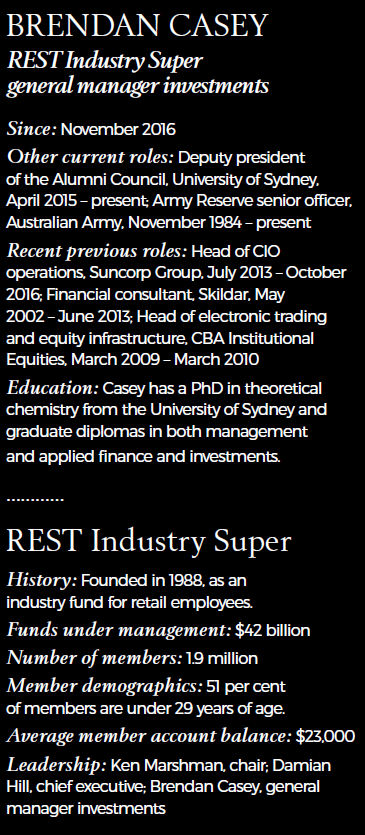
As adept at giving orders as taking them, REST Industry Super’s Brendan Casey juggles his dual careers in military operations and investment operations with aplomb.

Managing $42 billion in investments at one of the country’s largest superannuation funds is a big job but, even on its toughest days, the pressure pales in comparison to working under enemy rocket fire in Afghanistan.

REST’s recently appointed general manager investments, Brendan Casey, says 32 years in the Australian Army Reserve, including an active deployment overseas in 2011, have shaped him for the biggest civilian leadership role to date of his varied career.

“Leadership, planning and resilience are the qualities the army has given me,” says the former chemical engineer turned quantitative analyst, turned stockbroker, turned asset manager, turned investment operations expert.

A defence background that has taught Casey how to both lead and follow orders is set to prove invaluable in working with the REST investment committee – well known as one of the most hands-on in the industry.

Casey recently sat down with Investment Magazine at REST’s Sydney offices, in his first media interview since joining the superannuation fund on November 1, 2016.

He painted a picture of himself as a man not easily ruffled.

“[In Afghanistan], I went through six months where every other day people were rocketing our base,” he says. “People were dying every day. That was such an extreme level of stress. I can’t imagine anything happening here that could come close… It is much easier working in a civilian environment…much gentler.”

“The beauty of that is that I’m always calm and it’s hard to stress me.”

Immediately prior to joining REST, Casey spent a little over three years at ASX-listed insurance and wealth management firm Suncorp as its head of investment operations.

At REST, he fills the fund’s top investments job, which had been left vacant for five months following the departure of Ronan Walsh in May 2016, after just six months in the position.

REST independent chair Ken Marshman told Investment Magazine Casey’s “terrific” background in investments and investment operations made him an ideal candidate for the role, and that he was also impressed by his life experience beyond the financial services industry.

“He has a very diverse set of backgrounds and interests; a wellbalanced but very active life,” Marshman says. “He appears to be driven to excellence…and his track record shows a high level of mental agility.”

Casey started his professional life as a chemical engineer working internationally for DuPont and gained a PhD in chemistry, specialising in polymers. A dearth of career opportunities for senior scientists at home in Australia, where he and his wife, who also holds a PhD in chemistry wanted to raise their family, led to a career change.

After answering a advertisement in the Sydney Morning Herald titled ‘Move from science to finance” Casey landed a job as a quantitative analyst at County (now Citi) and never looked back, proceeding to rise to head of portfolio and trading, then moving on to various roles with Commonwealth Bank of Australia before landing at Suncorp and now REST.

Former Suncorp chief investment officer Nick Basile, recruited Casey as his deputy at the insurer, having previously been his boss at CBA.
Military precision

Basile says Casey has a “firm but fair” management style that “gets things done.”

“Probably the best recommendation you can give someone is to hire them again,” Basile says. “He tends to have very high expectations of his team, but he communicates goals early and clearly and delivers.”

Basile says Casey was always clearly ambitious and sought out career development. And as he was building his career in the financial services sector, he was simultaneously progressing up the ranks in the Australian Defence Force.

At the age of 19, Casey was already commanding a 10-man section in the infantry. Today he is responsible for 14,000 high school cadets as the commander of the NSW Australian Army Cadet Brigade. The plan is that his next assignment will see him promoted to brigadier general in the Army Reserve, in charge of 5000 adult service personnel.

It is notable that someone so ambitious and experienced at leading others is also comfortable following orders.

Most super funds of REST’s size employ a CIO to lead their investment strategy, under the guidance of the board’s investment committee. At REST, the investment committee, working closely with the fund’s longstanding asset consultant JANA, has always taken a much stronger role.

Casey says the fact the fund was recruiting for a general manager investments to implement its strategy, rather than a traditional CIO to set the strategy, was exactly what appealed to him.

“The job description matched me so perfectly,” he explains. “The investment committee fills the role of a strategic CIO and I fill the role of an operational CIO.

“Day-to-day decisions a CIO might make, I make. But longer term decisions go to the investment committee, which meets monthly.”

REST’s investment committee is led by fund chair Marshman and comprises five other trustees, plus JANA founder John Nolan, who sits on the investment committee as a non-voting member.

JANA executive director John Coombe, head of research and investment outcomes Steven Carew, senior consultant Matt Griffith and consultant Matt Gadsden also attend REST investment committee meetings.

The industry fund’s ties with its National Australia Bank-owned asset consultant, which has held the mandate for 26 years, clearly run deep.

Marshman is a former chief executive and chair of JANA.

So far, Casey is finding the close working relationship with the investment committee and its advisers constructive.

“JANA obviously have a house view but they’re willing to challenge that thinking on [how well it applies] for us,” he says. “They definitely speak their minds, especially John Coombe – he is not one to be handcuffed.”

Tilt to cash

The portfolio strategy Casey has been tasked with implementing over the short term is to tilt away from equites towards cash and credit securities.

REST is already holding 6 per cent of the portfolio in cash, ready to buy bargains in the event of a market dip.

This is driven by a view that equity markets are overvalued in a low interestrate environment and fear of heightened geopolitical risk, following Brexit and the election of Donald Trump as president of the United States.

“There are different views within the investment committee on whether things are going to be positive or negative because of Trump,” Casey says. “A lot of people think there will be a short-term boost in the US economy, but there is concern as to whether it can sustained…and what effect his policies might have in other markets.”

Another element of REST’s investment model that is different to other funds is its heavy reliance on subsidiary Super Investment Management (SIM): a separate, but wholly owned, externally operated funds management business.

“Across the industry, there is a push towards in-sourcing, but REST has always had a pseudo-internal investment team,” Casey says.

REST does not manage any investments internally, but has about 20 per cent of its mandates with SIM, an arrangement set up more than two decades ago.

Since its creation, SIM has been forbidden from taking on any clients other than REST.

“That is a philosophical approach in that we want them purely focused on REST and returns for our members,” Casey says.

It is also REST policy that SIM cannot be the fund’s exclusive manager in any asset class, with the exception of cash management, to keep the business on its toes.

“We perform due diligence on SIM, receive monthly reports, and assess them against benchmarks and their peers, just like any other manager,” Casey says.

The REST model of having a powerful investment committee fulfilling the strategic CIO role, a general manager investments focused on implementation, and external fund managers (including the wholly owned SIM) carrying out the day-to-day trades is unique in the industry.

“It is not typical, but it has obviously worked very well, as can be seen by how well the fund has performed and the great returns delivered for members,” Casey says.

The fund’s MySuper option – REST Core – was the top-performing growth fund in Australia over the 10 years to June 2016, with an average annual return of 6.4 per cent.

Casey hopes to add “a couple” of new roles to his team of 11 direct reports at REST, but says he is more concerned with building capability than headcount.

“The biggest area where I want to work with my team on lifting their capabilities is improved project planning skills,” he says. “Defence is all about planning…the finance sector not so much.”

With $42 billion in funds under management, REST is placed as the ninth-largest super fund in the country by funds under management.

But with more than 2 million accounts, it ties with its biggest rival ($103 billion AustralianSuper) as the super fund with the biggest membership.

This fact hints at one of the biggest challenges for REST’s executive management: looking after the interests of members with meagre balances.

REST is the default fund for some of the biggest employers in the retail and hospitality sector – such as Woolworths, Coles and McDonald’s.

More than half (51 per cent) of REST’s members are under age 29. Most members were automatically signed up to the fund when they got a low-paid casual job early in their working life.

Educating young members about the importance of super and how small contributions made early in life can add up to a better retirement is an important focus for the fund.

The demographics of REST’s membership also have a direct impact on the investment strategy Casey is tasked with implementing.

“Our members have got a long future ahead of them, so our style is to focus on growing long-term returns,” he says. The fund’s core MySuper strategy has a 78 per cent allocation to growth assets.

Frustratingly for Casey and his team, one of the most important drivers of total net returns for their most vulnerable members is completely beyond their control.

It is required by law that all super funds automatically sign default members up to a group life-insurance policy that includes three types of cover: death, total and permanent disability (TPD), and income protection.

The relative merits of default group life insurance, particularly for members with low balances – for whom the premiums leave a heavy dent in their retirement savings – is the subject of hot debate.


 Insurance dilemma

Each year, some default members with low balances pay out more in insurance premiums than they receive in investment earnings.

It’s a perverse situation, where default insurance premiums are eroding the retirement savings the scheme is intended to protect.

This is particularly challenging at the moment, when sluggish global growth means super funds are likely to struggle to deliver the type of average annual investment returns members have grown used to in the past decade over the 10 years ahead.

Casey told Investment Magazine that the insurance conundrum is an issue he has discussed with REST chief executive Damian Hill, who is a contributor to the Insurance in Superannuation Industry Working Group established in December 2016 with the goal of producing a new code of conduct by the end of 2017.

REST now has the simplest and cheapest default group life-insurance policy of any super fund in the market.

“That is intentional, because it is arguable whether very young people get much benefit from default life insurance,” Casey says.

Basic cover for total and permanent disability and income protection tends to represent good value to most members, but for the large swathe of REST’s members, who are aged under 25 and don’t have any dependents, the value of death cover is highly questionable, he says.

In the coming months, a parliamentary joint committee will examine the question of whether death cover should remain a mandatory default inclusion for default super members.

“It’s a question that is definitely worthy of a review,” Casey says.

This article first appeared in the February print edition of Investment Magazine. To subscribe and have the magazine delivered CLICK HERE. To sign-up for our free regular email newsletters CLICK HERE.

We believe the standard tools of economics, and the risk methods derived from them, are not going to steer us through market dislocations and crises.

At the University of California Office of the Chief Investment Officer, we are developing a new approach to risk management that may be better suited to dealing with market dislocations. We call this Risk Management 3.0. It extends risk management beyond the standard Risk 1.0 methods – like value-at-risk – which use historical relationships that assume the future will look like the past as their guide. It also looks beyond Risk 2.0 stress testing, which allows for non-historical stresses, but isn’t able to take the cascades and contagion of crises into account.

Based on our recent experience, economics does not fare too well in times of crisis. Despite having an army of economists and all the financial and economic data you could hope for, on March 28, 2007, then-Federal Reserve chair Ben Bernanke stated to the Joint Economic Committee of Congress that:

“The impact on the broader economy and financial markets of the problems in the subprime market seems likely to be contained.”

Less than three months later, this containment ruptured, taking a course that blew through one financial market after another. In 2008, Bernanke testified that there might be failures within the ranks of the smaller banks, but:

“I don’t anticipate any serious problems of that sort among the large internationally active banks that make up a very substantial part of our banking system.”

That September, Washington Mutual became the largest financial institution in US history to fail.

Risk Management 3.0 aims to be a better predictor of crises than Bernanke was. It is based on agent-based models that draw from complexity science, and take a bottom-up approach of looking at the interactions of the entities that make up the financial system, to uncover what emerges for the system overall.

Agent-based models at work: traffic flows and congestion

To see agent-based models at work, consider one area where they have become a standard tool: traffic. Traffic has readily identified agents: the drivers and their cars. When we are driving, we are operating in our own micro-environment, seeing a small set of the other cars on the roadway. The drivers react in different ways. Some go back and forth from one lane to the other. Some go slowly in the left lane, annoying all of us. Some speeding in the right lane. One minute, we might be part of a co-ordinated, smoothly flowing stream of traffic; another, we’re unaccountably contributing to a ripple effect of congestion.

All of this can be expressed in an agent-based model:

There are agents (cars, people) that employ various heuristics and can act with some degree of independence or autonomy.

At the start of each time period, each agent observes its environment and acts according to its heuristic. The agent’s environment is only a local view of the overall system.

The agents’ actions change the environment.

In the next period, each agent sees its new environment, altered based on the actions of the previous period, and takes action again. Thus there is an interaction between the agents and the environment, and between one agent and another.

These are the threads of agent-based models in a simplistic example. It ultimately boils down to the dynamics of interactions driven by the various agents and their environment, and the heuristics applied to that environment.

Models for financial crises

To understand how agent-based models can deal with the risks of market dislocations and crises, consider an analogy with an area where agent-based models have found application – dealing with the stampede of people escaping a fire. If you are a fire marshal, the critical question is whether people can get out in the case of fire, and this depends on three things: the number of people in the space, how many people can exit per minute based on the number and size of egress, and the time available to exit based on the flammability of the space. We are not looking at people walking through the exit in an orderly way. There is the potential for panic and stampedes. So we need to model this based on how people behave in a crisis – a job for agent-based models.

Using this as an analogy for the financial system, the spark creating the fire is a market shock. Market concentration measures the number of people in the market, liquidity determines the rate at which people can exit and leverage or, more generally, the potential for forced selling, determines the flammability of the market, and thus the number of minutes available to exit. Things get particularly complicated when we are dealing with financial markets. The exits shrink as investors push through them to liquidate. Flammability increases if the exits become smaller, because in financial markets the drop in liquidity fuels cascades.

So for Risk 3.0, and the use of the agent-based model that underlies it, we start with concentration, leverage and liquidity, and then see how that informs actions in the face of a market stress.

This time – every time – it’s different

A crisis is not simply a fat tail event or a bad draw from the urn. It is a draw from a new urn. Agent-based models allow us to recognise some essential aspects of the world, ones that are particularly apparent during crises. The real world is a rich and complex place. There are many different players and institutions interacting in sometimes surprising ways, changing the market environment, and these changing them in turn.

The standard Risk 1.0 and 2.0 models will work some of the time, like when people are all pretty much the same, doing the same sorts of things as always. But they generally aren’t all the same, and don’t all act the same. Especially during periods of crisis. That is when we need to move to Risk Management 3.0.


This essay is derived from, The End of Theory: Financial Crisis, the Failure of Economics, and the Sweep of Human Interaction, by Richard Bookstaber, Princeton University Press, 2017.


Jagdeep Singh Bachher is chief investment officer, and Richard Bookstaber (pictured) is chief risk officer, of the Office of the Regents at the University of California, which manages a portfolio of $100 billion.

The $12.5 billion School Employees Retirement System of Ohio (SERS) plans to trim its allocation to hedge funds through the course of the year, building on a strategy begun during its last asset liability study three years ago.

“We have had a number of discussions with the board, our staff and consultants and it looks like the current asset allocation is reasonable,” says chief investment officer Farouki Majeed, speaking from the fund’s headquarters in Columbus – Ohio’s capital city. “We do have concerns that the hedge fund allocation of 10 per cent is high, and we might trim this down. But I am not in the camp of eliminating hedge funds altogether.”

In 2013, SERS decided to reduce its hedge fund allocation from 15 per cent of assets to 10 per cent. That money went from hedge funds into real assets and that is the plan this time as well.

Gruelling 2016 for hedge funds, healthcare

The decision follows a gruelling 2016 for SERS’s hedge fund allocation, which was hit particularly hard when Visium Asset Management, the fund’s equity long/short manager specialising in healthcare, folded mid-year.

“It was a disappointing year on account of hedge fund manager underperformance and healthcare was a volatile play,” Majeed says. “Once we realised the problems with Visium, we began to withdraw money; we were never fully exposed right through.”

A UK-based, relative value quant manager for the portfolio also had negative returns, further weighing it down. Yet Majeed still says hedge funds are a vital part of the investment puzzle because of the diversity the allocation brings to the fund.

“The hedge fund and fixed-income portfolios are risk diversifiers because their contribution to total fund risk is lower than their asset allocation; this is the role these allocations play in the portfolio,” Majeed explains, adding that the hedge fund portfolio is bouncing back.

“At the end of December, our five-year net return for hedge funds was higher than its benchmark and well ahead of fixed income. Multi-asset strategies have brought a five-year return of 4.74 per cent, net of fees.”

SERS uses 20 hedge fund managers, reduced from 48 after a policy to allocate more money to fewer managers. This has helped reduce fees, as has negotiating longer lock-ups with high-conviction managers.

The process of reviewing the asset allocation has prompted Majeed and his team to examine introducing target allocations to sub-asset classes, namely high-yield debt, emerging market debt and master limited partnerships (MLPs) in the US – the mid-stream infrastructure asset. However, the review left the CIO unconvinced that separate allocations are necessary.

“Developing niche asset classes makes the policy portfolio more complicated,” Majeed explains. “The optimisation process becomes prone to more errors. There are more inputs, and the more inputs you have, the more likely you are to have errors. I believe less is more.”

He says the fund is now more likely to gain additional exposure to these assets via fixed income in actively managed, opportunistic allocations.

“If you have a target allocation for a fixed amount, you are forced to allocate it, otherwise you have a discrepancy relative to the policy portfolio. I prefer to access these assets on an opportunistic basis.”

Real assets within this opportunistic allocation include high-yielding infrastructure, such as aircraft leasing and oil terminals, and mid-stream MLPs.

“Valuations in MLPs were down 50 per cent in 2015. It was a good time to buy,” Majeed says. Credit strategies in private debt have also proved a rich seam, with SERS investing in funds lending directly to small- and mid-market companies.

“We look at the managers who have had very little or no credit losses,” he explains. “Terms include upfront fees and strict covenants; the loans are highly secured and shorter-term, so not beyond five years. Most are repaid before that anyway.”

SERS assets are split between a 22.5 per cent allocation to domestic stocks, a 22.5 per cent allocation to international stocks, 19 per cent to global bonds, 15 per cent to global real assets, 10 per cent to global private equity, 10 per cent to multi-asset strategies and 1 per cent to short-term securities.

“We are comfortable with this exposure to growth for now,” Majeed says.

REITs in favour

The allocation to real assets comprises property, infrastructure and real-estate investment trusts, in a portfolio that has netted a return of 11.58 per cent over the last three years. The portfolio used to have a heavy allocation to value-added real assets, in a risk-oriented approach with high levels of leverage. Now, 80 per cent of the portfolio is in core assets and the leverage is about 30 per cent on a total portfolio basis. Majeed particularly likes the allocation to income-producing REITs, which account for less than 5 per cent of the allocation to real assets but could, in theory, climb up to 10 per cent.

“REITs have equity-like volatility but offer good returns over a very long period of time,” Majeed says. “Over the long term, they have performed better than private real estate. It is helpful having a liquid component in the real-estate allocation.”

He also notes that accessing real-estate opportunities is becoming more difficult.

“In 2013, it was still a good time to deploy assets, when the allocation was increased from 10 per cent to 15 per cent. Managers could take and deploy money quickly and were also buying assets 25 per cent lower than the high values pre-financial crisis. Right now, the markets are much more richly priced. We will be very selective now.”

Majeed attributes much of the fund’s success to governance. The investment team provides the board with monthly reports, as well as quarterly and annual reviews that include analysis of all asset classes and managers. In return, the board has delegated all investment decisions to the investment staff.

“The delegation the board gives us to invest is crucial to our success, and our governance is a source of alpha,” Majeed concludes. “Not taking every investment decision to the board [allows us to] be opportunistic and nimble.”

The giant Japanese Government Pension Investment Fund (GPIF) is pushing its external managers to fulfil stewardship responsibilities and improve their own governance, as part of its conscientiousness as a “super-long-term investor”.

About 24 per cent of the fund is in domestic equities and it exercises its voting rights via external asset managers. Therefore, it fulfils stewardship responsibilities by promoting constructive engagement between its external asset managers and investee companies. In 2016, all of the fund’s external asset managers exercised their voting rights.

Targeting short-termism

The ¥144 trillion ($1.26 trillion) GPIF has clear expectations of its external managers around stewardship, including improving their own effective governance, exercising voting rights and integrating environmental, social and governance (ESG) principles.

This year, in addition to those tasks, GPIF is also asking external managers to establish a remuneration system for directors and employees of asset managers to prevent short-termism, and to look at passive management in the context of stewardship.

The fund is also calling for applications for more fund managers in passive Japanese equities.

About 80 per cent of the fund’s domestic equities are already in passive management.

In the qualitative assessments of GPIF’s external passive managers, the weighting to “activities of stewardship responsibilities” has been raised to 30 per cent, from 10 per cent. However, engaging fully with companies is difficult territory and some of the fund’s passive managers have indicated that the current fee structure does not provide enough compensation for the stewardship responsibilities they are asked to fulfil.

Of the fund’s 19 external domestic equities managers, 16 have signed the United Nations’ Principles for Responsible Investment, and seven have introduced independent outside directors.

In a formal summary report of its stewardship activities in 2016, GPIF indicated it would move away from one-way annual monitoring and toward constructive communication. It will also expand its stewardship activities to asset managers handling international equities. About 23 per cent of the fund is in foreign equities.

In the 2016 stewardship report, the fund states that: “It is essential for GPIF as a ‘universal owner’ (an investor with a very large fund size and a widely diversified portfolio) and a ‘super-long-term investor’…to minimise externalities of corporate activities (environmental and social issues, etc.) and to promote steady and sustainable growth of the overall capital market.

Equities managers step up efforts

The report also showed that all the fund’s domestic equities managers have set up or reinforced departments or committees dedicated to overseeing stewardship activities and stepped up their efforts to include continuous organisation-wide stewardship activities, not merely voting rights. They also all responded positively about ESG integration, although only a few of them have used ESG meaningfully in actual engagement.

Since 2001, the fund has returned 2.7 per cent annualised. It has been focusing on stewardship and ESG activities since May 2014, when it announced acceptance of Japan’s Stewardship Code.

More recently, it established a stewardship and ESG division comprising seven members – including two full-time staff members. And in November, it convened the Global Asset Owners’ Forum, to exchange ideas with global pension funds on ESG issues.