A low funding ratio of 64 per cent and a belief that mainstream public and alternative assets are fully priced is motivating the $11 billion New Mexico Educational Retirement Board to move into an unusual alternatives portfolio. The new allocation will include investments in litigation finance and reinsurance, as well as assets that tap royalty streams from intellectual property, music and medicines.

“We haven’t made any investments here yet. We’re doing the ground work but we expect to make our first allocation later this year,” says chief investment officer Bob Jacksha who oversees one of the more diverse portfolios among US public pension plan peers.

“We view public assets and mainline alternatives as fully priced; we’re now looking for other things that aren’t as well known and haven’t attracted so much capital.”

The allocation will sit as a subcategory within a portfolio of diversifying assets uncorrelated to public equities and core bonds that includes risk parity and global tactical asset allocation.

But choosing managers to look after such investments is a challenging process given the need for proven experience in these relatively new asset classes.

Litigation finance, where investors back costly litigation in return for a share of a successful claim in a niche strategy untethered to financial markets has only recently begun to attract university endowments and public pension funds. Early converts include the Municipal Employees’ Retirement System of Michigan and the Employees Retirement System of Texas.

“These investments are more obscure areas,” Jacksha says. “We’ve met with some managers who are on their second or third fund and these are the type of managers we’d like to work with. I’m not saying we won’t do first time managers – we’ve invested with first time managers in private equity and real estate – but we usually invest here with a group that has worked together for a while, maybe a lift out from another shop.”

The new allocation is in keeping with the trend at the fund to invest less in assets where the return comes from capital appreciation in favour of those with contractual cash flows.

“Capital appreciation is nice when it happens, and we still get it from our portfolio, but it’s irregular and harder to count on,” he says. “Our diversification theme has been to stabilise the results. It means we don’t have the lows. Unfortunately when you don’t have the lows, it means you also give up the highs, but we accept that.”


A preference for private markets

The new allocation will also keep the focus on private markets, where the fund has done best in recent years.

“Our public assets benchmarked against peers and indices have had a tougher time than private investments. They haven’t done poorly; they just haven’t excelled. Public markets are so liquid and so transparent it’s tough to add value.”

It means NMERB has indexed all its US public equity allocation, around half of its developed market public equity allocation, and is considering further indexing.

“If you can’t add value it doesn’t make sense to pay manager fees,” he says. “We now spend our limited resources in private markets.”

The best performing asset classes for the fund in 2016 were private infrastructure, private real estate and private equity which returned 13.4 per cent, 11.8 per cent and 9.2 per cent respectively.

NMERB’s latest allocation also chimes with Jacksha’s steady transformation of the fund, which he joined as CIO in 2007. Back then NMERB had a 70:30 equity/fixed income split.

“The trustees got tired of seeing what happens in a downturn when you have that much shaped around equity premium,” he says.

Today the fund’s target allocation to public markets is split between public equities (33 per cent), core bonds (6 per cent), REITS (3 per cent) and 3 per cent in cash.

Along with real estate, private equity and infrastructure, private investments include global tactical asset allocation and risk parity as well as opportunistic credit.

Rather than a specific allocation to hedge funds, Jacksha now favours investing in hedge funds via other assets. Most of the investments in the opportunistic credit portfolio are with hedge funds; similarly, NMERB invests in one Bridgewater hedge fund in global tactical asset allocation.

“We don’t view hedge funds as an asset class,” he says. “We’re indifferent as long as it fits the underlying asset.”

The fund also recently allocated new mandates in distressed debt and water property rights as well as infrastructure credit.


Strategy driven by funded ratio

The latest innovation comes against the backdrop of the NMERB’s large deficit. At only 64 per cent funded, Jacksha can’t afford any plummet in asset values.

“We need to keep the overriding strategic issues of the fund in mind when we’re casting our asset allocation targets,” he says.

Despite his ever-watchful eye on the deficit however, he is adamant that it isn’t something the fund can “invest its way out of”, observing that “investments didn’t get us into this problem”.

Since NMERB began recording its total rate of return in July 1983, it has earned an annual rate of 9.1 per cent, more than the 7.25 per cent it has been targeting since April this year, and more than the old target of 8 per cent. He believes the deficit is an historical structural problem of an imbalance between contributions and benefits.

Internal management

Internal management is another theme at the fund. Jacksha now oversees 30 per cent of assets in house with a team of 11, up from five when he started.

“We always try to think of two broad issues,” he says. “One is active or passive and if managers can’t add value, we should be passive. The other is if we should be internal or external, because if we can do it properly internally without giving up performance, we can do it cheaper.”

It is a thought process encapsulated in a dynamic, internally run core bond portfolio that used to be outsourced.

The allocation, which plays to Jacksha’s own experience in fixed income, has outperformed the Bloomberg Barclays US Aggregate Bond Index since inception in April 2015. The investment grade allocation comprises Treasuries, corporate, mortgage-backed and asset-backed bonds with the team able to deviate from the aggregate for outperformance – achieved most recently by being overweight credit.

“We don’t make duration bets,” he says. “We’re not good at predicting where interest rates are going and just focus on moving around the sectors.”

But with two vacancies on his team, building internal expertise is tough. It is no help that pay levels for most of his staff rank at the bottom of national pay surveys of state pension funds. Despite understanding from the board, pushing pay rises through the executive in times of austerity is hard.

“Calls for pay raises fall on deaf ears,” he laments.

The Dutch pension fund managers PGGM and APG Asset Management have done much of the leg work for other investors wishing to align their investments with the sustainable development goals (SDGs). The two investors are finalising a highly detailed process that identifies classifications where they see potential sustainable development investment (SDIs) opportunities that could transform the United Nations’ targets into tangible returns for institutional investors.

The result is investment opportunities linked to 13 of the UN’s 17 SDGs, and they are well on their way to integrating SDIs in the portfolio across all asset classes.

The managers, which invest a combined €600 billion ($705 billion) say these investments can fulfill the risk return requirements of their clients and provide a substantial and measurable contribution to one or more SDGs. Last year, APG achieved returns for its main clients, the $448 billion civil service scheme ABP and the $63 billion scheme for the building sector, BpfBouw, of 9.5 per cent and just over 8 per cent respectively.

“This is an important step towards developing a common language and moving from broad understanding of the investment principles to actual rules,” says Claudia Kruse, managing director sustainability and corporate governance at APG.

“More asset owners are dedicating resources to collaborate with us on this.”

The UN’s SDGs aim to help solve global challenges on climate, poverty, healthcare and education, and will require an estimated annual $5 trillion to $7 trillion by 2030.

In a highly detailed process PGGM and APG identify taxonomies or classifications where they see potential sustainable development investment (SDIs) opportunities that could transform the UN’s targets into tangible returns for institutional investors.

However not all SDGs are investable. For example, SDG 16 seeks peace and justice and strong institutions but the asset managers deem that it is “not possible to contribute to this goal through investment activity”.

In contrast, SDG 14 which targets “life below water” is investable because it could include potential areas of investment like systems and projects aiming to reduce water pollution such as wastewater treatment, sustainable fishing technologies and marine operation services like oil spill responders.

Measuring impact is one of the most challenging factors, say the investors. The taxonomies distinguish between investments where impact has and hasn’t been measured, and actively encourage reporting on measurable impacts.

A global leader in responsible investment

ABP, which is managed by APG and which has forged a reputation as a global leader in responsible investment, has set a target of doubling its allocation to high sustainability investments.

The pension fund has pledged to increase its allocation to SDIs from $34 billion in 2015 to $68 billion by 2020, including an investment of at least $5.9 billion in renewable energy, up from current levels of around $3.3 billion. So far the fund has invested $48 billion into SDI areas.

The allocation to SDIs will be split across asset classes. However SDIs are easier to integrate in allocations like renewable infrastructure than for example hedge funds, explains Els Knoope, senior responsible investment and governance specialist at APG.

“All asset classes will be included although not all have the same challenges, or opportunities,” Knoope says. “We are developing approaches that fit the different challenges of private and public markets with our portfolio managers.” The majority of the assets APG manages are run in-house.

ABP’s strategic investment mix consists of a 60 per cent allocation to equities and alternative investments and a 40 per cent allocation to fixed income investments. As the fund increasingly aligns strategy with SDIs this could change, Knoope believes. “It is a slow-moving process; as investment opportunities surface we will prioritise them and this could result in a shifting of capital overtime.”

And the giant pension fund is already well advanced in the process of integrating SDIs across the portfolio. By 2020 it aims to invest only in equities and corporate bonds where the company “pays sufficient attention to sustainability and responsible business practices,” according to its 2016 Sustainable and Responsible Investment Report. Under the strategy, the fund divides companies into leaders and laggards; over time it will divest from laggards unless they reform.

Elsewhere ABP’s green bond portfolio, where the fund invests in companies and governments to finance sustainable projects, has increased from $59 million in 2015 to $1.6 billion in 2016. Examples include new investments in the Belgian materials technology company Umicore, strong in metal recycling and rechargeable car batteries, and the Norwegian company Tomra Systems, which makes machines for collecting returned deposit bottles in supermarkets.

ABP’s real estate portfolio is already another important contributor to the pension fund’s SDIs target. The value of high sustainability investments in real estate rose from $24 billion to $27.5 billion last year.

Even where integration is trickier, ABP is making progress. To align its 5.1 per cent allocation to private equity with greater responsible investment, the fund designed a new questionnaire in 2016 that companies are required to complete prior to investment.

“We look at their policy, how they implement it, how they report on it and how they monitor it,” the fund says. “We also want to know how they approach climate change and the diversity on their boards.”

Trailblazers under observation

Other institutional investors are keenly watching APG and PGGM’s progress. Sweden’s four main buffer funds and Australia’s Construction and Building Unions Superannuation fund, Cbus Super, have expressed support for the research.

“We are seeing a great deal of interest from other investors keen to work with us who welcome the initiative,” Knoope says.

PGGM has already invested $11.7 billion in line with four SDGs themes – climate, food security, water scarcity and health – and is targeting $23 billion by 2020.


I start from a belief that the contribution rate is one of, if not the, most meaningful pieces of information for a defined contribution (DC) saver. It reminds them how much pay they are giving up month in, month out, and how generous or otherwise their employer is. It is certainly more meaningful than an annual statement of the accumulated account balance.

However, the thought here is whether we could convey even more meaning through the contribution rate, perhaps via a set standard, akin to performance reporting following the global investment performance standards (GIPS).

The thought was triggered by a comparison between the Dutch and Canadian defined benefit (DB) markets. In essence the Dutch system is run on a solvency basis, so the accrued liabilities should be fully funded at all times in case the sponsor suddenly goes bankrupt. The liabilities are therefore discounted at a government bond rate – say 2.5 per cent for indicative purposes.

All safe and secure, but the contribution rate needs to do most of the heavy lifting as any mismatch between assets and liabilities is very risky and needs to be closed down quickly if things start to go wrong.

The Canadian system is run on a going-concern basis, where the sponsor is assumed to continue to make contributions, and discount rates tend to be around 5.5 – 6 per cent. Here the heavy lifting of future provision is split between the contribution rate and investment returns.

There is much that could be debated about the two systems, but let us instead lift this thought back into a DC context.

A DC saver could smooth their lifetime consumption needs the Dutch way or the Canadian way.

For the time being, let’s keep the pension the same in both cases. We could therefore offer a choice to our DC saver between a zero-risk pension outcome albeit at a contribution rate of, say, 45 per cent of pay a year (Dutch) and a contribution rate of, say, 20 per cent (Canadian) but with a higher level of risk associated with disappointing investment returns and sponsor failure (albeit hard to quantify).

While observers may have a strong belief in which is better, we have actually set these up to produce the same result. What differs is the risk.

And my question is, are we doing a good enough job in communicating risk to end savers in terms they can understand?


A new approach to explaining riskis

Now I admit, quoting a 45 per cent contribution rate in a DC context may not be the best way to go – in fact it could have the unintended consequence of lowering pension saving (“what’s the point!”). But a 45 per cent contribution rate buys you the DB gold standard: retire at 65 on a 67 per cent replacement ratio, likely inflation-indexed, and payable no matter how long you live. Perhaps we define the DC gold standard at a lower level.

In Australia the industry body, the Association of Superannuation Funds of Australia (ASFA), publishes income levels associated with a “moderate” or “comfortable” retirement.

We could re-label these as we liked – bronze and silver, say – but we could agree on a set of parameters that were consistent with a number of retirement outcomes – so moderate or bronze requires a (say) 15 per cent contribution rate, while a 20 per cent rate gets you silver.

I am not underestimating the difficulty of agreeing on the necessary parameters and assumptions (mortality, inflation, returns, age of retirement, etc) but that would only be necessary if the idea has any merit.

The framework could be developed further. Member engagement would now be centred on the contribution rate.

Imagine the following possible communications:

  • “Investment markets have been weaker than expected, so we calculate that you will need to raise your contribution rate from the current 15 to 15.25 per cent to maintain your target of moderate or bronze outcome. Alternatively, you could raise the level of your investment risk and leave your contribution rate at 15 per cent – but this is highly likely to increase the future variability of your contribution rate. If you leave the investment risk at the current level and do not raise your contribution rate by 0.25 per cent now, we calculate that you will need to raise it by 1 per cent in five years’ time to stay on track.”
  • “Investment markets have been stronger than expected, so we calculate that you have built a small buffer relative to your target of moderate or bronze outcome. We would advise that you take no action as the buffer is small, but the following options are available to you …” The options would include lowering the contribution rate, lowering investment risk (to lock in gains), raising investment risk (buffer) or raising the target outcome (with accompanying contribution rate or investment choices).

To recap: the point of this article is to consider one way to improve member engagement and better empower the end saver by offering choices in terms that are meaningful and understandable.

The underlying belief is that the contribution rate is very meaningful to the end saver. The idea proposed is that we should make more of the contribution rate and the associated risks it brings or addresses.

Tim Hodgson is head of the Thinking Ahead Institute


The A$120 billion ($95 billion) AustralianSuper is a formidable equities investor. Not only does it have large lumps of cash to allocate to equities, it has an unwavering belief in active management, looking for its managers, both internally and externally, to take concentrated positions.

The AustralianSuper balanced fund, which holds around 80 per cent of members’ assets, has an exposure to listed equities of about 55 per cent, split across Australian equities (26 per cent) and international equities (29 per cent).

In dollar terms, this is more than $47 billion in assets and makes AustralianSuper the largest investor in equities in the country. The Future Fund is the only other asset owner that is larger than AustralianSuper, but its listed equities allocation only sits at around 29 per cent of its A$130 billion ($103 billion).

Not only does AustralianSuper have the largest dollar amount invested in equities, but it is also the fastest growing fund in the country, receiving inflows of about $6 billion a year which makes it the number one fund in Australia for cash flow.

“To be the biggest fund and the fastest growing is very rare,” says head of equities, Innes McKeand.

“The overweight position, compared to other funds in Australia, reflects our positive view on equities. The macro economic environment is supportive and the global economy is growing well,” he says from the fund’s headquarters in Melbourne.

But while the size of the portfolio and the pace of growth is an advantage for the fund, it also presents some constraints on how it is managed.

Domestic bias, global reach

In the domestic market AustralianSuper engages with every company it invests in and is a significant shareholder in a bunch of different companies. Here size is an advantage.

The fund invests in around 370 Australian equities stocks, with Commonwealth Bank the biggest position and the four banks, BHP, Telstra and Wesfarmers making up its top holdings.

“When we engage with companies it’s not just about ESG but that we understand the business,” he says. “We can influence the share price so they listen. Our pitch to them is that we are a shareholder of choice – we are a large, stable, long-term investor.

“We say we’ll engage with you in a thoughtful way, and now we’re among early phone calls if there’s a capital raising going on.”

This influence over, and close relationship with, listed companies is one of the advantages the fund has in the local market, and one McKeand says it wants to make the most of.

“So we’ll probably always have a domestic bias but inevitably more will go offshore because of our large flows,” he says.

Globally, Amazon is the largest holding and the fund has about $12 million worth of stock. Other large holdings are Tencent, Visa, Microsoft, Baidu, Accenture, Facebook, Time Warner and Oracle.

“The insights of the global equities team have a great effect on our Australian equities team, a good example being Amazon,” he says.

The fund’s global presence is growing. It has an office in Beijing, and a small London office and McKeand predicts it will have offices in most major financial centres within 10 years.

“You’d expect that from a global investor,” he says.

The matter of China

At the time of this interview McKeand had just arrived back from an Asian advisory committee meeting, which the fund holds four times a year in a revolving list of major Asian cities.

“We spent a lot of time talking about China,” he says. “We think the biggest risk in the global economy is China, not the US. The risks are building there; we’re more cautious than we once were.”

AustralianSuper has exposure to China primarily through the big Chinese internet stocks listed in New York and Hong Kong, which sit among the fund’s largest international exposures – Tencent Holdings being a high profile example.

“The local market inclusion of China in the MSCI indexes is interesting but we don’t spend time on index inclusion,” he says.

“The quality you can access is variable among Chinese companies – we don’t want to invest in low quality companies just because it’s in an index.”

The problem of size

One of AustralianSuper’s greatest challenges, and one felt by large funds around the world, is that because of its size, it is difficult for a manager’s outperformance to affect the total portfolio, unless there are large mandates involved.

“We want to get economies of scale,” McKeand says. “If we find a manager which we give a $200 million mandate to, and they give us 10 per cent a year in alpha, that’s great but we’d need to get a lot of those to dent the total portfolio.”

As a result, and also partly in reflection of the fund’s firm belief in active management, AustralianSuper awards only a few, but large, mandates to external managers. In international equities the average AustralianSuper mandate is $3 billion.

“But you need to put that in the context that the overall equities portfolio is worth $60 billion,” he says.

“We do recognise they’re large amounts of money and our operational due diligence on managers is a lot more than it used to be.”

A trend to insourcing

Most of the equities portfolio is still managed externally and despite the hype about internalisation, only around 10 per cent of international equities and around 40 per cent of the Australian equities portfolio is managed internally.

There is, however, a clear trend to insourcing, and the aim is to have 50 per cent for the entire portfolio internally managed by 2021-22.

The fund is about halfway to achieving that target, and currently about 25 per cent of all assets are managed internally, including some fixed income and direct deals in infrastructure and property alongside equities.

“There are limits to our ability to do everything and there will always be managers with greater insight who can do it better,” McKeand says.

The fund only employs 30 managers across the entire equities portfolio, including the in house team, and within those managers he says the focus is to look for those with concentrated portfolios.

“We’re paying hundreds of millions of dollars in fees, so for that we want an active result,” he says.

“We want all the things you’d expect: highly skilled managers at low cost with extremely high alpha.”

He speaks somewhat tongue in cheek, but stresses he is prepared to pay for managers that can outperform.


Evolution in internal management

An internal team is responsible for manager selection and they look for specific qualities in managers including those that are at an early stage of development with teams made up of skilled individuals in the right environment and with the right ownership.

“We want managers with concentrated portfolios, with differentiated approaches and strong research underpinnings,” he says.

“We tend to prefer managers with skin in the game who own or control their own business and tend not to like managers that are, for example, owned by a large bank or insurance company.”

The internal equities team, which is made up of 40 investment staff, is treated like any other manager and is listed on the fund’s manager line up online.

“In many ways the internal team is like an external manager,” he says. “We give them a mandate and they have a performance target and investment restrictions. My job is to hold them to account.

“We always have the power to hire and fire external managers, but for clarity of governance the investment committee has control of the internal mandates.”

In international equities, two strategies were funded internally last year. The first was a fundamental strategy, run by Christine Montgomery whose previous experience includes managing money at Fidelity, Franklin Templeton and Martin Currie.

“It took longer than we liked to set it up,” he says. “It’s hard to get the right people. This team is managing a reasonable amount and while it’s still early days I’m happy with their progress.”

The second was an internal quantitative strategy that uses machine-learning techniques and is headed up by Jonathan Tay.

“This is a natural area for us to focus on because of the scaleability,” he says, adding that more time and money will be spent on technology to support the data-driven strategy.

The Australian equities staff, which includes both large and small caps, is now organised as one team and the entire equities portfolio is run on one internal equities platform.

“It’s quite collaborative,” he says. “For example, in international equities there are a couple of sectors where they lean on the Australian equities team for help.

“They’re all looking for good quality companies with intrinsic value and scaleable mandates.”

So with essentially four internal equities mandates – large cap and small cap in Australian equities, and a global fundamental and global quant strategy – McKeand is happy with the internal team set up.

“We don’t want too many internal mandates,” he says. “We want to benefit from scale and not make it too complicated.

“We want to manage from the top level down so we can take enough risk at the individual level and it affects the overall portfolio.”

McKeand believes it is still early days for AustralianSuper in terms of internalisation, with only four years of internal management under its belt.

“Performance is pretty good,” he says. “We could always be better but it’s only been a short time.”

The international equities team has a benchmark of the MSCI plus 2 per cent and in less than a year since inception it is ahead of that benchmark, he says.

But he says if the team underperforms it’s difficult to plan on how to deal with it.

“In an external manager context,” he says, “if something goes off the rails, like a generational transfer of leadership, ownership changes or style drift, it’s hard to be presumptive. You can’t decide in advance how you’ll react.

“The important thing is to keep the right mindset. It’s not a one-year game: we’re investing for the long term.”

This points to one of the key advantages of the internal team, he says, which is greater alignment with members’ interests.

“Internal teams can take a longer term view,” he says. “There’s greater alignment with member interests and it takes out agency issues.”

“But if we did go through a period of underperformance, my experience shows the best thing to do is to see if the process is on track. If they’re still doing what we want them to do then it’s OK.”

Costs and performance

To a large extent the internalisation process is being driven by costs.

“If we could get an equivalent strategy at the equivalent cost externally then we’d consider it,” he says. “In the long run we’ll run internal at a quarter of the cost of external.

“We’re now able to do a bunch of things ourselves, but we can’t do it all ourselves. We like managers who can do better than us and we’re prepared to pay for that.”

The internal team has outperformed external managers over the past three years and also delivered lower costs to members.

The whole AustralianSuper portfolio costs 50 basis points to run, and asset class heads have budgets for outperformance, costs and illiquidity buckets.

“The cost budget at each asset class focuses us on what we need to do and focuses us on targeting alpha and costs. We’re prepared to pay for alpha if we see it,” he says, adding that most hedge funds fail to get through the cost budgets that are set.

McKeand oversees all equities, including private equity which with an MER of between 300 and 400 basis points is an expensive asset class relatively speaking.

AustralianSuper only invests with the top private equity managers that have performance persistence, which limits the number of managers to around 15 to 20 globally, “at a stretch”, he says.

“If this can give us a significant premium over equities then we’ll back them. It’s an expensive part of the portfolio but it justifies its existence.”

McKeand has been in charge of equities at AustralianSuper since 2011, prior to which he had experience as CIO of AIB Investment Managers and as head of investments at Nestle UK Pension Trust.

“There’s still a lot here for me to get interested in and be challenged by,” he says. “We’ll be building the internal framework for a long time. We’re still growing and there is so much more to do.”

This includes building out the quant investment strategy and using factor investing as a way of understanding the portfolio. The team has been spending a lot of time enhancing the platform, the operational due diligence and the technology needed to operate a large internal capability.

“We’re at a significant stage of evolution,” he says. “This is still effectively a greenfield and this makes it attractive to me and other members of the team. We can do a lot of things you wouldn’t get to do in other funds.”

AustralianSuper’s Australian equities managers

Airlie Funds Management

Alphinity Investment Management

Antares Capital Partners

AustralianSuper Internal Investments

Avoca Investment Management Pty Ltd

Celeste Funds Management Ltd

Eley Griffiths Group Ltd

FIL Ltd

Goldman Sachs Asset Management Australia Pty Ltd

Industry Funds Management Pty Ltd

Northcape Capital Pty Ltd

Paradice Investment Management Pty Ltd

Perpetual Investment Management Ltd

Tribeca Investment Partners Pty Ltd

Vanguard Investments Australia Ltd


AustralianSuper’s international equities managers

Ausbil Investment Management Ltd

AustralianSuper Internal Investments

Baillie Gifford Overseas Ltd

Causeway Capital Management LLC

First State Investments International Ltd

Genesis Asset Managers LLP

Independent Franchise Partners LLP

Jackson Square Partners LLC

LSV Asset Management

MFS Institutional Investors Advisors Inc

Orbis Investment Management Ltd

State Street Global Advisors Australia Ltd

Vanguard Investments Australia Ltd

Vontobel Asset Management Inc

Westwood Management Corp


AustralianSuper’s private equities managers

AustralianSuper Internal Investments

Frontier Investment Consulting Pty Ltd

Industry Funds Management Pty Ltd

Industry Super Holdings Pty Ltd

Members Equity Bank Pty Ltd

Quay Partners Pty Ltd

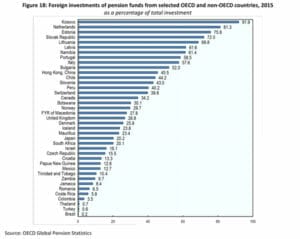
The extremely low levels of foreign investments in pension funds in emerging countries is cause for concern, according to the World Bank, which is calling for more diversification of portfolios.

A new paper by the World Bank, Pension funds capital markets and the power of diversification, outlines the need for pension funds, in emerging markets in particular, to invest more of their assets internationally in order to achieve higher returns with potentially lower volatility.

The paper calls for a deliberate creation of innovative domestic investment vehicles combined with more reasonable overseas investment limits, based on the size of the pension fund assets relative to macroeconomic and market factors.

Some countries, including Brazil, Turkey, Thailand, Colombia, Costa Rica and Romania, have less than 7 per cent of their pension assets in foreign investments.

Brazil has less than 0.2 per cent investing offshore, according to the OECD global pension statistics. This compares to the Netherlands, which has 81 per cent of its pension assets invested outside the country.

Some emerging market countries have restrictions on the amount of foreign investments, notably some African countries and India which have a limit of zero.

“There is often much resistance to allowing pension fund assets to invest overseas as governments and authorities wish to see domestic savings used for domestic purposes,” the paper says. “Macroeconomic factors clearly play an important role – including foreign exchange regime, capital flows and policy and availability of foreign currency held by a country’s central bank … however, deciding on the amount and allocation of these international investments should be done in a systematic fashion.”

In particular it says that the amount of foreign investment allowed should be linked to the size of a pension fund’s assets compared to the size and turnover of domestic capital markets or flows, and currency movements.

The paper looks at Chile as an example of a country that has more systematically increased its overseas investment limits, raising them as the pension fund assets have grown and become too large for the domestic market.

The regulatory authorities in Peru have also gradually increased their limits on several asset classes.

The paper also points out that improving governance and management is an important precondition for diversifying these portfolios.


Nevada’s public pension plan only pays 11 basis points in total costs due to 80 per cent of the fund being indexed. But CIO Steve Edmundson says low fees are a byproduct, not the reason for the strategy.


Low complexity, low costs and a disciplined rebalancing strategy are the key elements in how the Public Employees Retirement System of Nevada (NVPERS) aims to meet its long-term investment return target of 8 per cent a year.

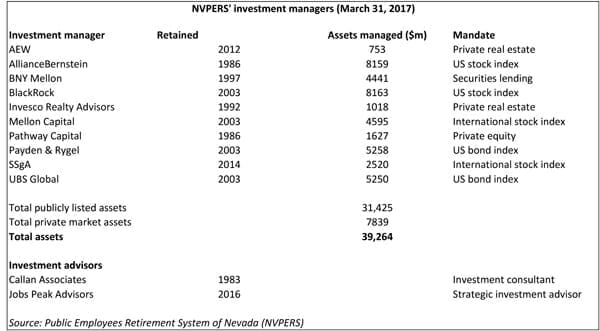
About $32 billion of NVPERS’ $40 billion, as at June 30, 2017, is managed in index strategies, explicitly designed to minimise complexity and to minimise the risk of the fund missing its return target.

As a by-product of an indexed-focused strategy the fund also boasts low costs. NVPERS accounts for the year ended June 30, 2016, reveal total investment expenses – including fees paid to fund managers and consultants, as well as investment administration expenses – were $39.3 million, or just 0.11 per cent of the fund’s $35 billion of assets at that date. The fund’s non-investment administrative expenses were just less than $11 million, or about 0.03 per cent of fund assets.

At these levels, NVPERS is low-cost by North American pension fund standards – even including $24.7 million of fees reported by the fund as paid to private equity general partners over the period.

Analysis by CEM Benchmarking in 2014 found US pension schemes spent, on average, 0.59 per cent of assets on investment management. The same analysis found Dutch funds – the lowest cost in the world – spent on average 0.44 per cent of assets.

NVPERS paid just $498,000 over the year to one of its investment managers for the management of an $8 billion US equity index portfolio – less than 1 basis point.

The chief investment officer for NVPERS, Steve Edmundson, says that while minimising complexity is an objective of the fund, it’s “a chicken or an egg thing: an uncomplicated fund leads to lower investment costs”. But a focus on keeping costs down precludes a high degree of complexity anyway.

Edmundson says the greatest benefit of indexing is often overlooked in the debate about the pros and cons of management styles, and it has less directly to do with minimising costs than many assume.

“Yes, it’s uncomplicated and, yes, it’s low-fee,” he says. “However I think more important than all that, indexing is a tool to put the exact market exposures into the portfolio that we’re looking for.

“That’s something that’s sometimes not appreciated when people refer to indexing.

“They say, well, you’re just getting what the market gives you, which is true, but what it means is we get to put in the exact market exposure that we want.

“It’s the best tool for the job, and it’s the best tool for the way we manage the fund. Keeping costs low is a nice byproduct of it.”


Strict rebalancing

NVPERS’ long-term investment objective of 8 per cent is based on a targeted return of 4.5 per cent above inflation.

“The fund’s current inflation expectation, which our actuary and board is reviewing now, is 3.5 per cent,” Edmundson says. “A 4.5 per cent real return we think is reasonable, but of course it will be impacted by the underlying inflation expectations.”

Outside its index portfolios, the fund holds about $8.4 billion in private market assets, including $1.7 billion in private equity. The long-term target for private equity is to exceed the S&P 500 Index by 4 per cent a year, over rolling 10-year periods.

NVPERS’ rebalancing strategy clearly defines triggers and what actions should be taken when asset allocation strays from long-term targets of 30 per cent in US fixed income, 42 per cent in US equities, 18 per cent in international equities and 10 per cent in private markets.

For each asset class the strategy defines a liquid asset target – the long-term target weighting of an asset class expressed as a percentage of the fund’s liquid (non-private market) assets – and a “liquid asset rebalance trigger”. When the liquid asset target hits a trigger, the portfolio is rebalanced back to the liquid asset target. For US equities, the liquid asset target is 46.7 per cent. The trigger to rebalance up to the liquid target is when the liquid allocation hits 44.3 per cent, and to rebalance down to the liquid target the trigger is 51.4 per cent.

“The funding source/destination shall be those asset classes that are the farthest from their policy target,” the fund’s investment policy says.

Edmundson says his chief task is to “do an effective job” of managing the fund’s asset allocation, including rebalancing, and to ensure the fund sticks to its stated philosophy even as market conditions change around it.

“Changes to our fund’s asset allocation are fairly infrequent and that is, in fact, by design”, Edmundson says. Adjustments to asset allocation are “somewhere in a three- to five-year time period, that’s about right”.

All NVPERS’ money is managed externally, and Edmundson says there are no plans to change that.

“I’m currently the only investment employee here in Nevada, so that would be a tall order,” he says. The fund’s organisational chart identifies a total of fewer than 70 staff.

Edmundson says that successful investing is as much about being patient and disciplined as it is about having any great ability to predict future market movements. Patience and discipline have been tested, with the portfolio returning 2.3 per cent in the 12 months to June 30, 2016, with positive returns from US stocks and bonds offset by negative returns from international stocks.

“It’s easy to get into the 24-hour news cycle – or it’s the second-by-second news cycle – and to get sucked into the daily noise,” he says.

“Ultimately what’s going to drive the return of our fund, and every other fund out there, is its asset allocation, how much we own in risk assets and how much you have allocated to risk-control assets.

“It’s easy to get caught up in trying to add value around the margins, when really the value that’s going to be added is in sticking with the approach over longer time periods.”


Long-term relationships

Some of NVPERS’ managers have been managing money for the fund since the mid 1980s; it last appointed a new manager in 2014. As long as its managers meet performance parameters, including minimising tracking error, “it’s not too surprising that we’re not going to be hiring and firing managers too often”.

Edmundson says NVPERS maximises its bargaining power on fees by employing few managers but awarding them significant mandates.

“We want our fees to be as competitive as possible, while still getting the service and the results that we’re looking for,” he says.

“Fortunately, that’s pretty easy to do with index strategies and the fee structures are going to be low. That helps, and it also helps keeping the number of managers low. Having fewer portfolios, but having them larger, certainly gives us the ability to carry a little bit more weight when negotiating fees.”

He says the fund’s relationships with its external managers are necessarily close, but “the relationship is a little bit different than it would be if those were actively managed portfolios”.

“Their main job is just to minimise tracking error relative to the index, and that’s something we’re constantly watching, but the relationship is inherently a little bit different than you would see with an active manager,” he says.

“But because those relationships are large, we are in regular communication with all our managers.”

Ultimately, a low-complexity, low-cost philosophy is how NVPERS has chosen to remove some of the gamble from meeting its pension liabilities over the long term. Edmundson says other funds will find success in other ways, but the main thing is “there’s a cultural buy-in from all the constituency”.

“From a cultural standpoint the fund believes the strategy in place is going to be successful over long time periods, and that belief in the underlying investment strategy allows you get through the tough spots,” he says.

“We know what we’re good at here, and that’s managing asset allocation and being patient and disciplined, and keeping our costs low. We’re just going to focus on what we’re good at.”