Eight consecutive years of positive returns have more than doubled the size of the UK’s biggest public-sector pension scheme, the Strathclyde Pension Fund.

The fund has grown to £20 billion ($26.3 billion), since the financial crisis of 2008-09. In 2016 alone, Strathclyde, a scheme for local government employees in the Glasgow area, returned 23.1 per cent, fuelled by equity and currency – the icing on the cake of recent success.

“It has been a stupendous year for us,” chief investment officer Richard McIndoe says in an interview from the fund’s Glasgow offices. “Our overseas exposure is all denominated in non-sterling currencies, so when sterling depreciated last year with Brexit, all that stuff increased in sterling value; a lot of the rise in listed UK equity was also on the base of these companies’ foreign earnings.”

Manager outperformance was a factor, too, he says.

“It’s been absent for a long time, but for the last couple of years, we have done well in terms of outperformance.”

Last year, the strongest managers in the stable for Strathclyde, which outsources all investment management, included Oldfield Partners, which posted a 42.3 per cent return for its concentrated equity allocation, and specialist emerging-markets manager Genesis, which posted a 31.9 per cent return.

“It’s not a no-brainer that active management works,” McIndoe says. “I have certainly doubted it at times, though happily our current experience is that it is working for us.”

Shedding equities to de-risk

Equity markets may have driven recent performance, but strategy is focused on reducing the equity allocation from 72.9 per cent in 2016 to a target 62 per cent allocation. It’s the first phase of a staged process that will result in equity accounting for just 52.5 per cent of the total portfolio.

The pace and asset choice of this de-risking journey will be shaped by the results of an actuarial valuation, due early next year. McIndoe is already preparing for the likelihood that strong investment returns have not offset the growth in liabilities and that the cost of future benefits has probably increased.

“We are definitely on a de-risking path,” he says. “I guess the questions are the when and the what – how quickly, and what do you buy instead.”

One thing is for sure. He is unlikely to buy UK Government bonds, because he is not trying to achieve the kind of liability-matched or completely hedged solution that comes with index-linked gilts.

“It’s not the way we are de-risking,” he says. We are de-risking by spreading assets. We are not hedging and matching, but properly diversifying.”

The diversifying assets will include private debt, emerging-market debt, global credit and UK infrastructure, where the focus is on renewable energy. This allocation is divided between short- and long-term enhanced-yield portfolios, targeting 15 per cent each of total assets under management in step one of the de-risking process.

So far, Strathclyde has boosted its debt portfolio most. It has built up allocations to multi-asset credit run by Babson Capital and Oak Hill Advisors, and embarked on its first allocations to private debt and emerging-market debt. The next phase will probably include more investment in longer-term real assets, particularly infrastructure, where McIndoe is “pondering whether to go overseas or not”, and possibly absolute return.

He acknowledges that competition for real assets may thwart progress.

“There is, unquestionably, more competition for real assets. You have to be patient and careful on the pricing, be selective.”

The fund has opted for new managers in both the emerging-market debt allocation, which was decided via an open tender, and the private debt allocation, where the manager was chosen in a consultant-led process.

“They were new asset classes to us; although a number of names we work with already covered these asset classes, we went with new names.”

In what he describes as “never an easy decision” because “there are a lot of managers out there, even in specialist areas”, Strathclyde chose managers based on organisational structure, people processes, and depth of specialisation.

“We wanted people who are really focused on this, to the extent it is the core of their business,” he explains.

In the wake of last year’s Brexit-triggered currency boosts, McIndoe has decided to lock in gains and is now hedging a third of the fund’s listed-equity currency exposure.

“We looked for the least costly way of doing it, through a passive portfolio that invests in pooled funds. [These] funds are offered on a hedged or unhedged basis and we were previously unhedged. The additional cost is pretty minimal.”

Although all management is outsourced, Strathclyde is building a direct investment portfolio that will ultimately account for about 5 per cent of total assets. Here, an internal team of three focuses on co-investment opportunities in “differentiated” UK assets with strong environmental, social and governance credentials: investments are illiquid and opportunistic, and include a stake in the Green Investment Bank’s Offshore Wind Fund and the Maven UK Regional Buyout Fund, which focuses on small and medium-sized enterprises.

“There is a capacity of £1 billion. We have committed about £800 million and only half of that has been drawn to date,” he says. “It’s pretty early to be measuring return, as they are long-term investments with a J-curve effect, so will profit only in later years. But the numbers from last year are quite positive.”
Investors, including the $194 billion State Board of Administration of Florida (SBA), are using factor analysis to select active managers and negotiate fees.

Alison Romano, who heads up the global equity group at SBA, looking after about $90 billion, said decomposing active manager returns is an important part of manager selection and portfolio construction.

“Am I getting returns from my traditional active managers that I should, or am I paying them for basic factor returns? I don’t want to give away what I’m getting in fees,” she said, speaking on a panel during the Fiduciary Investors Symposium at the Massachusetts Institute of Technology. “We have fundamental and quant managers and as we’ve decomposed those returns, we have had very constructive conversations with managers. We say, ‘We’ll pay you for what you’re adding but not for what we can get more cheaply.’ And we’ve been able to get reductions in fees, and that’s a big part of generating the excess return.”

Romano said this decomposition of returns, along with analysis, has allowed the fund to be more selective when hiring managers.

SBA manages about 42 per cent of its equities portfolio in-house, including a factor portfolio where it aims to access the rebalancing premium, rather than trying to time factors.

Andrew Ang, managing director and head of factor investing at BlackRock, spoke on the panel as well, agreeing that paying for what you get is an important consideration.

“There are many reasons you’d hire an active manager,” Ang said. “One way to think about alpha is that it is not broad and persistent, like factors are. You can produce alpha with data and machine learning, or through stock picking, but the things we’ve been talking about we’ve known since the 1950s, and we have well-established criteria to measure.

“If you can add value beyond [factors], which are broad and persistent, then of course it’s important to add those things, but the most important thing is paying the right price.”

The charade of skill

Also speaking on the panel, John Skjervem, chief investment officer of the $94 billion Oregon State Treasury and a graduate of the University of Chicago, said his experience had shown that, most of the time, active managers don’t produce any excess return outside of factors.

“I think the more important issue is the charade of skill,” Skjervem said. “The application of skill is such a charade that, more than anything, factor investing is a lens into exposing that charade.

“Factor investing, by circumstance, has been in my DNA for a long time. I’ve been fighting a 20-year battle against traditional active management, after being taught the skills at the University of Chicago, the simple multi-regression skills, to reveal what was really going on.”

Ang, who before joining BlackRock two years ago was a prolific academic as professor of finance at Columbia University, has advocated for factor investing and said there are many ways to use it.

But for the handful of funds employing it heavily, like the Canadian Pension Plan Investment Board, Singapore’s GIC, Norway’s sovereign wealth fund, and Japan’s GPIF, factor investing has become something beyond a portfolio construction technique, risk-management tool or investment strategy, per se.

“It has become part of their culture, an organising culture that looks at the way different people work,” Ang explained.

He said looking at a total portfolio through a factor lens, rather than an asset-class lens, can produce superior investment outcomes and that factors can enhance asset allocation decisions by highlighting portfolio-level sensitivities to markets and events. (See Total portfolio factor not just asset allocation)

“We can look at factors in different ways,” he said. “What’s dominated so far is equities but the concepts of buying cheap or finding high-quality names are extending to fixed income, and even private markets. The frontier is using them in total portfolio solutions, recognising you get growth in both private and public markets. If you want to buy cheap, for example, why constrain yourself to just equities?

“One question is does it add anything? Aren’t they just assets, asset classes, at the end of the day? But thinking about how to construct the portfolio in assets or asset classes or factors makes a big difference. If you don’t take into consideration these drivers, you will double-count growth in public and private and you open yourself up to unintended risks.”

The ratio of working years to retirement years should be a minimum of 2 to 1, says David Knox, senior partner at Mercer and author of the Melbourne Mercer Global Pension Index, who says increasing the pension age is a universal policy solution to the pension crisis.

He points to the Netherlands as an example of best practice in this regard. An increase in the target retirement age there is automatically triggered by any increase in life expectancy, as determined by the Dutch Central Bureau of Statistics. From January 1, 2018, the target retirement age for occupational plans in that country will increase from 67 to 68.

“If you live to age 95 but retirement is at 65, sustainability of the system is under pressure,” he says. “You will be in retirement for 30 years but you wouldn’t have worked 60 years to support that.

“In the old days, when people retired at 65 they would die at age 75, that ratio was more like 4 to 1. The ratio of working to retirement years shouldn’t be less than 2 to 1, preferably a bit more.”

Unchanged for 100 years

In Australia, as in many countries, the retirement age has gone unchanged for more than 100 years. The pension age was set at 65 in 1909 and was not changed until 2009 when the Rudd government announced it would be increased to 67 by 2023.

Knox says increasing the pension age adds to the sustainability of a system, but also adds to the awareness people have of working longer because they are living longer.

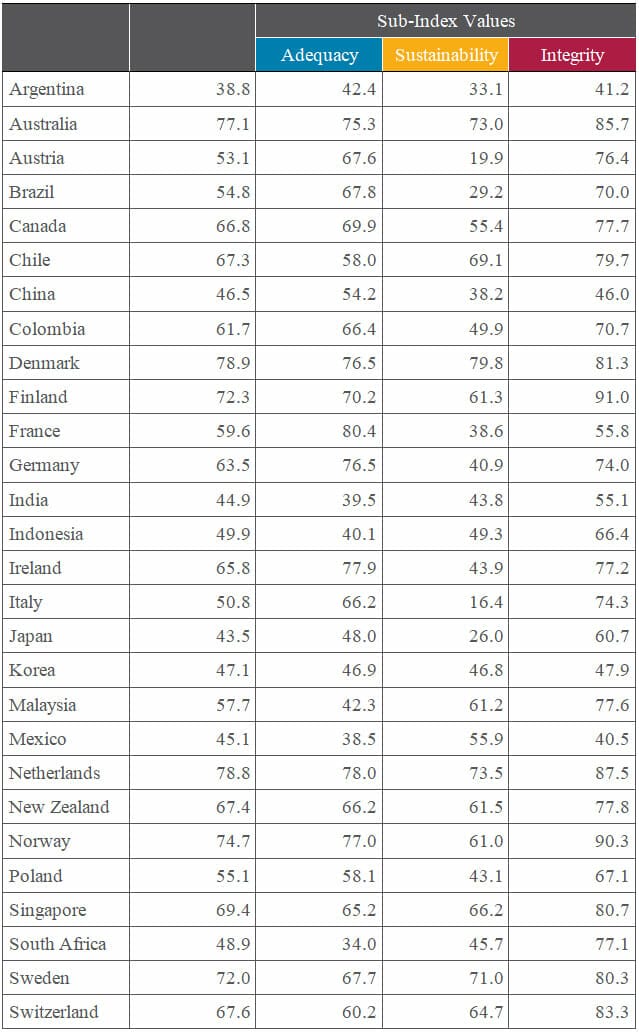
The Mercer pension index compares the retirement income systems in 30 countries, using more than 40 indicators that benchmark each country’s system. The index uses three sub-indices as metrics: adequacy, which accounts for 40 per cent of the index score; sustainability (35 per cent); and integrity (25 per cent). The Australian system ranks third, behind Denmark and the Netherlands.

Knox says many of the challenges relating to ageing populations are similar around the world, irrespective of a country’s social, political, historical or economic circumstances.

He says the policy reforms needed to alleviate these challenges are also similar. In addition to increasing the pension age, he suggests encouraging people to work longer, addressing the level of funding set aside for retirement, and employing benefit design that can reduce leakage of benefits before retirement.

Denmark, Netherlands, Australia lead pack

Denmark, the Netherlands and Australia – in that order – ranked as the best pension systems in the ninth Melbourne Mercer Global Pension Index. No countries received an ‘A’ rating this year, with Denmark, the Netherlands and Australia scoring a ‘B+’.

This is a slip for Denmark and the Netherlands, which have previously received the top score. Their lower score is due to the inclusion of real economic growth in the sustainability sub-index.

There is a huge disparity in systems around the world, as reflected by the scores. Argentina ranked last, scoring 38.8, and top-ranked Denmark scored 78.9.

The top three countries all scored well across all three sub-indices, while some countries, such as France, scored well in a particular category (80.4 for adequacy, which was the top score) but were let down by other categories (38.6 for sustainability and 55.8 for integrity).

Knox says the scores highlight weaknesses in the systems and areas for reform. He points to Austria, Brazil, Italy and Japan as countries that must tackle pension reform sooner rather than later.


Ninth Melbourne Mercer Global Pension Index country rankings


The fortunes of the United Kingdom’s largest pension fund, the £60 billion ($78 billion) Universities Superannuation Scheme, epitomise a challenge many defined benefit schemes now share: double-digit returns do little to solve a ballooning deficit.

USS, which provides pensions for 390,000 university staff spread across 350 universities, runs an innovative and successful investment strategy. Yet a £17.5 billion ($23.2 billion) deficit directly threatens university employers and their lecturing and academic employees.

USS disputes the figure, measured according to Financial Reporting Standards, arguing the deficit is, in fact, closer to £12.6 billion ($16.6 billion) as per “technical provisions” in Pension Regulator rules. However that quarrel plays out, the problem remains. It could lead to a hike in contributions and cuts to benefits, affect university research programs, and even force an increase in student tuition fees.

A key reason for the deficit is the large drop in long-term interest rates, which has inflated liabilities. Assets grew 20 per cent, to £60 billion, in the 12 months to the end of March 2017, but didn’t outpace the growth in liabilities, and the funding level has dropped to 77 per cent from 85 per cent.

But blaming interest rates doesn’t entirely divert scrutiny of the growth-focused strategy run by chief investment officer Roger Gray, who oversees a portfolio that includes a growing allocation to private markets, direct investment, and exposure to frontier economies like Egypt’s. Critics are calling for a cautious approach and more liability-matching assets. In an interview from USS’s London headquarters, Gray, with his familiar measured consideration, makes the case for the strategy he has shaped over the last eight years. He is resolute in his conviction that the funding position would be much worse without it.

“The deficit depends not just on asset performance, but also on contributions received and the revaluation of the scheme’s liabilities, based primarily on expectations for future returns, inflation and mortality,” he says. “The in-house investment team is tasked with outperforming the benchmark over five-year rolling periods through dynamic asset allocation across the full range of public and private market investments. Over the last five years, our principal review period, the scheme’s diversified portfolio has outperformed a liability-matching portfolio of index-linked gilts by about £10 billion.”

About half the fund is invested in equity-like investments, one-third in fixed income and the balance in infrastructure, property, private debt, commodities and absolute return.

Brexit shrinks gilt yields

Gray does acknowledge recent challenges, none more so than navigating the market fallout from Brexit last June.

“To have predicted Brexit, and predicted the adjustment to bond yields, would have been very helpful,” he says. “Brexit was painful for us because of the extra low bond yields that afflicted the UK.”

Gilt yields fell as market perceptions of the country’s fortunes outside the European Union took a dive.

As yields plunged, bond prices rose, creating another problem. In a gradual de-risking trajectory, USS is increasing its allocation to liability-matching gilts, but it had to hit the pause button in the wake of Brexit. Investors started favouring the safe haven offered by UK sovereign debt over other investments like stocks, making buying bonds to hedge liabilities a costly strategy.

“De-risking over the last 18 months has not progressed because government bonds [have become] the most expensive they have been in history.”

Moreover, looking to the future and the prospect of yields partially reverting from historically low levels, he foresees substantial capital losses in UK gilts over the next 10 years as bond prices fall. One strategy to counter this has come via switching bond exposure to the US, where USS now has a 10 per cent allocation to US government bonds.

“The majority of this is in Treasury Inflation-Protected Securities,” he explains. “Long-maturity TIPS offer yields about 2.5 per cent above UK index-linked, near the highest spread seen historically.”

During his tenure at the fund, which Gray joined from Hermes Fund Managers and, prior to that, a seven-year stint in academia, he has built up the matching portfolio. The ratio of growth to liability matching assets has reduced from a 90/10 split, respectively, to two-thirds of the portfolio now being invested in return-seeking investments and one third in fixed income. The de-risking journey will continue over the next 15 years – it just can’t be rushed.

“Because of our size, it can’t be sudden, but our long-term plan is to reduce risk over multiple years,” Gray says.

Private markets

Although USS is still in growth mode, Gray is increasingly choosing assets that allow him to hedge liabilities indirectly and guarantee reliable cash flows under the return-seeking umbrella. Private markets account for about a quarter of the whole portfolio but will grow to about 35 per cent in the next five years. It is home to a variety of allocations spanning traditional private equity, but also special situations, property and infrastructure, along with a growing allocation to shorter duration private credit.

Here, USS earns stable cash flows from providing finance in an allocation that includes new investments such as fund financing. In this strategy, USS provides senior debt financing to asset management firms that have raised direct-lending funds to finance growing corporations – many of which need an alternative to dried-up bank finance.

“Performance of private debt funds would have to be very bad before the senior fund financing we provide would be impaired,” Gray says. “It is a high credit-rated debt investment with quite a substantial spread in terms of the interest rate above Libor. Here is a way of gaining a spread over cash without taking duration risk.”

USS has a 4.5 per cent allocation to emerging market debt that Gray also foresees growing in importance.

“The emerging market debt allocation is an asset class with significantly higher expected returns than developed market fixed income,” he says.

With this in mind, he has combined the talents of the fixed income, multi-asset and emerging markets equities teams to manage part of the emerging market debt allocation. Investment is mostly in local currency; some is inflation-linked and some is in nominal bonds of emerging economies.

“The big thing here is investing in countries that have a significant, positive real rate of interest; a real yield on their bonds,” he enthuses.

Brazil, for example, has a 5 per cent real yield on its inflation-linked bonds; other popular markets are Mexico, Uruguay and Egypt.

“Investments here will support returns that are significantly ahead of, for example, UK index-linked yields. These are assets that we think are providing a better long-term return by a considerable margin. Obviously, the risk is not identical to gilts, but in a balanced portfolio, they have a part to play.”

He adds that the allocation is split evenly between internal and external management.

Direct investment

Investment in private markets is increasingly characterised by going direct. Around two-thirds of the private markets portfolio is now in direct investments, where USS has a majority or large minority ownership stake. It lowers the fee drag and increases the pension fund’s governance rights and alignment with the business. So much so, the ability to invest directly has become more important than the actual asset mix in the private markets portfolio, Gray says.

“The asset mix will be opportunity-led and we will always balance that risk across public markets with liquid investments of the scheme,” he says.

Still, he is mindful of the risks of investing without managers.

“We must be careful not to overestimate our own capabilities,” he warns, adding that the growing portfolio demands new skills and expertise that USS doesn’t necessarily have. It has given rise to a flexible strategy seen in action in 2015, when USS followed its 100 per cent purchase of the UK’s largest motorway service station provider, Moto, by selling a 40 per cent stake to private-equity partner CVC Strategic Opportunities.

“We will bring in operational expertise where we don’t have it in our own team. We often look to complement our own capabilities as a financial investor with the appropriate expertise.”

It is a hybrid model that hasn’t stalled growth in Gray’s internal team, which now manages 70 per cent of the portfolio in-house, with the private markets division accounting for about 30 staff.

The salaries and bonuses paid to the internal teams have become a lightning rod for anger over looming contribution rises. Yet Gray is quietly adamant that internal management reduces manager fees enough to justify the salaries and rewards for outperformance.

“According to independent analysis, our investment costs are £34 million ($43 million) a year, lower than our large global pension fund peers, and we are more internally managed than our peer group.”

He says most investment cost resides in external private equity and hedge fund fees. Total investment costs fell to 32 basis points in the latest financial year, down from 39 bps and 47 bps one and three years prior, respectively.

“This is explained by strong asset growth but also a moderate increase in overall assets managed internally, especially in direct private market investment.”

Repairing USS’s funding deficit will be difficult, given the prospect of lower future returns, and will take much more than a reversal in current bond yields. Difficult decisions around contribution levels and benefit cuts will inevitably pile the pressure on a strategy shaped less around hedging liabilities and more around growth. Whether the deficit forces a change in the asset allocation and a repositioning of the portfolio remains to be seen.


It’s a bit premature to be concerned with the idea that robots will take over our jobs or destroy all of civilisation, Massachusetts Institute of Technology Media Lab research specialist Kate Darling says.

Speaking at the Fiduciary Investors Symposium at MIT, Darling said this is not an era when robots take over, but an era of human/robot interaction.

“The more interesting robotics and AI, and those that investors should be looking for, are…supplemental to human skills,” she said. “Technology that is trying to automate and replace what humans do won’t be as impactful.

“I’ve been to many conferences and labour market economists are all over the shop on this issue. Anyone who tells you they know what is going to happen in automation in the next few decades doesn’t know what they’re talking about. We need more time and research to understand it properly.

“But it is important to point out the limitations of AI and robotics. These technologies function only within well-defined parameters and can’t deal with out-of-context, or unexpected, things. AI is still very different from human intelligence and human intelligence is still superior in a few ways. The compelling use of these technologies is not replacing humans but supplemental to us.”

Darling, who is a fellow at Harvard’s Berkman Klein Center for Internet & Society, specialises in how technology intersects with society, exploring economic issues in intellectual property systems and increasingly looking at the near-term effects of robotic technology.

Known as the Mistress of Machines, Darling’s research and personal interests lie in human-robot interaction.

“Subconsciously, or even consciously, we treat robots like they’re alive, even though we know they’re not,” she said. “We have an inherent tendency to project human-like qualities onto other entities, to make sense of non-humans and relate to them. Robots combine two interesting factors, physicality and movement, and our brains are hardwired to project intent onto any movement in our space.”

The lesson, she said, is if these technologies are going to be integrated into shared spaces with people, it has to be understood how people will treat them.

“Research in robot-human interaction is really important and a question I’m dealing with is, ‘Can we change people’s empathy with robots?’ ”

Darling also said when it comes to the impact of technology, there is still a divide between hope and reality. She pointed to autonomous cars as an example.

“We are close to having autonomous vehicles but it will be a while before they are safe to use in cities,” she said. “They can replace truck drivers fairly quickly but [that’s because] driving on the highway is a fairly simple task we could probably automate right now.”

But even there, problems arise, she said, when ethical decisions need to be programmed into machines.

“At the moment, these cars just try to avoid crashing into things, but in the future, if they had to discern between a person or a pole, what would happen?”

The chair of the International Forum of Sovereign Wealth Funds, Adrian Orr, says organisations that can play a role as clearing houses could help pave the way for large-scale capital investment in emerging-market infrastructure projects.

Speaking at the World Bank’s Maximizing Finance for Development event in Washington on October 14, Orr said there is “a wall of capital” seeking to invest in emerging-market infrastructure, but funds face obstacles to allocating it.

“At the moment, we cannot move global capital, large capital, into small, heterogeneous projects – it’s just too hard,” Orr said. “Fund managers are lazy. We like to plug and play, we don’t like to have to actually be on the ground and do hard work, so that’s why we need people like the World Bank, the International Finance Corporation, the International Monetary Fund, to act as clearing houses for us.”

Orr, who is also chief executive of the $NZ35.7 billion ($25.2 billion) New Zealand Superannuation Fund, said frontier and emerging markets are “a fantastic source of opportunity for large, long-term investors”.

He said the markets’ underlying economics, demographics, pace of urbanisation and increasing middle-class incomes, coupled with challenges posed by climate change, make them “a very opportunistic place for long-term capital to come”.

“Likewise, on the demand side, there is a real need for that infrastructure investment – but the two [sides] can’t meet at the moment,” he said. “They can’t meet at scale, which is a terrible situation, and I applaud the World Bank and the leadership they’re taking for acting more as a clearing house for these types of opportunities.”

Investor wish list

Orr said he is optimistic that capital can be connected to demand effectively.

“This capital wants to invest,” he said. “It’s simple, not easy. The simple part is, we need to communicate better. You asked what we’d need to see as global investors. [We need] a pipeline of large-scale opportunities, one where we are invited to be part of those opportunities, so there’s a risk sharing, and an invitation…to be involved.”

Orr said creating genuine partnerships, with “mutually assured embarrassment” if things go awry, is vital. He argued that the risk of infrastructure projects should be “carved up” and appropriately allocated to relevant parties to the investment.

“All investors are different, but you can carve the risk up,” he said. In addition, “I think a really important part from the demand side for this capital is that investors need to be invited, in a safe manner.

“By invited in, [I mean] you are going to have to give up some of the returns that you think belong to your country if you want third-party capital. It is not free capital, it is being invested to maximise return over the long term, and you need partnerships and you need mutually assured embarrassment if these projects go wrong.

“And standardisation,” he said. “I know it sounds dull, but the ability to plug and play, the ability just to get that capital allocated.”

Orr said developing nations seeking external capital should “get your fiscal plans sorted, understand which bits you want filled from third-party capital, then talk to those parties”.

“Don’t just say, ‘Hey, here is a project’,” he urged. “That just will not work on the way through.”

Sovereign development funds

Orr said the task of funding developing-market infrastructure projects would be aided by the continuing success of sovereign development funds established to co-invest with third-party capital.

“They’re in Ireland, Turkey, Angola, Nigeria, Botswana – there are a lot of funds that are set up to invest purely domestically, but to co-invest with other partners, whether they are sovereign wealth funds or the private sector,” he said. “That is that mutually assured embarrassment we’re after – to say for every dollar you put in, we’ll match it, and we’ll be your boots on the ground, your eyes on the projects, and we’ll assist on the way through.

“It’s early days, but they have proven very successful in some countries in a very short time.”

‘Many trillions’ in demand

The president of the World Bank, Jim Yong Kim, told the audience at Maximizing Finance for Development that the increased involvement of the private sector would be critical for constructing the infrastructure necessary to support developing nations’ aspirations.

“All over the world, you see aspirations rising,” Kim said. “As a person born in one of the poorest countries in the world, Korea, in 1959, it’s a great thing – aspirations should be rising.

“But as broadband expands, we know that just about everyone in the world will know how just about everyone else in the world lives, and as aspirations rise, what it will take to meet those aspirations – to build the infrastructure, to provide, the health, the education – is not billions of dollars but many trillions.”

Kim said meeting the United Nations’ Sustainable Development Goals alone would require capital investment of $4 trillion a year and “no matter how many multilateral development banks or how much ODA [official development assistance] goes up, we will never be able to meet that demand”.

“So what we’ve been trying to do is look at every single one of our tools,” he explained. “Of course, sovereign-guaranteed loans to governments, but also, very specifically, the loans we give to governments for policy change that will improve the investment environment.

“On the private-sector side, we have equity investment, we have loans, we have mezzanine debt, we have all kinds of different tools – first-loss guarantees, partial-risk guarantees, political risk insurance, credit-enhancement omega – and…if we were to say, with all these tools, what would be the best way to maximise for every country the resources they have to achieve their goals, it would look different than what we’re doing right now.

“We wouldn’t be competing with each other for low-hanging fruit that maybe could be done on an entirely commercial basis – an infrastructure project, for example. We would be looking at every single way that we could bring in the private sector.”

Kim cited the example of a $60 million guarantee from Swedish Sida [Swedish International Development Cooperation Agency] that enabled the World Bank to securitise emerging-market infrastructure loans. With the World Bank taking the first 10 per cent of any loss, the senior tranche of the security was assigned a BBB investment rating.

“For the first time, we were able to bring insurance companies, which are very conservative, into the emerging-market infrastructure space,” Kim said. “That’s just one example, and we need to do that on a much larger scale.”