The investment office of the $341.3 billion California Public Employees’ Retirement System (CalPERS) has revealed that it has shelved any plans to introduce leverage into its portfolios to help improve returns.

The use of leverage was canvassed extensively at the CalPERS Board of Administration meeting in July this year, as it looked for ways to meet return targets and improve its 68 per cent funded ratio. It was believed even then that leverage could have only a marginal impact on both measures.

In an asset liability management (ALM) workshop on November 13, CalPERS managing investment director, asset allocation and risk management, Eric Baggesen, told the board that “after a lot of discussion” the investment office decided not to proceed for two reasons.

“The first reason is the application of leverage, for one thing, certainly increases our market sensitivity,” Baggesen said. “It’s questionable as to whether we would really want to increase our market sensitivity when the majority of the segments of the investment opportunity set appear to be pretty highly valued at this point in time.”

Baggesen said the second, and “probably even more relevant” issue, from the perspective of strategic asset allocation, was that the application of leverage is not a set-and-forget exercise. He said the use and benefit of leverage depends on the spread between the cost of the leverage and the expected benefit of purchasing an asset using that leverage.

“That spread is not a constant, it expands and contracts,” he said. “That expansion and contraction, by definition, appears to recommend leverage as an active-management tool, in contrast to a strategic-management tool.”

Baggesen’s comments on leverage emerged during the CalPERS board’s asset liability workshop, an event held every four years to review, and if necessary revise, the fund’s long-term strategic asset allocation, and the demographic, actuarial, financial and economic assumptions that underpin them.

Four new candidate portfolios

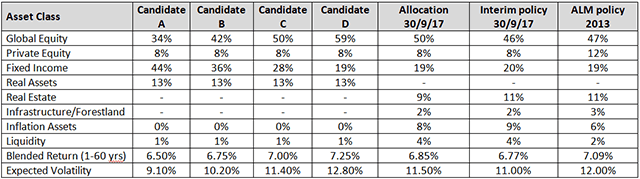
The board was presented with four new candidate portfolios (labelled A to D) the CalPERS investment office has developed. When the board meets in December, it will be asked to select the most appropriate of the four.

Candidate portfolio A is designed for an expected return of 6.5 per cent and that figure increases in increments of 25 basis points with each candidate, finishing at 7.25 percent for portfolio D.

The expected return of each portfolio represents its so-called ‘blended return’: the combination of a short-term (one-year to 10-year) return estimate based on the CalPERS investment office’s projections, and a long-term (11-year to 60-year) expected return, based on actuarial estimates, with an allowance for fees.

The board will need to consider these portfolios in terms of their volatility characteristics, and how the expected return of each portfolio supports the discount rate applied to the fund’s future liabilities.

For example, candidate A’s expected blended return of 6.5 per cent “would require a shift downwards in the discount rate, from 7 per cent; and that [50-basis-point reduction] in the discount rate would, in turn, immediately translate into a reduction in the funded ratio”, from 68 per cent to 64 per cent.

A reduction in the funded ratio would require additional contributions from the fund’s participating employers.

“In the same way, if you pick a portfolio that would increase the discount rate, that would result in an increase in the funded ratio, albeit with a greater degree of equity concentration and volatility that attaches to that,” Baggesen explained.

He said the investment office considers any one of the four candidates to be “implementable and prudent portfolios, although they’re not all equally advisable” given current market valuations.

He said portfolios A, B and D represent “pretty significant shifts in the actual exposure, and the shifts that take place in these candidate portfolios are really evident in the public equity and fixed income lines”.

“Elements such as private equity [are in asset classes attractive enough to] exist at the maximum bound constraint for them, regardless of any portfolio mix we put before you.

“That’s an indication of the degree to which the constraints are a binding issue on this analysis. I would suggest a [close look at] those constraints will be a big part of the mid-point review that takes place in two years’ time. But we believe [they] are rationally established for the present timeframe.”

The candidate portfolios currently have zero exposure to inflation-linked assets, across the board. Baggesen said this reflected “the fact we do not have a clear understanding of the effects of inflation on the liability structure, nor do we understand clearly exactly what risk inflation presents to the fund”.

“We do believe it presents a risk, though,” he said. But he explained there was more work to do on inflation to “restructure what we’re doing in that space to more appropriately align it with the effects on the liability structure.”

The four candidate portfolios’ allocation to liquidity is consistent as well, at 1 per cent across the board.

Baggesen said the fund was able to set a low liquidity target because it anticipated strong cash flows from contributing employers to make up for the impact on its funded ratio of recent underperformance, the reduction in the target rate of return, and general employee pay increases.

The candidate’s parade
Norges Bank Investment Management, which manages the giant NOK8.2 trillion ($1 trillion) Government Pension Fund Global, has aligned its internal practices with the FX Global Code of Conduct. The code is a set of global principles, released this year, for good practice in the foreign exchange market. NBIM is encouraging, and expecting, its counterparties to follow it as well.

NBIM also states, however, that uptake of the code won’t change a number of unique features of foreign exchange markets that provide scope for rent extraction by dealers, where they are more than compensated for the risks they take in providing liquidity. So, while the code provides a strong foundation for global FX markets – which with an estimated daily turnover of $5.1 trillion are the most liquid in the world – there is plenty of room for improvement in practices.

A new “Asset Manager Perspective” paper by NBIM outlines three industry practices that are particularly problematic, arising from systematic informational asymmetries:

  • The first is “last look”, which is a device in FX spot markets to deal with the instantaneous price risk of stale quotes
  • The second concerns the implementation of algorithmic execution strategies, a way of sharing the temporal price risk between client and dealer
  • The third is an apparent disconnect between dealer quotes and prevailing prices in the inter-dealer market.

The paper also outlines ways of managing these informational asymmetries.

Angela Rodell, chief executive of the $60 billion Alaska Permanent Fund Corporation, the biggest sovereign endowment in the US, can’t hide her frustration. Her freedom to scout the globe for long-term investments and build up a growth-boosting allocation to private markets could well be crimped by cash calls from the Juneau-based state government.

“This is, potentially, a very big chunk to manage,” she says.

APFC was created in 1976 to save and invest a portion of Alaska’s mineral royalties for the benefit of present and future generations of Alaskans. The fund pays an annual dividend to residents of the state that has risen along with the success of the fund. But now, with Alaska facing an annual deficit of nearly $3 billion, the sovereign fund may well have to help the government, which could cost more than the dividend ever has.

This would affect how Rodell manages liquidity, with a knock-on effect on an investment strategy that has always played to its long-term strengths. And because she still doesn’t know what the cash call will be – if it comes at all – it is difficult to plan.

“When the government comes to an agreement, we will decide what change this requires on our side,” Rodell says. “Paying the dividend so far has never required a change of strategy.”

But if the fund has to plug a gap as big as the deficit, she won’t have any choice.

APFC is not alone in its travails; the strain of low oil prices is forcing petroleum-rich governments from Azerbaijan to Saudi Arabia to pull money from SWFs to prop up their economies. Between March 2015 and March 2017, the collective assets overseen by SWFs decreased 0.5 per cent, compared with a 14 per cent increase in the two years to March 2015, the Sovereign Wealth Fund Institute states. Between 2014 and 2016, SWFs withdrew at least $85 billion from asset managers, figures from data provider eVestment show.

If the call comes at the APFC, Rodell will increase the current 22 per cent fixed income allocation. She is also re-evaluating the private-market portfolio, mulling which commitments to reduce so she has less money tied up in illiquid investments.

“We will leave public equity alone, but this strategy will still drive down our performance,” she says. “People want the fund to return 12 per cent a year, but you can’t have it both ways.”

APFC returned 12.37 per cent in the year ending June 2017; about 60 per cent of the portfolio is now apportioned to growth assets. The public equity allocation accounts for 40 per cent of assets. About 32 per cent of the portfolio is invested outside the US.

A high point of the year was the steady increase in the alternatives allocation, with new commitments to infrastructure and private equity, Rodell says. And if she had a free hand, this is where she would focus growth in the year ahead. She wants to expand the investment team from today’s 45 to perform the due diligence required for more co- and direct investments to cut fees and have more control. But securing a budget for the salaries and benefits needed to employ private-market expertise has proved tricky.

“We continue to look at ways we can streamline this process to make it easier to recruit. Not getting budget authority to spend on hiring has slowed us down the most,” says Rodell, whose reputation for transparency and openness has drawn global investors to Juneau to gather insight. Executives from Japan’s Government Pension Investment Fund (GPIF) recently made the trip to Alaska for advice on building a private-equity portfolio.

“They liked our mixed, three-pronged strategy and we don’t hide behind confidentiality walls,” Rodell says.

APFC’s $4.2 billion private-equity portfolio is equally split between direct, co-investments and fund investment. It has just set new mandates with ONCAP, Incline and Catterton Latin America. Internal private equity has returned 20 per cent since its inception in 2013. The bulk of the $25.9 billion public equity portfolio is externally managed, with a small, but increasing allocation run internally through exchange-traded funds.

Strategy in real estate, which accounts for 11 per cent of assets, is focused on tilting to non-core, in a break from the conservative core focus to date. Rodell likes value-added and opportunistic investments, such as seniors housing and medical properties. The portfolio includes a ‘build-to-core’ program and a focus on development opportunities. APFC is underweight industrials and overweight family and retail property, to capture urbanisation and Millennial themes. Investments include a joint stake with State of Michigan Retirement System in Simpson Housing, an owner and operator of multi-family properties across the US. Overseas property now accounts for 7 per cent of the real-estate portfolio.

Fixed income

The fixed income allocation is designed around an internally managed $7 billion investment-grade bond portfolio; an allocation to Treasury inflation-protected securities is also managed in-house. The allocations to global high yield, emerging-market debt, real-estate investment trusts and listed infrastructure are managed externally by a cohort that includes Oaktree, Capital Guardian and Cohen & Steers.

“We see a lot of value overseas, primarily in emerging markets,” Rodell says. “For the last five years, we have been tilting away from the US. Our emerging markets got hit in 2014-15 but we stayed the course and emerging markets have recouped their value.”

The private-income portfolio includes allocations to infrastructure – the bulk of which lies in energy assets but also in the mix are transport, waste management, timber – and private credit, which includes direct lending and distressed credit. For the last year, APFC has been running the private-credit allocation internally; it’s off to a good start, with one-year returns of 9.5 per cent.

The $2.2 billion absolute return portfolio includes recently added allocations to global macro, CTA, fundamental equity market-neutral, fixed income relative value and event-driven. Also, just this October, Rodell introduced a $2 billion currency-hedging program with London-based manager Adrian Lee & Partners.

“We have a $17 billion currency exposure,” she says. “This strategy is a recognition that currency does influence the value of the portfolio and can have negative repercussions.”

If Rodell doesn’t have to change tack to plug the state deficit, she has no plans to change the allocation.

“We have a heightened awareness of what is going on, and we are looking at opportunities to take value and realise value where we can,” she concludes. “But we are not altering our overall asset allocation at this time.”

A warning shot has been sounded to private-equity investors. Not only can they no longer expect the stellar returns they are used to from the asset class, but also the persistence of those returns, or their reliability, is slipping.

Some investors, such as Oregon State Treasury, are reacting to this by reducing their private-equity allocations.

Oregon, which is the oldest private-equity investor in the US, having first allocated capital 37 years ago to KKR, is gradually reducing its private equity allocation from 25 per cent to 17.5 per cent.

Chief investment officer of the $80 billion fund, John Skjervem, says it can no longer expect what it once did from its private-equity portfolio, which has added $9 billion above the public equity equivalent since 1980.

“Private equity has been the lead guitar in our band, but we are now adding extra instruments, with the expectation that there is no substitute for the excess returns of private equity,” he says. “$9 billion is a big number, but we don’t expect that to continue, so our efforts are focused not on a return replacement, but on adding instruments that are not correlated with the long-only approach in public and private markets.”

Skjervem was speaking at the Fiduciary Investors Symposium at MIT, alongside Antoinette Schoar, the Michael M Koerner Professor of Entrepreneurship at the MIT Sloan School of Management, and Nate Walton, partner at Ares Management.

In 2005, Schoar and the University of Chicago’s Steve Kaplan produced seminal research that showed “returns persist strongly across funds raised by individual private-equity partnerships”. (Private-Equity-Performance-Returns-Persistence-and-Capital-Flows)

This research gave investors comfort and confidence in the asset class. But recent research that Schoar presented at the symposium shows that this persistence has changed in the last decade. Her new work shows that the variance in returns between the top and bottom quartile still exists, but the persistence has decreased.

“Being in the top quartile is still as important as before, but because persistence is going down, you can’t rely on a top-quartile fund in 2000 [staying] top quartile,” she explains. “What this means for investors is your life is even more difficult.”

For Skjervem, this was cause for dialling back the allocation.

“The paper from Kaplan and Schoar in 2005 was really impactful for me personally,” Skjervem recalls. “It applied a factor model to private-equity returns, and showed the top-quartile managers did have statistically significant alpha and it persisted. It was a significant proof paper for the asset class. Just from our own empirical evidence over the last five years, I’ve had the feeling that persistence has been breaking down, and now we have another paper that validates our own experience.

“That’s really bad news for LPs [limited partnerships]. The golden ticket is not as meaningful as it used to be.”


Structural change

In the last two decades, private equity as an asset class has undergone significant structural change, the decline in returns and their persistence reflects this.

In that time, the capital under management and the number of funds have both doubled. In addition, the biggest and best-performing funds are getting bigger, and this means they need to expand their investment portfolios.

But the very nature of venture capital and private equity, where illiquidity is greater and opportunities are tougher to scale, means that when funds become larger, the marginal returns to capital are going down, even at the best funds.

Walton from Ares, a publicly listed alternatives manager with $106 billion in assets, says it should be no surprise that private equity has evolved as an asset class.

“The data shows that the same thing cannot be repeated by the same people over and over,” Walton says. “For a long time in our industry, the same thing could be repeated; everyone could use the same strategies, go after the same inefficiencies, and create alpha through illiquidity and some of the other structural inefficiencies. But in any asset class, that will change, and in an asset class of scale [the ability to do that] will be diminished.

“So our view is the traditional leveraged buyout (LBO) business model is fundamentally going to be more volatile, less predictable, and have lower rates of return than we have seen over a 30-year period.”

The solution, he says, is to have flexibility and diversification within the fund, including traditional LBO investing but also growth investing, and distressed and rescue capital, across geographies.

“This allows us to evolve with where the opportunity is in a moment in time,” he says.

For Oregon’s Skjervem the structural changes have put the asset class under more scrutiny, and he is getting questioned by his board about the continued validity of private equity. Where it was formerly the star performer in the portfolio, more recently it hasn’t met its benchmark, which is the Russell 3000 plus 300 basis points, he says.

“We haven’t met our benchmark in at least five years, so we are starting to get questions about performance,” he says. “Is this a realistic benchmark? I would argue no, so then you get into the discussion about what the benchmark should be.

“I could argue Russell 3000 plus 10 basis points is worthwhile because 10 basis points on a $16 billion portfolio is real money. But plenty of people want a more significant figure over public markets to justify the illiquidity you are taking on.

“For a public plan, I could make a philosophical argument that even if we do nothing but match public market returns, there’s a place for private equity because of the appraisal-based accounting, which artificially smooths our total fund volatility, and there’s a genuine benefit to that.”


Investor action

Schoar, who is also chair of the finance department at MIT Sloan, predicts the asset class will not return to its days of massive persistence in top performance. But she also has another concern.

“If LPs are not vigilant, we will start seeing persistence at the bottom,” she says. “We see so many LPs wanting to get into private equity that they are not sensitive enough to poor performance and keep reinvesting in partnerships that are not deserving of being reinvested in.”

Walton goes further, and jokingly observes it is “difficult to kill a private-equity fund”.

“We see it all the time; a fund has poor performance and then raises more capital and we ask how it can happen again,” he says. “I think it is a result of the incredible demand for the asset class, and in some ways this will continue, as you see the retail inflows and retail channels trying to pitch access to alternatives and PE as a way to provide value to intermediaries. I don’t think flows will change, but I do think there will be a bifurcation over time and eventually returns will drive investors to the right managers.”

But there is some good news, Walton says.

Even though the sizes of funds have increased, and returns have gone down, the top funds have still outperformed.

“I think the industry will end up with larger funds that can consistently outperform and niche smaller funds that can find an advantage in the market, and we’ll live in a barbell world.”


The first of this two-part series looked at Antoinette Schoar’s new research. To access the article click here.


Persistence of returns in private equity is diminishing. Further, the returns themselves are not what they used to be. And in even further bad news, new research from a leading Massachusetts Institute of Technology academic shows that co-investment vehicles may not be a panacea for these problems.

In private equity, the flow of capital and the number of funds have both doubled in the last two decades, hurting the persistence of returns, which until now has been thought of as the defining aspect of private equity.

New research by Antoinette Schoar, chair of the finance department and the Michael M Koerner Professor of Entrepreneurship at MIT Sloan School of Management, shows that persistence of returns from private-equity funds in the last decade has gone down, undoing the seminal research she co-authored with Steve Kaplan, from the University of Chicago, that showed “returns persist strongly across funds raised by individual private equity partnerships”.  See Private-Equity-Performance-Returns-Persistence-and-Capital-Flows

“I deal with LPs [limited partners] frequently that say there has to be persistence in returns, given our earlier research, which showed that top-quartile funds had a 33 per cent chance to stay in the top quartile,” she says…But [this persistence we saw in the 1990s has gone down over time.]…The question now is, why is this happening and what implications does this have for investors in private equity?”

Schoar’s new research shows the variance in returns between the top and bottom quartiles still exists, but the persistence has decreased.

“Being in the top quartile is still as important as before, but because persistence is going down, you can’t rely on a top-quartile fund in 2000 staying top quartile. What this means for investors is your life is even more difficult.”

Schoar attributes this change to the evolving nature of competition and the available capital.

“Private-equity fundraising over the last two decades has increased. The capital under management and the number of funds have doubled,” she says.

These structural changes to competition and available capital in the last decade have caused the top funds to grow at a much quicker rate than they have in the past, she says.

“There is more competition, but the concentration of [assets] in the hands of the biggest and best-performing funds is also growing more quickly than we saw in the 2000s,” Schoar explains. “You could say it is efficient that this happens, because we want capital to be with the best performers. But it also means the top funds have to expand their investment portfolios.”

The very nature of venture capital and private equity, where illiquidity is greater and opportunities are tougher to scale, means the marginal returns to capital go down, even at the top performers, when funds become larger.

“This is a very strong relationship – when the fund size increases, the marginal return on the funds goes down. Research suggests this is something that has accelerated in the last decade,” Schoar says.


More bad news – a co-investment warning

Sounds grim. And Schoar says co-investment as a solution is uncertain at best.

The recent trend of investors favouring co-investments, special-purpose vehicles and direct investment in private equity is a result of the changing trends in performance and persistence, she says.

Within the changing landscape of private equity, it seems that many LPs have been tempted to get involved in the investment process by going into co-investment because persistence and performance are going down.

“But our data suggests we should be very cautionary about it because we see massive variances in the performance of co-investment,” Schoar says, “and the timing [often] seems quite detrimental to the fund performance.”

Schoar and fellow author Josh Lerner, from Harvard Business School, are now working on new research examining co-investment returns. Using data from State Street, they have access to 1500 main funds and their co-investment vehicles.

“Our results were really stunning, we didn’t expect them,” she says. “The variance is humungous.”

While the research, including determining the drivers of this variance, is a “work in progress”, she says some of the reasons for the poor performance of some co-investments is bad timing.

In addition, the co-investment deals are particularly large, in some cases three times as large as the investment the same entity makes in its main fund.

“For an LP, the co-investments are even more difficult to diversify than normal” in private equity, she says.

Schoar states that, in some ways, the large variance in co-investment returns should not be a surprise, because of the nature of co-investment vehicles.

Much of the decision-making “goes back to the investment team at the LP…So one should be careful to see whether the LP is big enough, sophisticated enough and has the internal resources to make that trade-off.”

She also warned LPs looking at co-investment to think about when general partners are most incentivised to include LPs in a co-investment.

“The incentives might not be aligned,” she says.


In the last decade, the world’s largest 300 pension funds have grown by more than 50 per cent and now total $15.7 trillion, representing over 43 per cent of global pension assets.

While this is solid aggregate growth, especially since it coincides with the recovery from the global financial crisis, it masks the challenges these systemically important funds will face in the next 10 years. How they organise themselves to search for attractively priced assets at acceptable risk will shape their fortunes and their ability to meet objectives.

During this decade, we have seen the investment community undertake a plethora of strategy innovations, as uncertain and often volatile outlooks in capital markets have played on asset owners’ minds. There is now a growing recognition among those at the forefront of industry thinking that an ability to adapt to a fast-changing landscape is critical, and that this is best achieved by sharing and implementing best practice. In brief, self-awareness is emerging as central to the evolutionary success experienced by the world’s leading asset owners.

Funds that are able to demonstrate more effective decisions through improved cognitive diversity and board-executive engagement, combined with better sustainability and risk management, are the ones emerging at the vanguard of the global asset owner industry.

This was highlighted in our recent research, sponsored by the Future Fund, titled Smart Leadership, Sound Followership. In it, we sought to benchmark and compare practices across 15 world-leading asset owners, chosen from the North American, Asia-Pacific, and Europe, Middle East and Africa regions, based on their global reputation, strong governance, significant size and thoughtful, outward-looking perspectives. Findings of the research include:

  • The importance of cognitive diversity: research is revealing that biases in investment decision-making settings are more numerous and deeply embedded than investors readily recognise. Using diversity effectively can help reduce the impact of biases.
  • Sustainability and long-horizon investing are too shallow: Sustainability is a critically important emergent subject, yet opportunities are being missed in the overlapping areas of sustainability, environmental, social and governance investing, stewardship and long-horizon investing.
  • Boards are having trouble being strategic: Boards seem strong in interpreting their funds’ mandates and ensuring executive accountability, but less so in their development of a strategic dialogue with their executive. This is a work in progress, revealing an opportunity for organisations to improve.
  • Risk management is key as the business landscape is changing: There is merit in using scenario analysis to manage risks. Studying the investment ecosystem, not just the markets, is critical for anticipating transformational changes ahead.
  • Funds are changing their mix of internal and external intellectual property: There can be a better grasp of how to optimise the value chain, including the nature of external strategic relationships. Technology and increased sophistication make network opportunities across funds potentially more valuable than ever.

The overriding lesson from this study is that self-awareness and cognisance of peer groups have played an intrinsic role in the evolution taking place across the world’s leading asset owners. We believe this will only become more important, particularly given the scarcity of investments that meet the current risk and return targets of many funds.

If asset owners are to repeat the growth attained in the last decade, it is imperative that they continue to expand their skills, particularly in a lower-return environment that looks set to remain a feature of the industry. Leading funds have set themselves apart through their ability to innovate, rather than rely on practices that may have worked in the past. This will be a particularly desirable characteristic for all asset owners in the decade to come.

Roger Urwin is global head of investment content at Willis Towers Watson.