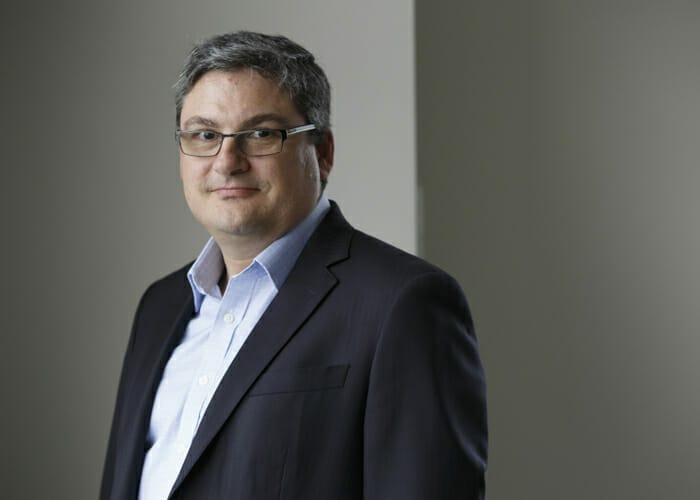
When Californian Craig Dandurand made the move to Melbourne nearly four years ago to join the A$135 billion ($101 billion) Future Fund as director of debt and alternatives, he arrived as the fund’s leadership was embarking upon a rethink about how to structure the portfolio and extract greater value out of managers.

The Future Fund’s current portfolio is distinct from the herd in its ‘barbell’ approach to risk: a heavy allocation to cash at one end of the spectrum and a big bet on absolute-return strategies at the other.

As at September 30, 2017, the Future Fund had an 18.9 per cent allocation to cash and a 15.4 per cent allocation to hedge funds and other alternative risk premia assets.

That compares with averages among local superannuation funds of 6.9 per cent in cash and 10.9 per cent in hedge funds and other alternative risk premia assets, data from SuperRatings shows. Together, the investments in cash, debt and alternatives total $45 billion, or 44.2 per cent of the Future Fund’s total portfolio.

Having a stash of cash at the ready means the fund is well-positioned to take advantage of buying opportunities, should a market correction occur.

In the meantime, a focus on hedge funds and other liquid alternatives is central to the fund’s overall strategy of stripping out beta and focusing on alpha-generating assets.

Dandurand reports to Future Fund head of debt and alternatives David George.

Appetite for alternatives

He admits the magnitude of the allocation to hedge funds and liquid alternatives, which the Future Fund refers to simply as alternatives, can throw people off. He says it is about looking beyond other drivers of performance – such as listed equities, credit and property – to add to the overall resilience of the portfolio.

The allocation is not just about chasing higher returns – it’s also about managing risk. In fact, Dandurand says the motive behind the alternatives strategy is to focus on return sources that diversify the key risks across the total portfolio. A key element of that is using macro-directional and multistrategy managers. The Future Fund also has significant exposures to alternative risk premia in the portfolio, which is part insurance and part other things.

Dandurand made the preceding comments in a wide-ranging interview with Conexus Financial head of institutional content Amanda White, on stage at the 2017 Investment Magazine Absolute Returns Conference, which was held in Sydney on September 14. During the candid talk, he outlined the fund’s for the role of alternatives within the portfolio, and how the fund is reducing costs and extracting additional value by forging stronger relationships with some of the world’s leading hedge funds.

Before joining the Future Fund, Dandurand spent 13 years at the California Public Employees’ Retirement System (CalPERS), the largest public pension plan in the United States, as a specialist alternatives portfolio manager. Prior to starting a career in investments, he was a lawyer and banker.

Sum of the whole

Future Fund chief investment officer Raphael Arndt espouses a whole-of-portfolio approach that requires the investment team to assess risks and opportunities in the context of how they interact across all asset classes. This is distinct from more traditional strategic asset allocation, in which decisions are made in a more siloed way by those responsible for particular parts of the portfolio. For Dandurand, the whole-of-portfolio approach has much appeal. It enables the fund to do more with the alternatives portfolio and simultaneously drive different return streams, rather than looking at things through too narrow an aperture.

One of the most important tasks at the Future Fund has been ensuring currency exposures across the total portfolio are managed more efficiently. As a result of these efforts, the altenatives portfolio now has more AUD denominated exposures, reducing the need to hedge.

“But [currency] is still a material risk to the fund, given the fact that a large majority of our portfolio is held in non-AUD assets,” Dandurand explains.

Alpha and diversification

Managing currency risk has been part of a larger project to recalibrate the alternatives portfolio to deliver greater diversification.

To this end, he has spent the last few years focused on finding “enough genuinely good diversifying things” to sit in the alternatives portfolio. This has enabled the fund to take more meaningful concentrated risk, without imperilling its downside risk profile, he explains.

The first step in revamping the alternatives portfolio was to remove managers entrenched in beta strategies.

“Unless you’re paying them zero, you probably have no chance of being adequately compensated for the cost of doing business with that manager,” Dandurand said.

The Future Fund now gives much greater attention to exploring one-off opportunities with entities that are looking to co-invest. The fund has also identified managers who need some kind of boost at an early stage in order to achieve scale.

This creates the opportunity to build stronger relationships and share ideas.

To demonstrate, Dandurand points to how increased collaboration with private-equity managers has gleaned valuable insights for the debt portfolio.

“If we’re managing a debt portfolio with an awful lot of money into middle-market firms and we don’t spend time talking to our [private-equity] guys about what they’re seeing from their side of the balance sheet, then we’re doing ourselves a disservice,” he says.

The Future Fund employs about 30 external fund managers in hedge funds and liquid alternatives, including: Arrowgrass Capital Partners and Citadel for multi-strategy and relative value exposures; Elementum Advisors and SouthPeak Investment Management for alternative risk premia; and macrodirectional hedge funds such as Brevan Howard Asset Management and Bridgewater Associates.

Dandurand says it’s a challenge for the industry that far too many managers have reached a scale where their incentive to take on enough risk to make the value proposition work well for the investor is gone. One of his priorities has been ensuring all of the Future Fund’s debt and alternatives managers are allocating enough risk, so the value the fund gets for the fees it’s paying for diversification is as high as possible.

Fees in focus

Of course, he is also focused on negotiating a better deal on fees, but says the emphasis is on making sure managers deliver adequate value. Every manager the Future Fund looks at is run through filters to ensure they are delivering a material degree of alpha generation that is generally diversifying, not just from asset classes, but also from the other betas out there.

Nevertheless, there will be times, Dandurand adds, when the fund may have to pay up for a fund it wants, even though it may not be ‘that hot’, based on market filters.

Determining how much to pay for talent is “always a question of supply and demand”, he notes. But costs matter, especially with an outlook for subdued returns.

“If my gross is the same and I paid less in fees, my net is higher, and I like that.

Pension funds are finally waking up to the danger of the diversity gap, realising they can miss out on pools of talent that would improve decision-making in their organisations if they stick to employees whose backgrounds cause monolithic thinking.

The problem in the industry is large, with gender, age and background diversity all lacking. Few investors are still in denial. They know there is a problem, the challenge is how to fix it. Now a handful of funds are showing exactly how that’s done.

There are plenty of examples of action. Canada’s C$90 billion ($69 billion) Alberta Investment Management Corporation, AIMCo has a policy objective “to achieve gender parity” on its 11-member board of directors, four of whom are now women. In Sweden, where a gender pay gap persists despite policies in place to mitigate it the SEK562 billion ($66.8 billion) AMF Pension pledged in its 2016 Sustainability Report to “reduce pay differences between women and men by 2018”. Elsewhere, massive Dutch scheme ABP, with nearly €400 billion in assets, is addressing both gender and age diversity with targets. It has even gone well beyond its target of two female trustees, as five members of its 13-person board are now women. It is currently addressing age diversity, pledging to appoint one member under 40. The scheme’s current youngest board member is 45.

In the United States, $220 billion California State Teachers’ Retirement System is leading the charge, looking at its own investment team make-up, engaging with portfolio companies on diversity and hosting diversity forums that bring together investment and corporate executives to discuss how to better capitalise on the abilities of the diverse modern workforce.

Closing the diversity gap requires pension funds to do away with entrenched, and often unconscious, biases to consider candidates from non-traditional backgrounds.

“Pension funds need to ask themselves if their culture is open to attracting people from different backgrounds with different experiences, styles and ways of thinking,” says Caroline Muste-Merks, director of fiduciary advice at MN, fiduciary manager for the €70 billion ($81 billion) Pensioenfonds Metaal en Techniek.

These investors are tackling diversity because it improves returns. Diversity of thought and experience reduces risk and boosts performance because if everyone thinks the same, risks and opportunities will be missed. In fact, studies show a direct link between diversity and corporate performance.

Updated research by Credit Suisse finds that diversity improves corporate returns by 3.5 per cent.  If that’s the case for the companies in which pension funds invest, it must surely be the same for the funds themselves, argues Joanne Segars, chief executive of the UK’s Pensions and Lifetime Savings Association (PLSA) which has just launched ‘Breaking the Mirror Image’, a campaign to increase pension fund diversity.

If investors view diversity in this context, rather than as a special interest, they are much more likely to be galvanised into action says Aeisha Mastagni, a portfolio manager within CalSTRS’ corporate governance division. The fund for California teachers walks the talk, with 50 per cent of its investment team made up of women.

“Diversity is not a social issue for us,” Mastagni says. “It is about mitigating the risk of group-think.”

Angela Rodell, one of the few female chief executives of a public fund the size of Alaska’s $60 billion Permanent Fund oversees the portfolio alongside a 20-member investment team that is ethnically diverse, gender diverse (a quarter are women) and aims to reduce groupthink.

“Women ask different questions to men and educational diversity stops just Harvard-think,” Rodell says. “It leads to robust discussions that turns into better performance.”

Recruitment

Such ethos is driving forward-thinking funds to go beyond box ticking to introduce policies and practices to solve the problem. The process compares to how many funds have introduced climate policies in recent years, argue Olivia Seddon-Daines and Yasmine Chinwala, co-authors of a recent report from think tank New Financial titled Diversity from an Investor’s Perspective.

The journey begins with gathering data about the makeup of internal staff. As the saying goes, you can’t solve a problem until you know what it is. The UK’s £3.3 billion ($4.3 billion) Environment Agency Pension Fund has just begun publishing the gender and ethnic makeup of its pension fund employees. Recruitment processes to address imbalances with the help of headhunters and shortlists are the next step, followed by targets.

It’s not all about gender and ethnicity. Expanding beyond so-called Harvard-think within investment teams is another consideration. Would CalSTRS ever employ someone without a finance degree on their investment team? ‘Absolutely’, comes the emphatic response.

“A number of people in the investment office don’t have finance degrees,” says Anne Sheehan, director of corporate governance at CalSTRS, herself a political science graduate.

But internal change won’t necessarily make it easier to recruit a diverse staff if it isn’t accompanied by a shift in the way an organisation is perceived from the outside. CalSTRS’ Mastagni says pension funds often still give the impression they hire only from a select pool of finance graduates. She suggests funds need to do more to clearly express how they truly hire.

“Folks get scared away; they think it is all maths and finance. But in corporate governance, private equity or real estate, you are working with outside partners, which requires a different skillset to just crunching numbers,” she explains. In remote Alaska, the Permanent Fund now runs an internship program to encourage more Alaskans into finance; technology is also helping broaden the fund’s recruitment base.

It’s lonely at the top

But the challenge of ensuring diversity in junior roles pales in comparison to ensuring diversity, particularly gender diversity, at the senior level. Research by State Street (Addressing-gender-folklore) shows women occupy only one-fifth of senior investment roles at large investors such as pension funds and endowments – although that is much better than at asset managers, where State Street found women hold just 7 per cent of senior roles. It’s an area where CalSTRS leads its peers, with six female investment directors in an 11-member cohort.

“If you look at colleagues, they have a difficult time trying to get to the level of representation we have in our senior ranks,” Sheehan says.

Alaska Permanent’s Rodell believes the problem is that senior positions are difficult to combine with family life.

“It’s a challenging road for women because they have to make certain choices about family and it can hinder their career track,” she says. The solution lies in proactively addressing work-life balance and promoting flexible working practices, while analysing retention rates, internal promotions and pay scales to ensure women are on the same deal as men.

“Our pay scales are public and we don’t have any disparity between men and women,” Sheehan says.

UK pension fund NEST is now accompanying its target to have women fill a least 30 per cent of its executive and director roles by autumn 2019 with more flexible working policies. It also runs a mentoring program in which employees offer guidance and insight to younger staff. Competing in a man’s world is something Alaska’s Rodell had to teach herself.

“You need the confidence to speak up and insert yourself, and that can be difficult at times,” she says.

Role of the board

Increasing pension board diversity is a crucial piece of the puzzle. In the UK, 4 in 5 board trustees are still men, the PLSA states. It’s the same in the Netherlands. A 2014 survey into gender diversity at board level among the 200 largest Dutch pension funds found 35 per cent of boards had no female trustees, and 60 per cent of the schemes lacked trustees aged under 40 – with no change from earlier findings, in 2011.

One explanation for the lack of progress is that pension funds rely on their boards for experience, financial knowledge and stability, leading to fears that diversity could be forced and upset this balance. This is Rodell’s view, shaped by her role as a trustee at Alaska before she made CEO. Only one of Alaska’s six board members is a woman, and turnover is low because each member serves a four year term.

“Our board isn’t diverse. We don’t even have Alaskan natives,” she says, questioning whether actively recruiting a diverse board would ever take precedence at the fund. “It would be difficult, but not impossible. If it was a priority it could be done.”

Even if pension funds are willing to shake up the board, their ability to attract diverse, particularly young, candidates isn’t guaranteed. Again, outside perceptions are critical.

“In the Netherlands, funds are struggling, especially the smaller ones, to get young board members,” MN’s Muste-Merks says.

Yet this, too, is possible. In a deliberate strategy to increase diversity, the £1.3 billion Accenture Retirement Savings Plan, a defined contribution scheme for employees of the management consultancy, has just selected a 24-year old to join its eight-member board.

“We have a huge number of people aged 20-38 in our scheme and we needed to reflect this,” said trustee chair Peter George, who sifted through 40 internal applications for the sought-after role before selecting Anna Darnley, who works in Accenture’s digital business.

Darnley said: “I don’t have a background in finance and I thought this would be detrimental to my application, but my expectations have been turned on their head. My motivation is to increase engagement with our members on investment and savings decisions. I think there is a real lack of financial education.”

Taking on investee companies

Internal diversity is only one side of the coin; investors are important drivers of such initiatives in their investee companies, too. But New Financial finds that only 41 per cent of its sampled 100 asset owners engaged with investee companies on the issue.

One reason could be a reticence among investors to engage on diversity with investee companies if they haven’t begun to tackle the problem in-house, governance expert Deborah Gilshan says. Recalling her experience as co-chair of the Institutional Investor Group at the 30% Club, an organisation that campaigns for more women on the boards of FTSE companies, she urges pension funds to take on both challenges together.

“Investors thought they needed to get their own house in order before they could engage with companies on diversity,” she says. “But diversity moves up the agenda faster if it is viewed internally and externally at the same time.”

A growing body of research shows that failing to engage with portfolio companies and asset managers on diversity hits returns; for example, McKinsey’s 2015 Diversity Matters report that found gender and ethnically diverse companies outperformed.

CalSTRS has championed diversity in its $119 billion global equity portfolio by engaging with companies through its governance rights. It makes its point through voting or shareholder proposals, in an approach that allows other investors to coalesce around an issue and give a forceful message back to corporations’ boards. Sheehan calls it an “ongoing discussion” but, in reality, it’s a fairly relentless pursuit of change.

“If there isn’t any progress, we don’t let up,” she says, evoking CalSTRS’ early calling-out of the US tech industry, which resulted in a shakeup in Facebook’s all white, male board in 2012.

“When investors peel back the layers and look at the nomination processes and the pool of talent that corporate boards are recruiting from, companies understand the concerns from a shareholder perspective,” says Gilshan, who led the UK’s £25 billion railway pension fund Railpen’s corporate governance and shareholder engagement policies for seven years.

In a toughening stance, CalSTRS will now vote against re-election of directors on companies’ nomination and governance committees if they continually fail to fill open seats on their boards with female representatives.

“We don’t believe it is a supply issue. There are plenty of qualified ethnically diverse women who could fill these seats,” Mastagni says.

In a similar strategy, A$110 billion ($82 billion) AustralianSuper has put all-male company boards on notice, voting against the re-election of male directors to already all-male boards.

 Asset managers

Leading pension funds are also putting pressure on their asset managers to improve on their diversity. Passive managers have done more than others, but an old boys’ network is still pervasive. According to data from the $182 billion New York City Retirement Systems’ Bureau of Asset Management, manager of the city’s five retirement funds, 83 per cent of US portfolio managers are white.

Private equity and hedge funds are at the bottom of the pack. Bloomberg found that women account for only 11 per cent of senior managers in the 10 biggest private-equity firms.

The New York City Employees’ Retirement System now asks every investment manager pitching for mandates to disclose the diversity of their leadership and investment teams. Illinois Municipal Retirement Fund and Public School Teachers’ Pension and Retirement Fund of Chicago, and NEST says it is planning to introduce diversity questions in its selection process.

It’s time for asset managers to pay attention, governance expert Gilshan says.

“If an asset manager is going to pitch for business with an all-male line-up and the client has clearly expressed an interest in diversity, the asset manager can’t be surprised if the pension fund wants to find out if their interests are really aligned,” she says.

Some asset owners have gone even further, integrating diversity into their portfolios. New Financial found 1 in 8 asset owners promote diversity by allocating capital to diverse groups. New York City retirement system invests $12 billion in firms and businesses owned by women and members of ethnic minorities, in a commitment that it has increased by 25 per cent since 2013.

Sweden’s AP2 and the Netherlands’ PGGM are aligning their investments with the United Nations Sustainable Development Goals, which include gender equality, and earlier this year, Japan’s $1.2 trillion Government Pension Investment Fund announced plans to allocate 3 per cent of its passive domestic equity – about $9 billion – to ESG indices, including MSCI’s Japan Empowering Women Index, which tracks companies that encourage women to work.

The value of niche investment products, such as State Street’s Diversity Index (SHE) ETF, has grown from $400 million in 2014 to $600 million in 2016, according to research from Veris Wealth Partners and Women Effect.

Pension funds take heart. Tackling diversity is possible. It just takes commitment. “I am very proud to be a part of this,” enthuses Accenture’s George. “This is a milestone, and the effectiveness of our board has increased significantly as a result.”

The largest pension funds in Canada are among the founding members of a National Pension Hub that will match research topics with academics to search for innovative solutions to industry problems.

Members of the NPH include: Alberta Investment Management Corporation, British Columbia Investment Management Corporation, Caisse de dépôt et placement du Québec, Canada Pension Plan Investment Board, Ontario Municipal Employees Retirement System, Ontario Teachers’ Pension Plan, and Public Sector Pension Investments, plus a diverse group including McKinsey & Co, Mercer and KPMG.

Members of the NPH will have input on the topics chosen for research, along with access to the results and their industry applications.

Barbara Zvan, chair of the hub and chief risk and strategy officer at Ontario Teachers’, said topics under consideration include items related to investments, governance, pension design and regulation; for example, portfolio construction, risk in private assets, liquidity risk and leverage, retirees’ spending habits and the impact of different discount rates.

“We are looking at research that can lead to solutions,” she said. “If we look at how to think of an asset mix for a pension fund with a very long horizon, that will [involve] more than one research piece.”

The pension industry has been grappling with a number of evolving challenges over the last decade, including an ageing population, finite resources in which to invest, more complex regulations, greater market volatility, and the need to generate strong returns in a slower economy. The NPH aims to be an incubator for outcome-based research that addresses these problems.

The hub will be implemented by the Global Risk Institute, which has a proven model for creating value from research, including setting milestones for delivery and governance oversight.

“GRI has the approach and processes down pat; this is one of the reasons we chose them,” Zvan explained. “They know the academic community and will act to match the topics [with] academics. That’s a big difference; this is not a call for papers.”

The 15 members of the NPH had their first meeting in November and the GRI, in consultation with the group, is now ranking the topics in terms of importance. It aims to fund projects in the first quarter of 2018.

Zvan said some of the research would be made available outside the member funds.


The 2017 annual general meeting season in Australia, with its many shareholder resolutions, has highlighted the need to modernise some voting policies too anaemic for contemporary active owners. It has also triggered renewed interest in provisions for shareholder-initiated resolutions, following the 2012 Companies and Markets Advisory Committee consultation into shareholder engagement and the AGM.

Regnan supports calls for reform. However, given that it usually occurs at a stately pace, it does not keep up with the needs of investors such as PRI signatories committed to active ownership, and many may need to make use of alternatives.

The emergence of advisory resolutions

Shareholders in Australian companies make do with an incomplete set of active ownership tools.

The first tool is company engagement. At its best, this is an information-rich two-way dialogue between investor and company, based on the mutual goal of long-term performance. By sharing research, insights, ideas and examples, good engagement encourages and empowers corporate leaders in governance maturity, risk oversight and better disclosure for a more informed market.

The second active ownership tool is proxy voting. Unlike engagement, which is generally conducted in private, proxy voting delivers to the company a concrete, unambiguous and transparent expression of shareholder views. However, that directness also narrows its scope to a simple ‘yes or no’ on prescribed matters, framed by the company or Corporations Act. Thus, it does not always cover the issues of legitimate and emerging interest to shareholders.

What is missing from the toolkit is a mechanism capable of both being originated by shareholders and overcoming equivocation, while also stopping short of trespassing on director authority.

Well-formulated, non-binding shareholder resolutions can achieve this balance, but they are not enabled under Australian law, other than for changes to the company constitution. In jurisdictions where shareholders have this right, this provision is regularly availed.

Calls to legislate for shareholder resolutions have recently resurfaced. Meanwhile, the absence of such a mechanism of law in Australia has encouraged workarounds such as protest votes at AGMs. Protest votes include ballots cast against directors, regardless of their role, to express dissatisfaction about a matter – such as a dearth of women on the board. Protest votes communicate the strength of investor concern, but uncouple the literal substance (“don’t re-appoint Mr X to the board”) from the intended message (“recruit some women”) and rely on separate communication to clarify what they are meant to convey. Even with clarification, this model will falter if protest votes become widespread; a director could be lost via this means if investors with diverse complaints all expressed their views in this way.

A different workaround dominating this year’s AGM season is the two-part resolution. Part one puts forward a change to the company constitution to allow advisory resolutions from shareholders. Part two contains the actual advisory vote. While advisory resolutions don’t bind directors to action, the strength of this model is that shareholders have the opportunity to express their views on part two, regardless of what happens in part one. And since advisory resolutions compel nothing more than formal recognition of shareholder views, this arrangement, in the absence of regulatory reform, neatly rounds out the active ownership tool kit.

Freedom of expression

Any tool could, and should, be used in support of fund policy – for instance, on climate change. When making decisions about resolutions before them during this AGM season, a number of investors have cited reasons unrelated to the merits of the substantive matter. The sheer variety of these reasons suggests a deeper underlying cause – defaulting to the company’s recommendations, out of concern that doing otherwise constitutes a rebuke.

This self-censorship is inconsistent with a commitment to active ownership. Investors should be able to express concrete views via advisory votes whenever opportunities arise. They could set an expectation for this by changing voting policy settings and communicating this change to companies proactively. The example in the box below shows a policy wording clarifying that a vote on a specific matter is neither generalised support nor lack of support for the company, and should not be misconstrued as a rebuke.

This policy change would free investors to express their true position on advisory matters via the voting process – and provide companies with a less muddied picture of their owners’ interests and concerns.

The integrity of the process is important. Workarounds that facilitate active ownership are available. We urge all active owners to embrace advisory resolutions until reform can be achieved.

The perfect should not be the enemy of the good.

Susheela Peres da Costa is head of advisory at Regnan.


Example of policy wording

An active owner could set its policy as follows:


“We will vote on all resolutions in accordance with our position on the substance of the resolution.


We will do this in all cases where we believe concrete communication of support is advisable.


We may also vote in ways that support our ability to do this. For instance, we may vote for mechanisms that enable an advisory resolution to be put forward.”


The C$328 billion ($258 billion) Canada Pension Plan Investment Board is looking at how it can maintain a 42 per cent allocation to private markets. At some point it might be possible to augment private market holdings with public-market proxies.

Alistair McGiven, CPPIB managing director and head of strategic tilting, says the fund was considering how the fund might retain its private markets, given its projected growth.

“One issue we are looking at is how we can retain the level of exposure we want on the private side,” McGiven says. “As we’ve grown, we’ve done a pretty good job increasing the amount in private asset classes but we are starting think about how we could retain a high share of private market assets as we continue to grow. The kind of debate we are having is whether we can augment some of what we are holding in private markets with public proxies. We don’t have an answer to that yet but it’s just one of the questions we are asking ourselves.”

CPPIB invests in private markets directly and through funds, and was relatively early into the space, influenced by former chief executive Mark Wiseman, who had a private-equity background.

In 2003, the fund had 3 per cent of its assets in private markets and has increased that exposure over time to the 42 per cent it has now.

The Canadian Government recently announced it was expanding the Canada Pension Plan and is increasing contribution rates from 9.9 per cent to 11.9 per cent McGiven says the fund is examining what sort of investments it will hold when it has assets of $1 trillion and beyond.

“There’s a capacity issue. We are looking at all asset classes to see if it makes sense to be in them or not. When you’re $1 trillion, there are some assets that can’t help you anymore so we might need to review their role in the fund,” he explains.

McGiven points out that private investments are expensive, and if the same proportion of those assets is maintained as the fund grows, there isn’t the benefit from the economies of scale like in public markets.

CPPIB has a 6.7 per cent 10-year annualised return.

“We have had very good returns, and there has been a negative bond/equity correlation, so the Sharpe ratio has been very good. Will this be sustained? Dangerous for us to assume that negative correlation will remain. We need to be at least testing whether we are robust,” he says.

McGiven says CPPIB believes there are three main sources of investment returns: security selection, diversification and strategic tilting. The strategic tilting, for which he is responsible, is tactical asset allocation done at the total-fund level, similar to what New Zealand Super does.

“It’s a global macro, tactical asset allocation overlay…It’s very high scale,” he says. “We try to figure out the intrinsic value of the asset classes and when they are cheap we’ll go long and when they are expensive we’ll go short. But value can be one of those things you have to be patient [with and let] play out. Because we have a long-term horizon, we have an edge and can be more patient, maybe, than the average investor – and can be rewarded for our patience.”

The investment office of the $341.3 billion California Public Employees’ Retirement System (CalPERS) has revealed that it has shelved any plans to introduce leverage into its portfolios to help improve returns.

The use of leverage was canvassed extensively at the CalPERS Board of Administration meeting in July this year, as it looked for ways to meet return targets and improve its 68 per cent funded ratio. It was believed even then that leverage could have only a marginal impact on both measures.

In an asset liability management (ALM) workshop on November 13, CalPERS managing investment director, asset allocation and risk management, Eric Baggesen, told the board that “after a lot of discussion” the investment office decided not to proceed for two reasons.

“The first reason is the application of leverage, for one thing, certainly increases our market sensitivity,” Baggesen said. “It’s questionable as to whether we would really want to increase our market sensitivity when the majority of the segments of the investment opportunity set appear to be pretty highly valued at this point in time.”

Baggesen said the second, and “probably even more relevant” issue, from the perspective of strategic asset allocation, was that the application of leverage is not a set-and-forget exercise. He said the use and benefit of leverage depends on the spread between the cost of the leverage and the expected benefit of purchasing an asset using that leverage.

“That spread is not a constant, it expands and contracts,” he said. “That expansion and contraction, by definition, appears to recommend leverage as an active-management tool, in contrast to a strategic-management tool.”

Baggesen’s comments on leverage emerged during the CalPERS board’s asset liability workshop, an event held every four years to review, and if necessary revise, the fund’s long-term strategic asset allocation, and the demographic, actuarial, financial and economic assumptions that underpin them.

Four new candidate portfolios

The board was presented with four new candidate portfolios (labelled A to D) the CalPERS investment office has developed. When the board meets in December, it will be asked to select the most appropriate of the four.

Candidate portfolio A is designed for an expected return of 6.5 per cent and that figure increases in increments of 25 basis points with each candidate, finishing at 7.25 percent for portfolio D.

The expected return of each portfolio represents its so-called ‘blended return’: the combination of a short-term (one-year to 10-year) return estimate based on the CalPERS investment office’s projections, and a long-term (11-year to 60-year) expected return, based on actuarial estimates, with an allowance for fees.

The board will need to consider these portfolios in terms of their volatility characteristics, and how the expected return of each portfolio supports the discount rate applied to the fund’s future liabilities.

For example, candidate A’s expected blended return of 6.5 per cent “would require a shift downwards in the discount rate, from 7 per cent; and that [50-basis-point reduction] in the discount rate would, in turn, immediately translate into a reduction in the funded ratio”, from 68 per cent to 64 per cent.

A reduction in the funded ratio would require additional contributions from the fund’s participating employers.

“In the same way, if you pick a portfolio that would increase the discount rate, that would result in an increase in the funded ratio, albeit with a greater degree of equity concentration and volatility that attaches to that,” Baggesen explained.

He said the investment office considers any one of the four candidates to be “implementable and prudent portfolios, although they’re not all equally advisable” given current market valuations.

He said portfolios A, B and D represent “pretty significant shifts in the actual exposure, and the shifts that take place in these candidate portfolios are really evident in the public equity and fixed income lines”.

“Elements such as private equity [are in asset classes attractive enough to] exist at the maximum bound constraint for them, regardless of any portfolio mix we put before you.

“That’s an indication of the degree to which the constraints are a binding issue on this analysis. I would suggest a [close look at] those constraints will be a big part of the mid-point review that takes place in two years’ time. But we believe [they] are rationally established for the present timeframe.”

The candidate portfolios currently have zero exposure to inflation-linked assets, across the board. Baggesen said this reflected “the fact we do not have a clear understanding of the effects of inflation on the liability structure, nor do we understand clearly exactly what risk inflation presents to the fund”.

“We do believe it presents a risk, though,” he said. But he explained there was more work to do on inflation to “restructure what we’re doing in that space to more appropriately align it with the effects on the liability structure.”

The four candidate portfolios’ allocation to liquidity is consistent as well, at 1 per cent across the board.

Baggesen said the fund was able to set a low liquidity target because it anticipated strong cash flows from contributing employers to make up for the impact on its funded ratio of recent underperformance, the reduction in the target rate of return, and general employee pay increases.

The candidate’s parade