The €473 billion ($575 billion) APG, Europe’s largest investor, is constantly looking for new ways to innovate that can enhance its processes and decision-making to benefit the 4.5 million members it serves.

For many investors, the sophisticated application of AI, machine learning and big data remains a fantasy, but APG has had data scientists as part of its investment team since 2016.

The company-wide evolution started about three years ago, when chief operating officer of APG AM, Marcel Prins, asked the question: “What will the workplace environment for an investor look like in 2020?”

This led to AI becoming a core part of the conversation at the group level as the fund looked to change its business model.

It was important to the fund that the changes not become just a top-down exercise; technology innovation had to develop into a core function of every department and every decision.

In APG’s 2020 vision, innovation and investment technology will become a key driver for pension fund success. Specifically, the fund’s leadership thinks ‘investech’ will give portfolio managers new and more data, leading to unique insights, better operational efficiency and, ultimately, better returns.

APG head of quantitative equities, Gerben de Zwart, says that from an investment point of view the team looks beyond the mystique of AI and homes in on what it can bring to the client. Much of the fund’s client focus centres on sustainability, and de Zwart says AI can lead directly to better responsible investments.

An impactful acquisition

Last week, APG announced it would take over Deloitte Netherlands’ data analytics activities for sustainable investing. The acquisition gives APG an edge in a number of ways. Firstly, the fund will inherit a mature data science team that is “ready for action”. It will also now have its own infrastructure, and a data engine with a smart algorithm that can extract information and turn it into actionable insights.

APG’s clients have set clear responsible investment goals they want to achieve by 2020, including: lowering the carbon footprint of the portfolio by 25 per cent; being invested only in companies that behave well; and doubling its allocation to sustainable development investments.

“There’s a lack of data on investments as identified by the UN Sustainable Development Goals [SDGs],” de Zwart says. “For example, we all agree with the goal of zero hunger…but it is difficult to quantify which companies are [actively working on] that. Machine learning and AI can help.”

APG and fellow Dutch investor PGGM have been at the forefront of converting the concept of the SDGs into an investible universe. The two funds developed a methodology to identify investment opportunities linked to 13 of the 17 SDGs, and refer to this methodology as the taxonomies. These are available for all investors to use.

“The beauty of this new machine learning is it can take those taxonomies and look for companies where they apply,” de Zwart says. “The Deloitte team can make an important impact on realising those goals and KPIs we have.”

APG also plans to leverage the infrastructure, data and processes of the Deloitte team and apply these to factor investing and other areas over time.

“We are very excited about this acquisition,” de Zwart says. “The acceleration we will realise from this innovation is a multiple-year acceleration, and we expect higher returns via more responsible investment.”

The Deloitte data team and infrastructure are a complement to the machine learning APG already has.

“We have an innovation team and an innovation portfolio, so it’s not one idea that will make a difference, but about 15 different ideas that could all lead to drivers,” de Zwart explains; for example, machine learning has the potential to save time on reading company reports.

The technology should take two analysts’ reports, read them and see if there is sufficient difference in the reports for the portfolio manager (PM) to bother reading both. If there are no sufficient differences, the portfolio manager can read just one report.

In the quant world, de Zwart says, using 10 different data sets, mostly centred on financial statements, has been the norm for 35 years. Now there are 500 different data sets available.

“Now that data is unlimited, it’s turning the daily work of quant PMs 180 degrees,” he says.


Dealing with data overload

But the abundance of data does not come without its challenges.

De Zwart warns other investors that a vision is required to lay out how to deal with innovation and, for example, prioritise which data set to use for what and when.

“How you deal with the overload of data is a question to ask, and it’s a journey,” he says. “We have changed the culture in the company to be open to new ways of doing things and looking for alpha.”

This is an important point to stress, and APG’s experience shows the entire company needs to be involved, not just a single team, in order to profit from collaboration and develop IT systems that get the most out of AI integration.

“Investments have become even more data-driven than ever. There must be a close relationship between the investment and IT departments,” he says. “The IT department will play a pivotal role. They are servicing PMs in a different way than they used to.”
Infrastructure investors today use ad hoc benchmarks for unlisted infrastructure investment. EDHECinfra wishes to establish an industry standard for the infrastructure asset class – and we’ve made progress.

We have established a framework for data collection and developing asset-pricing techniques to measure the risk-adjusted performance of private infrastructure. From this foundation, we can now build market indices.

But what are the most relevant broad market indices for this asset class? Do infrastructure investors wish to put assets into the same geographic or sector categories the bond or equity markets use or are they segmenting their universe differently? In other words, what should be the industry standard for unlisted infrastructure market indices and sub-indices?

Input from investors

We recently conducted one of the largest surveys of infrastructure investors globally, with more than 200 respondents, in order to establish their preferences for the segmentation of infrastructure. The majority of respondents were asset owners; more than half were focused solely on infrastructure equity investment, while a third sought both infrastructure equity and debt.

When asked how to consider geographic segmentation of private infrastructure equity, most respondents said economic development and infrastructure investability were the most relevant methods; only 10 per cent said using the geographies of standard capital market benchmarks would be the most relevant method.

For infrastructure debt markets, economic development was also the type of geographic segmentation that survey respondents most frequently proposed – 35.6 per cent said it was the most relevant. These results suggest the reference market indices for infrastructure should follow broad economic development lines.

We found that infrastructure investors preferred both broad and sector-specific segmentation. This is an indication of the infancy of the asset class. The results suggest access to a well-defined asset class remains limited amongst investors who prefer to focus on sub-segments; however, large managers and asset owners who wish to be exposed to infrastructure investments across multiple sectors say that only widely defined sector indices make sense.

The lack of adequate performance data until now has made it difficult for investors to assess strategic asset allocation for infrastructure. Ultimately, until performance of infrastructure is better understood, it cannot exist as an asset class in a multi-class context.

Infrastructure is still typically segmented by industrial sector but it can be argued that business models – such as contracted, merchant and regulated – are a more relevant way to categorise these investments, especially when considering business risk; for example, Gatwick Airport, a regulated asset, has more in common with Anglian Water, in terms of risk profile, than with Munich Airport, which operates under a merchant business model. In the survey, 90 per cent of respondents said making a distinction between business models was relevant or highly relevant.

Projects versus corporations

The difference between infrastructure projects and infrastructure corporations is as relevant as that between business models. EDHECinfra’s research shows it is infrastructure projects, rather than corporations, that offer investors the benefits of the infrastructure investment narrative of equity-like returns with reduced volatility and predictable cash flows. Infrastructure projects tend to have a relatively low-risk business model and are usually smaller in size than an infrastructure corporate. As a result, indices built with infrastructure projects tend to diversify better and faster and this means higher returns and lower portfolio risk measures.

Investors’ views were divided on how to benchmark infrastructure projects and corporations: 37 per cent favour benchmarks specific to project finance; 42 per cent would rather use benchmarks that group projects and corporations together; and 20 per cent would prefer an index with infrastructure corporations only. These differences reflect the different interpretations of what it means to invest in infrastructure.

Finally, we asked infrastructure debt investors whether it is useful to create infrastructure debt indices by maturity and level of credit risk – standard components of fixed-income benchmarks, portfolios and products. Respondents were almost unanimous in the need to bucket infrastructure debt by credit risk and maturity.

Eight proposed indices

Using the results of this survey, EDHECinfra is putting forward indices and benchmarks to represent the global infrastructure asset class.

We’ve created eight broad-market indices to provide a global view of infrastructure and respond to investors’ requirements for asset allocation. There are also a number of sub-market indices to allow investors to monitor the risk-adjusted performance of particular strategies. (See Figure 1)

The broad market indices segment the debt and equity universes either by areas of economic development or types of corporate structure. The thematic sub-indices (See Figure 2) represent specific risk profiles. With these sub-indices, investors can track the risk-adjusted performance of almost any specialised manager or dedicated account that is focused on a sub-segment of the infrastructure market.

At last, infrastructure investors will have the tools to adequately measure risk-adjusted performance and we can begin to see the development of a distinct infrastructure asset class.


Sarah Tame is an associate director at EDHEC Infrastructure Institute based in London.


The Canada Pension Plan Investment Board is a true long-term investor. It considers investments in quarter-centuries not the next quarter, amortises returns over 75 years, and can put capital to work in long-term projects, such as infrastructure.

But CPPIB still has about 10 per cent of its assets handled by external managers in public market exposures. This style of investment management is not typically associated with the long term, so how the board works with those managers is important to maintaining a consistent long-horizon framework.

The C$337 billion CPPIB has more than 150 private equity and public market fund manager relationships around the world.

Poul Winslow, managing director and head of thematic investing and external portfolio management, says CPPIB has a clear focus on how to align managers’ behaviour with its own long-term thinking.

This centres on the “economics of engagement”, or an alignment of fees, and maximised transparency.

Why transparency works

“The more we know about a manager, the better we understand what they do and the better we can ride volatility in tough times,” Winslow says. “We spend a lot of time on due diligence, more than a lot of managers are used to, but this gives us comfort in why they’re doing what they’re doing and then we can live with things like short-term underperformance.”

While he recognises that due diligence is not unique, the amount of time and resources CPPIB spends on it contributes to a true partnership with the manager, which he does think is special. The fund also has the advantage of internal specialisation in many areas, so its portfolio managers have an in-depth understanding of the strategy and can ask detailed questions of external providers.

The benefits of working in this way are many, but Winslow says the biggest one is less manager turnover. A relationship with a manager typically ranges about five to 10 years for CPPIB, with some lasting even longer than that.

“Looking at investment with a long-term perspective benefits the manager, they can exercise their strategy to the fullest – and that benefits us,” Winslow says.

It’s not just in the hiring of managers that CPPIB exercises understanding and patience. It’s also in the firing.

“You need to understand a manager’s performance and shouldn’t redeem just because of bad performance,” Winslow says. “If you’ve underwritten the process and the team and the execution is still intact, you should be able to understand why the performance is as it is at a certain point in time.

“Underperformance shouldn’t be the driver of sacking a manager. It’s more important to understand what’s happening. For many asset owners, the biggest risk they face is style drift from their managers. Style drift, or the strategy changing, happens when short-term pressures hit the manager.

“You should expect to see performance when the market is honouring that type of strategy.”

Designer fee structures

Winslow says asset owners need a deep understanding of the strategies and actions of managers because it underpins alignment on fees.

As a general principle, CPPIB subscribes to performance fees, with the belief that when they are well constructed they’re the best way of incentivising good performance. The board also believes it is essential to measure and evaluate fee structures over long periods of time.

Ten years ago, CPPIB developed its own fee structure for paying managers, which aims to reward long-term skill.

In a paper titled  Paying-Only-for-Skill_A-Practical-Approach, Don Raymond, who was senior vice-president at CPPIB at the time, outlined the fund’s design objectives in creating the structure.

The first objective was to align the manager’s interests with the client’s. The board also wanted to pay only for skill and it wanted to avoid any moral hazard; for example, active managers who have no downside in their performance fee.

When developing the fee structure, the board was not attempting to reduce the fees paid, but to align the managers’ interests with the clients’.

The first task in designing a structure to pay only for skill, was to define skill. CPPIB does this with a seemingly complicated, but relatively simple, formula that can be seen in Raymond’s paper.

The major component is a performance fee that is scaled to how successful the manager is over multiple years, and deferred in earlier years. The intention is that, over time, a manager will be paid a fixed proportion of the value added.

The base fee is the negotiated base rate multiplied by the active risk target, and that kicks in if the manager has not met requirements for its performance fee. Implicit in this fee structure, Raymond outlines, is the idea that the base fee is an advance on future performance fees.

To date, many managers have responded well to the fee structure because they get rewarded for their skill and long-term performance.

For Winslow, it’s all part of building a relationship with managers and the mission of securing the ones that can think long term.

“Fee alignment and monitoring of managers are the most important things in this,” he says. “When our managers are partners, we have built close ties with them. They see the benefit of the long term. It’s paid off for them and for us.”

CPPIB’s annualised rate of return for the 10 years to March 31, 2017 was 6.7 per cent. In 2017, it paid $987 million in management fees and $477 million in performance fees to external managers.


Institutional investment mandates: Anchors for long term performance

Focusing Capital on the Long Term, an organisation CPPIB co-founded with McKinsey & Co, recently released a paper, Institutional Investment Mandates: Anchors for Long Term Performance, which includes 10 recommendations for long-term mandates that cover fees, benchmarks, the term of a contract, and performance reporting.

The paper gives investors ideas for changing behaviours to better inform long-term thinking; for example, changing the frame of reference of performance reporting, and flipping the standard practice of listing short-term results ahead of longer-term outcomes.

For more on these recommendations, see our earlier article, A guide to long-term mandates.


The year 2017 proved to be one of the most costly on record for insurers. With the cost of devastating hurricanes Harvey, Irma and Maria – together with two earthquakes in Mexico and wildfires in California – the losses are expected to reach more than $100 billion once all claims are paid.

These losses will be borne by insurers, reinsurers and investors in insurance-linked securities (ILS) strategies. As we have stated in the past, ILS strategies have many attractions but are suitable only for investors that understand and can bear the associated tail risk.

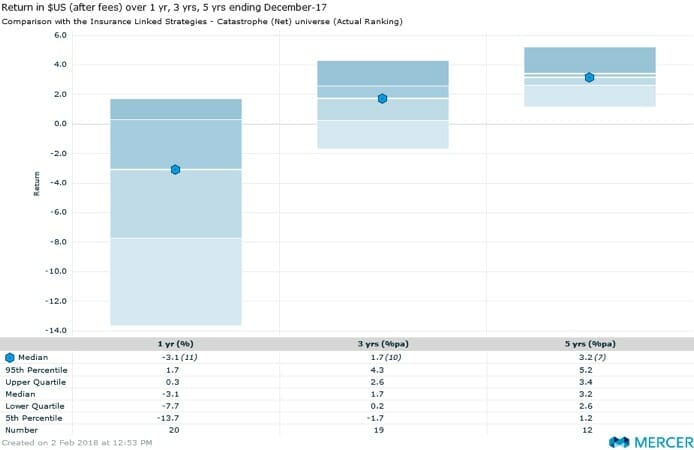
As can be seen in the chart below, the majority of ILS strategies in the Mercer universe produced negative returns in 2017; however, most returns were positive over the last three years and all were positive over the last five years. Last year, investors experienced not only losses but also instances of trapped capital, which happens when the exact size of insurance losses is uncertain and, until it’s known, issuers of securities can hold back capital.

The impact of trapped capital varies from fund to fund but has been fairly minimal for most ILS portfolios. Some managers have issued side pockets to deal with the issue.


The results show a high level of dispersion in performance, in part because strategies included in the universe have quite different risk profiles, but this is mainly caused by the varying levels of exposure to hurricane losses. Most ILS strategies comprise a mixture of catastrophe (cat) bonds and private transactions. Because most cat bonds cover events that are even more extreme than last year’s hurricanes, the broad impact to the cat bond market over 2017 was minimal, although individual bonds did suffer losses. The Swiss Re BB Cat Bond Index was up slightly last year.

Outlook for 2018

Following last year’s storms, many managers believed opportunities would arise and launched post-event funds and reopened existing funds that had closed to new investment. We believe topping up investments after losses is key to successful in ILS and continue to encourage investors to consider this. But should they go further?

After several years of declining reinsurance premiums and, hence, lower returns from ILS, 2018 is bringing an increase in premiums. In 2006, there were dramatic increases in premiums due to the severe capital shortages caused by hurricanes Katrina, Rita and Wilma. What’s different now is that the insurance and reinsurance industries are still well-capitalised, and many more investors are willing and able to deploy capital into ILS. This will moderate the premium increases.

A large portion of reinsurance renews on January 1, and the 2018 premiums for these contracts are generally higher by up to 10 per cent – as are yields on cat bonds – and some increases are significantly higher.

The largest increases were seen from loss-impacted purchasers of reinsurance, with instances of retrocession – when a reinsurer passes on some of its risk to another reinsurer – typically showing the biggest hikes.

As we move through 2018 and new cat bonds are issued and we pass other reinsurance renewal dates, the true impact on premiums will become clearer. January 1 premium increases have not been uniform, and ILS managers expect this pattern to continue, meaning certain areas and individual cases offer opportunities.

Conclusion

We continue to believe that ILS as an asset class offers attractive diversification characteristics for investors that are able to bear the associated tail risk.

In recent times (prior to last year’s storms), ILS has often had either a neutral or underweight allocation relative to strategic weights in many investors’ portfolios. Although overall expected returns were fairly attractive compared with those in many other asset classes, they were less attractive from a historical perspective.

With expected returns now higher, we believe existing ILS investors should consider increasing their allocations within sensible diversification limits, and those not invested should consider or reconsider the asset class.

Robert Howie is lead researcher for insurance-linked strategies at Mercer.


The financial system is operating unsustainably, perpetuating or ignoring environmental and social problems. The continued financing of excessive greenhouse gas emissions and worsening economic inequality, for example, threaten to further divide the financial system from the interests of the users and beneficiaries it is designed to serve.

Now, however, a groundbreaking report offers a genuine framework for solutions.

The final report of the High-Level Expert Group on Sustainable Finance, from the European Commission, represents a systematic view of the urgent changes needed to make Europe’s capital markets sustainable for the long term. It builds on more than a decade of market experience and practice on sustainability, and is further informed by responses from European citizens, the financial and non-financial sectors and public authorities.

The HLEG’s report is different from previous efforts in a number of ways. First, its initiation, backing and support come from the highest levels of European Commission policymaking. Second, the HLEG is led by, and comprises, European investors – each with their own ideas, clients and investment style. Together, they have set out the sustainable investment challenge and the solutions we need to implement. Expect policy change to follow the report’s publication; announcements of intent on market supervision and investors’ duties have already been made.

Given what we face, each recommendation in the report may seem modest in isolation; clarifying investor duties, publishing a taxonomy for sustainable investment, and supporting sustainable infrastructure, for example. These are not new ideas, nor are they radical. But, in aggregate, they represent reforms that can realign capital markets to better serve financial system users and beneficiaries for the long term. These reforms will ensure that investment and financial activity are no longer agnostic to sustainability issues and, instead, make a net positive contribution to sustainability goals.

The report sends a clear message that acknowledging ESG factors is a critical component of investor duties, which are essential to investment processes. This puts down a marker for the whole world showing how to contribute to a more sustainable global financial system that is equitable for all and recognises the significance of ESG incorporation.

Effective oversight

The HLEG points to “considerable evidence” that individual investors are increasingly expecting their providers to consider long-term sustainability issues, as the industry’s demand for clarification around investor duties grows. Indeed, the misinterpretation of investor duties has previously been identified by signatories to the Principles for Responsible Investment (PRI) as a top barrier to ESG incorporation.

While we have seen a surge in much-needed regulation related to sustainability and responsible finance in recent years, they are still widely perceived as voluntary, with unclear objectives. Such regulations are also often detached from other crucial aspects of broader financial regulation, and lacking in the oversight they need to be effective.

Although investor duties are codified in European financial services edicts, such as Markets in Financial Instruments Directive II and the Alternative Investment Fund Managers Directive, the HLEG report cautions that they “do not factor in sustainability to the level required”. It also notes that the Undertakings for the Collective Investment of Transferable Securities regulatory framework contains “no explicit mention” of ESG issues, nor does it address the need to disclose information about how such issues are considered in the investment process.

Echoing the HLEG report, the PRI strongly encourages pension trustees and other clients of investment consultants to ask that ESG issues and their probable effects on risk and return be included in the advice for which they pay. Our recently launched Investment Consultant Services Review found that, despite “pockets of excellence”, ESG considerations still are not a standard part of the advice many investment consultants offer.

Other recommendations the report makes cite the need to: link the duties of investors to the horizons and sustainability preferences of the individuals and institutions they serve; develop and implement official European sustainability standards and labels, starting with green bonds; and better align corporate culture in the financial sector with a long-term outlook.

Next steps

Promoting high standards of competence on ESG issues, including awareness, training and ensuring that they are part of management’s continuing professional development, will serve as a vital catalyst to help realign the financial system with the long-term interests of beneficiaries and clients. As the HLEG points out, we also need robust backing from international standard-setting bodies, including having groups such as the Organisation for Economic Co-operation and Development clarify that investor duties should incorporate sustainability issues.

Buoyed by growing awareness that ESG factors do influence market and portfolio returns, the PRI enthusiastically welcomes HLEG members’ determination that the group’s work effects substantial change in many areas of financial policy.

Their recommendations point to an enormous window of opportunity to pave the way for a series of reforms that will transform Europe’s approach to sustainability and, ultimately, ensure that the global financial system is in the best position to support the environment and society for years to come. It is essential to earn returns for beneficiaries and members, and to make a net positive contribution to sustainability goals. The financial system can and must align its activities with pressing issues, including those related to climate change, reducing economic inequality and ensuring that new technologies are connected to – and not siloed from – the real economy.

We are confident that the HLEG’s report represents the start of a new chapter in European and global sustainable finance.


Nathan Fabian is the director of policy and research at the Principles for Responsible Investment and participated in the High-Level Expert Group as an observer.


We all know past performance is not indicative of future results, but a new study finds evidence that US public pensions are basing performance forecasts on their own prior experiences anyway.


US public pension plans base their return expectations for individual asset classes on their own experience with those classes, new research has found.

Stanford University’s Joshua Rauh and Erasmus University’s Aleksandar Andonov examined how institutional investors set return expectations. Their work shows evidence for the claim that pension plans “excessively extrapolate” from past performance when formulating return expectations.

Their study looks at 231 state and local government funds in the US over the period 2014-16. It states that it’s the first that looks at the relationship between beliefs and past experience for institutional investors.

By examining US public pension plans with combined assets of $4 trillion, the authors find that variation in institutional investor return expectations is influenced by the funds’ own investment histories.

Their paper, The return expectations of institutional investors, states a fund’s asset-class based expected returns, with its chosen weights, should equal, or at least approximate, its discount rate, or overall portfolio expected return. But the research finds that is often not the case.

The paper details the plans’ underlying assumptions, and their behaviours in making them, and states that the average returns experienced in the last 10 years of an asset class, and the extent of the plan’s unfunded liabilities, add “substantial explanatory power” regarding expected returns.

More specifically, each additional percentage point of past return raises the portfolio’s expected return by 36 basis points. And an unfunded liability equal to an additional year of total government revenue raises the portfolio expected return by 14 basis points.

Further, when unfunded liabilities are large, state pension plans are more likely to make aggressive predictions about inflation to justify high nominal return forecasts than to use higher real asset return assumptions for that purpose, the paper states.

Using past performance as an indicator of future performance could be justified, if performance is persistent, the authors state. But there is little evidence in most asset classes to indicate that is the case. In fact, the authors write that in public equity, skill and persistence in pension fund performance are weak or non-existent.

In private equity, however, there has been some evidence of persistence (although our recent interview with MIT’s Antoinette Schoar reveals her new study that could rebuke previous findings around this, see Private equity persistence slips), so the authors investigated this further.

They separated the private equity investments by date: those more than 13 years old and probably realised; those nine to 13 years old and most likely realised; and those 3 to 8 years old and only partially liquidated.

The results showed that the pension funds exclusively extrapolated the returns of the oldest group of investments.

The research uses pension fund data disclosed under US Governmental Accounting Standards Board Statement 67, which requires that public pension funds report long-term expected rates of return by asset class as part of a justification of the plan’s overall assumption for a long-term rate of return. The data reveals the return expectations of individual asset classes, alongside their targeted asset allocation.


To access the paper click below

The-return-expectations-of-institutional-investors