Asset owners remain key to the future success of the PRI and responsible investment. Given their long-term investment horizon, asset owners are well placed to use ESG factors to build value for their beneficiaries.

But in order for this to happen, it is vital that asset owners develop clear ESG investment goals and ensure those goals are supported throughout their organisation. While progress on ESG-focused investing is not materializing as quickly as we would like, the signals that we are seeing in the market tell us that things are moving in the right direction.

The PRI Blueprint, released last year, had as one of its core areas empowering asset owners.  In order to strengthen our work with asset owners, the PRI said it will: 

  • Drive ESG incorporation throughout organisations, from areas such as strategy, policies and trustee capacity through to portfolio/plan-level decisions including asset allocation;
  • Enable asset owners to effectively oversee and monitor investment managers, consultants and others in order to meet their responsibilities to beneficiaries;
  • Demonstrate the long-term global trends that will shape the investment environment of tomorrow;
  • Establish that asset owners’ duties to their beneficiaries extend beyond the risk/return profile of their investments to include making decisions that benefit the world beneficiaries live in.

To fulfil their duties to beneficiaries in the 2020s and beyond, asset owners will need robust approaches to investment that acknowledge the effects their investments have on the real economy and the societies in which their beneficiaries live.

Because the work we do with asset owners is so vital, the PRI is consulting with asset owners on their strategic priorities and how the PRI can help to empower them.

We appreciate that asset owners’ are a diverse group: more than 350 organisations, from 33 countries, with US$19 trillion of AUM have signed up to the Principles for Responsible Investment. These organisations range from very small foundations to the largest pension fund in the world; from organisations that have been with the PRI from the outset to those just joining the journey now; from completely outsourced to in-house investment processes and expertise.

In truth, to empower our asset owner signatories the PRI will require a number of tailored strategies. This is why we need your help.  The PRI is consulting asset owners via this short survey and a series of asset owner roundtables. The survey is a primer for our face-to-face conversations. We are asking for your perspectives on, and prioritisation of:

  • The PRI Blueprint objectives, including empowering asset owners;
  • Environmental, social and governance issues;
  • How effective the PRI is in supporting you;
  • The value of ongoing asset owner focused


Your survey responses will kick-start the roundtable discussions, which will begin later this year.

I look forward to our forthcoming discussions on how the PRI can empower asset owners and collectively drive responsible investment in the coming years.

Click here to complete the online survey

Defined-contribution funds should set default retirement products for members, NEST chief investment officer Mark Fawcett said at a conference. His fund has developed new ideas to do just that.

NEST is the UK’s workplace pension fund set up by the government. It has 6 million members and has developed a blueprint for a default retirement offering to give members assurance and flexibility.

The announcement in the 2014 UK budget that annuities were no longer compulsory was a catalyst for NEST to examine what best-practice retirement income distribution looked like, and to determine the best solution for its members.

“Instead of looking in the mirror to get the answer, as most people do, we surveyed our members,” Fawcett said. “What that revealed is they wanted regular fixed income and protection from stockmarket falls – which is basically an annuity – but they also wanted more. They wanted lump-sum access, pass-on money, and the flexibility to change. So we decided to explore what products might work.”

NEST looked at the fears and behaviours of its members and some issues emerging from a Financial Conduct Authority interim report before it started designing ideas.

What NEST found was that people don’t trust pensions. They would rather take their money out, pay tax and put it into an account that earns negative rates, Fawcett said.

Consumers are also not shopping around or getting advice, and there is little product innovation.

“People like the freedom and choice but they don’t know what to do with it,” he said.

“The conclusion we came to was that members needed a default retirement product. [That way] the only thing they would have to do is call up the fund and say they want to switch to decumulation.”

Ease of use is essential

The fund’s research showed that people with balances as low as ₤10,000 still wanted an income, but it had to be easy for them to set up. The only thing NEST thinks its members should have to do is elect to go into the decumulation phase.

The NEST blueprint has three building blocks: an income drawdown fund; a cash lump-sum fund of 10 per cent, positioned as a rainy day option; and a protection fund for later in life. The building blocks are designed to cover members from their mid-60s through to their 80s and beyond.

The protection fund is contributed to monthly for the first 10 years.

“It’s like taking out an insurance premium with monthly payments, then at age 75 the member buys a deferred annuity, and at age 85 that kicks in, when the income drawdown finishes,” Fawcett explained.

In addition to making products easy to use, he said it was important to use appealing language when communicating with members about retirement.

“We don’t like to say death so we call it the end of retirement! Similarly, people don’t like the word annuity, but they like the idea of insurance and are happy to pay for it,” Fawcett said. “Our aim is to give people something that meets their needs – flexibility in younger years and assurance in older years.”

Fund members were prepared to pay an insurance premium for living longer than they expected.

“They got it and were prepared to pay for it but they didn’t want to use their whole pot,” Fawcett explained. “Overall, they said they’d use about 20 per cent and taking that as a monthly premium, it was easier to swallow.

“The difference between an annuity and what we propose is you have flexibility. If you go into a computer store, it’s only the really geeky people who know exactly what they want. [Most people] just want something that works.”

Rapid growth ahead

While the fund has only about ₤2 billion, it is expected to grow to about ₤25 billion in the next five years.

At the moment, contribution rates are 2 per cent, split evenly between employees and employers. These rates are going up to 5 per cent, then 8 per cent, which will be 3 per cent from the employee, 4 per cent the employer and a 1 per cent tax break.

NEST has a cap of 75 basis points, including investment and administration; however, on average, its fees are about 50 basis points, and Fawcett spends much less than that on investments, even with allocations to unlisted property and alternative credit.

“With 6 million members and our assets doubling every year, it’s amazing what deals you can get done with fund managers,” he says.


Mark Fawcett was speaking at the Investment Magazine Post Retirement Conference, on a panel alongside Simon Ellis, global head of client segments from HSBC UK.

Denmark’s largest pension fund, the DKK768.6 billion ($126.9 billion) ATP, has just posted its best results in years, returning an exceptional 29.5 per cent. This cements the fund’s average annual return of 16.6 per cent, in a portfolio that has achieved positive returns in 18 out of the last 20 quarters. The portfolio is split between hedging and return-seeking investments and the bumper results relate only to assets in the much smaller return-seeking portfolio – about one-seventh of ATP’s total assets under management.

Behind the returns lies a complex structure and investment strategy, which are as much a source of pride for chief investment officer Kasper Ahrndt Lorenzen as the numbers themselves. It’s the result of a meticulously crafted strategy that he likens to an engine. Getting it to fire on all cylinders requires constant tinkering with checks and balances, drawing on tools such as leverage and derivatives.

The basics

The return-seeking fund, which has been run on a risk-parity basis since 2005, introduced four risk factors in 2016. ATP decided to replace the traditional asset classes it had invested in during the previous decade with allocations based on equity, interest rates, inflation and other risk factors – namely illiquid risk factors and an allocation to long/short hedge funds or alternative risk premiums.

“We wanted factors that made sense, that you can talk about and which are tradeable and easy to implement,” Lorenzen says.

Assets are chosen according to the extent to which they “load to the right factors” and meet the return hurdle based on the fund’s understanding of risk. The bulk of the portfolio is internally managed by a team of 120, divided into investment, risk and IT teams, based at ATP’s Hillerød headquarters.

While some risk-parity investors don’t apply the strategy to illiquid investments, ATP includes illiquid alternatives – namely private equity, real estate and infrastructure – under its risk-parity umbrella.

“We didn’t want to have two parts of the organisation,” Lorenzen explains. “We didn’t want to access public markets via risk parity and then, in another part of the building, have a private markets organisation that doesn’t want to know about risk and risk parity.”

Running the engine

Much of ATP’s recent success is attributed to careful sizing and adjustments of the different factors to ensure the risk in the portfolio remains balanced. Correctly gauging the size and scale of the interest-rate factor, amid today’s low-rate environment and inflationary pressures, has required constant tweaks and analysis, Lorenzen says. What kind of loading to the interest-rate factor will ensure a good balance? Are there any hidden interest-rate risks in the portfolio construction? These are the questions he typically asks.

“You want to be balanced but you also want to be sure there isn’t too much interest rate exposure,” he says.

He is particularly mindful of hidden interest rate risk bleeding into other factors and upsetting the balance; for example, in the equity valuation metric – something he calls equity duration. If rates move more than expected, equity valuations will probably erode.

“All of a sudden, higher interest rates convert into lower equities and you don’t have the balance in your portfolio anymore.”

Rising inflation could be another source of disruption.

“It is not a problem having hidden interest rate risk across a portfolio if we live in a low-inflation environment, but if inflation takes off, all of a sudden, we will see hidden interest rate beta come into your portfolio.”

It’s why he is mulling whether to increase the allocation to inflation risk.

ATP reduced its allocation to the equity risk factor to 44 per cent through 2017, down from 50 per cent at the end of 2016. It increased exposure to both inflation and interest-rate factors to 15 per cent and 32 per cent, respectively, up from 9 per cent and 25 per cent. The remaining 9 per cent is exposed to the other risk factors, down from 16 per cent. ATP’s expenses amounted to 0.31 per cent of the aggregate assets the fund managed at the end of 2017.


Hedge funds

Lorenzen is also mulling scaling down the basket of alternative risk premia/long-short hedge fund strategies, all run internally.

“We like hedge funds,” he enthuses. “We are just looking at options.”

He’s found that the performance of the hedge fund basket is most useful in informing the risk strategy and asset allocation of the beta portfolio. The long/short strategies give him an ability to “zoom into the market” and glean information that he can apply to producing equity, rate and inflation beta across the broader mandate. He’s deciding whether to scale down the hedge fund strategies and include more risk-premia strategies in the beta implementation.

“Do we really need the kind of size in long/short format we thought we would, or do we need a smaller size here but use all the work and signals in the asset selection?” he asks. Volatility risk and foreign exchange premia strategies will continue unchanged, while others have been included in the beta implementation.

Another potential change could an increased allocation to private markets and illiquidity risk. The imperative of balance and equality that runs throughout ATP means the current 40/60 split of illiquid and liquid assets, respectively, is on Lorenzen’s mind.

“Forty per cent of our overall fund risk is in private, illiquid investments,” he says. “If we are to have a truly balanced approach, [should] this be 50/50?”

Whatever he decides won’t happen overnight; it takes time to engage in private markets, he says.

Even if none of the changes Lorenzen considers come to fruition, the thoughtful process that characterises every aspect of ATP’s investment strategy is highly beneficial. The in-depth analysis by investment teams is followed by explaining the process to the board and other stakeholders. It is a powerful, affirming journey.

“When you consider something, you are forced to talk about it and embrace it,” Lorenzen says. “We have to prove it is not something we just came up with, but that it is based on a number and is anchored in academia and asset pricing.”

It is a culture of questioning and analysis, what he calls a “sanity check”, that runs throughout the portfolio. The fund constantly questions whether it can justify its complexity, its information technology resources, and investment in illiquid markets that will take time to come to fruition, he says.

It was this decision-making process that led ATP to close its New York private equity office recently – despite private equity topping 2017 returns. Now the fund will focus on fewer but larger allocations within buyouts and distressed funds, along with co-investment with general partners, both of which can be done out of the Denmark office.

As Lorenzen explains, “We asked ourselves if we could justify having a NY office that focuses on funds-of-funds and we decided we couldn’t lift that burden.”

Trust is the bedrock of any sustainable relationship. The general partner-limited partner connection is no different.

What begets trust is candor, transparency. Increasing the transparency of portfolio exposures and risk controls has taken centre-stage with LPs since the global financial crisis, due to bad experiences and the opacity and idiosyncrasies of quantitative and private strategies.

This quest for transparency includes efforts to better understand investment policy, expense recognition, team remuneration, performance measurement, attribution, valuation methodologies, risk management (including operational), governance, ethical conduct and, of course, fee computation.

With predictions of overall low returns amidst rising unpredictability, performance-based fees have become an integral part of the trust equation, which needs to be solved to re-align the business incentives of GPs with the economic interests of plan beneficiaries.

Simply put, there’s increasing rhetoric around fees, and around the disclosure of practically everything that underlies performance to justify fees.

Towards a culture of transparency

Pending future regulations, the recently reincarnated Standards Board for Alternative Investments (SBAI), based in the UK, promotes a culture of disclosure by devising related standards for voluntary adoption, allowing funds to comply or explain. SBAI prefers to rely on a governing body of independent fund directors to ensure compliance or, alternatively, recommends including disclosures in marketing or offering documents, at the manager’s discretion.

LPs probably need to be more involved in the appointment of truly independent supervisors, who don’t just lend their names, with due recourse. As ultimate beneficiaries, LPs need to develop a comprehensive understanding of the nuances of GPs’ strategies, and their legal and regulatory environments, to interpret and compare standardised disclosures meaningfully.

Based on their experiences complying with similar standardised disclosures of the Institutional Limited Partners Association (ILPA), GPs located overseas from LPs often doubt that LPs interpret disclosures contextually to give them a fair shake. Openly sharing sensitive information (for example, side letters) is also an issue for most GPs. All that said, transparency is indispensable and the onus is still on seekers of capital to get LPs comfortable with their priorities and concerns. Conforming to higher disclosure standards also provides managers a template to satisfy the varying needs of LPs globally.

Practical challenges and perception gaps hindering trust could potentially be solved by independent third-party strategists and regional specialists, who could provide LPs verification of compliance with a set of standards and a holistic understanding of an investment, integrating and interpreting all desired disclosures in the context of each individual manager’s operating environment and strategy.

This is akin to taking voluntary disclosures of Global Investment Performance Standards compliance and ESG practices to the next level with third-party independent verification, as is common in pricing and valuations, fund accounting and administration.

Fees and the crisis of confidence

Apart from transparency, what can perhaps alleviate LPs’ embedded skepticism is a fundamental shift in GPs, towards being less asset-centric and more performance-oriented in uncertain markets.

With fee compression rife, Mercer’s “radical contribution” in a recent Financial Times article that “managers should pay to run clients’ money”, is worth a closer look (see also “Building a better fee model”). If one views the asset-management industry like any other that needs capital, then couldn’t one argue that investors who provide capital should get paid by seekers of capital?

If the LP’s capital is regarded as a loan from a bank to a borrower, a fixed fee or guaranteed return is understandable, as Mercer has suggested. However, Mercer’s call for skin in the game to absorb any losses is debatable if LPs come in as equity investors willing to share gains and losses.

Managers have long claimed fees for providing access to opportunities and complex strategies executed by talented professionals with modern infrastructure to deliver superior gains and protect better in down markets – alpha, in other words.

When confidence in alpha is shaken for historical or forward-looking reasons, however, LPs typically compensate only the proven geniuses and niche strategies, to help them retain talent and keep their lights on. Without that confidence and trust, Mercer’s proposal suggests, GPs might have to vie for LPs’ capital with competitive guaranteed returns, absorbing losses and co-sharing any additional gains (bond-plus-warrant structure).

GPs might have to dip into internal rainy-day funds and be more thoughtful in the allocating and vesting of performance fees for their underlying contributors.

It’s encouraging that some proactive GPs have led by example with creative fee structures; for example, 1-or-30, hurdle rates, fees that decline with rising assets under management, tiered pricing, and more.

Alternatively, the parties could strike a pure profit-sharing arrangement with no fees either way, as is prevalent in co-investment of private assets.

Kamal Suppal is chief investment auditor of Boston-based Emerging Markets Alternatives, an independent investment audit firm specialising in due diligence on alternative strategies in emerging markets.


Through the course of the last year, AP3, the SEK345.2 billion ($42.2 billion) Third Swedish National Pension Fund, scaled back on hedge funds and boosted its internal portfolio construction capabilities. The fund also continued steadily building its alternatives portfolio, where chief investment officer Mårten Lindeborg sees a stronger risk/return ratio than in equity.

But it was the fund’s absolute return strategies – accounting for 4 per cent of assets under management and encompassing internal and external hedge funds plus risk premium strategies – that underwent the most change last year. AP3, one of five AP funds that manage the capital buffer of Sweden’s state income pension system, introduced volatility risk premium back in 2010 and has since added other premia, such as value, quality, momentum and carry, all designed and run by external managers until recently.

Although the fund still uses what Lindeborg refers to as “external building blocks”, it has now internalised all construction of the risk-premia portfolio. The decision was motivated by a desire to increase internal capabilities and reduce the over-diversification AP3 had in the absolute return portfolio.

“We have the internal resources to cope with these kinds of decisions, and we also have the necessary platform,” Lindeborg says. “We haven’t seen the proof in the pudding yet. We need to wait a couple of years to judge if it has been a good adjustment or not.”

Seeking more from hedge funds

Lindeborg has also overseen a reduction in the number of hedge fund managers in the portfolio to less than 10, retaining those with the strongest track record, in a decision motivated by cost and a frustration with poor returns.

“Global hedge fund indices are at the same level they were 10 years ago,” Lindeborg says. “Of course, some hedge fund strategies have done well, but others have done badly, and we need to consider the cost side. The cost pressure on our fund, and all AP funds, is high. AP3’s asset management cost ratio was 0.10 per cent in 2017,” including 0.06 per cent from operating expenses.

The fund can replicate some hedge fund strategies in-house, via its risk-premia strategies.

“Obviously, some hedge funds are extremely successful, and it’s hard to analyse what the real performance maker, or alpha, is,” he says.

It means AP3’s relationship with hedge funds has become increasingly strategic. Lindeborg now looks for additional contributions from these managers, such as research, thoughts on portfolio construction or other insights.

“We can’t significantly increase our hedge fund exposure, but we will always look for strategic partnerships within this area. The hedge fund industry has a lot of work to do. It has to prove it’s a good vehicle for diversification, performance enhancement and other complementary benefits,” he explains.


Equity allocations

AP3 has close to 50 per cent of the portfolio in equity, including private equity, and the allocation returned 17 per cent for the year. Of this, a quarter is invested in an active allocation to Swedish stocks, run internally, which continues to be highly successful.

“The Swedish stock exchange has been one of the best performers globally, if you go back 100 years,” Lindeborg says.

The fund has active allocations to European and emerging-market equities – managed internally and externally, respectively – and has passive, low-tracking error allocations to the US, Europe, Asia and Japan with BlackRock.

In addition, the equity portfolio harvests several risk-premia strategies, including small-cap risk premium.

“In some areas, it is better to implement risk premia in the beta portfolio, instead of the long/short portfolio, in order to reduce overall transaction costs,” Lindeborg says.

The fund has returned 8.8 per cent for 2017, against its long-term 4 per cent real return target. But Lindeborg predicts modest returns in the years ahead, while acknowledging that six years ago he anticipated lower returns around now and today’s returns are stronger than ever.

Steady rise in alternatives

He notices an increasing need to move quickly and react to short-term factors to achieve alpha. Also, since 2010, he has steadily increased AP3’s allocation to alternatives, in line with his belief that the risk return is better than in equity. About 20 per cent of the fund is now in alternatives.

“We are not the only fund that thinks alternatives are good, so they are expensive. But from time to time there are opportunities,” he says.

Investing in alternatives also requires chipping away at the equity allocation. Rules dictate that all the buffer funds invest at least 30 per cent in liquid fixed income, which restricts alternative investments if they don’t cut their equity allocations. AP funds 1-4 are also capped at a 5 per cent allocation to private equity.

Real estate has been one of the best-performing alternatives, where strategy is focused on ownership stakes in successful property companies like Vasakronan, Sweden’s largest real estate company, which owns, develops and manages commercial real estate throughout the country. AP3 owns it, in partnership with sister funds AP1, AP2 AND AP4.

AP3 is also the main shareholder in Hemsö, Sweden’s leading owner of community service buildings, spanning care, nursing and education facilities. The fund is developing and building-up other majority-owned property businesses, focusing on office and commercial buildings and residential real estate.

“In our experience, owning a company is a very good way to implement a strategic view in alternatives, especially if we are a majority stakeholder in the company. It means we can make decisions around the strategic direction,” Lindeborg says. AP3 also has a distinct advantage over the competition, due to access to cheap finance. Companies the fund owns can implicitly borrow under the Swedish Government’s AAA status.

“It means our financing cost are lower than many competitors’.”

But the strategy has pros and cons. While building up companies can be better than investing in funds, where fees can eat up expected returns, running a company requires a board, a chief executive and putting processes in place.

“If we take the route to build up a company, the equity allocation should be a considerable size to make the effort worthwhile,” Lindeborg says.


AP3’s other alternatives

The allocation to alternatives includes infrastructure, private equity and insurance risk. There is also a 1.5 per cent allocation to timberland – which is proving big enough to be a worry.

Strong returns from forestry in Sweden, Australia and New Zealand have not been matched by timberland assets in the US and emerging markets. Lindeborg attributes this to emerging-market currency issues.

“We are not that highly exposed to emerging markets, but on aggregate, we have to reconsider and rethink our timber strategy,” he says.

The fourth-annual Chief Investment Officer Sentiment Survey, conducted by conexust1f.flywheelstaging.com and Casey Quirk, a practice of Deloitte Consulting, has revealed a clear picture of how large institutional investors are viewing and responding to current market conditions.

Most CIOs in the 2018 survey (52 per cent) lowered their return target during the last year, compared with 40 per cent of respondents in 2017. This confirms investors’ more cautious outlook for markets. A large majority of respondents (71 per cent) now have a return target below 7 per cent.

While more respondents said they were confident of reaching these new, lower targets, (57 per cent, compared with only 27 per cent the previous year), there were still some concerns.

Falling equities markets were the most common concern (51.6 per cent cited it), followed by rising interest rates (40.1 per cent) and geopolitical risks (24.8 per cent).

Active long-only managers losing share

The survey, which included 132 respondents from pension funds, sovereign wealth funds, endowments and insurers, with total assets worth $3.1 trillion, also revealed that active long-only managers are receiving lower allocations, as investors seek returns outside of traditional asset classes.

In the 2013 survey, respondents said they allocated 60.3 per cent of their portfolio to active long-only managers, this has fallen to 57.9 per cent.

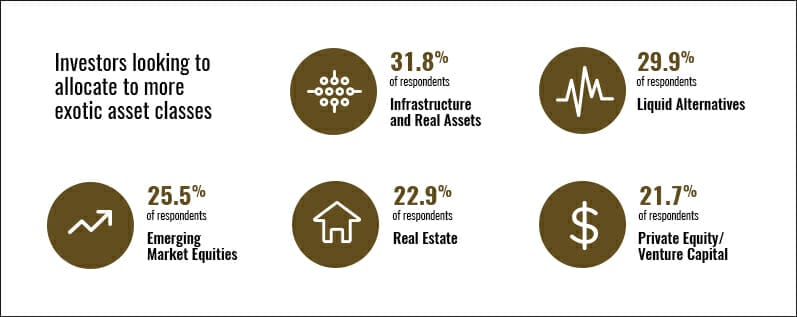
Instead, investors are looking to more exotic asset classes. Investors were planning to allocate more capital to infrastructure and real assets (31.8 per cent of respondents), liquid alternatives (29.9 per cent), emerging market equities (25.5 per cent), real estate (22.9 per cent), and private equity/venture capital (21.7 per cent).

Casey Quirk consultant Chloe Gardner says there are broad implications for the providers of long-only active management and their role, as it is not seen as a sustainable long-term strategy.

“The search for alpha is more challenging, and as allocations to infrastructure and real assets and alternative types of equities are increasing, there is a push away from long-only active, and a dramatic shift to good alternative managers,” Gardner says.

Her colleague, Casey Quirk senior manager Tyler Cloherty, says he has been observing the bifurcation of strategies between traditional and alternative for years.

“I’m surprised the reduction to long-only active managers wasn’t larger in this survey,” he says. “There is plenty of supply of new strategies; the question is, are there good enough managers with high-quality opportunities and track record to sustain the demand.”

Focus on costs

The survey revealed reducing investment costs is a growing priority for investors, with 42 per cent of respondents calling it “very important”, compared with 36 per cent in 2017.

While investors are employing a wide range of strategies to reduce these costs, by far the most common that respondents mentioned was negotiating harder with external managers (57 per cent), followed by allocating more to passive or smart-beta strategies (26 per cent), insourcing (20 per cent) and shifting out of high-fee asset classes (13 per cent).

The most popular fee structure among investors is a performance-based sum with a smaller management fee.

Better control, rather than cost, is the primary motivation for insourcing. But it is clear that those investors with internal capabilities have lower costs than those without.

For example, in the investor cohort with assets greater than $25 billion, the total investment costs for those with internal capabilities was between 22 and 60 basis points. For those with no internal capabilities, total costs were between 50 and 92 basis points.

“There is a clear benefit of scale, because larger asset owners are more likely to negotiate with managers and insource asset management,” Gardner says. “They are more efficient and have better cost structures [based on] salaries and bonuses, rather than on basis points.

“For smaller asset owners, it might be better to wait it out to negotiate with managers, rather than take on the organisational and operational issues of insourcing, such as portfolio attribution and retaining staff.”

Cloherty says managers have been more flexible and open in negotiating performance fees, even in traditional strategies.

“This creates more operational complexity for managers, and sometimes more confusion for trustees in predicting costs, but the upside is in alignment and evaluating the value add of a manager,” he says.

The consultants say they are clearly seeing the preference for some combination of management fee and performance fee from the buyer side.

“This gives some baseline, for stability, and the performance fee for alignment,” Cloherty says. “The performance fee is typically highly negotiated.”