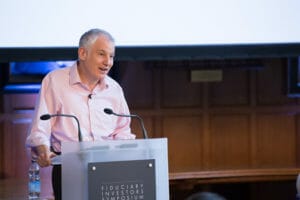
Albert Einstein said, “We cannot solve problems by using the same kind of thinking we used when we created them.”

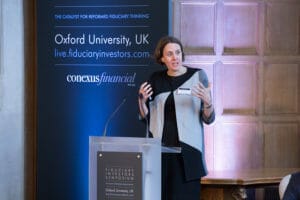
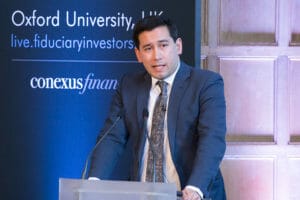
It’s a statement that Eric Beinhocker, professor of public policy practice, says is particularly apt when it comes to addressing capitalism today. Speaking at the Fiduciary Investors Symposium at the University of Oxford, he argued that Western capitalism is broken and needs fixing. Although he said there was no quick and easy answer, he suggested different ways to think about the world.

Beinhocker, executive director of The Institute for New Economic Thinking at the Oxford Martin School, argued that the vast majority of people in the West aren’t benefiting from capitalism and haven’t for a while. In the US, where the data is most extreme, incomes for the bottom 90 per cent of the population have flatlined since the early 1970s. All the gains in the economy have gone to the top 1 per cent of the population, due to an uncoupling of wages from productivity and profit from investment.

“People are as productive, but where did the profits go?” he asked. “It all went to the top, and the people participating didn’t benefit.”

There are many changes behind the breakdown. All the jobs growth has occurred at the top or bottom of the income spectrum, while employment in the middle has fallen. Pension and healthcare costs, which corporations or governments have traditionally borne, have shifted onto the shoulders of families. There has been a “great disinvestment” in infrastructure with little money going into the real economy. All of this has coincided with unprecedented environmental damage, Beinhocker said.

In Einstein’s axiom, this shift from earlier “constructive capitalism” to “extractive capitalism” is the kind of thinking that created the problem. It has led to a breakdown in the social contract of inclusivity and participation. The idea that if you contribute you get something back has died, leading to feelings of unfairness and a loss of trust in the system. It has triggered a moral outrage stoked by the media, and a desire to punish the elites who have broken the social contract.

Today’s problem stems not from globalisation or technology but from fundamental changes in economic thinking and policy dating from the early 1970s.

“This is when the system broke down,” Beinhocker said. “We can see in the data. Giving and getting back used to work, but it broke down in 1973.”

The new ideas introduced in the ’70s and now firmly wired into today’s economy include widely held beliefs such as: corporations should be wholly run for the benefit of shareholders rather than multiple stakeholders; unemployment is a consequence of people preferring leisure; and labour is a cost to be minimised. In the early ’70s, policy set the market against the state and GDP became overwhelmingly important, Beinhocker said.

His solution is bottom-up reform of capitalism. He argued that economies were complex, adaptive systems, where designs and strategies evolved over time and macro patterns emerged from micro behaviour; that economies were neither simplistic nor linear, but dynamic, unfolding processes. An economy was a network of self-organising social phenomena tied to our physical environment, he said.

He argued that prosperity shouldn’t be measured in monetary terms but by the accumulation of, and access to, solutions to human problems, citing the invention of antibiotics as an example. The purpose of capitalism, therefore, should be to provide solutions to make our lives better. In this new metric, wealth becomes the accumulation of solutions, growth is the rate at which new solutions are created and made available, and prosperity is a set of solutions and our ability to access to them.

The goal of business and investment would be to create new and better solutions and make them more widely available, he continued. And markets and governments should work together to create an interdependent evolutionary ecosystem for creating solutions and providing access to them. It would require navigating between good and bad economic activities and sifting out those that don’t work for society, he explained. He pointed to climate change as an example of a “solution today” becoming “society’s problem tomorrow”.

Beinhocker said the solution he offered looked to capitalism’s inherent strengths. One of the reasons capitalism has been so successful has been its ability to foster innovation and co-operation to solve problems.

“Capitalism is the world’s largest co-operative system,” he said, citing the co-operation that goes into building a Boeing 787 as an example of that “co-operative dance” fundamental to solving problems; therefore, the future should involve bigger networks of co-operation and deeper and more specialised pooling of knowledge and inclusion.

The genius of capitalism is its ability to evolve. It has always passed through cycles and breakdowns. What is needed today is strong leadership in business and the investment community to turn the system back into a co-operative and constructive force.

“It has to happen fast,” he urged. “History shows we can get trapped for a long time.”
An estimated $3.4 trillion is invested in renewable energy but that is set to grow to much more. The compelling case for investing in renewable energy comprises: consumer demand, revolutionary technology such as electric cars, changing corporate behaviour, and galvanising factors such as the sustainable development goals (SDGs), a panel of experts has argued.

Electricity is no longer a homogenised product and market choice is allowing consumers to vote with their feet, some of the most influential consumers are corporations. Many large, investment-grade companies have committed to using renewables, argued Alex Brierley, investment director, Octopus Investments, in the UK. These companies are committing to buying power directly from renewable energy providers at fixed prices. It is giving renewable assets a new cashflow certainty many are losing as government subsidies that have supported solar and wind projects fall off.

Although it is a “big decision” for companies to lock-in long-term costs, Brierley, who spoke in the panel at the Fiduciary Investors Symposium at the University of Oxford, said the arguments to do so are compelling, particularly as renewable energy prices continue to fall. Paul Crewe, executive director and chief sustainability officer at the UK’s Anthesis Group, noticed the corporate shift into renewable energy during a nine-year tenure as a sustainability officer at supermarket chain Sainsbury’s.

“Sainsbury’s is 149 years old but in that entire history, sustainability has brought the supermarket its highest returns on investment,” Crewe said.

The panellists noted that companies aren’t just turning to renewables for investment. They are also looking at how to decarbonise transport fleets and tackle infrastructure challenges.

The investment returns from renewable energy are good for pension funds, noted Peter Damgaard Jensen, chief executive of the DKK269.6 billion ($44.5 billion) Danish pension fund Pensionskassernes Administration (PKA), which first invested in renewables back in 2011 when it bought a stake in a large offshore park in Denmark. The fund targets long-term returns of about 6 per cent a year. Looking ahead, Jensen says renewable asset investment opportunities will open in emerging markets, where transactions are often easier, and “leapfrog” investment processes in developed markets, storage and grid infrastructure. Investment will also be backed up by much more accurate forecasts of the amount of power renewable assets produce, he said.

Grid infrastructure is an investment opportunity because solar and wind generation is subject to weather vagaries that make balancing supply and demand difficult.

“There are interesting technologies that can balance supply and demand,” Brierley noted.

Although renewable assets tend to sit in investors’ infrastructure and alternatives portfolios, they also fit in equity or credit allocations. For mature pension funds, renewables are an important source of cash flow, and could be a useful source of income in a downturn. Some investors use leverage to increase returns. Investment returns can jump from 5 per cent to 6 per cent on an unleveraged basis to 10 per cent on a leveraged basis.

The asset class still faces risks. Governments are scaling back on subsidies, exposing investors to price uncertainty. It is also difficult to accurately measure renewables’ impact on meeting SDGs. And although renewables offer diversity in a crisis, it is not yet clear how they will perform in a downturn.

“Will the asset classes be resilient if we see a financial crisis?” Jensen asked. “In theory, they will behave well, but we really don’t know yet.”

Investment opportunities in private equity are thin on the ground, argued Sandra Robertson, chief investment officer and chief executive of the UK’s £3 billion ($4.3 billion) Oxford University Endowment Management (OUEM), which manages assets on behalf of 32 investors, including the University of Oxford, 25 colleges and six associated charitable trusts.

“There are pockets of opportunity,” Robertson said, speaking at a panel discussion during the Fiduciary Investors Symposium at the university. “But there is a huge amount of capital chasing everything, all around the world. There are no barriers to entry, anyone can raise a fund. Investors are also allocating because they have made good returns in the past and are making that assumption going forward.”

Robertson also noted that access to the best fund managers is difficult because the top-quartile general partners tend to handpick their investors and limit their fund size.

Success in private markets also depends on having a meaningful allocation, something she said some funds lack.

“Having 5 per cent to 7 per cent to alternatives is meaningless because of the fees,” she said. “I don’t have a magic number but it’s not worth dipping a toe in.” OUEM has a 24.5 per cent allocation to private equity that it has built up over the last 10 years. It invests directly in funds and has about 15 general partner relationships, Robertson said.

At Canada’s OPTrust, which manages C$20 billion ($15.9 billion) in assets for 87,000 former and current public-service employees in the province of Ontario, success in private markets depends on robust relationships and alignment, said Morgan McCormick, OPTrust managing director of private markets and head of Europe. The fund, which invests directly in infrastructure, and via funds and co-investment in private equity, also links its success to a 20-strong internal team. This in-house ability has enabled OPTrust to embark on co-investment, which has brought down fees, McCormick said. This also means the fund can increasingly negotiate deal by deal. The team’s ability to work “on the ground” and navigate different geographies is also important in private markets. OPTrust has offices in Canada, the UK and Australia.

Investor enthusiasm for private equity has remained blighted by high fees and a lack of transparency, argued Ludovic Phalippou, associate professor of finance in the Saïd Business School at Oxford University. He pointed to the recent decision by the Norwegian Government to continue to bar its $1 trillion sovereign wealth fund from private equity, despite the fund’s wishes and the recommendation of a government-appointed expert group, as proof that the asset class still had opacity and cost problems.

“Norway is not comfortable with the model,” Phalippou said. “It is in the best interests of fund managers to fix the model, improve transparency and create cleaner contracts, as this creates a sustainable asset class.”

Despite the challenges, Nalaka De Silva, private markets investment specialist at Aberdeen Standard Investments argued private markets would play an increasingly important role in asset allocation because of the diversity and return these allocations bring. He said investors in public markets were frustrated by an increasing number of companies not making it to the initial public offering stage. Moreover, private-market investment in infrastructure and young companies is an important driver of economic growth. He said a swathe of European regulation, such as the Markets in Financial Instruments Directive, would make investment in private markets more transparent and “level the playing field”, but could also curtail management of private assets and make it even harder to invest with top-tier managers.

Technology has affected our ability to judge what is true and what is false. Words and images can be manipulated. Navigating through fake news, AI and algorithms to find the truth is one of the biggest challenges facing investors today, professor Stephen Kotkin has argued.

Kotkin, professor of history and international affairs at Princeton University, urged caution when describing the extent to which truth has been disrupted in today’s new epoch driven by technological innovation. It’s nothing near the extent of the falsehoods under Stalin and Hitler, he said. He also pointed out that fraud was not new, only the methods had changed. There are now apps that change our apparent gender or alter our faces to make us look younger, something he likened to old-fashioned Hollywood’s special effects.

Speaking at the Fiduciary Investors Symposium at the University of Oxford, Kotkin traced today’s disruption of truth back to policy change in the US in the 1980s. he said the repeal in 1987 of the Fairness Doctrine, which had required the media to balance arguments with different voices, laid a foundation for today’s “tribal” divisions and belief that, “If it’s good for me, then it’s true. If it’s not good for me then it’s fake news.”

He said technology was also to blame, such as the rise of addictive algorithms that lead us down prescribed paths; an initial internet search invariably leads us to another, more extreme, site that will ensure our attention remains focused.

“The business model of social media is based around [the idea that] the more extreme things are, the more you will stay [tuned] to watch it,” he explained.

Investors have even more reasons to be worried. The financial data they rely on, from government policy announcements around interest rates to their own company information, is all at risk of being falsified. Financial markets will react just as quickly to fake news as to the real thing. An AI-generated market-moving speech from a politician will be impossible to differentiate from the real thing, he said.

“Imagine if this information is delivered in real time, falsely,” he said. “This is the world we are about to enter, it’s moments away.”

He asked delegates, “Who is protecting your data?”

Ways to fight it

Kotkin did offer some encouragement that the problem might not be as bad as it seemed – at least in democracies. He pointed out that although false stories spread more than true stories, false stories also diffuse more quickly. He noted that Twitter users who spread falsehoods had fewer followers and argued that the “fake stuff is shallow; it is spread more, but not as wide or as deep”.

There were also solutions to hand, he said, and listed values, technology, private capital and imagination as important counters. Fact-checking helps, although he noted that the people who consume fake news don’t look at fact-checking sites.

Stronger branding does not work as a stamp of authenticity, since it is easy to simulate brands; however, companies and organisations can use their weight as advertisers on the big platforms to effect change. When American consumer goods giant Procter & Gamble slashed its digital advertising budget, it didn’t hurt sales, he said. Investors can also engage with internet firms to get them to take their responsibilities more seriously.

But the real cure to killing off fake news begins in schools and at home, Kotkin said, with the teaching of the lesson that truth is many-sided and not universal.

“The only way to combat this is by teaching tolerance; we need it like oxygen,” he said.

Technology is the problem, but it is also the solution – primarily Blockchain or distributed ledger technology. Blockchain’s ability to store data so that it can’t be changed or altered, in a chain visible to all, is a guarantee that data is genuine.

“This way, everyone has the same record of a transaction,” Kotkin explained.

The established internet giants publishing fake news and damaging the ability to know what is true and false were fighting to preserve the status quo by snuffing out any innovation that threatened them, Kotkin said. This manifested as “buying companies, buying ideas and putting them to bed,” he explained. But he argued that an “inflection point” would come that would allow the new technologies that help solve the problem to come to the fore. He likened it to a point in the hydrocarbon sector when the cost of investment would lead to an implosion and consign fossil fuels to the past.

“This is a model of how change could happen,” he said. “When will people start fleeing from the internet? They will go somewhere else when there is somewhere else to go.”

Fiduciaries should think about their collective duties to human society when they consider their investment strategies, the Dean of the University of Oxford’s Said Business School has said.

At a time of multiple global threats and unknowns, investors should take a big-picture approach guided by both a moral perspective and investment opportunities, the Peter Moores Dean and Saïd Business School professor of finance told delegates at the Fiduciary Investors Symposium at Oxford.

He argued that priorities should go beyond wealth creation for individuals to the long-term interests of beneficiaries.

“If fiduciaries have a collective duty to human beings, we have to consider happiness and survival of the species,” he said.

That thought process led him to ask what makes people happy. The World Happiness Report states that it’s not just money.

“What we know from happiness research is that beyond a certain level of subsistence, increased money doesn’t correlate with increased happiness or satisfaction,” Tufano said. “Happiness and satisfaction are stronger when individuals have meaning and purpose.”
He drew on a range of sources to illustrate the economic landscape and challenges that could lie ahead. Kate Raworth’s Doughnut Economics suggests the future goal for economies is ensuring a balanced combination of human and planetary prosperity. Her future scenario is a flourishing web of life where human needs such as peace, equality and health are in sync with planetary needs around mitigating climate risk and ensuring biodiversity.

Research from Oxford’s Future of Humanity Institute finds that grave threats lie ahead. Drawing on collective data and interviews, the institute has isolated 12 risks that threaten human civilisation, Tufano explained. Some are acts of god, such as an asteroid impact or a super volcano; others are things we have at least some control over, like extreme climate change and ecological collapse, nuclear war or global pandemics. The research also lists AI, synthetic biology and nanotechnology as threats, despite their positive consequences, because these technologies can also be weaponised.

“It is sobering,” he said, reflecting on the 12 threats. “I have sat on investment management committees for the past 50 years and we haven’t discussed many of these things in board meetings.” He noted that these threats were a consequence of both market and government failures and that new technology would increasingly address them.
Imperatives and opportunities

Investors navigating a future strewn with risk have several options. They could do nothing, which Tufano argued was a choice, just not a “positive one”. They could consult their beneficiaries, something few institutional investors tend to do, or they could let their actions be guided by both moral imperatives and investment opportunities.

To illustrate how these two factors could interact in typical investor activity, Tufano concluded with a case study and an imaginary scenario. When US food giant Kraft Heinz bid for Anglo-Dutch company Unilever in 2017, offering an 18 per cent premium for the consumer goods group, Unilever rejected the proposal. The company said at the time that it wanted to balance profitability with environmental sustainability, and Kraft Heinz was known for aggressive cost-cutting that would put that strategy in jeopardy. In a hypothetical shareholder vote, 75 per cent of symposium delegates also voted to reject the offer.

In the scenario, Tufano asked delegates to vote on whether to invest in a new imaginary technology that allowed parents to control the gender of their child. The technology would probably be met with strong consumer demand and generate superior risk-adjusted returns, he said. Again, delegates rejected the idea, with 83 per cent voting no for reasons including the long-term impact such a technology would have on the gender balance.

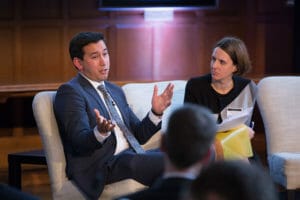
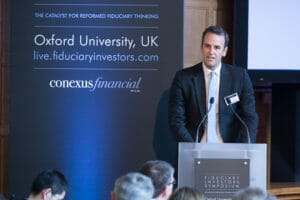
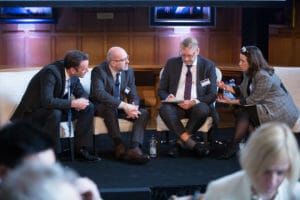
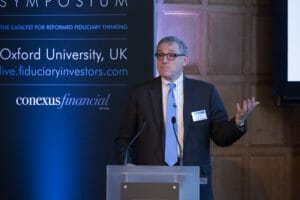
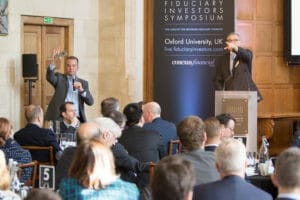
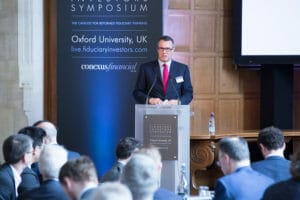
Photo Gallery from the Fiduciary Investors Symposium – April 15-17 2018, Oxford