The inclusion of small- and mid-cap China A-Shares in the MSCI Emerging Markets Index will depend on investors’ experience with the initial 226 large caps, MSCI’s head of research, Asia-Pacific, Chin Ping Chia, says.

Subsequent additions to the index, which has $1.9 trillion in assets benchmarked against it, will require further reforms of the China A-Shares market, to reduce accessibility frictions and barriers, Chia says. Much of the responsibility for reviewing these companies lies with China’s financial regulator, the China Securities Regulatory Commission, he added.

A-Shares inclusion strategy

MSCI’s approach to A-Shares inclusion has been somewhat cautious and, therefore, done in phases, as it expects A-Shares could one day make up more than 40 per cent of the total Emerging Markets Index.

The gradual phasing in of these shares also gives investors more time to prepare for the weighting to Chinese companies, Chia says.

MSCI applies the same methodology for all of its indices, with the aim of capturing 90 per cent of the eligible investment opportunities in a given country, head of ESG and real estate at MSCI, Remy Briand, says.

“In the case of China, because there were constraints due to the access channel, we applied the same methodology up to a point,” Briand explains. “The point was then to limit the [inclusions] in the first phase to large companies. We essentially split the demand to buy into A-Shares.

“As we look at the full inclusion, which may take years, it will depend on how quickly China opens up. Then we will talk about other batches of companies, mid-cap and eventually small-cap as well. It may happen quickly, it may happen slowly, it may never happen.”

For now, the initial inclusion has been a success, despite concerns, Briand says.

“What we’ve heard from the various market participants is the actual implementation of the inclusion went very smoothly,” he says. “When trading happened, it went smoothly, to the credit of all the market participants.”

The suspension question

Chinese companies that suddenly suspend trading for weeks or months pose an ongoing problem for both MSCI and investors of the index, mainly because it temporarily cuts off access. There’s also no definitive reason why suspensions occur, which can leave investors in the dark about what’s happening inside these companies.

Suspensions have, therefore, become a focal point for MSCI and tighter rules around them must be created before further A-Shares companies are added to the index, Briand says.

“It’s up to the [Chinese regulatory] authorities to ensure that the number of suspended stocks decreases, because it is a characteristic of the China A-Share market,” Briand says. “There are actually a lot of suspensions and some of them can be for a very long time, which is making the problem worse. So, yes, that’s something that would need to improve.”

The case against investing in gun companies rests on the basic principles of ESG, but also on the first purpose of an investment portfolio – making a maximum profit within a given risk framework. It is not the purpose of investing to change the world, teach it morality or foist any political dogma on its beneficiaries. It follows that an ESG policy should not be the consequence of the emotional or political preferences of those who manage or control the portfolio. It should be the logical consequence of risk management and return maximisation.

It is unclear what influence ESG has on returns. A number of studies point to a positive effect, some at a negative effect. What these studies have in common is that they use figures from a period in which ESG went from a fringe issue to an accepted mainstream requirement in most of the developed world. In other words, the benefits of ESG are slowly being priced in. If you are not taking ESG into account as an investor, you have probably missed a source of alpha from the return effect already. Today, it is safe to assume that ESG will, at a minimum, do no harm to your returns.

In the area of risk management, there are opportunities. The related risks come in two general classes. One is the image effect of investing in a company that gets embroiled in a scandal. As an investor, the media will tar you with the same brush as the offending company. This will have an effect on your clients or beneficiaries: they will trust you less. Trust is the oxygen of investors, so you need to protect it.

The other class of risk is regulatory. The enterprise you have invested in could suddenly have its product legislated to death, if that product comes to be seen as malevolent or having undesirable side effects. Think of chlorine in white paper, once a mainstream bleacher, today an impediment to paper exports.

ESG proponents typically think setting up a policy starts with exclusions and develops from a ‘best-in-class’ approach to impact investing. That makes exclusions a primitive policy. In practice, different situations call for a different approach. Some products, like tobacco, will do damage in all circumstances. Others, like oil, may or may not cause big environmental damage and are extremely useful in daily life. Just like exclusion makes sense for tobacco, best in class is called for in the case of oil. The other way around would be nonsensical.

Wrongheaded political arguments

The political discussion is centred in the US, where a powerful lobby argues against any restrictions on the distribution and possession of any firearm. Philosophically, it bases its position on historical traditions and the US constitution. Both pillars are wrong. The mythology of the Wild West sharpshooter does not stem from reality: early revolvers were so badly constructed they were as likely to explode in the hand of the user as to fire a bullet. Instead, circus-like Wild West shows performed in the cities created the story. As for the constitution, the Second Amendment is explicitly based on the need to maintain a militia, a volunteer army of amateurs, not on the need for hunting or private justice.

An important error of the lobby is that it equates its position with freedom. As stated in the declaration of human rights and citizens of 1789: my liberty ends and begins with the liberty of others. Individual liberty is relative and should be weighed against the rights and liberties of others.

Gun proponents will often defend their attachment to guns by pointing at the use of firearms to defend themselves against crime. The argument is revealing, in that it implicitly rejects the option to leave defense against crime, both before and after the crime is committed, to the police and court system. It condones punishment meted out by private individuals, thereby rejecting the rule of law, one of the basic pillars of democracy.

As long as the discussion remains emotional and dogmatic, the lobbyist’s position can be maintained, but it is so flawed that it is vulnerable to sudden collapse if that situation changes.

The case against handguns

In general, a number of the negative effects of handguns rest on the fact that they are difficult to aim with precision. Even training will not diminish this disadvantage by much.

Handguns (guns that may be operated with one hand, pistols) may be used by private individuals, the military and the police. We can be short about handguns in the military. Their only use is as a status symbol for officers. The military offers a plethora of much more effective alternatives.

Handguns are particularly ineffective in private hands. US statistics indicate that in the private sector, their main effect is to facilitate suicide and harm family members and bystanders in domestic accidents and social conflicts. Evidently, they are pointless and potentially counterproductive in a situation where the other party is armed with a more effective weapon. Handguns are useless for hunting.

That leaves the police. US statistics indicate that a large majority of handgun shots fired by police officers hit nothing in particular. A significant minority hurt the wrong person. Of the tiny minority of shots that hit the right person, many do not damage the part of the body targeted. The difference in target efficiency between police officers who re trained and those who are not is statistically irrelevant. Police have safer, more efficient alternatives, ranging from stun guns to automatic firearms.

In short, handguns do not solve any real-world problem. It is easy to live without any handguns at all.

Australia offers a case study for handgun control. While it started with few restrictions on handguns and a large mass of privately owned guns after the return of its soldiers from the First World War, the country soured on handguns after some bloody shooting sprees, known as the Port Arthur massacre, the Monash University shootings and the Sydney hostage crisis. These took place from 1996 to 2014. Tight gun laws were introduced in 1996. The other two shooting dramas led to further tightening. Political resistance was restricted to shooting and hunting enthusiasts and lobbyists. Vast numbers of weapons were ‘sold’ to the government (more than 1 million in 1996 alone, from a total population of about 15 million at the time) and Australians overwhelmingly support the present situation or want gun access tightened even further. This shows how an incident in a country can lead to a complete change that amounts to permanent loss of virtually the whole market. Moreover, it shows how popular support makes sure there is no way to backtrack. Change is in one direction only.

A risk profile of handgun producers

The list of the major handgun producers is short: Beretta, Browning, Colt, Glock, Remington, Sig Sauer, Smith & Wesson and Walther. It is, therefore, easy to ban them from an investment portfolio. All are subject to the risk of having their products virtually banned overnight, even in their home countries. Most have good name recognition. They are sensitive to becoming embroiled in scandals and dramas perpetrated with their products or even products of competitors, and to the risk that the negative effect of such scandals will spread to other products they make. None of them offers a return above average as a reward for running an extraordinary investment risk. That makes the decision simple.

Peter Kraneveld is international pension expert at PRIME and retired chief economist of PGGM.

The investment outlook over the next few years looks pretty dismal compared with the double-digit returns investors have grown accustomed to over the last decade, so it is critical for asset owners and managers to have a crystal-clear understanding of their clients’ risk appetites.

For the Queensland Government’s top investment adviser, Jim Christensen, that has meant spending countless hours over the last year meeting with stakeholders and ensuring they, themselves, have a clear understanding of their own investment objectives and how much risk they are prepared to take on in a bid to meet them.

“Quite a few of our clients have been served pretty well by their strategy for some time, but the world is different and more challenging now,” Christensen says. “Getting absolute clarity around what a fund’s objectives are and marrying that with the strategy is very important, because if we’re not on the same page, then down the track there are going to be disagreements.”

Christensen concedes it is a “strange conversation” to initiate.

“Because returns over the past decade, the past five years in particular, have been very good, lots of funds with a moderate-to-high risk profile have delivered double-digit returns,” he explains. “But over the next five years, we think returns on these moderate-risk funds are going to be around half that, with a high single-digit return a pretty good outcome.”

QIC began life in 1991 as the Queensland Investment Corporation, tasked with delivering long-term returns to help the state fund its asset liabilities associated with programs such as WorkCover and public servants’ defined-benefit plans, as well as the investment portfolios backing local councils, hospitals and cultural institutions.

Since 2001, the Queensland Government-owned firm has been allowed to take on external mandates, prompting its growth into a major player as a specialist global diversified alternatives house.

Today, QIC has more than A$85 billion ($65 billion) under management on behalf of 110 institutional clients, half of which are from outside the Queensland Government family, including superannuation pension managers based in other states and internationally.

Christensen regards it as a big advantage for QIC that it operates on both the buy and sell side.

“It means that there are more expertise and resources in my team than if we were investing only QIC’s own money,” he says.

The 404-member investment team is growing. In late January, former DMP Asset Management chief executive Allison Hill joined QIC, reporting directly to Christensen, in the newly created role of director of investments for the global multi-asset division. She’ll continue many of the conversations around risk appetite.

As Christensen sees it, asset owners have three options for how they react to the lower-return outlook: ramp up risk, lower their return targets, or come to accept targets may be missed for a number of years. He believes the latter is the only sensible response.

“Most people like to be successful in their objectives, so they either lower their objectives or they take on more risk,” he says. “But the world is genuinely uncertain and you’ve got to ask yourself if it is actually prudent to take on more risk.”

Christensen’s view is that in most cases it is not, but that ultimately depends on the risk profile of the end client.

Most of QIC’s clients have longer-term horizons, which means they can handle some short- to medium-term illiquidity risk, but he is worried about the outlook for the group of smaller clients with a shorter time horizon and mandates that make them unable to withstand capital losses.

Taking the time and effort to ensure expectations around risk are aligned up front makes it easier to

act quickly when markets turn.

“It’s about getting risk levels set at a tolerance that makes sense and setting strategic long-term asset allocation,” Christensen says. “Once we’ve got that in place, there’s a lot of trust there that means we can change managers or allocations, so long as they are within these broad, agreed ranges.”

To date, QIC has not made any major strategic changes to client portfolios and is maintaining risk levels at about their long-term averages.

Homecoming

It is a little over two years now since Christensen returned to QIC to take on the top job as chief investment officer and managing director of its global multi-asset division.

He joined from TelstraSuper, the country’s largest corporate super fund, where he held the role of CIO for six years. Prior to joining TelstraSuper, Christensen had spent more than 12 years at QIC, culminating as managing director of its active-management division.

It has been a happy homecoming for the Queenslander who, from 2010 to 2015, commuted between TelstraSuper’s Melbourne head office and the family home in Brisbane almost weekly.

Christensen couldn’t have been happier when the opportunity came up to lead the investment team at QIC and spend more time with his wife and kids. Such plum positions in the industry are few and far between in the Sunshine State.

While QIC runs as an independent body, being government-owned can bring a perceived pressure to invest in the state of Queensland.

“We get pitched a lot of stuff from folk up here in Queensland, and from all over the world…Having a lot of money to invest means you’re a very popular guy,” Christensen observes. However, he says that while local deals have the advantage of easier due diligence, their financial merits have to stack up.

“You probably know your own back yard a bit better, but you’ve still got to hold it up against the lens of what other stuff is available around the globe,” he says. “Everything needs to justify its place in the portfolio.”

Liquid alternatives

Over a truly long-term horizon, of 20-30 years, Christensen still sees great value in real illiquid assets, although he laments that it is getting harder to find real estate and property deals that look attractive in the short-to-medium term.

One of the main ways QIC has been trying to juice up returns within the agreed-upon risk settings of clients’ strategies is by allocating more to its diversified liquid alternatives funds.

“Tactically, over the past six months, we have been adjusting our exposures to liquid assets in line with our internal dynamic asset allocation processes,” Christensen says. “This has generally meant a slight reduction in equity exposure and an increase in exposures to fixed interest.”

QIC’s approach to building liquid alternatives strategies is to find systematic, factor-based exposures that offer excellent transparency.

Basically, it’s looking for equity-like returns that are largely uncorrelated with equity risk. The strategies are typically long-short funds, although QIC does offer long-only solutions for clients with mandates that preclude shorting.

The systemic risk factors that can be isolated and targeted include quality, value, carry, momentum, trend-following and volatility, across a wide range of liquid markets.

Volatility risk-premia strategies have been favoured recently. As a result, when volatility made a notable return to global markets in late February, the liquid alternatives strategy dipped between 1.5 per cent and 2 per cent, but outperformed global equities, which were down 3.5 per cent to 4 per cent for the month.

This was “broadly in line with expectations”, Christensen says. “The overall strategy has strong risk-control measures that limit the impact of extreme movements in volatility, such as we experienced in February.”

Since its inception, the QIC Liquid Alternatives Fund has generated total returns of about 6 per cent annualised, in line with its objective.

“Within the liquid alternatives strategy, there are a number of specific volatility strategies, which ranged from flat to negative outcomes in February,” Christensen says. “Over time, these strategies have contributed strongly to the fund’s overall performance.”

Liquid alternatives remain only about 5 per cent of QIC’s total portfolio, which is dominated by real assets such as property and infrastructure.

Housing stress

Most of the investment decision-making processes at QIC are run using quantitative models, which indicate that mortgage stress will be, hands down, the biggest threat to the Australian economy and financial markets as interest rates inevitably rise in the years to come, Christensen warns.

“In terms of our doomsday scenarios, they are all linked to things like a housing market crash,” Christensen says. “The level of household debt is high and that’s probably one of the largest concerns we’ve got. If you look at interest payments, compared with what they were pre-GFC, they are relatively low, so there is headroom to stomach some extra interest payments, but everyone should be aware that it is going to happen at some point.”

When rates do rise, Christensen notes, some households won’t cope with their mortgage repayments.

“Some households have been paying down more than the minimum for some time, so will have a buffer, but clearly there are also newer entrants with a lot of debt that will be under stress if marginal rates trickle higher.”

That said, he remains confident that the Reserve Bank of Australia won’t allow a housing bubble collapse.

“Rates will rise at a moderate pace in Australia, while remaining well below historic averages for the foreseeable future,” he predicts. “The increase in rates will invariably have a negative impact on the sector, but the moderate backup in yields means this is manageable.”

Eye on China

The macroeconomic risks Christensen worries more about, in terms of the likelihood of them happening, all come from China.

“In Australia, we are very much linked to China’s fortunes,” he says.

QIC’s quant team is focused on monitoring the risks of a hard landing for China’s slowing growth, and Christensen visits China at least once a year to “get a feel” for things on the ground.

“I was in China in August last year, and the mood was generally positive on the outlook from the locals,” Christensen says. “On China, we have a broadly consensus view that growth is moderating in line with government forecasts, but will remain healthy and supportive of global economic activity.”

For QIC, one of the advantages of being a state-owned entity is the entrée it provides into the international sovereign wealth fund community.

This includes an ongoing dialogue, and some co-investments, with the roughly $US1 trillion ($1.3 trillion)

China Investment Corporation, although Christensen remains tight-lipped on the specifics of that relationship.

“We’ve got good relationships with a number of government funds around the world, but particularly up in Asia,” he says. “They’ve got a much deeper insight into what’s happening in China than we will have.”

Another benefit of working with sovereign wealth funds is the opportunity to learn from how they manage the challenges that come with massive scale.

“Some of these organisations have hundreds of billions, or even trillions, of dollars and there are all sorts of challenges that come with putting that sort of money to work.”

A clear head for the long run

QIC has 10 offices around the world, with staff working out of: Brisbane; Sydney; Melbourne; New York; Los Angeles; Cleveland, Ohio; San Francisco; Fort Lauderdale, Fla.; London and Copenhagen.

When Christensen isn’t travelling, members of the QIC investment team know that if they want to talk to him about an idea, they can always join him on his daily run along the Brisbane River.

“If people want to find me, they can come for a run with me at lunchtime,” Christensen says. “I like to run most days. So, it irritates me if I can’t get out for 6-8 kilometres.”

He credits the running with helping him keep a clear, calm head.

“Markets will do unpredictable things,” he says. “And if you’ve been around long enough, you’ll realise that…because you can’t be jumping at shadows.”

The Treasury Department issued a report in Mayseeking comment on ways to improve retirement income security in Australia.

We recommend a simple innovation by Treasury that can achieve the three principles of an effective comprehensive income product for retirement (CIPR): “efficient, broadly constant income, in expectation; longevity risk management (income for life); and some access to capital.”

Australia’s Treasury could issue new, low-cost, liquid and safe ultra-long bond instruments we call SeLFIES (standard of living-indexed, forward-starting, income-only securities).

SeLFIES start paying investors upon retirement and pay real coupons only, indexed to aggregate per capita consumption – for a period equal to the average life expectancy at retirement. It is easily shown that SeLFIES ensure constant income (in terms of standard of living), provide access to capital and improve longevity risk management. These bonds are a good deal for the Treasury, too.

Retirement security challenges

The Treasury report notes: “The retirement phase of the superannuation system is currently under-developed and needs to be better aligned with the overall objective of the superannuation system of providing income in retirement to substitute or supplement the age pension. The government is addressing this through the development of a retirement income framework.”

By issuing SeLFIES, Treasury can have an immediate impact on the retirement challenge, create a liquid retirement income option, and raise funding for infrastructure. These bond instruments provide a retirement income strategy, improve engagement, and offer a flagship CIPR.

Individuals seek a guaranteed, real income, ideally from retirement through death, and to lead a lifestyle comparable with pre-retirement.

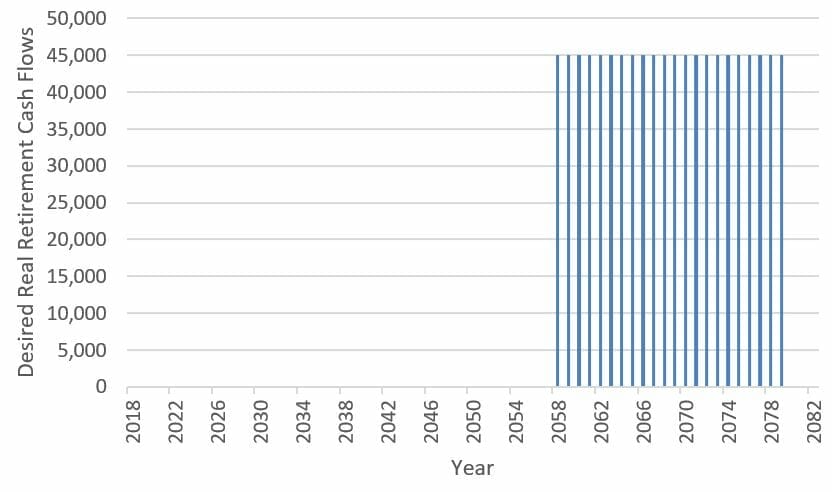
Chart 1 visualises a retirement savings goal – a 25-year-old Australian woman desires basic/comfortable $45,000/year guaranteed super income, starting at age 65, for 22 years (assuming a life expectancy of 22 years in retirement, based on the most recent data from the Australian Government Actuary – for men, it’s closer to 20 years). This guaranteed income would secure the retiree’s pre-retirement standard of living.

Chart 1: Potential desired retirement cash flows for a 25-year old Australian
A major challenge to achieving this goal isindividuals’ lack of the necessary financial knowledge to determine how much to save, what assets to invest in, and how best to de-cumulate. Few adults can answer basic questions about compound interest, the effect of inflation or the benefit of diversification. They are overwhelmed by the information their portfolio reports provide.

Further, investing in existing assets for retirement is risky, because these assets fail to provide a simple or low-cost cashflow hedge against desired retirement income (Chart 1). For example, deferred life annuities offer a retirement cashflow profile, but are complex, illiquid, inflexible in providing survivor benefits, not commonplace in Australia, and often costly.

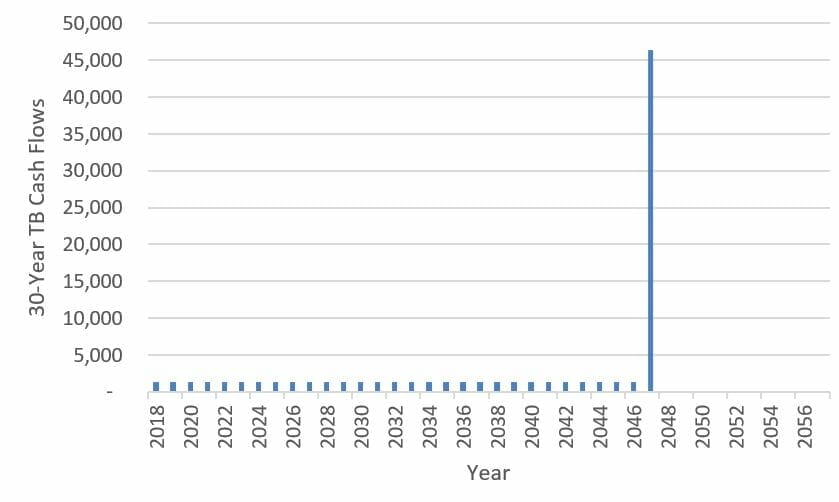
Treasury bonds (TBs) are also not an ideal match. They offer the traditional payout of interest-only coupons and principal repayment at maturity (see Chart 2). This means peoplereceive coupons before they need them (while they work and have income) and, thus, must reinvest them at future, uncertain interest rates. Also, for 25-year-olds, the principal is repaid in a lump sum 10 years before retirement, leading to further cashflow mismatches and re-investment risk.

Because of these mismatches, even a portfolio of traditional, ‘safe’ TBs, unless heavily financially engineered at some cost, would be risky.

Treasury also issues inflation-linked bonds but even if payments were adjusted for inflation, they would not be sufficient; for savings invested long before retirement, standard-of-living risk is significant. The amount needed to maintain one’s evolving lifestyle while working will probably increase over this long horizon, potentially leaving retirees with inadequate savings to cover that more affluent lifestyle.

This absence of both effective income-hedging instruments for institutions and simple methods to allow financially unsophisticated individuals to achieve their goals is a major challenge for Australia.

Chart 2: Cash flows from a traditional, nominal 20-year TB (with a 3% annual coupon)

Addressing issues, satisfying CIPR principles

SeLFIES address many of these issues. They start paying investors upon retirement and pay real coupons only, say $5, indexed to aggregate per capita consumption, for a period equal to the average life expectancy at retirement; for example, another 22 years. Unlike current bonds that index solely to inflation, SeLFIESwould cover both the risk of inflation and standard-of-living improvements. SeLFIES would be designed to pay people when they need it and how they need it, and greatly simplify retirement investing.A 55-year-old would buy the 2028 bond today, which would start paying coupons when she turns 65, in 2028, and keep paying for 22 years, through 2050.

In this way, even the most financially illiterate individual can be self-reliant with respect to retirement planning. The complex decisions about how much to save, how to invest, and how to drawdown are folded into an easy calculation of how many bonds to buy. For example, if investors want to guarantee $45,000 annually, risk-free for 22 years in retirement to maintain their current standard of living, they would need to buy 9000 SeLFIES – $45,000 divided by $5 – over their working life. This achieves the first principle of an effective CIPR: broadly constant income.

Besides being simple, liquid, easily traded at low cost and with low credit risk, SeLFIES would also be bequeathed to heirs.

SeLFIES would qualify as a CIPR, as they offer total clarity on the retirement income that would be earned, hence super statements would be much clearer, as they could tell citizens how much retirement income is guaranteed and how many additional bonds need to be purchased to achieve the target. Further, since the assets would be liquid, individuals would have access to capital and could easily change their target retirement income level or even target retirement date with minimal effort. This ensures that SeLFIES would achieve a second principle of an effective CIPR: access to capital.

SeLFIES do not directly address longevity – the other principle of an effective CIPR – but they do go a long way toward hedging longevity risk. (Another innovation, which we call longevity-indexed variable expiration bonds, would create bonds to hedge longevity risk directly but in the interest of brevity, we do not discuss those here.) By covering the average life expectancy, SeLFIES ensure that poorer individuals who tend to have lower-than-average life expectancy are covered for longevity risk. In effect, the shorter-lived, poorer segments of society are not subsidising the richer, longer-lived segments of society. The richer, longer-lived participants can purchase deferred life annuities. Moreover, innovative Australian insurance companies and super funds could also purchase such bonds to better hedge their retail retirement income products. SeLFIES improve asset-liability management of vendors and insurance companies, potentially improving their willingness to offer these deferred life annuities and also lowering cost. These characteristics can indirectly help SeLFIES contribute to longevity risk management.

In research, we have shown how SeLFIES could be combined with risky assets to create products that could ensure guaranteed retirement income (i.e., the amount invested in SeLFIES) and attempt to raise returns and lower contributions. Innovative investment operations could be used to hedge dynamically and target a retirement income that a participant might have in mind. Further, safe harbour could be provided to those flagship CIPRs that achieve the client’s target retirement income, thereby ensuring that safe harbour would be based on outcome, as opposed to investment process.

SeLFIES are a good deal for governments, too. In fact, governments would be the biggest beneficiaries. First, cash flows from SeLFIES would reflect synergistic cash flows for infrastructure spending: namely, large inputs upfront for capital expenditure, followed by delayed, inflation-indexed revenues, once projects are online. Second, SeLFIES would give governments a natural hedge of revenues against the bonds, through value-added taxes such as Australia’s goods and services tax.

The looming retirement crisis needs to be addressed by timely innovation, because the longer governments wait, the higher the cost to the taxpayer. SeLFIES would improve retirement security and fund infrastructure, and could be created immediately at low cost. They would also allow the Australian Government to ensure that superannuation trustees could achieve their retirement income covenant and all the goals of an effective and flagship CIPR.

Robert C. Merton is a Nobel laureate in economics and teaches at MIT and Harvard University. Arun S. Muralidhar is cofounder of Mcube Investment Technologies.

OPTrust is positioning itself to improve its funded status if there is any rise in interest rates. The pension fund, which manages C$20 billion ($15.5 billion) in assets for 92,000 former and current public-service employees in the Canadian province of Ontario, is poised to buy bonds as soon as yields start to improve, says Hugh O’Reilly, president and chief executive of the fund.

“We measure our success on our funded status and an uptick in interest rates could be very beneficial for us,” O’Reilly says. “If yields improve, we will be a significant participant in the bond market in terms of purchases, because this would have the most positive impact for our members over the long term.We manage our liquidity carefully for times like this.”

OPTrust runs a member-driven investment strategy, which, like the better-known liability driven investment (LDI), is driven by the cash flows needed to fund future liabilities.

Last year, OPTrust renamed its annual report the Funded Status Report, reflecting the pension fund’s prioritising of its fully funded status over all other measures. But returns have been just as healthy as the funded status. In 2017, OPTrust achieved a 9.5 per cent net return.

Manoeuvring for a rise in interest rates isn’t the only way O’Reilly is preparing OPTrust for a changing economic climate. Since 2015, the fund has steadily scaled back its equity allocation, which combines with private equity to account for 18 per cent of assets under management.

“In terms of the three big risks – equity, inflation and interest rates – it is easiest to control equity risk,” he says.

Equity was the fund’s best-performing allocation last year, benefiting particularly from an overweight position in emerging markets. The scale back has been matched by OPTrust’s increasing prioritisation of an alternative risk premia allocation in which strategies are diversified and implemented both internally and by a handful of external hedge fund managers.

O’Reilly notes that finding truly diversified strategies is “harder than it looks” but using both internal and external expertise helps meet the challenge.

“Our absolute return strategies and alternative risk premium strategies are among our fundamental sources of diversification,” he adds.

Mindful that it is challenging to ensure adequate reward for risk in today’s market, he is also careful “not to put money out the door” unless the opportunities are there and to avoid “trophy assets”, where the competition to invest is fiercer.

“Every financial crisis has the same causes,” O’Reilly argues. “Investors get over-exuberant and overly confident and don’t get rewarded for the risk they take. We have found pockets of value and opportunities by having diverse strategies and being disciplined.”

Targeting costs

Saving on costs has become another priority. OPTrust has internally managed its alternatives allocations to real estate, private equity and infrastructure since 2005, via its private markets group.

Last year, the fund added public-market allocations in bonds, foreign exchange and derivatives to its in-house capabilities, so that, today, about 70 per cent of assets are run in-house, by teams in London, Toronto and Sydney.

It’s one of the reasons costs are so low, at just 35 basis points, split between the investment portfolio (24 basis points) and benefits and administration (11 basis points). The fund’s beefed up internal management capabilities have also made it more nimble and sped up the time between decision-making and execution, O’Reilly says. Witness last October, when OPTrust bought a put on the S&P 500 to protect it from downside risk.

“We talked about it for a couple of days and implemented the strategy in a few hours,” O’Reilly says. “If we’d been with an external manager, it would have been harder to do.”

By the end of last year, OPTrust’s new trading desk had completed more than 2850 trades.

Relationships with innovative managers worth the cost

The pension fund’s focus on fees, and the resulting reduction in its manager headcount, are balanced by the importance O’Reilly attaches to manager relationships. If the strategic relationship is right, the fees are worth it, he says.

“I know the emphasis is always on costs, but we want strategic relationships with managers and if we can have this kind of relationship in place, then the value proposition ends up justifying the fees we pay,” he says.

He seeks managers able to offer exposure to new and different strategies and investment approaches that suit the fund’s specific goals, rather than off-the-shelf products. He also wants intellectual cross-fertilisation.

“We want strategic relationships that will suit our investment goals and focus on our fundamental role in enhancing the funded status of the plan,” he says.

He also seeks an honesty in his manager relationships, acknowledging that this involves a certain amount of courage but insisting that it’s also an important reflection of OPTrust’s own internal culture.

“I want our managers to be courageous enough to tell us what we could be doing better,” O’Reilly says. “By the same token, we have to have the courage, and be confident enough, to listen and hear the message.”

Last April, OPTrust extended its defined benefit (DB) offering to a raft of new Ontario employers.

“We are in talks with a number of organisations from across the Ontario charitable, not-for-profit, and broader public sectors,” says O’Reilly, who promotes DB pensions globally as the best provider of retirement security. Bringing new employers into the DB offering will help the plan navigate the effects of the ongoing maturation of its client base.

The $204 billion Florida State Board of Administration is selling private equity and real-estate assets it believes are overpriced, chief investment officer Ash Williams says.

FSBA is steadily weeding out the mature allocations in its $10.9 billion private equity portfolio that still have to complete final realisations, and selling them in the secondary market.

In a process that in aggregate has accounted for about $3 billion to $4 billion over the last two years, Williams has bundled together weaker funds, sold them off and redeployed capital to higher-yielding areas, in a “disciplined pruning of the portfolio”.

He’s applied the same principles to FSBA’s $14 billion real-estate portfolio, which accounts for just under 9 per cent of assets under management. Here, he’s sold off highly sought after but dated apartment blocks and office space, freeing up capital to buy real estate that should have a higher value and return for the next 20 years.

“If an asset is a better fit for another investor’s portfolio, that will be reflected in its value to them and allow us to redeploy those dollars on assets better suited for our portfolio,”Williams says.

In private equity, higher-yielding assets are coming via new opportunities in Asia, where FSBA works with Asia Alternatives – an Asia-dedicated private equity fund of funds. It has led Williams to one fund investment that includes a portfolio company targeting India’s burgeoning second-hand car market.

The company’s founder has developed a sophisticated mobile app that combines car valuations, access to finance and insurance, and matching of buyers and sellers, in a strategy that Williams describes with his characteristic colour and detail.

“It’s the kind of thing that could be a unicorn,” he says. “It shows what an entrepreneur in an emerging economy can achieve with technology and a first-rate education.”

Williams’ team manages about 40 per cent of assets in-house. About half of the real-estate portfolio is run in-house.


For more on this story, see Florida SBA trusts long-term plan”.