Politics can seem illogical. Listening to Stephen Kotkin, the John P. Birkelund ’52 Professor in History and International Affairs in the Woodrow Wilson School and history department of Princeton University, speak about President Trump and US politics provides evidence of that.

While the headlines we read and the stories we hear might leave us feeling that Trump is unreasonable or even ridiculous, Kotkin argues he is in a strong position. Trump has a loyal following among Republican voters; in fact, Kotkin said within that cohort, the Republican Party is less popular than Trump himself. In addition, there is no unfavourable economic situation at the moment to encourage voters to choose Democrats.

“The economy is booming, so the ability of the Democrats to mount a challenge makes sense in the liberal press, but it doesn’t make as much sense with the voters,” Kotkin said.

He adds that Trump is a genius at effective culture war and tribalism, which is how he won, and of course that continues.

The politics in the US, Kotkin said, are interesting and complicated.

“There are citizens of the United States who are supportive of Trump and Trump-like candidates at the local level, and because we live in a democracy, they’re entitled to exist and to have their voice heard, and it’s up to the Democrats to appeal to them and win them over, which is what could happen, but I’m not sure it’s going to happen [in the November 2018 mid-term elections].”

In more evidence of Trump’s strength, Kotkin emphasised the significance of the tax legislation, and Trump’s appointment of Supreme Court justices – another appointment to replace retiring Justice Anthony Kennedy looms, possibly before November’s elections.

“So the idea that Trump is incompetent and gets nothing done is partially true – the White House is empty, and of the 5000 available political appointments, he has made only several hundred, and half of them have been fired or quit. But on the policy side, there’s been a lot more than nothing, and depending on where you are in the social order and where you are on the values issues, it has been an extremely consequential presidency.”

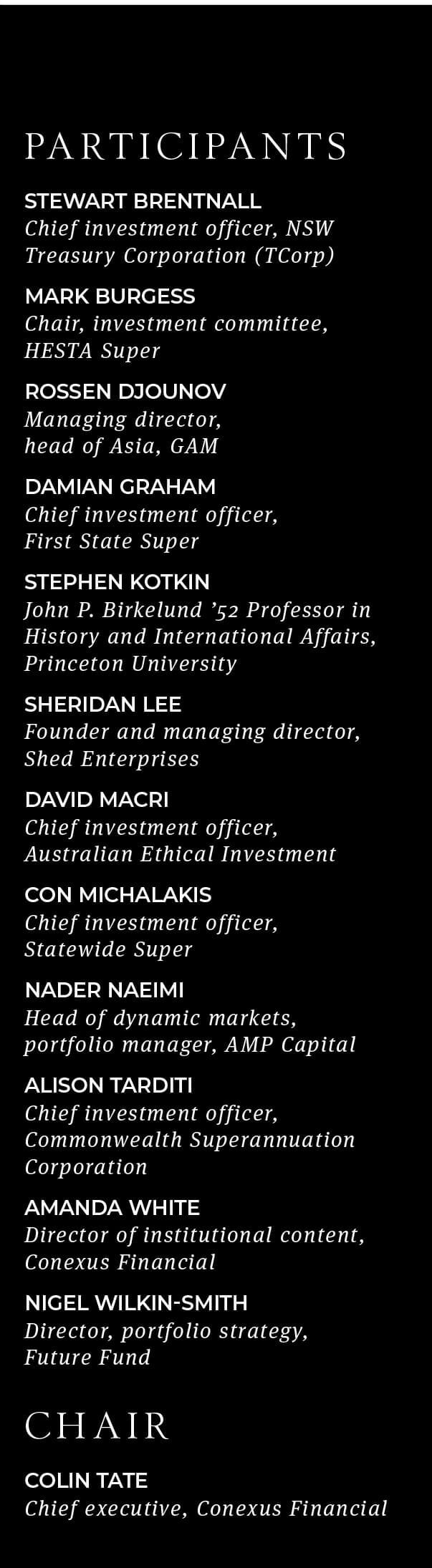
Speaking at a roundtable hosted by Investment Magazine and sponsored by GAM and Shed Media, Kotkin gave Australian investors an insight into the workings of the White House and the complexities of US politics, and traversed geopolitical hotspots such as the Koreas, Taiwan, China and Russia.

Kotkin has taught at Princeton since 1989, including courses on modern authoritarianism, global history and the Soviet empire. And as a specialist in communist regimes, he has visited the White House occasionally during the last three administrations. In addition to learning more about the Trump enigma, investors at the roundtable were interested in learning more from Kotkin about the interaction and relationships between the US and key economies, such as China, along with how issues such as populism might play out around the globe.

In terms of how investors view geopolitics in their decision-making, Damian Graham, chief investment officer of First State Super, sums it up by saying geopolitics “doesn’t matter until it matters”.

“It feels like the rubber band’s growing a little bit, where there could be some additional risks,” Graham says. “This highlights a number of things [to watch]. Geopolitics is always relevant, sometimes more relevant than others.”

The China question

First State Super is one of the few funds in Australia with a Qualified Foreign Institutional Investor licence from China, and Graham wanted to hear from Kotkin about the view of China from within the US and whether that view was valid.

“How accurately do you think China is viewed by the US with what you know about China and the political system there, the market, and the market risks?” Graham asked. “It would be great to get a sense of how accurately you think perception is for the US around that, the relationships and also the forward-looking potential outcomes for China.”

Kotkin said: “In the Trump administration, there are hardliners in most of the important positions of influence and this includes on the big foreign policy issues, like Iran, North Korea and China.

“Cutting against enactment of [hardline policy] is the lack of policy process in the administration as a whole.”

In addition, Trump’s behaviour around any particular issue is unpredictable and inconsistent. The situation in North Korea continues to be volatile and many lives in the region could be at risk, but Kotkin said it is not a global system threat. What is a systemic threat is Taiwan, he argues. On one hand, the Chinese claim Taiwan as their territory and call it a core interest; on the other hand, the US has an act of congress that obliges it to defend the security of Taiwan.

“Taiwan is the systemic issue that can blow up everything, and miscalculation on one side or the other – or even the Taiwanese as the third-party actor in this – could lead to a systemic crisis of proportions where the risk [can’t be priced],” Kotkin said. “So you can see the Americans know that the Taiwan thing gets under the skin of the Chinese, and you can see how irresistible it is from the American side to play that card, and the hardliners around Trump are whispering in his ear.

“For the Chinese regime, they see that public opinion on the island has been moving definitely away from identifying as Chinese toward identifying as separate Taiwanese. Time is not on the mainland’s side. So I’m very concerned, the whole thing could blow up.

“I’m not saying that one side is right or wrong, the problem is the incentive to do something, to miscalculate and to take an action that destroys the global system.”

Kotkin, who has visited Russia many times, and was a Pulitzer Prize finalist for his book Stalin: Paradoxes of Power, also said Russia was a major piece of the global balance of power. But it is not Russia’s strength, but its weakness, that is the problem.

“It’s so ironic because Russia looks like this big bad beast that’s doing all these things, when, in fact, the thing is barely holding together in some ways, haemorrhaging human capital, and we should be afraid that without Russia, China has more wide-open space,” Kotkin said. “Now, once again I’m impressed with China, what they’ve achieved economically is breathtaking and every time I go back, I’m more and more impressed, but the regime is not a friendly regime.”

Populism will persist

In terms of big geopolitical themes, Kotkin told the investors that global populism is not going away, that it is structural and there is no reversal.
“Globalisation does not produce sameness, it does not bring people together. The internet didn’t do that either, it accentuates difference, so you get the nationalism, and you get the cultural responses,” he explained. “Globalisation is not Westernisation, China didn’t become like the US, and it’s not going to, it’s China. It has its own civilisation, its own institutional legacies, and this is true of any place you go. There is a level of Westernisation, harmonisation, of institutions in places like the EU, but now we also see the accentuation of difference, even in places like that.

“It’s a deeper, structural open-markets assumption that if you integrate economically and technologically you then become more like each other culturally and institutionally. That assumption is false. People retain their culture, they retain their institutions and, moreover, those are accentuated in the process of integration.

“Democracy must incorporate the entire political spectrum, from Trump to Zuckerberg and everything in-between. We live in a democracy and people have opinions. It just so happens that the resentment, the anger, the culture condescension and the reaction to that – all of that makes it seem radioactive. Trump voters have a legitimate opinion, and democracy gives a voice to that.

“I’m only afraid if the politics turns violent. I don’t see any trouble with right-wing nationalists or socialists having a voice, I just don’t want it to be militarised the way it was as a result of the First World War.

From an institutional investor point of view, this raises some interesting questions, CSC chief investment officer Alison Tarditi said.

“I think that long-term investors, and decision-makers more broadly, are being challenged to keep pace with two fundamental shifts,” Tarditi said. “The first is a broad sociological shift towards connectivity, but not necessarily cultural connectedness. And the second is a shift in our ability to imagine the future, which has been compromised by an unfamiliar mix of disruption from technology, policy and amplifying stakeholder voices.

“As investors, we’re all used to dealing with uncertainty. But it does feel as though we are having to adjust from decision-making with probable certainty to decision-making with much less, arguably constant, uncertainty. The potential tail risks associated with political strains across and between both the developed and developing worlds give examples of this. We all understand that the long-term consequences of these risks are likely to be important. Regulators, governments and policymakers are reacting to, rather than proactively driving, these forces. How cross-geography relationships develop or deteriorate and how global governance structures evolve or fail matter to long-term investors.

“It isn’t clear that these risks are adequately priced. Neither is it really possible to identify when, or indeed whether, they ever will be. Today’s discussion has been useful because it has provided a roadmap for thinking around these issues and their subtleties.”

It would have been Karl Marx’s 200th birthday on May 5, and German professionals came together in Frankfurt on the 18th of that month to establish the German Association of Institutional Investors (bii).

Today, institutional investors in Germany, as elsewhere, face tough challenges. Interest rates are low and many have the majority of their portfolios invested in interest-related assets. Like in many other countries, a number of German pension funds are no longer in a position to meet their payment obligations. Alternative investments can address this, but the selection process requires dedicated and well-educated teams that come at a cost.

 Professionalisation is the answer. We need dedicated university-level certificates customised for institutional investors; we need institutionalised exchanges between Solvency I and Solvency II investors and, above all, we need more international exchanges of ideas.

bii aims to further such professionalisation in Germany through the exchange of ideas its members have with one another, and with legislators, supervisory authorities and friendly associations. The international exchange of ideas with institutional investors in other countries is also an important priority of bii. We want to meet and learn from representatives of Australian superannuation funds, Canadian and Dutch pension funds, Norwegian state funds, US university endowments and many others.

Co-operation with existing industry bodies is a priority, too. Germany already has a number of highly regarded institutional investor initiatives, such as aba, ABV, GDV and VFPK. bii will work with those bodies in its function as an institutional investment think tank. On one hand, this group includes large insurers that know a great deal about risk management, among others areas of expertise. On the other hand, this group includes family offices, the “speedboats” of institutional investment, which are well-versed in alternative asset classes such as private equity.

The case for the active investor

We also believe German institutions could become more active investors to establish and safeguard strong governance standards at public companies and cast their vote for strong shareholder rights. Most institutional investors are trustees of their beneficiaries; while delegation can be efficient from time to time, it is doubtful it’s acceptable to delegate the main asset management function effectively and thereby potentially forego higher risk-adjusted returns. Defined-contribution schemes were introduced into the German market only this year. German institutional investors can make good use of this additional option and bii wants to support them in creating additional asset management capabilities.

Let’s establish international standards

bii will be reaching out to well-established associations such as Association Française des Investisseurs Institutionnels in France, the Chartered Insurance Institute and others, to work on international standards. Those could cover uniform mandate tender questionnaires, ESG implementation and other current topics.

bii hopes to bring many international players to the table at its inaugural German Institutional Investor Days on May 21-22, 2019, in Leipzig. Meanwhile, we will continue to work hard to create useful formats and resources for our members.

As the late Marx would have said: “Nothing can have value without being an object of utility.”

Thomas A. Jesch is managing board member of the Frankfurt-based German Association of Institutional Investors (bii).

It is with great pleasure that we present to you our Big Book of SI. We firmly believe in sustainability investing, and think all the stars are aligned for this investment discipline. From a bottom-up perspective, sustainability is clearly changing markets. The environment in which companies operate is very different from 20 years ago. Climate change, resource scarcity, pollution and the working conditions in emerging countries are all trends that affect companies, as well as provide opportunities for new markets.

However, they also present risks as they are changing the regulatory landscape, altering consumer behavior and, in many cases, increasing costs. Moreover, clients are increasingly looking to create more sustainable portfolios to meet the demands of their sponsors, participants and regulators. And then there is the socioeconomic perspective and the many global challenges faced by our generation. While prioritizing growth above issues such as climate change risks may yield better returns in the short term, the long-term prospects for such a strategy may be less rosy.

Sustainability investing is of strategic importance at Robeco. We started adopting it in the mid-90s and it has been at the core of our business since the mid-2000s, when Robeco acquired Sustainable Asset Management (now RobecoSAM). The acquisition of SAM gave us the knowledge and insight we needed to integrate sustainability in all aspects of our business. Our current joint sustainability strategy is built on four key aspects:
1. A unique sustainability culture that has evolved over the last 20 years
2. Our extensive in-house expertise in research, analytics and investments
3. A truly integrated investment approach across the asset classes stemming from interaction between our SI researchers, financial analysts and engagement specialists
4. The ability to innovate quickly and offer clients bespoke solutions as sustainability investing evolves

Despite our clear vision on sustainability, we realize that there is no one size fits all, so we offer many different products and solutions for many different clients across the globe. At the time of writing, we manage EUR 100 billion of integrated sustainability assets in equity, fixed income and private equity. We believe that the investment industry will move from creating only wealth to creating wealth and well-being, and it is our intention to contribute to that shift. It is in the interests of both society and our industry, and when these two are aligned progress can be swift.

The topic of sustainability arises within minutes of talking with clients. I believe that we have reached an inflection point. It is already clear that taking a sustainable approach does not detract from performance. We believe that using financially material ESG information leads to better-informed investment decisions and benefits society. The Sustainable Development Goals are a very important development in this context that take sustainability to the next level by making it tangible and measurable. There has been a change in thinking in the asset management world, from avoiding companies that have a negative impact on the environment to investing in companies that have a positive one.

You can embark on sustainability investing in small steps. What we see at Robeco is that, as knowledge and experience in sustainability investing increase across the organization, so too does conviction. I hope that this Big Book of SI will help you find your way in the fascinating, multi-dimensional world of sustainability investing.

Click here to read the full paper.

Over the last year, Sweden’s SEK345 billion ($39.1 billion) buffer fund, AP2, has increased its allocation to Chinese A-shares to 2 per cent of assets under management and built an allocation of 1 per cent to Chinese bonds.

The A-shares allocation is run by three external managers – Singapore-based APS, Cephei Capital and UBS – and strategies all focus on Chinese stocks exposed to domestic consumption as China’s households shift from low- to middle-income levels.

The A-shares portfolio returned 36.3 per cent last year, and AP2 chief executive Eva Halvarsson says the allocation could increase depending on parliamentary approval of new investment freedoms for Sweden’s AP funds.

“It is doing extremely well and is the best-performing asset class that we have,” she enthuses in an interview from the fund’s Stockholm headquarters.

AP2 was the first Swedish pension fund to have its A-shares licence increased to today’s 2 per cent, in a decision that finally enabled it to build on a portfolio that dates from 2013, when the initial licence was awarded. The last five years have been a learning curve Halvarsson says, particularly in getting to grips with the impact China’s inefficient and debt-ridden state-owned industries have on the market’s function. She also advises careful selection of external managers and spending time in-country. ESG is also central to the fund’s due diligence and AP2 is an active member of the Asian Corporate Governance Association.

In-house expertise transforms fund

It’s a growing expertise that means AP2 will probably manage the allocation in-house in the future, bringing Chinese equity to join the other 83 per cent of the portfolio that Halvarsson’s investment team already oversees.

“Over time, we will probably be able to manage our Chinese equities in-house but not at this point,” she says. AP2 already manages the allocation to Chinese bonds itself, and in both portfolios, ESG is assessed quarterly; the fund’s Chinese exposure also includes real-estate funds.

AP2’s in-house management ability has grown to span complicated portfolios such as emerging market bonds in local currency. It is competence that has dramatically changed the fund since it was set up in 2001, Halvarsson notes. Apart from Chinese equities, the only other externally managed portfolios comprise alternative risk premia covering convertible arbitrage, merger and acquisitions arbitrage, and an uncorrelated allocation to re-insuring insurance companies – AP2 is the fifth-largest provider globally.

“We like to keep a few of our equity allocations external because it allows us to learn from our managers,” Halvarsson says.

ESG integration via bespoke indices

In another innovation in the equity allocation, Halvarsson’s quant team has recently integrated ESG across the entire foreign quant portfolio via two new bespoke indices. The portfolio accounts for about 29 per cent of assets under management, at about SEK99 billion ($11 billion) The team has replaced six single-factor indices with two multifactor indices, one for developed markets and one for emerging markets. Under the old system, four of the indices tracked about 1600 companies in developed countries and the other two followed about 800 companies in emerging countries, with various factors determining the weighting of the equities in each index.

Now stocks are weighted according to four factors: ESG in a basket of themes around climate, diversity, corporate governance and transparency; value; volatility; and uncorrelated returns. Halvarsson is particularly proud that the indices were developed in-house, in a process that involved the team building its own algorithms from raw data and rigorous back testing. The new indices have better expected absolute and risk-adjusted returns than the former six, and swapping six for two reduces transaction costs.

“They have turned out well and we like what we see, although we are constantly monitoring to see if we can improve them,” Halvarsson says. “We were able to build them in-house because of the abundance of ESG data, AP2’s long history with quant investing and our talented people. ESG integration is very much driven by everyone here and is a bottom-up and top-down approach. It is not easy doing this and we are doing many things for the first time.”

The team is now considering developing a similar index for the bond portfolio, along with developing quant strategies that identify and weight smaller companies that are developing solutions to future ESG challenges.

“It shows that it is possible to do ESG integration in different ways – internally via quant or fundamental management, or with external managers,” Halvarsson says. “In our case, we have learnt by doing it ourselves and this makes us stronger.”


Diversity as part of ESG

She is equally proud of the fund putting diversity centre stage in its ESG criteria, a matter that is particularly close to her heart because of the lack of women in senior roles in the industry.

“I am 55 years old and CEO of one of Northern Europe’s largest pension funds, but I have had meetings where it is assumed that one of the men is the boss. Even though we think we are impartial, we unconsciously judge women and men from a different perspective,” Halvarsson says.

The fund’s diversity strategy focuses on board nomination committees, where reform can reap real results, she says.

“Corporate boards without a formal nomination committee have the fewest women. Nomination committees that include women lead to more women on the boards.”

Back in 2001, AP2’s assets were split between a 20 per cent exposure to Swedish equities, 40 per cent to foreign equities and 40 per cent to Swedish fixed income. Now the fund’s diversified portfolio spans Swedish equities (9.5 per cent and actively managed) developed market equities (22 per cent) emerging market equities (11 per cent) fixed income (27.5 per cent) emerging market fixed income (6 per cent) real estate (11 per cent) private equity (5 per cent) alternative credit (2 per cent) alternative risk premium (3 per cent) China A-shares (2 per cent) and Chinese government bonds (1 per cent)

The asset allocation will change again when the AP funds are able to reduce their bond allocation from 30 per cent to 20 per cent and make additional allocations to illiquid asset classes now capped at 5 per cent (excluding real estate) from January 2019. The relaxation of government rules around investment could also result in the fund investing more in infrastructure and private debt. AP2 is looking at private debt opportunities via fund investment and directly in club deals, Halvarsson says.

Earlier this year, RPMI Railpen, investment manager for the £28 billion ($37 billion) pension fund serving the UK’s railway workers, embarked on a joint venture with the $66 billion Alaska Permanent Fund and Kuwait’s Public Institution for Social Security (PIFSS) to better access private markets.

Like many other asset owners, the trio have found competition and elevated prices has made accessing private markets difficult. The hope is that combining firepower and expertise in a joint venture will open up more opportunities. The joint venture, Capital Constellation, will invest in private equity and alternatives managers, and plans to deploy more than $1.5 billion in the next five years. The three funds manage about $200 billion in assets between them.

The project has revealed important lessons, Railpen chief investment officer Richard Williams says. First, asset owners should partner with investors that bring different elements to the party. In Railpen’s case, this means finding partners that can complement its ESG experience and UK presence, he says.

“It is also about finding heterogeneous skill sets that blend together,” Williams says. “There are lots of hurdles to jump through and we would like to do more initiatives like Capital Constellation, but only time will tell if we do. It won’t be for lack of intention.”

Preparing the ground at the beginning of a collaboration in case things grow tricky and parameters shift in the future is important as well, he says.

“It is a little bit like a prenup [prenuptial agreement],” Williams says. “If it doesn’t work out, all parties need to know how they can separate without it getting too acrimonious. I’m not suggesting the best marriages have to have a prenup, but sometimes love isn’t enough.”

For more on Railpen’s strategy see our profile Railpen reaps benefits of in-house team.

Running a pension scheme, regardless of size, is not a job for the faint-hearted. After a number of high-profile failings, it comes as no surprise that questions are being asked about the role of the pension trustee, and whether tighter control and scrutiny are required to better protect pension members in the future.

When you add to this the already significant challenge of keeping up with legislation, an ageing population and technical issues around investment, being the trustee of a pension scheme looks especially overwhelming; however, despite the increasing pressure and scrutiny, I believe trustees have a great opportunity ahead of them and that, in fact, the role of a trustee today is simpler than ever.

The primary role of a trustees today is steering the ship in the right direction.

MNOPF’s journey plan

The Merchant Navy Officers Pension Fund is different to many pension schemes in some ways. It is a multi-employer scheme (we had 300 employers at the last count) and it is a last-man standing fund, meaning the liabilities pass to the last employer in the scheme when the other employers have ceased to participate or become insolvent. It also has multiple sections that have developed and changed over the years.

In other ways, MNOPF is not so different. With £3.3 billion ($3.9 billion) in assets under management, it is a moderately sized pension fund, and its overriding aim is to create sustainable benefit security for its members.

Established in 1938, the scheme has experienced a great deal of change. Just 10 years ago, it was in a very different position to the one it’s in today. Back then, the fund was divided into two portions: the old section for pre-1978 benefits and the new section for benefits after that. It had a deficit of about £400 million ($527 million), a poorly mapped-out governance structure and a lack of accountability and ownership on investment matters.

We could not continue down the path we were on. So, in partnership with the chief executive, we set about making changes. We established a ‘journey plan’ that would result in a better funding level for the MNOPF and ensure the running of the scheme was effective, efficient and wholeheartedly in the members’ best interest.

Prioritising diversity

Step one was ensuring the make-up of our trustee board was right, which meant bringing in a broader diversity of experience and background, and creating a clear picture of what was expected from each member.

I truly believe one of the key strengths of a trustee board is the diversity of life skills that each individual brings. When you sit in a trustee board meeting, it matters not a jot whether you are a so-called expert or a cashier or a pilot or a seafarer. What matters is your ability to evaluate what you are being told, being prepared to question what you don’t understand, and being ready to make clear decisions that are for the good of the fund.

Establishing diversity and setting out a mandate of freedom to challenge ensured that our next step, engaging expert advisers, would go much smoother.

Expertise, delegation and bravery

With the plethora of different skills and expertise required to run a pension scheme, it is impossible to believe it can all be done in-house. For MNOPF, greater and clearer accountability for investment decision-making and execution was essential if we were going to reach full funding by 2025. We felt the best way of introducing the specialist knowledge and additional resources required for the Journey Plan with minimal risk was for the fund to become an early adopter of the fiduciary management model.

As a trustee board, we wished to remain responsible for overall levels of risk and the investment strategy; however, with clearly defined responsibilities and accountabilities, the external fiduciary manager mandate would make portfolio construction and decision-making more dynamic and opportunistic, with additional value added through manager selection, asset allocation and liability hedging designed to provide required investment returns with less risk. It would also enable the trustees to sleep better at night knowing all of the detail was not with us.

When we started this journey, delegation was in its infancy. We had to travel to the Netherlands to learn more about how large funds considered delegation; no large UK funds had been brave enough to do it at that point. But if we were going to radically improve our funding and execution capabilities, we had to be innovative. We also knew we were going to be setting a precedent and attracting attention, as MNOPF was a high-profile scheme because of its maritime industry status. There was some weight on our shoulders.

We knew, therefore, that we needed to manage the process carefully and ensure that we were being thorough with our decision-making. We ran what is believed to be the first intermediated fiduciary management tender exercise involving a great many providers. In 2011, we appointed Willis Towers Watson as our external fiduciary manager, referred to as a Delegated CIO (DCIO).

The intermediated tender is now normal practice in the UK. The 2017 KPMG UK Fiduciary Management Survey states that 60 per cent of all tenders in the UK that year intermediated, but at the time it was an innovative approach.

Delegation does not come without checks and balances. DCIO is a powerful position and to oversee the performance of ours, we appointed an independent investment adviser, Hymans Robertson. This model is also becoming more commonplace, with about 20 per cent of schemes using it, the KMPG Survey found.

An enabler for de-risking

The newly established governance structure gave the trustee board more time to focus on strategy and oversight. We no longer needed an investment committee, as the entire board could now play that role. Gone were the days when just a few trustees understood the investments; now the whole board would actively participate. The new strategic focus allowed the board to consider incremental insurance settlement opportunities. By 2012, the funding position of the old section had improved so much that it was worth approaching the insurance market for full settlement.

The role of the DCIO in this was to align the portfolio with insurers’ requirements. The trustee board then made the decision in December 2012 to do a 100 per cent buy-in of all the old section liabilities, followed by a full buy-out in 2014. For the remaining section of the fund, a longevity hedge of £1.5 billion ($1.9 billion) was implemented in 2014, and in 2016 the fund closed to future accrual. The DCIO carefully controlled investment risk by making full use of the opportunity set. Over the five years to December 2017, it delivered a return of 2.7 per cent a year in excess of the gilts-based liabilities, at a tracking error of only 2.6 per cent a year. Returns, alongside contributions, helped improve the gilts-based funding level to about 90 per cent by the end of 2017. This enabled the trustee board to complete a £490 million ($646 million) buy-in with Legal & General in December last year.

For the next generation

Now that MNOPF is closed to future accrual, de-risked and well on track for future funding, the focus shifts to the future of pension provision for the maritime industry, via the Ensign Retirement Plan (ERP), the industry’s defined-contribution master trust.

Our delegation model for governance and investment brought in expertise that we could not afford in-house and provided greater clarity around decision-making. But it also freed up time. The establishment of ERP was a fundamental part of the MNOPF’s journey plan and now enables us to protect the retirement outcomes of the next generation of seafarers.

My advice for pension fund trustees:

  1. Make sure you have the right people on board, quite literally! It is essential that a trustee board has diversity of skills and experience, and the freedom – even the responsibility – to challenge.
  2. Outsource the skills to experts when you can. Give them accountability, but always ensure the responsibility stays with you.
  3. Don’t be afraid to make a decision. A great number of these innovative solutions are now becoming commonplace but there is always an opportunity out there that may not have been thought about. Remember, the biggest risk you can take is doing nothing.


Rory Murphy is chair of the Merchant Navy Officers Pension Fund and of the Ensign Retirement Plan, the maritime industry’s defined contribution (money purchase) master trust.