The $1.4 billion Panama sovereign wealth fund will allocate to private equity for the first time since it was formed in 2012.

Abdiel Santiago, chief executive and chief investment officer of Fondo de Ahorro de Panamá, said a dramatic change a few weeks ago has resulted in an allocation to private equity for the first time – in a bid to add diversification.

The allocation now includes 15 per cent in global equities, 50 per cent in fixed income across the gamut and 20 per cent in cash and short-term securities. The rest will be allocated to private equity and alternatives, although it hasn’t happened just yet.

“This will be the first time the fund has allocated to private equity,” Santiago said. “Our alternatives allocation is informed by our desire to have a diversified portfolio. Despite where we are on the private equity cycle and that prices are at the higher end of valuation, we think private equity adds a diversification component to the entire portfolio.”

Santiago said the fund was taking “baby steps” in implementing the new allocation.

“To the extent we achieve 250 to 300 basis points over equities, how we do that in primaries or secondaries, I don’t know,” he said. “If secondary fund-of-funds provide us with the ability to mitigate medium-term risks, that could be an attractive way of going about it.”

But he was quick to stress that diversification is the key.

“It’s about vintage, we still don’t want to be exposed at the security, investment level; we want to be diversified,” he said. “While we are still doing the work, we will most likely invest in the developed markets.”

The fund previously had an allocation of about 22 per cent to global equities and 75 per cent in fixed income. Santiago describes the asset allocation changes, made a couple of weeks ago, as a de-risking of the portfolio.

“Our expectation is rates will go higher, which will potentially have a negative effect on the fixed income portfolio in the short term. On the cash end of the spectrum, short-term opportunities are yielding 1.5 to 1.75 per cent for the amount of risk, not a real incentive to take on additional risk, especially on the fixed income side.”

About 85 per cent of the portfolio is invested in North America, so what happens in the US is of paramount importance. The country’s upcoming mid-term federal elections are a potential catalyst for change.

The impact of a dual purpose

Panama’s sovereign wealth fund, like many of its peers, invests only outside of the country. Also, like many SWFs, it has a dual purpose, and for Panama that is stabilisation and to serve as a rainy day fund. Dual purposes complicate things in more ways than one. The liability streams have different purposes with different time frames and this affects liquidity.

The rainy-day part of the purpose refers in part to natural disasters, which Santiago says are within the realm of possibility.

“But what’s the liability stream? You can’t tell when or how big a natural disaster will be,” Santiago said. You have to have a reasonable expectation of returns and be risk averse and have OK liquidity and the ability to sell assets. The way we defend that is through numbers. We don’t want to lose more than 5 per cent of the fund within one year.”

The stabilisation purpose is more of a concern because it deals more with potential downturns in the economy, which are more plausible than a natural disaster.

“The economy growing at less than 2 per cent, how you handicap that is pretty tough,” Santiago said.

Because of the two purposes, with two different liability streams and time frames, asset allocation is fairly conservative.

Internal staff and relationships

Santiago was educated in the US and worked there before returning to Panama to run the fund in April 2013. He is the head of a fairly small team with only seven staff.

All assets are managed externally; the internal staff are in charge of asset allocation.

The SWF employs only three managers for the whole portfolio – BlackRock, Morgan Stanley and Goldman Sachs Asset Management. The portfolio is roughly split across the managers.

“The relationships pre-date the creation of the fund and we now review them very rigorously,” Santiago said. Implementation is quantitative and he estimates the portfolio has a total management expense ratio of about 20 basis points.

“We gave them a tracking error of 70 basis points; it’s a risk-mitigating tool,” he explained. “We track them closely. We have the ability, from our custodial relationship [with Northern Trust], and directly with managers, to track the portfolio closely at the securities level.”

Panama’s SWF is one of only a handful in Latin America. Its seed capital came from a fund that had managed government money from privatisations and was created in 2012.

The original idea was it would get capital injections from revenue raised via the Panama Canal. Those revenues have been different from expectations, and the SWF hasn’t received any top-ups since creation.

The government can request earnings from the fund yearly.

“To the credit of the current administration, over the last couple of years, it has called on about 50 per cent of our returns, where previously it was 100 per cent,” Santiago said.

Sign up to our weekly newsletter for regular news flashes and industry insights.

The leading superannuation, institutional investment and fund management publication in Australia.

Private equity and hedge fund managers are in the firing line for charging opaque management and performance fees. The problem won’t go away until more investors display all the fees they pay by opening up their annual financial reports with full fee disclosure.

The $43.6 billion Public School and Education Employee Retirement Systems of Missouri (PSRS/PEERS) shows it can be done. The system stands out amongst many of its US public pension fund peers for its focus on transparency.

PSRS/PEERS reports all the investment management fees in its recently boosted 25 per cent target allocation to alternatives, including the split of the investment profits or ‘carry’. Also witness fiscal year 2016, when the fund reported it paid one manager $19.2 million in fees, breaking down the total to $6.3 million in management fees and $12.9 million in performance fees.

Other funds would’ve reported these figures quite differently. Pension funds that have a policy to reflect only fees paid through the accounts payable process would have reported a management fee of zero, while a pension fund with a policy to include only management fees and not incentive fees would have shown only $6.3 million in fees in their annual report.

“For most private equity, real estate and hedge funds, fees are deducted from performance and thus not tracked,” PSRS/PEERS chief investment officer Craig Husting explains. “As such, the retirement system never directly pays a fee. The system gets a net return. Typically, a system will only pay direct fees – through the accounts payable process – to traditional managers in the public equity or public fixed income area.”

Husting, who joined the fund in 1999, has made fee transparency a tenet of his strategy.

“Our philosophy is to be fully transparent to the people interested in our system,” he says. “It’s the best way to do it.”

That belief took root back in 2009 when a board member, Jim O’Donnell, pushed the fund to publish all fees in its annual report, Husting recalls. The process is now supported by internal staff tasked with extracting information from reluctant managers and checking every quarter to ensure the fund is billed correctly. Transparency and disclosure are also rooted in a ‘fee philosophy’ with stated beliefs that give a direction and confidence to manager selection in the fund’s active pursuit of a 7.6 per cent annual return.

Investment selection is made according to expected net-of-fees returns and investment risk, meaning Husting is prepared to pay higher fees when performance is strong. Also, he won’t choose a manager just for its low fee.

“Higher fees do not mean lower investment returns,” he says. “As a general rule, PSRS/PEERS only pays higher fees for skill-based investment returns, diversification that is not available through passive alternatives and access to hard-to-obtain asset exposures.”

PSRS/PEERS now pays 6 basis points on more than $7 billion invested in fixed income strategies and15 basis points on over $8.5 billion invested in large-cap equity strategies.

Over the years, the process has revealed certain patterns.

“The investment expense ratio will be very high in a year when the beginning assets of the systems are low, and performance is very good,” he explains, noting that this is consistent with the PSRS/PEERS philosophy regarding fees: net-of-fees returns are the most important and the systems will pay higher fees when performance is strong.

For example, in 2014, the fund returned 16.7 per cent and the expense ratio – or fees – totalled 1.15 per cent, compared with poorer returns and a correspondingly lower expense ratio of 0.84 per cent in 2014. In 2016, PSRS/PEERS total management and carry fees were 0.92 per cent but reflected through the accounts payable process this would’ve been 0.20 per cent, and if policy were just to reveal fees but no carry, it would’ve shown 0.69 per cent.

Hedge funds

True to PSRS/PEERS’ promise to negotiate the lowest fees possible, over the last three years the fund has taken advantage of the tougher climate for hedge funds to renegotiate terms. The 6 per cent target allocation sits in PSRS/PEERS’ 60 per cent allocation to liquid public markets but is currently overweight at 11 per cent of assets under management. Shares and bonds are overvalued and Husting likes hedge funds’ lower-risk alternative to equity.

“With hedge funds, we typically try to renegotiate fees for a five-year period,” he says. “It’s a negotiating process between the asset-based fee, the carry and potentially a lock-up.”

PSRS/PEERS runs two hedge fund programs. A standalone portfolio with a beta of .35 per cent, which is invested with 16 managers and no fund-of-funds in 21 assignments. The portfolio had a total management fee in fiscal year 2017 of 111 basis points and PSRS/PEERS paid an additional 89 basis points in performance fees.

A second hedge fund portfolio, established in 2006, is an alpha overlay on the S&P 500 comprising 10 mandates with 8-9 managers. The alpha overlay cost 110 basis points in management fees and 75 basis points in performance fees, says Husting, frustrated that he can’t compare what he pays with other pension funds.

“There is no industry standard regarding fee disclosure,” he says. “Each system provides varying levels of disclosure. The Institutional Limited Partners Association (ILPA) has had some success with their fee disclosure and reporting initiative, but full adoption by investors and the firms they do business with will not occur in the near term.”

Private equity

In private equity, where booming demand has made fee negotiation with PSRS/PEERS’ 86 general partners much harder, strategy focuses on diversifying amongst big and smaller managers. Rather than focus on large assignments with a limited number of managers, each manager gets the same bite size.

“We think that if we were to give a $20 billion fund $500 million and a $1 billion fund $50 million, there would be too much weight on the $20 billion fund in the portfolio,” Husting explains. “We also believe that some of the smaller private equity firms can produce as good if not better returns over the long-term.”

He takes this stance even though it creates more work for his team. It’s much easier to give larger allocations to big GPs, since PSRS/PEERS has chunky amounts of capital to deploy. The fund also uses a consultant, Pathway Capital Management, to access the best funds and is gaining a toe in venture capital by agreeing to take smaller, $10 million, allocations in the expectation more will follow.

“Pathway reviews a large number of partnerships and then works in conjunction with our internal staff on a smaller focus list to conduct due diligence and secure an allocation,” Husting explains.

Sign up to our weekly newsletter for regular news flashes and industry insights.

The leading superannuation, institutional investment and fund management publication in Australia.

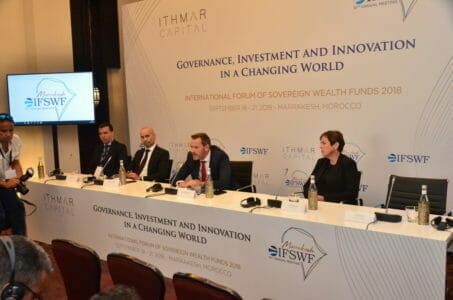
In a competitive world where much of the capital is chasing the same opportunities, sovereign wealth funds must collaborate to access investments, Alaska Permanent Fund chief executive Angela Rodell said in an interview at the annual International Forum of Sovereign Wealth Funds conference in Morocco.

Alaska Permanent was a founding member of the forum and Rodell, who this week was elected deputy chair of IFSWF, said while the forum has evolved, it started with a mandate that included the Santiago Principles and creating a transparency framework for good governance.

“There is also now an understanding of how our peers are operating and a higher degree of comfort,” Rodell said. “If you look at the investment opportunities and where global growth will come from, it is important for us to have those relationships, for example, in Africa, South-east Asia and China.”

Alaska has launched two partnerships collaborating with other investors – one in private markets and one in public markets.

Capital Constellation, which took about 15 months to create, is a joint effort between Alaska Permanent, the UK’s Railpen and Kuwait’s Public Institution for Social Security, to better access private markets.

The second team-up for Alaska Permanent is a collaboration with McKinsey Capital on the creation of a public equity closed fund investing across 25 countries in the Middle East, Africa and south Asia. The fund’s heaviest weight, about 40 per cent, is in India.

Alaska Permanent invested $100 million in this fund, and is encouraging other investors to allocate. The idea is to list the fund.

“The idea is to gain access to those public markets that are hard to access and not overwhelm or create too much heat in that exposure,” Rodell said.

While the modern world relies on technology, Rodell said nothing beats having personal relationships and people on the ground in various places.

“Even if an SWF can’t invest side by side with you, [it] might give you insight and understanding that gives you a leg up as an investor,” she explained. “Some investors have a sense there is a finite set of investment opportunities and all the world’s capital is fighting for that. For some of us, the opportunities are limitless but harder to find, so it’s not so much a competition as it is [a search for the] hard-to-find pathways to the opportunities.”

Alaska Permanent gives Alaska citizens a dividend every year. Until 2016, there was a statutory formula for the amount but for the last three years it has been negotiated between the legislature and the governor. This year, the dividend will be $1600 a person.

Rodell said Alaska is a vast state (three times the size of Texas at low tide, and twice the size at high tide) with a population of only 700,000. If the person/square metre ratio of Alaska applied to Manhattan, only 30 people would live there.

Alaska Permanent has a board meeting next week to look at how to invest in Alaska directly, along with emerging manager initiatives.

In calling on other investors to collaborate, Rodell said it was important to be patient.

“From my standpoint, while you may philosophically be on the same page, the devil is in the detail. You have to have a lot of patience,” she said. Taking 15 months to create Constellation allowed time to generate alignment on expectations for outcomes and benchmarking for success. Similarly, the public market fund with McKinsey took about nine months to finalise.

The new chair of the IFSWF, Majed Romaithi, executive director of the strategy and planning department at ADIA said that with long-term mandates, SWFs make natural investment partners.

“But we are still only touching the surface when exploring opportunities to collaborate,” he told delegates in his introductory remarks at the conference.

The framework for integrating climate change risks the One Planet SWF working group recently developed is a possible template for collaboration in other important areas going forward, Romaithi said.

“SWFs share many similar objectives, but also have differences, in many ways,” he said. “It’s important to welcome new members who bring different perspectives. Working together, we can be more successful in reaching our own objectives and contribute to the global financial system for which we depend.”

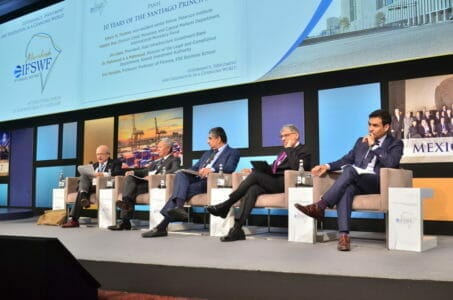
The conflicting modern-day purposes of sovereign wealth funds – to grow capital by investing globally and to be a stabilising force for their domestic economies – make it necessary to revise the Santiago Principles, argues Udaibir Das, division chief, monetary and capital markets department, at the International Monetary Fund.

“When they were written 10 years ago, it was only from the lens of the global mandate of SWFs,” Das said. “But look what’s happened since then, several members of the IFSWF have been challenged; the stabilisation function has overtaken investing abroad. It’s a tension that everyone in the room has felt, you can liquidate investments abroad that could have the impact on the international financial system but at the same time domestic situations need to be addressed.”

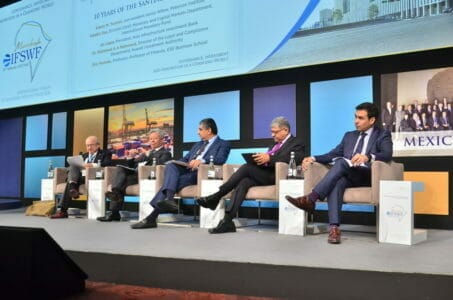
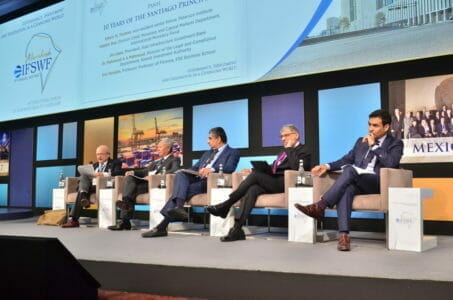
Speaking at the International Forum of Sovereign Wealth Funds conference in Morocco, on a panel reflecting on 10 years of the Santiago Principles, Das also said that when the principles were formed, there was no massive policy focus on financial integrity, governance corruption, accountability and geopolitical risk, as there is today.

“The issue for me now is it’s not about returns only, it’s safety, security and the surety and sustainability of the money given to the SWFs to trust and keep intergernerationally,” he said.

Das suggested a forward agenda for the SWFs, in what he called the Marrakesh 7.

He urged the following:

  • Bond – remain together, get closer, communicate
  • Review – the Santiago Principles, a forward-looking vision statement for the IFSFW, Santiago Principles version 2
  • Value – seek it first for the members, but members and for others
  • Co-operation – co-operative completion, co-investing, technical co-operation, in-house capability, analytics
  • Global – regulations and international discussion
  • Local – remember you are part of the domestic sovereign balance sheet and macro-fiscal framework
  • Trust – engender trust and confidence, explain, disclose, bring about reform.

The panel, chaired by Edwin Truman from the Peterson Institute for International Economics, also recognised that the Santiago Principles had moved the dial on transparency and accountability for sovereign wealth funds.

Mohmoud AA Mahmoud, director of the legal and compliance department, Kuwait Investment Authority, who said thanks to the Santiago Principles there were two draft bills in Kuwaiti Parliament in favour of more transparency.

“We have to prove we are not doing something wrong, show the world we do invest for specific purposes and reasons,” he said.

Geopolitical issues, in particular the rise of protectionism, are a threat to the free flow of capital, a condition of investment extremely important to large global institutions, says Shahmar Movsumov, executive director of the $39 billion State Oil Fund of Azerbaijan.

In an interview at the International Forum of Sovereign Wealth Funds in Morocco, Movsumov, who was elected to the board of the IFSWF on Wednesday, said protectionism needed to be addressed.

At the forum, participants are celebrating 10 years since the creation of the Santiago Principles, which are credited with bringing transparency, accountability and a rule book on best practice to the sovereign wealth fund community, which represents about $10 trillion.

“When the principles were created 10 years ago, they were far-sighted and achieved a lot,” Movsumov said. “Today, there are new threats, protectionism is rising again…This might mean renewing the Santiago Principles, or maybe there are other ways we can impact that.

“The free flow of investment and capital is the most important thing for all of us, and protectionism is becoming a threat to that.”

The Oil Fund of Azerbaijan was one of the first member funds of the IFSWF to do a self-assessment of progress on the principles.

“This helped us see our gaps in relation to governance, accountability and disclosure and we made some minor adjustments,” Movsumov said. “For other SWFs, newcomers, it has been a rule book, an important set of best practices.

“They have also been important for the whole industry. [A decade] ago, SWFs were not well known players, and there were some misconceptions and concerns around their investments. This has disappeared. We are what we declare and thanks to the Santiago Principles and the IFSWF, we can show we are prudent, institutional investors without any hidden objectives.”

The Oil Fund of Azerbaijan was established in 1999 with $270 million and has grown to about $39 billion.

Its policy portfolio is 60 per cent bonds, 25 per cent private and public equity, 10 per cent real estate and 5 per cent gold. The fund has dual purposes – the stabilisation of the economy and the needs of future generations. Due to the stabilisation objective, it currently has a lot of liquidity so, in reality, about 80 per cent of investments are in bonds, managed internally.

This year, the fund will contribute about $6.5 billion to the government’s budget and will receive about $10 billion from oil contracts. Azerbaijan is one of the fastest-growing economies in the world, due to its energy sector.

The executive director of the oil fund is appointed and dismissed by the president of the Republic of Azerbaijan.


For more on the Santiago Principles see:

SWFs could help global stability: forum

Abu Dhabi sovereign fund coughs up: first ever review published

Sovereign wealth funds look to risk

Letters to trustee boards and investment teams addressed ‘Dear Sirs’; conferences and events where the only dress code on the invitation is ‘suit and tie’; being called a ‘girl’ when you are in your 50s. These were recent anecdotes that female executives who spoke at the Diversity Project’s #actionnotwords event in London recounted with a sense of humour, but a serious message resonated: diversity in the investment industry remains a challenge, yet diversity in gender, age and ethnicity feeds into diversity of thought and experience, reduces risk and boosts performance.

Even pension funds that have put diversity at the top of the agenda have more to do, noted Elizabeth Renshaw-Ames, chief executive of HSBC Pension Trust in the UK. Renshaw-Ames leads a diverse team of 15, eight of whom are women and three of whom are from non-majority ethnicities.

“One of the youngest members of my team recently said that he felt culturally at home in the team but philosophically not,” she told the conference. “It was a wake-up call because I feel I am leading in an inclusive way to foster diversity of thought more than the physical manifestation of diversity. Yet this man was being honest in recognising there is more to do.”

The £25 billion ($32 billion) BP Pension Fund for employees of the oil giant is trying to counter the traditionally male culture in its industry by building diversity into its management team from the bottom up, noted David Rix, chief executive of BP Pension Trustees.

“Diversity can’t just be a dictate from the board and senior management,” Rix said at the event. “It is about getting every voice in the room involved and requires an organisational culture.”

BP Pension trustee initiatives include looking at ways to encourage women to return to work by offering flexible working practices, something that was championed by Rix’s predecessor, Sally Bridgeland, who worked part-time at the pension fund and set up a charity to support executive-level part-timers. The fund has three women on its nine-member board.

New asset manager £50 billion ($64 billion) Border to Coast Pension Partnership, one of the eight mega funds to emerge from England and Wales’ 91 local government pension schemes pooling their assets, is putting out a similar message in its bid to attract an internal team.

Based in the northern city of Leeds, away from London’s financial centre, Border to Coast wants to recruit an inhouse team of 70 and aims to attract talent by ensuring it is a flexible employer.

“At Border to Coast, we need to concentrate on a wider set of drivers to recruit people,” Border to Coast Pensions Partnership chair Chris Hitchen said. “We have a strong purpose and we can also ensure it is somewhere people will enjoy working and that it will fit with their lives, no matter who they are.”

Creating a new culture has allowed the asset manager to champion diversity from the beginning so it has become engrained and is now second nature, Hitchen notes.

“It’s interesting to watch because we have all the best candidates for the jobs, and there has been no positive discrimination. If you set up an organisation in a different way, then it has its own momentum and builds from that. It happens naturally.”

Pension funds are also putting pressure on their asset managers to take diversity seriously, a panel at the conference heard. The £30 billion ($38 billion) Brunel Pension Partnership won’t invest with managers that aren’t prepared to take diversity seriously because it would make alignment and a long-term partnership difficult, says chief executive Dawn Turner, who joined Brunel from the Environment Agency Pension Fund (EAPF), now in the Brunel pool.

“For me, a lack of recognition from any of our providers of the importance of diversity would make a difference if we did not think it could be addressed or was too much of a risk,” Turner said. “These are long term partnerships and there [must] be a cultural fit and” strategic alignment.

Moreover, she noted, if a manager doesn’t integrate diversity – or any other ESG factors – inhouse, they aren’t going to push for it in their investment process.

“ESG material financial risks are something we expect all our managers to consider,” Turner said. “If they are not responsive to us on this, or not demonstrating it in their own organisation, how can we be convinced that in their investment processes they really understand what it takes to look at those issues?”