Listen to the full speech by Hiro Mizuno on Where to for asset owners? How can investors embrace the ideas presented at this conference? From embracing disruption in energy markets, and fintech, to innovation around fees, and the better use of AI. The chief investment officer of the world’s largest institutional investor, the $1.5 trillion Government Pension Investment Fund of Japan, will discuss how large asset owners should embrace the future to create a better world.
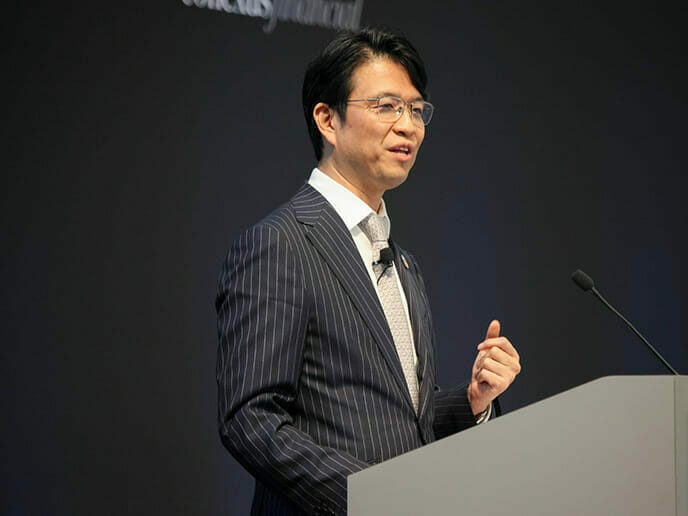
Hiro Mizuno, executive managing director and CIO of Japan’s $1.5 trillion Government Pension Investment Fund (GPIF), described himself as an unconventional CIO. Closing the Fiduciary Investors Symposium at Stanford University, Mizuno told delegates about the far-reaching changes he has introduced at the world’s biggest pension fund in the three years since he joined.

Much of that change has been driven by his belief that integrating ESG throughout the portfolio, starting with equity and now in fixed income and alternatives, too, is key for a long-term, cross-generational investor.

Perhaps the most breakthrough change is that GPIF, which outsources all management, now uses artificial intelligence to monitor its asset managers. By studying the impact of artificial intelligence on asset management, in a project with Sony Computer Science Laboratories, the pension fund is now able to see exactly where its asset managers are investing. Asset managers don’t always trade as they pitch to us, Mizuno told delegates. By collecting daily data, the fund has found discrepancies between what fund managers report and what AI reveals.

Along with providing a window into different asset manager’s styles in action, the information allows the pension fund to change the premise of its conversations with its asset managers. It is no longer a question or asset managers coming to GPIF headquarters with updates, because GPIF already knows how their managers are investing.

“It takes away their chance to pitch their story to us,” Mizuno said. He noted that many asset owners have been poorly resourced in the past, they haven’t used data from their asset managers and have been “at their mercy”, but AI has changed this.

Mizuno has also made changes in GPIF’s managers by pushing them to be long-term. Most notably, the fund now demands its passive managers become active owners.

GPIF’s managers were confused and said they were not paid enough, Mizuno recalled. Yet with 80 per cent of GPIF’s equity in passive, these managers have huge voting power. The change required managers to come up with a new business model and those that did so had their fees increased; those that haven’t have had their mandate cut.

The pension fund has also changed its fee structures in other ways. According to the pension fund’s investment and stewardship principles, it gives its managers guidelines but doesn’t dictate how, or where, they should invest.

“We believe in ESG and demand that our active and passive managers engage on critical ESG issues,” Mizuno explained. “We don’t say what these are – we leave asset managers to classify what the critical issues are.”

The new fee structure means that 30 per cent of GPIF’s evaluation of its managers is now based on their stewardship activities; stewardship is the most critical factor in them keeping the mandate.

Active managers have also had to change. Mizuno no longer accepts their traditional alpha targets or capacity limits.

“In our history, less than 20 per cent of active managers ever deliver their target alpha,” Mizuno said.

He grew similarly weary of managers’ arguing that fees couldn’t be discounted because of capacity limits.

“We found that when we asked them if they could take an additional billion dollars, they always said yes,” he said.

Now GPIF has slashed base management fees with its active managers but gives generous performance fees to share the value managers create. This can be as much as a 40 per cent profit sharing, Mizuno said. To push asset managers to focus on the long term, GPIF has also introduced multi-year contracts for active managers and asks managers what market cycles they need to prove themselves.

Given the pension fund’s large passive allocation, Mizuno has also prioritised working with index providers.

“When I am asked who our biggest asset manager is, I answer BlackRock,” Mizuno told delegates. Yet because this investment is mostly passive, it is dictated by the index vendor: “GPIF owns 10 per cent of the Japanese equity market and 1 per cent of MSCI ACWI. It doesn’t make sense to beat the market because, in reality, we are the biggest owner of the benchmark,” he explained.

Last year, GPIF introduced three ESG indices and has just created a new global environmental index, in which it invested $11 billion.

Sign up to our weekly newsletter for regular news flashes and industry insights.

The leading superannuation, institutional investment and fund management publication in Australia.

John Hennessy, the chair of Alphabet and former president of Stanford University spoke to delegates at the Fiduciary Investors Symposium about the evolution of the internet, the mistakes and successes of Silicon Valley and where the industry is headed. Listen to his Q&A with Professor of International Affairs at Princeton University and Fellow at the Hoover Institution at Stanford, Stephen Kotkin

AI now dominates research and investment in Silicon Valley, John Hennessy told the Fiduciary Investors Symposium at Stanford University.

Innovation clusters as new ideas appear, Hennessy, a computer scientist, academician, the chair of Alphabet and former president of Stanford University told delegates. In the early ’80s it was around the PC, 10 years later, it was the internet. Today it is AI, evident in Alphabet’s decision to set up ‘AI First’ five years ago and move the technology centre stage. A recent catalyst, Hennessy said, was when Google DeepMind’s AI program AlphaGo beat world champion Lee Sedol at Go, the ancient and complex game of strategy and intuition.

“That program made moves that any high-playing Go player would have said were outstanding,” Hennessy said.

He said AI posed ethical questions and called for standards on developing how the technology is used, clarifying what it should and shouldn’t support.

Yet Hennessy’s view of Silicon Valley’s growth and the global businesses that have spun out of Stanford via one-car garages, give him cause for some regret.

“We made one really big mistake,” he told delegates. During research and experimentation into payment for online content, an idea around micro payments gained traction. In the model, small amounts of content would be free but if users wanted more, they paid. However, the idea lost ground to a belief that information should be free and later, the advertising model took hold. I wish we had put something in place that allowed a better model for paying for content, he said.

Need for security

Security and cybercrime remain key issues for the internet, Hennessy said. He called phishing – sending fraudulent emails to collect passwords and other personal information – “the really big hole” and said that once fraudsters have got behind corporate and institutional firewalls, they “can hit much harder” and, “like termites in a house”, are difficult to get rid of. The average time between a hacker breaking in and being identified is 100 days, during which they have “sucked up information” and victims haven’t begun to understand what is stolen, he said.

Users need to be able to dial up privacy, accepting that if they choose to be wholly private some services will not be available. Google Maps is not going to work if you don’t want to tell it where you are, he said.

Removing fake news and hate speech is also challenging, Hennessy said. Screening videos on YouTube for hate speech led to screening out archive videos of Hitler because they also contained hate speech, taking out original and important source material in the process.

“We’ve got to figure out new technologies to grapple with this,” he said, adding that technology’s ability to change lives and affect public opinion has emerged so quickly, the industry is only just catching up with its responsibilities.

Hennessy told delegates that Google set up Alphabet to allow it to diversify and open new business lines outside the “mother ship”. Companies with successful core products and dominant market positions often failed to invest and nurture future growth, he said. They wait until the core business begins to plateau; then they make the investment but it’s too late. He said Warren Buffett’s recruitment of chief executives to Berkshire Hathaway companies on the promise of delegating complete control and management of the business has now become a key model at Alphabet, too.

When Stanford was founded, it didn’t have enough students to fill the institution. Since then, its reputation for entrepreneurship and taking risks has led it to thrive and attract people with the ability to turn academia into profit. Yet Hennessy noted that today Silicon Valley is in danger of losing the people and environment that have nurtured its success. He cited Yahoo!’s early days to illustrate the issue.

“I remember going to see the prototype for Yahoo. They had offices in a trailer and were building it in their spare time,” he recalls. Today, the housing crisis and high living cost are affecting the ability of students and entrepreneurs to live in the area, he said.

China concerns

Hennessy also told delegates of his concerns about China’s continued censorship of the internet and the gathering pace of AI investment.

“China is investing more in AI than any other country in the world,” he said, noting the “snooping” potential this gives the government, and the possibility of its manifestation in national defence via robot soldiers or autonomous vehicles.

“This is doable in the not so distant future,” Hennessy warned. “There are bad uses of AI, and a global security threat that exists with use of this technology.”

It is possible to meet the challenge of climate change successfully by introducing a carbon tax, celebrated veteran politician and academic George Shultz said.

Shultz spoke at the Fiduciary Investors Symposium at Stanford, where he is Jack Steele Parker Professor of International Economics, and told delegates that research and development were keys to managing climate change.

Rather than regulation, which holds back economies, he said, a gradually rising, revenue-neutral carbon tax would use “the marketplace” to cap carbon production.

“It works, and it will work in this case,” he said. Shultz noted broad support for the tax and referenced his work with the corporate sector, including major oil companies.

“Companies whose names you would recognise have signed up for a revenue-neutral carbon tax,” he told delegates. “More companies see it as better than the regulatory hand.” His next step is to garner political support amongst Republicans in the US Congress.

Shultz also noted the crucial role research and development play in meeting the challenges of climate change. The amount of federal support for energy research and development in the US is small, but he said federally funded programs had proved they nurtured ideas that drew the private sector. “Private people come on board, and private money is 3 to 1 [over] public money,” he said. He noted that adding business expertise to research programs brought scale and important collaborative relationships.

He cited the innovation climate research and development has already produced.

“It is a fact – the energy research and development people are getting somewhere.” Solar is competitive in price, car batteries are smaller, lighter, less expensive and more powerful, he said.

“The electric car is here,” he proclaimed. He also said scientists were “on the cusp” of solving challenges around storing large amounts of renewable electrical power that would take the intermittency problem out of solar and wind power.

Shultz argued that innovation on climate change required thinking about solutions that wouldn’t hold back economies, and that research and development held a global buy-in, since they create products and services people use.

“I’ve had solar panels on my house for 10 years and have long-since paid for them from money saved,” he said. “And they produce more electricity than my electric car uses, so the cost of my fuel is zero. What’s not to like?”

In a wide-ranging discussion that referenced Shultz’s own extensive career and close personal relationships with US presidents, he told delegates that governments act only when there is a “major event”; however, he explained it was possible to include disparate groups that jostle and disagree, via broad action plans.

Shultz cited how former US president Ronald Reagan, for whom Shultz was secretary of state, committed to the Montreal Protocol in 1987 without “demolishing” those who disagreed that the ozone layer was in danger.

“Reagan put his arm around the disbelievers,” he said. At a time when politics is fractured, Shultz talked about the importance of a two-party system, rather than a multi- party system, which he said would lead to poor decision-making and leadership.

President Donald Trump’s withdrawal from the Paris Agreement would not stop America’s states and cities from developing their own climate solutions, Shultz said, something he said reflects a new federalism taking shape across America, in which state governments are effecting change, rather than Washington.

“Washington is broke,” he said. The political system is unable to handle difficult problems and people want more control over important aspects of their lives nearer to where they live. Challenges such as rising interest rates, high debt and the healthcare crisis won’t be resolved by Washington politicians, he said.

“The chances of Washington facing up to this and doing something are zero, but in California we can do something.”

Shultz did note, however, the importance of global co-operation in tackling climate issues. It led him to reflect on the need for leadership to stop nuclear proliferation, a global struggle he called a “crime” and likened to climate change. He said deploying nuclear weapons had become “loose talk” and that people had forgotten the destruction they wreaked.

“We have got to get to grips with them,” he said.

Sign up to our weekly newsletter for regular news flashes and industry insights.

The leading superannuation, institutional investment and fund management publication in Australia.

Persuading asset owners to collaborate and work together is challenging, given the inherent competition for investments and returns. Yet a group of Australian investors speaking at the Fiduciary Investors Symposium at Stanford University proved that collaboration can create economies of scale and help reap rewards such as cheaper fees and improved access to opportunities.

Australia’s investor-owned IFM Investors, set up more than 20 years ago, now manages A$107 billion ($76 billion) on behalf of 310 institutional investors with 27 Australian superannuation funds as its shareholders. It offers member funds a higher level of control and better financial outcomes than a pooled investment fund, Brain Clarke, IFM executive director told delegates. Part of IFM’s success in persuading its institutional clients to forego self-interest is rooted in the ’80s, when Australia’s industry fund movement began, noted Garry Weaven, chair of IFM Investors Australia.

“It was easier to create collectivism because it was a movement from day one,” Weaven said. “We were not trying to bring existing organisations together.”

Mark Delaney, CIO of AustralianSuper, one of the largest investors with IFM, told delegates that working in a collective is not always easy.

“Everyone has an angle around ideas and portfolio construction,” Delaney said. He added that it is instinctive for different investors to “seek an edge”.

“It is not easy to invest collectively because people want credit for themselves, rather than give it to someone else,” Delaney said. Yet he called returns from AustralianSuper’s collective investments with IFM “phenomenal”, in infrastructure particularly.

Successful collaborations involve larger and more experienced investors within the group acting as leaders. Sonya Sawtell-Rickson, CIO of Australia’s HESTA, the A$43 billion ($30.5 billion) superannuation fund for health and community workers, noted the leadership role of larger investors within IFM.

“The larger funds have stood up and been stalwarts, breaking ground and sharing learnings for the benefit of others,” Sawtell-Rickson said.

Collaborations can have a real impact on fees, too, noted Kristian Fok, CIO at Australia’s Cbus Super. Negotiation in collaborative infrastructure investment has slashed fees by as much as a third, Fok said, referencing an investment outside IFM. It involved the larger investors in the group linking with the smaller ones to reach a compromise for the greater good.

“There are lots of reasons why managers can make it difficult for investors to make change, because they divide and conquer,” he explained.

Collaboration can help pension funds address issues that test their risk appetite, such as climate change. It is also a way to diversify investments, particularly for funds with home or industry biases. Different US public-sector pension funds could invest a little in each other’s states, Weaven suggested.

“It could be a win-win all around,” he said.

Cbus invests much in the building and construction sectors in support of its beneficiaries. Collaboration has been a way for it to spread its wings. Collaboration has also proved a good way to negotiate with the Australian Government, visible in AustralianSuper and IFM’s purchase of Ausgrid under a long-term lease in 2016.

“The government was comfortable because we are a broad-based collective,” Weaven said.

Yet collaboration is challenging for US public-sector pension funds, noted Chris Ailman, CIO of the $335 billion California Public Employees’ Retirement System (CalPERS). Bureaucracy and an inability to move quickly has hurt partnerships; a lack of understanding of individual investment processes and staff turnover within collaborative groups are also hindrances. Delegates heard that America’s municipal bond market remains the largest and cheapest source of capital for large infrastructure, squeezing out pension funds.

CalPERS has launched collaborative efforts but despite the interest there were “no takers”, Ailman said. He attributes this to pension fund staff being stuck in their own way of doing things; however, increased interest from foreign institutions in US infrastructure could trigger partnerships, he said.

Sign up to our weekly newsletter for regular news flashes and industry insights.

The leading superannuation, institutional investment and fund management publication in Australia.

Stanford University’s state-of-the-art energy system relies on renewables and thermal storage in water tanks. This takes advantage of the fact that the cost of thermal storage in water is cheaper than lithium batteries by a factor of 10.

The system is an example of the innovation under way in the most cutting-edge energy systems, said Arun Majumdar, Jay Precourt Professor at Stanford University, who spoke during the Fiduciary Investors Symposium at Stanford.

The race to introduce new systems is paramount, given the little headroom left to cap carbon if the world is to contain warming at less than 2 degrees. Yet decarbonisation must be balanced with continued economic growth, particularly in many regions of the world that still have poor access to electricity. It also needs to run parallel with the huge growth in the world’s megacities, Majumdar said.

Natural gas would be one gamechanger, he predicted. It is an abundant resource, and it has decoupled from oil prices in markets. Majumdar forecasted a massive increase in liquefied natural gas trading and new technologies, making production cheaper still. He noted that renewables were now the cheapest way of generating electricity in many parts of the world. They are undercutting nuclear in California, as evidenced by the state shutting down its last nuclear power plant, Diablo Canyon. Switching from coal will cause “social dislocation” in India, where he noted coal was becoming a stranded asset.

The challenge is now adapting electricity grids never designed for volatile generation to take solar and wind power. Data and digitisation would play a key role in integration, Majumdar said. Developing grids to balance volatile energy supplies from renewables is a “common problem in California and around the world”, he explained. Storage is one solution but it work across days, or even a season, to be available for days when renewables aren’t generated.

“Are there solutions today? No. Are there some promising [potential] solutions? Yes,” he said.

Developments in batteries would usher in more electric vehicles, with real penetration in the next five years, he predicted. Majumdar noted that electricity utilities were “beginning to talk” to the automotive industry to prepare for the rise of electric vehicles so that grid services and mobility services could work together. Some oil majors are preparing for the threat of being squeeze out, he said. Royal Dutch Shell, whose chief executive, Ben van Beurden, recently said the world’s demand for oil could peak as soon as 2025. Galvanised by shareholder pressure, and helped by a strong balance sheet, the company bought UK energy supplier First Utility. Shell also has a large electricity trading arm in Houston, Texas. BP is also transforming its business, recently buying Chargemaster, the UK’s largest electric vehicle charging company.

The pace of innovation is gathering speed. Majumdar has noticed that, in recent years, incremental innovation has accelerated due to falling costs and improved performance. It means transformative ideas like solar, which first began in the 1960s, are now truly disruptive.

“It takes 20-30 years to bring down cost and then become disruptive,” Majumdar said. Finding future disrupters involves research and development, finance and scale. Policy is also important, nowhere more so than in the carbon price. Without a carbon price, it is difficult to integrate carbon capture or public acceptance, he said.

Sign up to our weekly newsletter for regular news flashes and industry insights.

The leading superannuation, institutional investment and fund management publication in Australia.

Investors hunting opportunities in AI should focus only on projects and innovation that find solutions to today’s problems, said Dr Vivienne Ming, a theoretical neuroscientist, technologist and entrepreneur, who spoke at the Fiduciary Investors Symposium at Stanford University.

Ming charted her experience using AI to address enduring disabilities in children. She said the technology was “meaningless” unless it was applied to solve hard problems. She noted that AI has “nefarious” possibilities and said the technology should be measured by its “purpose” and “sacrifice” and that people “getting rich” by developing AI technology had clear conflicts of interest.

Ming told delegates her most personal AI project was developing a model to treat her diabetic son. The technology, which can predict hours into the future what his blood sugar would be, became the first AI treatment for the disease.

“It is a multitrillion-dollar industry, yet some woman who had a sick son was the first person to do this – and not because I am a genius,” Ming said.

Now innovation in diabetes includes a ‘smart pancreas’ that acts like a thermostat. In other areas, AI is being used to predict manic episodes for bipolar sufferers’ weeks before they happen. Ming is also working to solve problems that will have an impact on policy; for example, AI could have provided early signals of the housing crisis, she said.

In another project, Ming has helped build wearable technology to allow autistic children to read and facial expressions, allowing them to learn what they mean.

“This doesn’t come for free with autism like it does for most of us,” she said. Another missing attribute with autism is empathy and with the technology autistic children were able to develop that, too.

“Kids who learned to read expressions, learned empathy,” Ming said. It was like granting a superpower to people who otherwise “felt like aliens”.

In yet another project, she is using AI to help children with brain damage recover lost memories.

“Where their life story has been taken away, AI can give them a boost and push them back to the person they could have been,” she said.

Ming spoke of applying the technology to help boost learning for people with poor memories, pointing to statistics that say a better working memory can lead to a 15 per cent to 30 per cent increase in lifetime earnings. It could be applied to children who suffer household stress, which is proven to decrease working memory, or kids growing up in war zones like Syria.

AI will transform work, but not the way many now predict, Ming said. Low-paid jobs will continue to exist but intellectually demanding roles such as lawyer and doctor will disappear – along with software developers, she said.

“Silicon Valley is full of software developers that don’t have jobs. Everyone thinks writing code is a guarantee of a job, but the vast majority of code is going to be written by AI,” she said.

Ming cited research that found AI read and corrected legal documents much quicker than trained lawyers could.

“Humans took 90 minutes to read each contract, AI took 22 seconds,” she said. Although the technology didn’t know what to do with the knowledge, she said, law firms won’t keep expensive professional staff who spend the bulk of their time reading contracts when technology can do it for free. AI will make de-professionalisation an overwhelming trend, she predicted. There are a hundred start-ups around the world targeting people who do cognitively demanding, complex – but largely rote – tasks, Ming said. The most sought-after people will be creative problem solvers.

Ming urged delegates to invest in projects that would reap long-term rewards that won’t directly benefit them because investing with a strength of purpose results in people living longer, and happier lives.

“Investing in the future pays back,” she said, and added that AI models with purpose should be given away for free. First-movers in technology have reaped massive benefits when they’ve released little-understood technologies in the world but AI must be available for all, Ming argued.

AI’s ability to increase childhood intelligence should be a “universal vaccine”, rather than a present wealthy people can give their children, she said.

Sign up to our weekly newsletter for regular news flashes and industry insights.

The leading superannuation, institutional investment and fund management publication in Australia.