France’s fourth-biggest pension fund, Union Mutualiste Retraite (UMR) will slightly increase its allocation to cash, private equity, private debt and infrastructure in response to high valuations and the late cycle, director general Paul Le Bihan says, in an interview from the fund’s Nantes headquarters.

UMR, one of France’s few pension organisations, runs three separate funds, of which the €7.9 billion ($8.9 billion) Corem is the largest; with about 300,000 members, two-thirds of whom are still active, the fund has a healthy growth-seeking allocation comprising equity, property and infrastructure.

Real assets

Real assets, which Le Bihan favours for the diversification, liability hedging and duration benefits, account for about €900 million in the Corem portfolio – about 11.5 per cent of total assets. The lion’s share of the allocation is in real estate with the remaining 2 per cent in infrastructure. UMR has steadily increased its real-estate allocation over the last decade. In that time, it has also diversified from a bias towards residential housing in Paris, entering new allocations to assets such as hotels, healthcare, logistics and industrial centres.

The portfolio has also diversified assets among France, the rest of Europe and the US, although 70 per cent still remain in France. UMR is managed dynamically and includes direct investment with allocations to funds and funds-of-funds. A key priority through 2018 has been increasing direct real estate investments, which now make up about 40 per cent of the property portfolio, Le Bihan says.

UMR’s infrastructure portfolio dates from 2008. Strategy is focused on generating recurring long-term revenues in regulated markets, visible in its stakes in European telecoms infrastructure. Investments are split between funds (75 per cent) and funds of funds (25 per cent). Tried-and-trusted partners with good track records are favoured.

Diversification

UMR’s ability to build a diverse real assets allocation outside Europe is crimped by European regulation. Solvency II makes it costly for the French pension fund to invest overseas because of a perceived risk premium.

“Due to the cost of the Solvency II regulation, if we change the risk in the portfolio, our priority is to invest within the eurozone,” Le Bihan explains.

Other new rules President Emmanuel Macron has proposed for France’s pension system are also a cause for concern.

“We think the new rules for French pension funds’ ‘third pillar’ under discussion are not favourable to customers and could be dangerous for our asset liability management,” Le Bihan says.

Under the proposals, retirees will have an “open choice” of either a lump sum or annuity product in the decumulation phase. Le Bihan argues that lump sums should make up only a small proportion of assets during the decumulation phase, to ensure a lifelong income. He adds that the policy also threatens to reduce the fund’s liability horizon, which will damage asset performance.

Equity

Corem’s 18.3 per cent equity allocation is invested in two funds-of-funds UMR manages: the Select Europe fund and the UMR Select OECD. Allocations include European equities, US equities, frontier markets and emerging markets, along with a direct allocation to Chinese listed equities. Each fund-of-funds holds about 30-40 funds and strategy is counter-cyclical and value driven, shaped around different styles of active stockpicking using a broad range of asset managers.

About 4.4 per cent of Corem’s assets under management are invested in hedge funds and, as with equity, the UMR Select Alternative portfolio is all invested in funds-of-funds. Although Le Bihan says he is looking into some of the fund choices, he has no plans to change the allocation, which seeks to reduce the volatility from the equity portfolio. UMR has invested in hedge funds since 2002. The pension fund decides on a specific investment strategy internally, before selecting individual hedge funds with the help of its fund managers, as with the equity allocation.

UMR has an internal investment team of four. It has “premium relationships” and frequent contact with five asset managers but works with about 30 in all. The priority is to build long-term relationships based on mutual understanding and confidence.

“We are very selective, particularly for private debt and private equity,” he says.

UMR adjusts its targeted rate of return to market performance and reinforces the investment-grade side of the portfolio when risk levels increase. Despite the impact of low interest rates on the bond allocation, UMR returned 4 per cent in 2017. The pension fund is also improving ESG integration. It now excludes from its investment universe tobacco firms and companies selling firearms to civilians. It also signed the Principles for Responsible Investment this year.

Boston-headquartered Fidelity Investments, one of the world’s biggest asset managers, launched two zero-fee indexed funds last September – to a mixed reaction.

Some see it as a minor ratcheting-up in the price war among the mega indexers. Like the climate, they argue, fee models change at a snail’s pace.

Others see it as a defining moment. Not only have passive funds been a money magnet, they are also enabling passive providers to enjoy the so-called network effect, under which a service becomes more valuable the more it is used. Zero fees, it is argued, will create new revenue streams from the expanding client base at the expense of pure active managers.

The reality, as ever, is more nuanced. That fees are a slow-burn issue in global asset management, due to the large pool of legacy assets, is undeniable. That the price war in the passive space has been causing fee compression in the active space is equally undeniable.

Active fund managers are taking notice. With the large majority of them unable to beat their benchmarks in this decade, they have suffered the double whammy of fee compression and fund outflows.

Fidelity’s own stock-picking business had been challenged for years, as investors have flocked to low-cost indexed funds. Unsurprisingly, after itslatest salvo, the stock prices of active managers – like Franklin Resources, Invesco, Legg Mason and T Rowe Price – tumbled.

The media has, thus far, focused on private equity and hedge fund fees; however, the change is just as perceptible across the active space. Only those managers that have delivered their benchmark returns have remained immune.

For the rest, fee pressures have intensified like never before, in response to sub-par performance in this decade. And all the more so since quantitative easing has brought forward future returns, ushered in a low-return environment and turned fees into a key source of performance, once compounded over time.

In Japan, the $1.4 trillion Government Pension Investment Fund is implementing a two-part fee structure for active funds: a minimum base fee and a performance fee linked to the excess returns they generate. Failure to deliver them means managers receive only a base fee equal to that for passive funds of similar size.

Pricing pressures are acting as tectonic forces across the asset management industry, crushing some companies while helping to elevate a select few to unprecedented heights. As a percentage of assets, fees for active funds have declined by 3 per cent a year for the last three years. Asset managers are moving the pricing of their actively managed mutual funds from a fixed management fee to a performance-based variable fee with a very low minimum fee applied in all circumstances.

Of course, performance fees have their own issues. In particular, they encourage fund managers to ramp up risk to meet the return target. Even so, there is no doubt that such fees are coming, in various guises.

The trend is reinforced in the institutional space, as a growing number of pension plans worldwide are bringing investing inhouse. Back in 2016, Jack Ehnes, the chief executive of California State Teachers’ Retirement System, the third-largest pension plan in the US, said externally managed money needs to be brought inhouse because “for every $10 we pay an outside manager, we would pay $1 inside”. The best way to get better returns is to lower costs, he argued.

As we progress into the next decade, a new generation of fee models will emerge. The current fixed percentage fee based on assets under management is seen as ‘heads-I-win, tails-you-lose’ by investors. It is unlikely to survive intact. Apart from performance-based fees, unbelievable as it may sound, we may even witness fees based on flat pricing, giving asset managers a fixed sum of money, irrespective of mandate size. In funds management, today’s heresy can often be tomorrow’s orthodoxy.


Amin Rajan is chief executive of CREATE-Research.

Studies estimate that the US had the second-highest number of gun deaths in the world between 1990 and 2016, in absolute terms. Health.com states that gun homicides kill 13,000 people a year in the US, a rate 25 times higher than in other developed countries. The same study shows that 1300 children die gun-related deaths in the US each year, the third highest cause of death for children.

The 2012 Sandy Hook Elementary School shooting, in which 20 children and six staff where shot dead at a school in Connecticut, set off a groundswell of emotional backlash against the horror of gun violence. However, at that time there was no consensus as to what responsible corporate practices investors should advocate with respect to the gun industry.

This has now changed.

A coalition of 13 institutional investors, co-ordinated by the $229.2 billion California State Teachers’ Retirement System (CalSTRS), has drawn up a set of investor principles to improve the safety and responsibility of the firearms industry.

Working with a coalition of investors whose assets total nearly $5 trillion, the Principles for a Responsible Civilian Firearms Industry serve as a starting point for investors to begin discussions with organisations that manufacture, distribute, regulate or fund the firearms industry, with the goal of creating safer products and reducing investment risk.

The principles serve as engagement points for investors seeking to protect and enhance long-term portfolio values by ensuring risks are being appropriately monitored and addressed. They are not prescriptive in any way and each signatory will interpret and apply them on their own as they see fit. The principles document states:

“As asset owners and asset managers, we have a duty to our beneficiaries, who depend on us for financial security; such obligations compel us to assume responsibility for reducing risks that we and our beneficiaries face if and when we hold a financial interest in both private and public firearms-related enterprises.

We believe that enterprises involved in the manufacturing, distribution and sale and enforcement of regulations in the firearms industry are well positioned to support pragmatic transparency and safety measures that contribute to the responsible use of firearms. Through this framework, we assert our role as investors in encouraging such practices, and we identify expectations for the firearms industry that will reduce risks and improve the safety of civil society at large. Further, we commit to monitoring progress by companies over time and engaging with them regularly on this issue, especially in support of enterprises that champion adoption of responsible practices.

The Responsible Civilian Firearms Industry Principles are meant to be sensible and not intended to be prescriptive in nature. We recognise that there are many ways to apply a principle; companies are free to apply the Principles in a manner they deem appropriate. We also recognise that the civilian firearms industry is highly regulated by both federal and state entities with respect to the manufacture, sale, use and transfer of firearms. However, we also recognise that more can be voluntarily done by companies within these existing regulatory boundaries to advance safety and the responsible use of civilian firearms.”

The five principles, downloadable at FirearmsPrinciples.com, are:

Principle 1: Manufacturers should support, advance and integrate the development of technology designed to make civilian firearms safer, more secure, and easier to trace.

Principle 2: Manufacturers should adopt and follow responsible business practices that establish and enforce responsible dealer standards and promote training and education programs for owners designed around firearms safety.

Principle 3: Civilian firearms distributors, dealers, and retailers should establish, promote, and follow best practices to ensure that no firearm is sold without a completed background check in order to prevent sales to persons prohibited from buying firearms or those too dangerous to possess firearms.

Principle 4: Civilian firearms distributors, dealers, and retailers should educate and train their employees to better recognise and effectively monitor irregularities at the point of sale, to record all firearm sales, to audit firearms inventory on a regular basis, and to proactively assist law enforcement.

Principle 5: Participants in the civilian firearms industry should work collaboratively, communicate, and engage with the signatories of these Principles to design, adopt, and disclose measures and metrics demonstrating both best practices and their commitment to promoting these Principles.

The principles are deliberately written so that each investing institution can decide for itself what to ask of companies and how to respond to what the companies decide to do or not do. Building in this flexibility was important to each institution, given they all have different models for engaging their portfolio companies.

The Firearms Principles set the stage for global institutional investors to engage with companies in the civilian firearms industry by having productive discussions on how these principles can be applied over the long term to address gun safety while reducing investment risks. There are a variety of outcomes that could unfold within the next many years but the best one for all would be to engage in constructive dialogue across the civilian firearms industry about what companies can do to keep society and our future generations safer.

Working with Chris Ailman and CalSTRS to convene these institutional investors at Harvard to write the Firearms Principles was just the beginning. We invite and call upon global institutional investors of all types to become signatories to these principles to reduce risks and encourage progress on gun safety issues in the US.


Christianna Wood is advanced leadership fellow at Harvard University.

Interested investors may send an email to FirearmsPrinciples@CalSTRS.com


Members of the coalition

California Public Employees’ Retirement System

California State Teachers’ Retirement System

Connecticut Retirement Plans and Trust Funds

Florida State Board of Administration

Maine Public Employees Retirement System

Maryland State Retirement and Pension System

Nuveen, the asset manager of Teachers Insurance and Annuity Association of America

OIP Investment Trust

Oregon Public Employees Retirement Fund

Rockefeller Asset Management

San Francisco Employees’ Retirement System

State Street Global Advisors

Wespath Investment Management


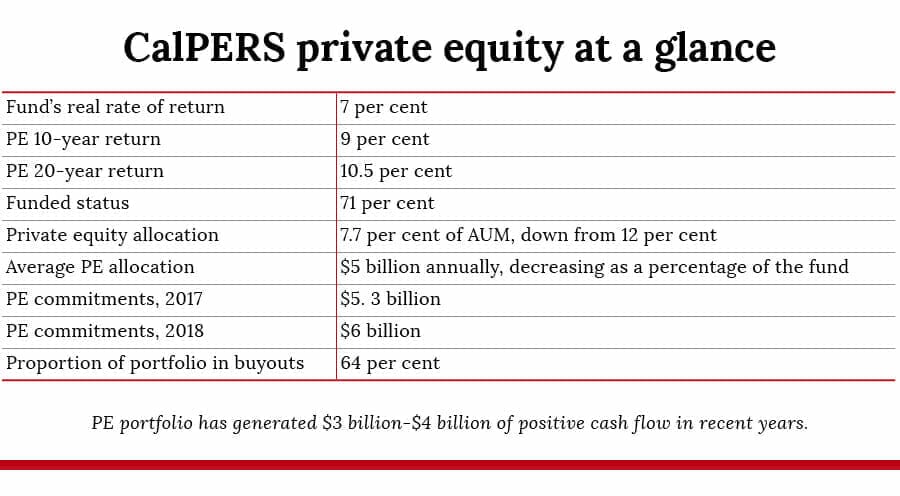
The California Public Employees’ Retirement System has taken another step towards clarifying the new shape of its $27.2 billion private equity allocation.

After two years of discussion and analysis, the CalPERS investment staff’s latest presentation to its 13-member investment committee inches the pension fund towards an execution phase for the new-look portfolio.

It also drops some of the more ambitious plans CalPERS had mooted for increasing direct investment in its best-performing asset class. There had been talk of creating a separate company and bringing private equity inhouse. The pension fund has taken these ideas off the table in the CalPERS Direct pillar of the new portfolio and states that it now plans to invest directly via a traditional general/limited partnership structure.

In this separate account model, CalPERS will be the only LP investing with a single GP. The captive entities will operate independently of the pension fund but with a clear mandate that will involve routine interaction with CalPERS senior staff. The entities will also have their own board of advisers, focused on ensuring the management team adheres to the fund’s mandate.

“It is the structure that works best for us going forward and the structure we’ve used quite deliberately in our real estate and infrastructure programs for over 20 years,” departing CIO Ted Eliopoulos said in his final board meeting in that role. “We have two decades of experience of separate account partnership; it is nothing new to us and right within the core competencies of our staff.”

Yu Ben Meng will take over as CIO in January, returning to CalPERS after serving as deputy CIO of China’s State Administration of Foreign Exchange (SAFE).

The partnership structure will allow the fund to invest for the long term and move the portfolio away from the playbook of short-term, co-mingled funds – leverage, dividends, cost cutting and selling assets after four years. The separate account vehicles will be “perpetual entities” and “evergreen”, says CalPERS senior portfolio manager John Cole, one of the key architects of the new portfolio. He explains that investments won’t have fixed terms and deals will be structured to incentivise behaviour that results in long-term value creation and growth. Investee companies will be encouraged to expand into new products and generate cash flow, jobs, long-term dividends and sustainable contributions to society.

This structure also offers the opportunity for better alignment on fees, which will be based on operating budgets rather than assets under management. The pension fund will also be able to specify the incentives it wants to prioritise, rather than taking what is offered “off the rack” in co-mingled fund investment. CalPERS will be able to incorporate its values, beliefs and principles into this section of the private equity portfolio, Cole says.

The individual GP mandates in the direct allocation will comprise late-stage venture capital companies in life sciences, tech and healthcare in the ‘Innovation’ portfolio. A twin seam will come via the ‘Horizon’ allocation, where CalPERS can model a platform approach to building the portfolio, which will feature long-term, core-economy companies capable of attractive cash yields.

Both portfolios will target an investment rate of about $1 billion to $2 billion in commitments annually, which will grow to $10 billion each over the next decade. Both will also employ an ‘operations approach’ to support and nurture investee companies’ growth. Allocations will be carefully selected so as not to compete with existing GPs within CalPERS’ continued allocation to co-mingled funds, where most of the portfolio will continue to reside.

Co-mingled

“We expect to continue to access co-mingled funds for the foreseeable future, in $5 billion to $7 billion commitments a year,” Cole says.

CalPERS has spent the last year evaluating potential partners for a discretionary role to help it access the best funds and improve its access to co-investment and secondary transactions. BlackRock, Goldman Sachs Asset Management, Neuberger Berman, AlpInvest Partners, Hamilton Lane, and HarbourVest Partners all submitted plans to CalPERS early this year detailing the role they would play in managing the largest private equity portfolio in the US. Cole says that, despite working with “six outstanding organisations”, the pension fund decided these approaches wouldn’t “meaningfully” strengthen the organisation”.

Now the focus at the fund is finding a permanent head of private equity to replace Réal Desrochers, who left in April 2017 to join a private equity firm. Once the position is filled, CalPERS will reconsider whether an advisory approach will help supplement its own capabilities and whether to extend capacity and resources in its allocation to co-mingled funds.

The emerging-manager pillar of CalPERS’ private equity program will also remain the same. It was established over a decade ago as a small, $1 billion allocation that promotes new manager blood and thinking in the private equity industry, allowing CalPERS to tap investors of the future. Although the fees are higher here, and CalPERS pays for a fund-of-funds adviser, the allocation will remain – and grow to about $1.5 billion.

“We think this is worthwhile and pays dividends to the fund,” Cole says.

Less is more

The fund will also continue working to axe its GP relationships to about 40. CalPERS has already reduced the number of private equity GP relationships from several hundred to about 90 today.  At the presentation, interim CIO Eric Baggesen reminded the investment committee of the rationale behind scaling back on managers. When CalPERS had capital invested with several hundred GPs, it was comparable to investment in “an index of private equity firms”, where LPs ended up with an average of that universe. Now the focus is on investing with top-quartile managers, concentrating on a smaller number where the CalPERS relationship is material to the GP. The challenge, Baggesen says, is that not all managers want to be captive to CalPERS and the caprices of the organisation.

Sign up to our weekly newsletter for regular news flashes and industry insights.

The leading superannuation, institutional investment and fund management publication in Australia.

Developed countries are facing a “demographic time bomb” and those who think economies can grow their way out of it will soon face a harsh reality check, professor David Blake, director of the Pensions Institute at the City University of London’s Cass Business School says.

Rising life expectancy, falling fertility rates and ageing populations are driving a precipitous decline in many countries’ total support ratio (TSR) – which is the ratio of workers to young and old people who need support, Blake says.

A high TSR has historically been associated with rapid economic growth, as seen in China, India and Korea. But the UK and other countries, including Australia, China, Korea and in particular Japan, are becoming unsustainable places to support pension systems due to their top-heavy populations with shrinking numbers of young people shouldering the burden of supporting large older populations.

“In the 1950s, when you take the world as a whole, we had 12 people in work to support an older person in retirement, and you can see by 2050 that’s going to go down globally to something like five,” said Blake, who is also chair of Square Mile Consultants. “And of course in the more developed regions, you’re down to something like two.

“So you’re going to have two workers to support an older person in retirement, which means they’re going to have to pay huge amounts in taxation to pay for older people [who] have not prepared adequately for their own retirement.”

Japan is an early warning sign for what will happen demographically in the rest of the world, Blake said. The country’s TSR peaked in 1992 and the economy has been flatlining ever since.

“Whatever government has tried to do, its economy has flatlined, and that, I think, is to do with the demographic situation in Japan and not the macroeconomic policies it has tried to introduce.”

Productivity growth will not be the answer, as it is stagnating in the developed world, Blake said.

He predicted the consequences of this trend would be wide and varied: a shift in demand towards products and services for the elderly, increased demand for robotics in long-term care.

The labour market would experience a decline in the size of the economically active population, he said, and while this could cause gross wages to rise, taxes would probably rise to a greater extent, to pay for higher state pensions, meaning net wages would fall.

Blake also forecast a fall in the total pool of savings – assuming the old save less than the young – which would put upward pressure on interest rates. But there would be lower investment necessary in a smaller working population, putting downward pressure on interest rates, which would probably be lower on a net basis.

Risk taking would be lower due to lower risk tolerance among older people and there would be a preference for stable cash flows and safer investments.

“Bonds will be preferred to equities in investment portfolios,” Blake said. “Companies will respond to this by undertaking lower-risk projects financed by bonds rather than equities. That will increase the relative prices of bonds and reduce the relative prices of equity.”

This would increase the premium organisations would have to pay for equity when undertaking investment projects.

Overall, living standards would probably fall, GDP growth in Europe and Japan could drop from the traditional 2 per cent to 1 per cent as capital flows to countries with higher returns, and there the world could expect a decline in the relative economic importance of Europe and Japan.

The International Monetary Fund had raised concerns about this in its Global Financial Stability report in 2012, but even the IMF’s predictions were based on baseline population forecasts that underestimated how long people were likely to live, Blake said.

With enormous volatility in longevity, and studies showing people typically underestimate how long they will live, long-term care insurance is a sensible response, but very few people in the UK buy it, he explained.

The UK Government is now spending 1.5 per cent of GDP on adult social care, he said, and local authorities are “effectively insolvent because of the costs of adult social care”.

Politicians in the UK have been tinkering with the pension system constantly, leading to an over-guaranteed system, he said. As a result of over-regulation, politicians have over-guaranteed the system and it is now falling far short of the promises made.

The result for Millennials?

“Younger generations, the Millennials, with debts and without home ownership or pensions, will have a lower living standard than their parents, yet are expected to pay taxes to support what could be the luckiest generation in history, the Baby Boomer generation,” Blake said. “My conclusion is it’s now ‘the demographics, stupid’, it’s no longer ‘the economy, stupid.’ Demographic matters will dominate economic and financial matters over the next half a century, with a high risk of intergenerational conflict if this goes wrong.”

The notion that an organisation can build a new identity from a strategy that champions continuity may sound like an oxymoron. But looking at the recent sweeping changes at the UK’s £50 billion ($64 billion) British Telecom Pension Scheme (BTPS), the idea makes perfect sense.
BTPS has recently brought its liability-driven investment (LDI) and gilts portfolios inhouse along with its treasury function, sold off a majority stake in its inhouse asset manager, Hermes, and closed its defined benefit scheme. It has also just hired Danish pension expert and NOW: Pensions founder Morten Nilsson as chief executive, following Eileen Haughey’s resignation from the top spot.
And it is Nilsson who is convinced that once these changes bed down, a new identity will begin to emerge at the UK’s largest private sector pension fund.
“I feel it is a new start for the pension fund and that we are entering a new phase because of all the changes. I think this is really exciting,” he says in an interview at BTPS’s London headquarters, where the unfurnished white walls and lack of greenery are starting to bother him. “We must get some pictures and plants,” he asserts.

Infrastructure
Nilsson’s stamp on the fund is already coming through in more important ways. Nowhere more so than in his plans to boost exposure to cashflow-generating assets like infrastructure. Along with equity and property, BTPS’s growth portfolio comprises a mature infrastructure allocation that includes stakes in assets such as rail company Eurostar and Associated British Ports. He wants to invest much more.
“The pension fund pays out around £2.5 billion in benefits annually and being able to match this income from our investments has to be more and more our focus.” he says.
A four-member, inhouse illiquids team now focuses on “supporting the transition” and finding the investments to fit a larger allocation, which Nilsson believes will increasingly come from core UK infrastructure.
“If I was in the UK Government, I would be very focused on having UK investors in the infrastructure space whom I could trust and who have long-term aspirations,” Nilsson says. “I think there might be an attitude change here.”
Attitudes are also shifting within the fund. After years of outsourcing to a small cohort of key external managers, Nilsson is weighing-up the pros and cons of managing a cash-generating portfolio inhouse. He’s also keen on collaborating with other asset owners in club deals, bringing better access and global reach in a cost-efficient way.
It’s a thought process informed by the pension fund’s altered manager structure following the sale of the majority stake in Hermes, which still runs the private equity, infrastructure and real-estate allocations.
Selling Hermes doesn’t change investment strategy and Nilsson says it’s a timely and natural separation that allows Hermes to build its multi-client base while BTPS can hone a strategy better aligned to the needs of its members. It allows BTPS to forge a new, independent identity after years of working closely with its sister company.
Where the fund has already in-sourced, it has worked well. BTPS is already reaping cost and control benefits of bringing the LDI, gilts trading and currency strategies inhouse to join existing internal teams covering manager selection and illiquid opportunities, Nilsson says.

Technology empowers
“We are very pleased with the things we have bought inhouse and are carefully considering doing more. For example, we have already added value and reduced complexity by reducing our trading frequency in foreign exchange, and some of the things we now do with the LDI portfolio would have been difficult if it had been outsourced.” he explains, in a nod to how technology is transforming the pension fund’s ability to do more itself.
The split from Hermes means the fund no longer shares IT solutions. Areas like reconciliation and developing bespoke platforms are now within BTPS’s capabilities and will change its traditional relationship with its asset managers.
“Things that could only be done by large organisations are now affordable for an organisation like us,” he says. However, he is mindful of the negatives that come with big internal teams. He believes insourcing can create internal competition and rivalries that conflict with a pension fund’s broader mission. Under the current structure, BTPS’s specialised investment teams also work across asset classes.
“Part of the logic behind the current structure is to prevent deal hunger within the teams,” he says. Another challenge is ensuring any changes to internal teams don’t affect the investment process.
“The investment process needs to ensure we’d reach the same decisions even if some of the people in the process were to change,” he explains.
Whether he decides to further build out internal allocations or not, BTPS is unlikely to throw open its door to a raft of new managers. Rather than shallow relationships with “hundreds”, he wants to continue the fund’s long-term relationships with a few. For now, his priority is to “fully understand” the relationships BTPS has with its primary cohort – which includes Blackrock, Insight and Wellington alongside Hermes – and ensure alignment, particularly around performance fees in the illiquid allocations, which he says should only ever be based on realised gains.

Out of the shadows
As part of BTPS’s new identity, Nilsson is determined to have the pension fund make much more of its responsible investment strategy. Much of the fund’s progress and achievement here has gone unnoticed he says; the pension fund has the “same genes and DNA” as Hermes, which has grown to become a global leader in the field.
“The pension scheme has traditionally talked very little about what it is doing in responsible investment but it is hugely impressive and different from many other schemes,” says Nilsson who says he’ll always remember his first meeting with the Responsible Investment Oversight Committee, whose strategy includes integrating the impact of climate change, technology disruption, changing demographics and scarce resources across the portfolio.
“I was so impressed with the way they worked,” he recalls.

Brexit hedge
BTPS’s portfolio is split 45/55 growth to matching assets, with a hedge ratio of about 50 per cent on a solvency basis, steadily increased from 20 per cent over the last three years. The hedge ratio comes from the fund’s LDI portfolio, which includes investment-grade corporate bonds and index-linked gilts alongside inflation and interest rate derivatives. It is all structured to produce an investment return that offsets a portion of the effect on BTPS’s liabilities from changes in interest rates and inflation. The LDI portfolio also reduces the risk from the fund’s £11 billion ($14 billion) funding deficit.
The fund has a longevity hedge established a few years back. BTPS set up an insurance company to insure its own longevity risk cost-efficiently.
“The alignment of the scheme’s funding and investment strategy with our demographic is very solid,” Nilsson says. “I think there is very good logic behind what we are doing. It is very strong and well thought through.”
It stood the pension fund in good stead during the UK’s Brexit referendum in 2016 and Nilsson thinks it will be an important tool in case of a no-deal Brexit, one of the scenarios BTPS repeatedly simulates. He says liquidity will be paramount.
“When we run our scenarios, we see the effect of our hedging program and it gives us a lot of protection,” he explains. “It doesn’t mean we are immune because we are not if a bad scenario plays out; however, a great deal of the risk is taken out by the hedges we have.”
He expects one of his key roles going forward to be communicating the importance of the hedging program in the changing economic climate.
“Falling interest rates over the last 10 years and the money we have been able to make out of our hedges have made the program intuitively attractive,” Nilsson says. “This may change in the next 10 years [if rates start to rise], which means we may need to do more to explain why it is still critical for us to have that stability going forward, and what the hedges give us.”