Executives from 75  companies representing all 50 states, with a combined market value of $2.5 trillion and employing more than one million people, came together last month as part of the LEAD on Carbon Pricing effort to urge the US Congress to pass meaningful climate legislation.

Ceres and our partners convened the largest group of businesses calling for climate legislation in at least a decade. Their message was loud and clear: Congress must put forward policy responses equal to the severity of the climate crisis including a national price on carbon.

A cascade of new scientific findings and economic research shows the increasingly devastating impacts of climate change on the economy and on communities. The latest National Climate Assessment explains that, even with adaptation measures, climate change is likely to cause $800 billion in damages. Without strong action, that number could rise to as high as $3.6 trillion.

An analysis by Trucost shows that operating margins will turn negative for 46 per cent of companies in the chemicals sector by 2030, because emitting carbon will become too expensive. In the US, climate change could lead to as much as $160 billion in lost wages, as two billion labour hours will be lost annually by 2090 due to temperature extremes.

As study after study has made clear, ignoring climate science means accepting enormous economic risks. We must act now to reduce emissions and avoid the worst impacts of climate change.

A well-designed price on carbon is widely considered an essential component of the efforts necessary to meet the climate crisis. The goal of a price on carbon is to address a market failure: greenhouse gas (GHG) emissions have global costs that are currently not borne by the emitter. A carbon price puts a monetary value on those emissions to account for their real social costs, which helps to drive down emissions across the economy.

Investors, companies and the people they serve rely on functioning supply chains, operations, and distribution facilities—and climate change poses significant threats to these elements essential for a profitable business.

Companies recognize this threat and are taking action to accelerate the transition to a low-carbon future by investing in renewable energy and setting GHG reduction targets. However, they cannot tackle to problem without policy solutions from Congress.

An economy-wide price on carbon would create a level playing field as these companies work to protect themselves against the financial risks of climate changes, by allowing companies to decide for themselves the best approach to reducing emissions.

Furthermore, a meaningful national price on carbon would provide the policy certainty investors and companies need to make long-term operational and investment decisions in the United States. As Tim Smith, director of environmental, social and governance (ESG) shareowner engagement at Walden Asset Management, puts it:

Investors are increasingly aware of the dangers of climate change and its impact on companies and our portfolios. We have seen a flood of papers and statements in the last six months, from BlackRock to the Bank of England to our Fed, calling for urgent action. Companies and investors working together have a central role in implementing climate solutions. A price on carbon would create the market signals needed to drive clean energy investments, grow the job market and strengthen the American economy. It is a critical tool in US efforts to address climate change.

Investors and companies agree on the need to implement a national price on carbon. Beyond the 75 investors and companies that gathered on Capitol Hill last month, 415 investors from around the globe—many based in the US and together representing over $32 trillion in assets under management—have called on governments around the world to step up action to tackle climate change, including a meaningful price on carbon.

And, it’s not just the private sector that supports a price on carbon. A March 2018 Gallup poll of registered voters found that 71 per cent of respondents favour a carbon tax on fossil fuel companies and support using the revenue to reduce other taxes.

At last, congressional leaders are hearing the call to act on the climate crisis. More than 80 congressional offices on both sides of the aisle and in both chambers took the time to meet with investors and companies participating in LEAD on Carbon Pricing.  Lawmakers and their staffers heard the resounding message on the urgency of the climate challenge and the need for a strong policy response from the federal government.

Now, we need Congress to do more than listen. They must act.


Anne Kelly is the vice president of government relations at Ceres, a sustainability nonprofit organization working with the most influential investors and companies to build leadership and drive solutions throughout the economy.



The A$50 billion superannuation fund for health care professionals, HESTA, has embarked on a journey of aligning its assets with the SDGs. Measuring its current investments against chosen sustainable development goals revealed a need for standardised measurement tools.


The A$50 billion superannuation fund for health care professionals, HESTA, has been on a responsible investment journey for nearly two decades, launching its first eco pooled fund, one of the first in the country, back in 2000.

In that time the fund has evolved its ESG stance, including a strong engagement program and the newly launched HESTA Impact headed by Mary Delahunty.

HESTA Impact brings together the work the fund does on advocacy, responsible investment and its own actions and behaviours to give consistency to its sustainability approach across those three areas.

In bringing that to life, the responsible investment team has been integrated into the investment team and now reports directly to chief investment officer, Sonya Sawtell Rickson; as does Delahunty.

“We have repositioned that team as a centre of excellence and shifted the accountability of responsible investment to the investment team,” Sawtell-Rickson says. “This has been a big transition over 12 months. We now use the RI team as a knowledge centre to help educate the investment team.”

At the same time a new governance structure has been set up over the impact area, with the formation of a new Impact Committee consisting of six representatives: two from the investment committee who are also on the board, three board members who are not on the investment committee and an independent, Angela Emslie, who was formerly 12 years as chair of HESTA and now sits on the PRI board.

Within the responsible investment expansion, the next phase for the fund was reorienting the portfolio in line with the United Nations’ Sustainable Development Goals (SDGs).

The fund has chosen seven SDGS to align its portfolio with: good health and wellbeing, gender equality, clean water and sanitation, affordable and clean energy, climate action, sustainable cities and communities, and decent work and economic growth.

Around 80 per cent of the fund’s membership are women and the fund has been very vocal in advocating for equality – being namedEmployer of Choice for Gender Equality by the Workplace Gender Equality Agency for the third year in a row testament to that.In addition its members are health care workers, so SDGs around good health and gender equality made sense.

In order to direct investments in line with these SDGs the highest priority was to measure where the fund’s holdings already sit with regard to these measures.

“As a first step, we wanted to get a basic baseline assessment across the portfolio. It was important for us to measure whether investments would materially contribute to addressing SDG targets, rather than an investment simply being aligned with any of the SDG themes. So, we set a high bar,” Sawtell-Rickson said.

For example, taking the gender equality lens, there were a number of holdings in its private equity portfolio that were lending to poorer customers in developing markets traditionally underserved by the banking industry – and this practice was found to have had a direct positive impact on a woman’s ability to access finance.

“Our initial work to establish an SDG baseline drew on the work undertaken by APG and PGGM, and made sure to reflect each SDG target rather than being a thematic overlay. We ended up arriving at approximately $1.5 billion in investments materially contributing to addressing the seven SDGs we are focusing on,” she says.

It’s a common story that funds that are progressive on responsible investment and are looking to align their investments with the SDGs, come up short when they actually measure the impact their current investments are having.

The 220 billion euro Dutch fund, PGGM, widely considered to be one of the global leaders in implementing a framework that aligns its investments to the UN Sustainable Development Goals, mapped its portfolio according to the SDGs last year.

Partnering with Impact Management Project and using a specific methodology it found that 4.5 per cent of its portfolio is allocated to investments that are benefiting people and the planet and 2.5 per cent is allocated to investments contributing to positive outcomes.

PGGM is far ahead of other investors on this matter, but when they scrutinised their data, they realised they didn’t set impact goals, so they couldn’t measure that. (See PGGM maps portfolio impact.)

For HESTA phase two of the project is looking at how to develop a more granular approach with the aim of monitoring how its portfolio is supporting specific outcomes that contribute towards SDG targets.

Sawtell-Rickson says to truly measure and, more importantly, amplify the impact the fund can have for members it needs to look beyond portfolio exposures.

“As an active owner, how we’re engaging with companies on SDG themes we know to be material to our members is also an important consideration,” she says. “As is how we increase the effectiveness of our engagement by coordinating this with our share voting, as we have a long standing commitment to vote all the shares we own, wherever possible.”

The fund is also committed to contribute to the ambitions of a number of the SDGs through its own operations. For instance, through how it interrogates its supply chain and the way it acts as an organisation.

For example, the fund recently surveyed its external fund managers and discovered on average they had 16 per cent women in positions of leadership. This was seen by HESTA staff as an opportunity to focus on improvements. Its internal investment team is made up of 42 per cent women.


What’s next?

The next challenge for HESTA is how to measure its impact going forward, and figure out what the right measurement is, and this will be a focus for the next 12 months.

“We are focused on real outcomes rather than measuring how much investments could be bucketed under various themes,” Sawtell-Rickson says. “The way forward in terms of measurement from our perspective is to focus on tangible real world outcomes, to look beyond the dollars and to look at how we can have a positive impact on people or the environment. We’ve learnt a great deal from our impact investment program and our work with partners like Leap Frog internationally and Social Ventures Australia domestically. The respective measurable social return that’s embedded in the objectives of these investments is helping us develop our understanding of outcome reporting.”

But she does acknowledge that comprehensively measuring impact is pioneering work and it will be overseen by the fund’s new governance arrangements.

“Impact measurement in Australia and broadly throughout the world is relatively new and we are assessing the emerging theories to understand what avenues to pursue. We are looking for opportunities to partner with others to further this area of work,” she says.

“We know that for this outcome assessment to be meaningful it must be across the entire portfolio – every decision we make has impact and is made as a responsible universal owner, so it should be measured.”

The fund regularly surveys its members to gauge their views, and responsible investment has been one of the drivers of members’ satisfaction. It’s a true alignment of interest for the fund.

In communicating with investors, Sawtell-Rickson says storytelling is important.

The biggest commitment of Hesta’s social impact investment trust, which is managed by Social Ventures Australia is $19 million to help finance the development of Australia’s first dementia village in Glenorchy Tasmania. The development is a partnership between HESTA, SVA, Glenview – a not-for-profit aged care provider, and the Commonwealth Government.

In communicating with members the fund talks about this investment in terms of helping to fund best practice dementia care that community has never seen before, and in doing so is creating jobs in Tasmania (as well as delivering financial returns).

“Our members overwhelmingly want us to invest in improving public health and helping to further sustainable development and stronger communities. They also want us to use our influence to advocate for public policy outcomes that are fairer for women,” she says.

“The next frontier for us is how we can amplify the positive impact we can have for members and invest in opportunities through the lens of the SDGs.”


International pensions adviser at PRIME bv, Peter Kraneveld, looks at how different China scenarios could impact portfolios.

Investing in emerging markets is becoming popular again and China is a vital part of an emerging market portfolio. However, it is difficult to understand the long-term projections for China. Its statistics are unreliable, its governments unstable through the strong link between economy and policy, yet its policies are inflexible as economic development is subservient to government politics. In this article, I will use a simple scenario analysis that investors can use to monitor China’s developments and update the assumptions behind their emerging market portfolios from time to time.

Don’t predict the future

The future is too complicated to predict with many more variables than equations. Moreover, the judgment of those who predict is normally clouded by such factors as education, culture, experience, constraints of time and access to data. In principle, all predictions of the future beyond the very short term should be considered with very considerable care. At best they represent only one-way things might develop. More often, they are an expression of a combination of fear, wishful thinking, marketing imperatives and other factors that should not have played a role.
As an alternative, after a short inventory of the present situation, I will develop two polar scenarios (whether the one or the other is positive depends on the eye of the beholder), assuming that the real future will play out somewhere in between. The major advantage of this approach is that it allows for easy updating: throw out what has not happened and has become highly unlikely to happen. Keep what is still possible and add newly surfaced imponderables. This updating process has value in itself, as it forces the reviewer to reconsider yesterday’s easy assumptions.

Today’s economic issues

China, like every country in the world, is dependent on foreign trade. It needs it for know-how, capital, energy and basic materials that are not found in sufficient quantity in China, but also as a back-up to smooth domestic economic problems. In principle, China’s size allows it to play an important role in international trade. In practice, China’s role in international trade is restricted by political considerations. First among those are the real and perceived enemies of China, including Taiwan, Russia and the US. Second are military strategic considerations. In addition, trade suffers from over-regulation that gets in the way of flexibility.
When China was poised to join the World Trade Organisation, it fought hard to retain all kinds of mechanisms to control imports and incoming capital and to undermine industrial and intellectual property rights. This backfired into a deep distrust from its trading partners and a lack of domestic economic discipline. Typical examples are food safety problems and fake Chinese banknotes and coins circulating within China, but also judiciary blackmail on foreign direct investors.
China’s trade policy includes efforts to corner markets. The country will engage with developing countries, offering physical, non-financial development aid with financial and economic strings attached. China tends to seek out countries with highly corrupt economies, ruled by dictators or the military. These countries are not reliable political or economic allies. The policy is backfiring into painfully ruptured relations, especially after a change of regime. China’s project execution, often a closed compound with Chinese workers only, does not provide employment or education for the local population, so that the projects tend to create resentment, rather than goodwill locally.
Using economics and trade as a tool of political goals, China has made itself vulnerable to pressure from the US particularly. With China’s historic background of attempts at colonisation (“unequal treaties” in Chinese parlance) it is unlikely that the government wants to, or even can, make economic concessions in trade disputes.

The “all goes well for China” scenario

In this scenario, the world develops China’s way and China becomes the world’s largest economy. That means next to nothing, as GDP figures can be compared only when related to population. But as the US media and financial markets attach emotional value to the US no longer being in ‘first place’ it will have a psychological effect.
China increasingly gets influence on trade and basic materials and uses it to create favourable conditions for itself. Several developing countries lose the possibility to trade without China’s permission. The big prize, the oil market, eludes China, because of major production in the US and Russia. However, Saudi Arabia, the world’s largest producer may feel increasingly attracted to China as a counterweight to the US. Venezuela, another large producer, may be in the Russian or Chinese orbit, but it is not in the US sphere of influence. Meanwhile, green pressure diminishes the importance of oil.
Politically, China succeeds in silencing all countries on its borders, apart from Russia and it will awaken the military aspirations of Japan. Trade disputes are a running war that hollows out the liberal trading system and replaces it with bilateral relations, where China’s influence looms large. Investments into China go from private to government induced.
Perhaps China’s greatest success is in international bulk transport. Its shadowy companies buy up harbour front service industries and airports, making sure that Chinese trade flows get preferential treatment. This is also another way to keep other nations in line. In principle, Chinese internet companies could take over domination from their US competitors. In practice, China lags so much behind in privacy legislation, good behaviour (hacking, trolling, spamming) and consumer trust that, while it would be likely to grow in importance, any chance of domination would be countered by legislation. For the same reason, Chinese computers and software would be unable to convince the security conscious.
The obvious problem with this scenario is that it is in the interest of only one country. China will see the world turning against it and attempts to isolate it further. Other countries will restrict their R&D information and its practical results, as happened to the Soviet Union during the cold war. The question arises whether, in the event China can even reach a state of affairs where it dominates distribution, the situation can be maintained for long.

The “all goes badly for China” scenario

Now, the most important threat to China seems the trade war, induced by the US. However, it may well all be over by the next US presidential election. What will still be there are the major domestic imbalances. One is the distribution of the population. China’s population is concentrated along the Eastern coastal provinces. That goes for the largest population group, the Han Chinese. By its inability to tolerate other cultures, religions and opinions, the Han have already created several tensions. In the North, the Uighur, a Muslim population with a distinctive culture, is discriminated against and in the South, Tibetans chafe under an oppressive Chinese regime. The inevitable death of the current Dalai Lama will not change that.
In addition, the repression of China’s rural population in favour of huge, uncontrollable cities can quickly become another source of instability that may find ready allies among intellectuals and students. In the shorter, but more durable run, a culture that rewards “who do you know”, rather than “what can you do” promotes graft, decisions driven by the wrong consideration and exclusion.
China’s political and economic isolation would deepen as new alliances are born, none of which trust China. Its AI efforts would be a domestic success at most and its internet policy would hamper creativity and flexibility to the point where it is constantly running behind innovation, cannot compete on quality and must compete on price, to the detriment of domestic growth and the development of the middle class.
The weak point of this scenario is that it presumes implicitly that China cannot change. The transformation from Maoism to the current proves that it can. The real question is therefore if it can change quickly enough. The higher the level of flexibility, tolerance and growth that can be introduced, the more this scenario is unlikely.

From this analysis, it becomes clear that the strength of China lies in its size. Just like its major competitors, it is a large economic presence. The challenge is to use this strength well. China’s greatest weakness is its view of economic policy as a political tool. This restricts its flexibility and makes China suspect in the eyes of the rest of the world, keeping it in isolation. China’s major opportunity is growing its domestic economy and thereby meeting the aspiration of its population, increasing stability and its influence in world affairs. This ought to be China’s priority. The major threats to China are if the rest of the world unites against it, and increased divisions in its own population, against each other, and the state.

Peter Kraneveld is international pensions adviser at PRIME bv

AustralianSuper chief executive Ian Silk aims to capitalise on foreign opportunities by having more people on the ground in major markets to identify and execute deals earlier, thus avoiding the prospect of a bidding war for prized assets.

Australia’s largest superannuation fund plans to open offices in New York and Asia and beef up its London operation as part of a strategy to invest in, and directly manage, more offshore assets, Silk said.

The superannuation fund, projected to reach A$300 billion in assets in five years, is forecast to increase its allocation to overseas investments from about half to about 60 per cent by 2024.

AustralianSuper’s overseas ambitions are partly driven by watching rival funds snare key assets through having a greater presence in major markets, according to the superannuation fund boss.

“The best opportunities are often ones that don’t go through a big public process or auction which drive up prices to some very lofty levels,” he argued.

“We want to carry out transactions that don’t occur in the public gaze and don’t have the sort of competitive tension that auctions spark.”

Silk believes building relationships and understanding a vendor’s particular circumstances makes it easier to cut a deal that suits two parties.

Silk also conceded that running foreign transactions out of Australia is not sustainable.

“We are approached on investments because we have a big pool of capital but if we are on the ground in these markets, we think we will be aware of opportunities earlier,” he noted.

Importantly, with A$160 billion in assets under management, the fund now has the scale to make this cost effective.

“The next wave of change is going to be a much greater allocation offshore and a much greater direct investment,” Silk said.

TheAustralianSuper chief called this a “very significant shift” in the way the fund invests.

About 62 per cent of the fund’s assets are managed by external parties and the rest is managed internally.

The fund has received around A$16 billion of new inflows this financial year, which was up about 90 per cent on last year. The bulk of this has come from retail offerings from the country’s big four banks, and financial services provider AMP, who have lost customers due to the revelation of bad practices during the Hayne Royal Commission at the end of 2018.

Silk says he is “staggered” to see that inflows from retail funds is continuing.

“We thought there’d be a short-term blip during the currency of the royal commission when the publicity was at its keenest,” he noted.

“But its continued and we have had certain months this year which have outstripped many months last year so it shows no signs of dropping off.

“Presumably it will at some point but there are but no signs yet.”

Silk said the fund’s goal was not growth for its own sake, and the new money had to drive better performance for members.

Critically, he argued, unless the inflows are actually driving enhanced performance, then AustralianSuper should be shutting the door on new members and new money.

“If the money was coming in and we couldn’t invest it well and continue to deliver good performance we would be acting entirely contrary to what a for member fund is all about.”

Institutional investors are increasingly worried about investing in businesses that exploit slave workforces through their supply chains. A roundtable into modern slavery discussed how asset owners and managers can take the lead to impact the 40.3 million workers in the world suffering from some form of labour abuse.

With modern slavery and human trafficking gaining new prominence there are questions over how best to tackle some of the worst human rights abuses.

While the onus is primarily on company supply chains, banks, asset managers and financial services also have big roles to play, according to James Cockayne, director at the Centre for Policy Research at United Nations University.

In fact, he can see the conversation on modern slavery shifting from an additive approach – which says as long as the marketplace gets the right information then market forces will fix the problem – to a more prudential approach.

“This approach would see a reliance on banks, insurers or asset managers or other non-governmental actors to shift us in the right direction,” he said.

Cockayne is the head of the secretariat for the Liechenstein Initiative for a Financial Sector Commission on Modern Slavery and Human Trafficking, which is a partnership between the governments of Liechtenstein, Australia and the Netherlands together with a consortium of banks, philanthropic foundations, and associations.

Forced slavery generates revenues of US$150 billion annually. The United Nations estimates 40.3 million people around the world are suffering some form of labour abuse – that’s one in 185 people.

What’s worse, two-thirds of those in forced labour reside in Asia Pacific. The breakneck growth in the region and migration have heightened risks of modern slavery and human trafficking.

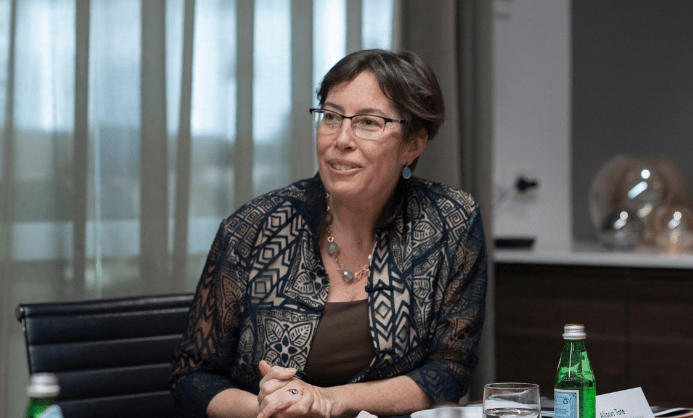
Top1000funds.com held a roundtable with a number of the Liechenstein Initiative commissioners, as well as asset owners and banks, to discuss the role they play in moving this agenda.

Fiona Reynolds, chief executive of Principles for Responsible Investment and the chair of the Commission said there has not been enough focus on the finance sector, and leveraging the innovation in the sector for change.

“It is critical to leverage financial innovation in the fight to make vulnerable workers less vulnerable.”

Financial inclusion

Cockayne picked up this point adding that there are many people in the region who don’t have reliable access to financial services and this is a major driver of modern slavery.

“If you are poor or financially insecure in some other way, and you suffer a financial shock … maybe you had an illness. You don’t have access to reliable health insurance. Or, you experience a natural disaster that wipes out your small family farm crop,” he told the group.

“This can actually drive you into unsafe labour practices or unsafe borrowing practices. And that is a major driver of modern slavery – not only in Asia-Pacific but actually, it turns out, even in developed countries.

“So, there’s a reason to look at the access to financial services as a way of thinking about preventing modern slavery.”

On his figures, about 1.7 billion people globally don’t have access to reliable and safe financial services.

“Marrying digital innovation to this question of how do we broaden financial inclusion could be hugely beneficial for those people who might anyway be vulnerable to modern slavery and human trafficking.”

Participants heard that digital banking makes it easier to offer services to those who previously missed out because the risk to return ratio wasn’t acceptable.

Supply chain risks

There was heated discussion about the reluctance of some businesses to discuss human rights and supply chain risks even after the collapse of the Rana Plaza factory in Bangladesh five years ago, where more than 1,000 workers died.

“Bringing awareness to companies that it’s not okay. We’re in an era that Rana Plaza is not okay to happen (not that it ever was), or Thai tuna sold in Australia isn’t okay anymore,” said Alison Tate, the head of economic and social policy at the Brussels-based International Trade Union Confederation, who is also a Commissioner.

On that topic LUCRF Super CIO Leigh Gavin said the issue is “always there”.

“We don’t accept bad practices in Bangladesh apparel manufacturing but we do accept it in Australian fresh food industry. We accept it in all parts of different supply chains because we haven’t had a thousand people die in a factory here.

“We just all need to think about what the inconsistencies are through supply chains we look at all through the world. Because there are massive inconsistencies in what we accept.”

Meanwhile, regulations on modern slavery are tightening around the world. For example, UK now requires public reporting on corporate efforts to remove slavery or human trafficking from supply chains.

A new law

Australia’s Modern Slavery Act came into effect on January 1 this year. The first reporting cycle starts in July. The law requires large businesses to report annually on actions to address modern slavery risks in their operations.

The idea is that mandatory reporting will expose poorly-performing companies, prompting a consumer backlash. However, the Act does not slap fines on companies for failing to lodge a report.

Still, all participants at the roundtable welcomed the introduction of the Act which explicitly demands actions in line with UN guiding principles on human rights.

“That means unlike the UK, it will not be acceptable to say, “We know there’s risk, and we’re doing nothing.” Since the guidance is absolutely explicit about this,” said Cockayne.

Speaking of the Australian legislation, Mans Carlsson-Sweeny, head of ESG at Ausbil Investment Management, underlined the emphasis on legal compliance. To this end, he flagged the importance of not harassing companies that behave badly by naming and shaming them.

“There are still a lot of activists in Australia who are quite happy to write shareholder resolutions against companies.” he said. “If companies are pushed too hard, there is the risk that they will just engage in box ticking as opposed to driving real change.”

  Leverage over suppliers

Geoff Shaw, the former Australian Ambassador for People Smuggling and Human Trafficking, said the starting point for companies is to consolidate their supply chain and source from fewer suppliers.

Aside from giving businesses more leverage over suppliers, by operating a less complex chain, companies can wring efficiencies from operations and free-up capital.

“By incentivising the tier one suppliers to monitor conditions further down – that’s half the battle won.”

Still, there are big challenges ahead for asset owners such as a heavy reliance on fund managers- some of which are laggards which needed to be shifted up the curve.

“The number of companies I speak to that say, “no one’s ever asked me about this issue or environmental issue.So, there’s a huge role as  asset owners to play to be challenging our fund managers.” said Liza McDonald head of responsible investment at First State Super.

On the data front, participants are still seeing a reluctance from businesses to provide the information that institutional investors need to be able to make informed investment decisions on what the risks are.

Worse, sometimes the wrong data is being disclosed.

The PRI’s Reynolds asked how investors could use certification more effectively. “Investors don’t have time to crunch all the data for thousands of companies, so how can certification be improved to better provide confidence and credibility,” she queried.

Higher costs; lower returns

To asset managers short-term thinking is hurting sustainable business models.

Anne-Maree O’Connor, head of ESG at New Zealand Super, asked how to frame the argument so companies believe these investors will accept lower returns and higher workforce costs, “because we believe that would be better for our returns over the long-term.” she said.

The disproportionate amount of time being spent on executive remuneration as opposed to ensuring living wage and proper pensions down the employee pipelines was also touched on by the roundtable.

“I think if the investors could spend more time on human rights, workers’ rights, freedom of association than on what makes a good headline executive pay, we’d get more done,” O’Connor stated.

Responsible lending came in for discussion as debt bondage is one of the most common forms of modern slavery in the world today, claiming millions of victims.

Quite aside from investments in organisations that tolerate modern slavery – lending to potential offenders – there is a question mark over the banks and their responsibilities.

For Anita Ramasastry, Professor at the University of Washington Law School, the solution is clear.

She advised the group that there is new OECD guidance on corporate sector lending and how that fits with the UN guiding principles.

“So, I think there, again, for investors to be able to really ask the financial institutions, “What are you doing to look at who you are lending to and what kind of due diligence are you engaged in?”

Participants heard that the UN has set a target to try and cut that 40 million people to close to zero by 2030 which would mean removing 9,000 people per day from the size of the affected population.

Cockayne’s best guess is we are nowhere near that number.

“So there clearly has to be a very rapid movement. And there’s going to need to be some pretty creative thinking both from financial sector and indeed from governments.”

Attendees, Top1000funds.com Roundtable on Modern Slavery and Human Trafficking

  • Nicole Bradford portfolio head of responsible investment, Cbus Super
  • Mans Carlsson-Sweeny, head of ESG, Ausbil Investment Management
  • James Cockayne, director of the Centre for Policy Research at United Nations University; Head of the secretariat, Liechtenstein Initiative for a Financial Sector Commission on Modern Slavery and Human Trafficking
  • Mary Delahunty, head of impact, HESTA
  • Mark Eckstein, director, environmental and social responsibility,CDC Group; Commissioner, Liechtenstein Initiative for a Financial Sector Commission on Modern Slavery and Human Trafficking
  • Leigh Gavin, chief investment officer, LUCRF Super
  • Liza McDonald head of responsible investment at First State Super
  • Anne-Maree O’Connor, head of responsible investment New Zealand Superannuation Fund; Commissioner, Liechtenstein Initiative for a Financial Sector Commission on Modern Slavery and Human Trafficking
  • Anita Ramasastry law professor, University of Washington School of Law
  • Fiona Reynolds, chief executive of Principles for Responsible Investment; Chair of the Liechtenstein Initiative for a Financial Sector Commission on Modern Slavery and Human Trafficking
  • Geoff Shaw, former Australian Ambassador for People Smuggling and Human Trafficking
  • Anders Stromblad, head of alternative investments and external management, AP2; Commissioner,Liechtenstein Initiative for a Financial Sector Commission on Modern Slavery and Human Trafficking
  • Alison Tate, head of economic and social policy, International Trade Union Confederation; Commissioner,Liechtenstein Initiative for a Financial Sector Commission on Modern Slavery and Human Trafficking

Spain’s largest corporate pension fund, the €5.8 billion ($6.5 billion) pension fund for CaixaBank employees, has pared back its listed equity allocation in favour of increasing its fixed income allocation from 46 per cent to 51 per cent. The bulk of that will go to long-duration, safe-haven US treasuries and linkers in response to tougher market conditions.

In other risk-off moves Pensions Caixa 30 runs an options strategy to hedge tail risks associated with its equity exposure and has recently built out its allocation to diversifying real assets, explains president of the fund Jordi Jofra speaking from the Barcelona offices.

“In our annual strategy review we revisited our US Govies portfolio and increased duration in order to protect our portfolio. We believe that this asset class could act as a safe-haven in a potential downturn.”

Caixa’s equities allocation generated a loss of 8.6 per cent in 2018 compared with a 10.5 per cent gain in 2017, of that, Eurozone equities lost 14.8 per cent while its frontier markets allocation fell 15.1 per cent. The Caixa fund comprises €4.2 billion in defined contribution assets and €1.6 billion in a closed defined benefit allocation, and it targets a return of Euribor + 2.75 per cent and an annual volatility target of 10 per cent.

Caixa has hedged tail risk in its equity bucket for the last two years with strategies focused on either buying put spreads or outright put options and funding the purchase by selling the upside.

The fund also runs an overlay on its currency exposure, hedging all currencies which account for more than 3 per cent of AUM. This is implemented using a combination of forwards, and more innovatively via options on some currencies, since 2016. Around a third of the portfolio is in euros; dollar exposure accounts for around 58 per cent of the portfolio with sterling and yen the other hedged currencies.

“The board has decided to hedge currency exposure employing options instead of forwards due to the cost of forwards for hedging USD and GBP,” says Jofra.

Hedge funds

Other recent strategies at the fund have included axing the 4 per cent hedge fund allocation due to a combination of high costs, poor performance, correlation with equities and the fund’s overarching policy to increase diversification.

“The hedge fund allocation cost more than any other,” says Jofra. Instead, he is now planning to increase the allocation to real estate, building out the portfolio from fund of funds to direct investment to capture the illiquidity premium. Another asset class to benefit from hedge funds demise is reinsurance.

“Reinsurance is another illiquid asset that has a return profile that acts in some of the same ways as hedge funds. It is just cheaper.”

In other strategies, the pension fund will reduce its emerging markets allocation to improve its ESG ratings and will also build out its private equity allocation by 1 per cent later this year, he says.

“We want to try to improve our ESG rating and have noticed that emerging markets are one of the worst performers in ESG. This strategy will also help cut our volatility,” he says. An example of the struggle to build its ESG rating in emerging markets was a four-month engagement with an Indian mining company it held in the portfolio that ended in divestment.

The current asset mix comprises equity (30 per cent, reduced from 33 per cent in 2017) fixed income (51 per cent) and alternatives (19 per cent) comprising commodities, REITS, private equity and other real assets.

Governance

All investment is managed by Caixa’s fiduciary manager VidaCaixa, Spain’s largest asset manager, also owned by Caixa Bank. It’s backed up by a fine-tuned governance structure that Jofra, at CaixaBank for 13 years where he has presided over the pension fund since 2016, says has become a flagship for other Spanish funds despite the Caixa fund only dating from 2000.

Caixa’s 15-member supervisory board administers the fund, decides the investment policy and approves performance and return expectations in a wide-ranging and active remit that embraces sustainable investment and risk-adjusted performance.

“We have become a pioneer in setting local standards for investment governance,” he says.

Examples include a 2016 initiative when trustees drew up seven investment beliefs to improve decision-making and achieve better outcomes; in 2018 it also approved eight SRI-related investment beliefs.

Trustees have just carried out a deep-dive into the asset allocation centred around analysis of the current and forecast membership and the distribution of accumulated assets across the membership and the risks implied by the various drawdown methods that the scheme offers its members.

“As a corporate DC pension fund with only one strategic asset allocation it is important to understand the way in which members access their accumulated balance of the fund at retirement age, the distribution of accumulated assets across the membership as well as their potential restrictions in terms of liquidity requirements from a strategic perspective,” he says.

In 2017 the pension fund further developed its governance policy through a review of its internal structures, re-defining and clarifying the functions, roles and accountabilities of its governing structure.

The result was a strategic plan for 2018-2020 that now guides Caixa’s long-term investment strategy.

“Our strategic plan is a clear statement of the main structural design, principles and decision-making processes that the board of trustees, and each committee, should follow to achieve the main objectives and ensure that the board and management are working towards common goals,” he concludes.