Governance is a modern invention that, at its best, delivers a product that is far more than the sum of its parts. It involves empowered people coming together to make well-judged and high-powered interventions on big issues. Good governance always sets organisations apart, and in crisis conditions it can do so more if it flexes to respond to our crisis circumstances in new ways – think of governance moving on a same where possible, different where necessary plane (and let’s be clear some change is necessary).

The governance in our investment industry setting is focused on investment committees (ICs), both in asset owners and asset manager settings, where best practice has evolved considerably.

IC governance has improved markedly during my career, but in the current circumstances it needs a big step up. To help, here are five suggested ways to consider:

  • Balance the urgent with the important. We must work on the critical short-term agenda but do so showing respect for the critical issues in the medium and long term. We cannot afford to lose sight of the longer-term mission. The fundamental temptation here is to over-do the anxiety, but the step up to better governance here is to apply ourselves to meeting the long-term mission through a balance in our time horizons.My best example here is about holding your nerve on strategy. As long-term investors, being patient is crucial, safe in the knowledge that you can stay the course through whatever turmoil markets throw at you. Current market volatility is scary, and there is a chance it will get worse, but history should confirm our beliefs that we will be okay in the longer term.
  • Try to see around corners. Investment committees can weaponize their skill through anticipating future trends and patterns. In present uncertain times we must work harder on the unexpected as many more issues ‘lurk’ out there. When we think we see the light at the end of the tunnel, we should not relax, and the focus should still be on ‘seeing around corners’ – good governance’s most prized asset.Investment beliefs remain the mainstay of good IC practice and some may need updating now. There are the long-term core beliefs that only need light refreshing, but there are ‘the world has changed’ beliefs which need serious work.
  • Reprioritise.  Staying true to core principles and beliefs is important but good governance should be adaptable around its edges. This suggests doing a few things more deeply and letting lesser stuff drop away. We must respect the idea that a governance budget is finite.Doing a few critical things well is the key principle here. This environment means we are experiencing a series of squeezes everywhere, for example liquidity, capacity, communication, resilience and wellbeing. Accepting that there are constraints to what is possible is critical to ensure the actions ICs take actually add value. This means reprioritising strategic agendas and focusing on activities that have highest impact relative to the effort involved.
  • Communicating deeper, wider, better. IC communications must pick up pace at times of crisis. Many aspects of good communication are timeless. Central concepts here are managing expectations through communications frequency and cadence. But at times of uncertainty, the key is to communicate even more, even when it seems like there is fundamentally less to say given the uncertainty.

One practical example: IC meetings need an innovative re-tread to ensure the best-practice elements translate into a virtual setting. To this end we have set out below a new physically-distant but socially-connected model for governing through virtual meetings without compromising on the best elements of inclusive decision making. This builds on previous thinking on more effective meetings.  We believe this model is useful near-term but has longer-term appeal to complement physical meetings once they resume.

  • Live your values. Values set the tone for behaviours, the behaviours drive the actions, the actions drive the outcomes, simple.At a time that is presenting massive dilemmas everywhere, people and purpose come ahead of profits and performance. This is a key element in governance thinking. In current times with life and death playing out, people must come first. And profits will surely follow in the long run if we can cluster around a stronger purpose crucible.

    Governance is a construct that is brought to life by good people, leadership and culture working well together. Better governance can emerge from our current adversity through a mix of effective design, focus and leadership. The opportunity for that leadership beckons.

The Virtual IC Meeting Model

A strawman proposal of a physically-distant but socially-connected governance model

1 Build out the prequel segment to the meeting Work in this prequel segment includes pre-reading and indicative polling (see below) and puts IC members further forward before the meeting starts.
2 Work to a well-structured set of papers Meeting papers are a more critical contributor to effective virtual meetings needing better executive summaries, narratives and background references. Web-based platforms for papers, files, communications and collaborations of the IC and the team also play their part.
3 Develop the ‘Run-Sheet’ to add to the meeting agenda ‘Run-Sheets’ are precise specifications of meetings that add key parameters over and above an effective agenda; the specifications need to cover the hard and soft ‘ask’ of IC members, and of outside parties.
4 Use high-quality video technology Meetings will need to be appropriately convened in a high-quality video format: Skype, Web-Ex, Zoom, Teams, etc
5 Work at chair-effectiveness through planning and preparation The chair is critical – they are first of all facilitators, and secondly strategists, coaches, arbiters and content providers. Facilitating a virtual (call) meeting is a big challenge, but good planning and preparation takes you far.
6 Apply cognitive diversity and turn-taking Cognitive diversity requires surfacing all views and this is helped by going around the virtual room person-by-person on certain issues.
7 Use informal polling Virtual polling (using technology) can be used to provide insights on key issues indicative to values and preferences, without becoming binding votes. Polling also adds diversity.
8 Gather feedback on meeting effectiveness Meetings should be assessed for on-time, on-inclusiveness, on-point delivery. Good feedback gathered consistently is critical to be able to improve practices.
9 Build out the sequel segment to the meeting Meetings need to be completed with accurate minutes, notes, clear follow-ons, including polling results to support thinking and action.
10 Stage the virtual meetings to complement physical ones When constraints requiring virtual meetings are removed, ICs should explore a new cycle of physical and virtual meetings as a more efficient and sustainable solution to IC governance.


Roger Urwin is co-founder of the Thinking Ahead Institute and global head of Investment Content at Willis Towers Watson.

Cash is king right now, according to the chief investment officer of the Pennsylvania School Employees’ Retirement System, Jim Grossman, and he’s got plenty of it.
The fund has a very diversified asset allocation, with about half the portfolio invested in liquid assets and Grossman and his team are working hard to make sure that the strategic allocations are maintained.
“All rebalancing decisions are made with the primary goal of ensuring our system maintains enough cash and liquidity to get through this storm,” he says. “ We are succeeding.”
Earlier this month it sold $1 billion of US long Treasuries after other investors looked for safety in bonds.  That rush to safety caused yields to fall fast and prices to rise, which in turn pushed PSERS’ allocation above the target allocation for that asset class.  “We sold Treasuries to raise liquidity and get back to our 6 per cent strategic target allocation,” he says.
An Aon liquidity analysis of the fund shows about half of the portfolio is in liquid assets (less than three months) with 14 per cent in quasi-liquid, 17.5 per cent in illiquid (5-10 years) and 19 per cent in 10+ years. Stress testing of the portfolio showed that in a “recession scenario” the allocation could drift enough from the targets that the fund would want to rebalance. So Grossman and his team are prepared.

“Cash is king right now,”he says. “All investors should be managing liquidity and cash levels. We’re always concerned about liquidity issues; however, our liquidity remains solid and liquidity was addressed during our strategic asset allocation process through the allocation of 6 per cent to cash.
“Following the Great Recession, PSERS restructured its portfolio to have more balanced investments across multiple asset classes and geographies while maintaining specific levels of cash and liquidity. This diversified portfolio is holding up. We continue to manage liquidity very closely and are actively managing the asset allocation that was set by the board within the board’s pre-established target ranges.”

At the end of last year the fund’s asset allocation included listed equities (16.7 per cent), private market equities (14 per cent), investment grade credit (9.5 per cent), credit elated (9.4 per cent), inflation protection (14.14 per cent), MLP (3 per cent), infrastructure (2.7 per cent), commodities (7.7 per cent), real estate (10.2 per cent), risk parity (8 per cent), absolute return (10.3 per cent) and cash and cash equivalents (6.2 per cent).
It was the listed equity volatility that pushed the asset allocation out of range, and prompted the rebalancing. Grossman says he is is preparing for a decline in private market valuations, but he doesn’t think the selloff will be as bad as public markets.

“Private markets are on a quarter lag,” he said. “Their March 31 valuations, which will be coming in during the course of the second quarter, should catch the tail end of the speedy market downturn the world saw the last few weeks. I can’t speak to specific portfolios or underlying companies in them. However, when the Russell 2000 index loses 30 per cent in the first quarter, it’s safe to say private markets portfolios will see negative valuation changes too. Those valuation changes should vary sector to sector.
However, if portfolio valuations do fall, we don’t expect those declines to be as steep as their counterparts in the public sector, where investment time horizons are shorter and trades are made in part on human emotions, including panic.”

Inhouse investment team
In early March the fund had around $60 billion in assets, and just under half is managed inhouse, across 10 asset classes, and the team has been working from home for a month or so. As part of the fund’s initial preparations, the IT department prepared an extra 100 laptops and iPads for employees and more devices have since been issued since to enable more employees to work remotely.
“I am happy to say my team is handling this crisis as I’d expect, like professionals,” he says. “They are on top of their daily workload and the ever-changing market conditions. In fact, the entire agency is managing quite well thanks to early planning across all PSERS departments. PSERS began preparing for long-term remote workplaces in late February.

Despite the new working from home arrangements, with Pennslyvanians under a stay at home order through to April 30, there has been little disruption to the way decisions have been made, according to the CIO.

“I’ve always tried to run PSERS investment office as a collegial meritocracy where the staff is encouraged to voice opinions and ideas to their immediate supervisors or to me,” he says. “That workplace atmosphere is continuing even if we are doing it over conference calls and electronic communication formats. Our decision-making process hasn’t changed, it still goes through our internal asset allocation committee or allocation implementation committee.”

The group is also meeting more frequently than usual, partly as a way to connect, but importantly because the markets are so volatile.
“We are having senior leadership group meetings and committee meetings more frequently given the volatility of the markets,” he says. “We are all learning how to cope and adapt. However, I do like to remind myself and my team that it’s not 2019 anymore and we can only do the best we can while working remotely for at least the next few weeks of 2020.”

PSERS also works with nearly 200 external managers and the communication with them continues as the team works from home.
“Working remotely does not negate our fiduciary duties. My team is keeping up with the markets, and they remain in constant contact email, phone or other electronic communication with our investment managers. In addition, the management of the fund continues, and we are doing due diligence conference calls with prospective managers as well as working with our investment consultants who continue to perform their own due diligence on managers.”

The fund decreased the total cost of its investment fees last year from $468 million in 2018 to $450 million, and that has been steadily declining since 2014 when it was $463 million.

This is due in part to an increased savings from internal management as they brought more fixed income inhouse as part of a fee reduction plan which they presented to the board in August 2018.
The vast majority of last year’s fee, or $425 million, was spent on external management, where absolute return managers accounted for $104 million.

The internal management costs of $24 million include fees paid for consulting, custody, specialised service providers such as BlackRock Solutions and Bloomberg, as well as staff compensation.
The fund’s plan includes reducing base fees by $38.7 million per year by the end of 2021, to a total of $334 million. This will be achieved by more internal management, but also in part by increasing co-investment in private equity and infrastructure, reducing the allocation to private real estate, and moving to different fee structures including base fee plus profit share in absolute return and MLPs.

I speak to Matt about his wonderful collection of old (retro?) computers but also all about the challenges of defining an ethical framework for algorithms, and what we can do to understand this tricky area. 

Defensive equity investment strategies are nothing new, but a key issue with many is that defensive does not necessarily mean low volatility. Scientific Beta looks at a strategy to target both goals, using robust low volatility controls to create a new defensive index for the volatility-averse investor.

Traditional defensive strategies have been popular for many decades. In addition to providing relative protection in bear markets, they benefit from the positive long-term premia associated with the low volatility factor.

Unfortunately, we can observe that the popular low volatility strategies’ strong tilt towards value is often associated with negative exposures to the other rewarded factors, which deprives these strategies of the potential for long-term risk-adjusted performance.

To respond to this shortcoming, it is possible to apply a high factor intensity filter to a defensive strategy, which removes the highly negative exposures to other rewarded factors.

This type of approach harvests the low volatility factor while maintaining positive exposures to other rewarded risk factors.

Figure 1: Low Volatility Strategies’ Exposures to Rewarded Risk Factors

21-Jun-2002 to 31-Dec-2019 (RI/USD) SciBeta Developed HFI Low Volatility DMS (4-Strategy) SciBeta Developed Narrow HFI Low Volatility DMS (4-Strategy) MSCI World Minimum Volatility
Sharpe Ratio 0.85 0.86 0.70
Size (SMB) Factor 0.10 0.08 0.10
Value (HML) Factor 0.09 0.08 -0.12
Momentum (MOM) Factor 0.05 0.04 -0.04
Low Volatility Factor 0.32 0.43 0.42
Profitability Factor 0.09 0.01 -0.04
Investment Factor 0.03 -0.02 -0.04
Factor Intensity (Int) 0.68 0.62 0.27


However, traditional defensive strategies are not always low volatility and unfortunately, in absolute terms, can exhibit strong peaks in volatility, notably in periods of crisis, like highly volatile market conditions, when the investor would like to be genuinely protected.

One solution is to combine a traditional defensive strategy with a tool that minimises volatility to create an index that offers both benefits. For example, a maximum volatility protection risk control strategy, or MVP, is fairly easy to implement, smooths volatility through time and reduces its peaks.

To smooth volatility, it is of course necessary to forecast it. That is why a volatility forecasting model, which takes into account properties such as volatility clustering, leverage effect or fat-tailness, is necessary. Using this good volatility forecast, it is then easy, in an expected period of strong volatility, to reduce market exposures, which are the main source of the portfolio’s volatility, using a futures overlay. MVP delivers low volatility in all market conditions, especially when investors need it most. Reduced market exposure in periods of high volatility shrinks downside risks and allows Sharpe ratios to be improved, improving risk-adjusted performance over the long-term. Given its innovative nature, we provide details below on the benefits of the MVP strategy and how it works.

Maximum Volatility Protection: a new way of smoothing out returns

The MVP’s objective is to cap volatility at the historical volatility of the underlying defensive index with which you combine it. This can achieved by a monthly allocation to a CW overlay, determined by two elements:

  1. The volatility target, which is set as the historical volatility of the selected defensive index;
  2. The volatility forecast over the next month. The forecast is based on a robust model that captures the main stylised facts of financial returns. Since the objective of the MVP risk control option is to cap the volatility of the new defensive solution at the volatility target, the allocation (WOverlay) to the CW Overlay is set as follows:

where σtarget is the volatility target, σforecast is the volatility forecast over the next month and is the market beta of the defensive index.

The allocation to the CW overlay can only be negative, ie when the volatility forecast is below the target we have a zero allocation to the CW overlay and the new defensive solution is fully exposed to the underlying index.

When the volatility forecast is above the target, then we take a short position in the CW overlay (as defined above), which allows market exposure to be reduced. The CW overlay can be replicated using futures, which makes it very simple to implement. Indeed, futures are very liquid instruments with no counterparty risks and they are cheap to trade. Moreover, the allocation to the index is always 100 per cent, so almost no additional turnover is linked to this implementation.

However, certain institutional investors face governance or regulatory constraints that hinder them from using a CW overlay.

For them, we suggest a physical implementation that requires a dynamic allocation between the underlying index and cash. Like the CW overlay implementation, we impose a no-borrowing constraint on cash that implies the allocation to the index is limited to maximum of 100 per cent.

Of course, this implementation can generate significant additional turnover because of round trip allocations that might be non-optimal.

Therefore, to improve the replicability of the physical implementation, we can apply turnover control to limit the turnover while conserving the effectiveness of the MVP approach. The main challenge in implementing the MVP is to accurately forecast the volatility. Our forecasting model is an asymmetric GARCH4 model to forecast volatility with student-t innovations. This model captures financial returns stylised facts such as volatility clustering, leverage effect and fat tails. We tackle structural breaks by using two forecasts based on an expanding window and a five-year rolling window.

The key benefits of using Maximum Volatility Protection risk control

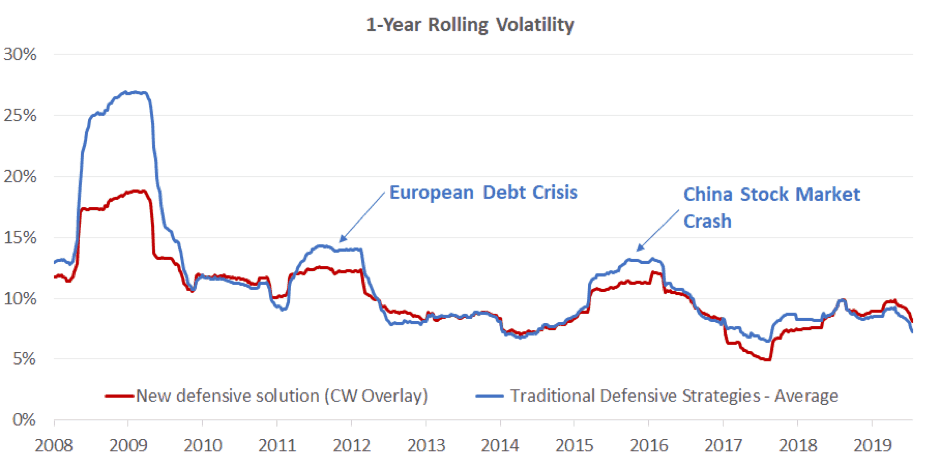
Figure 2 compares the MVP’s one-year rolling volatility compared to that of traditional defensive indices, it’s clear that it provides much more stable volatility and significant reduction of volatility peaks during market distressed regimes, such as the financial crisis of 2008 or the European crisis of 2011.

Figure 2: Maximum Volatility Protection to Avoid Volatility Peaks

We use three different traditional defensive strategies to get an average 1-Year rolling volatility: MSCI World Minimum Volatility,
FTSE Developed Minimum Variance and Robeco QI Institutional Global Developed Conservative Equities. Sources: Scientific Beta, DataStream and Bloomberg

It achieves this volatility smoothing thanks to a dynamic allocation to either the CW overlay or the underlying defensive index. For example, during the 2008 financial crisis and 2011 European debt crisis, the allocation to the index was massively reduced. During the 2008 financial crisis, the reduction was more than 70 per cent for the physical implementation and 54 per cent for the CW overlay implementation.

There are also two very recent events that generated strong reduction of exposure to the underlying defensive index.

  • First, on February 5, 2018, the Dow Jones had its worst point decline in history when the index closed with a negative performance of -4.6 per cent. This event generated a strong exposure reduction to the underlying index at the February rebalancing.
  • Second, the final quarter of 2018 was marked by a poor equity market performance following fears of an imminent economic downturn after the most important bull market in recent history. Our volatility forecast model reacted very quickly and exposure to the underlying index was reduced significantly in October and December.

Finally, we underline the differences in the variations of allocations through months between both implementations. The CW overlay implementation has no turnover control and reacts therefore more quickly to change in volatility forecasts from month to month than the physical implementation.

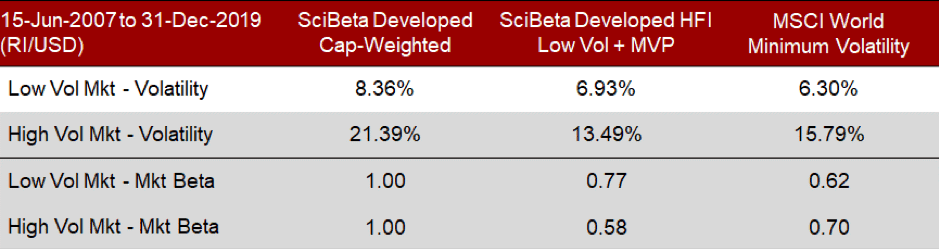
The MVP risk control strategy has a very interesting impact on the conditional market beta and volatility measures. Both are strongly reduced in high volatility market regimes and almost identical to the underlying index in low volatility regimes. This dissymmetry is at the heart of the success of the MVP risk control strategy.

Figure 3: Reduction of Market Beta and Volatility in Distressed Times

A modern solution to volatility protection

The defensive strategy that we have summarised is unique in the indexing industry. It is nonetheless easy to implement if one has a good capacity to forecast volatility. This new solution allows volatility to be smoothed through time and consequently improves average and extreme risks as well as the Sharpe ratio. Investors worried about a possible market downturn after the longest bull market observed over the recent history should consider this new defensive strategy.

Daniel Aguet is head of indices at Scientific Beta, Noël Amenc is chief executive at Scientific Beta and Associate Dean for business development at EDHEC Business School, and Felix Goltz is research director at Scientific Beta.

Ensuring a portfolio has enough liquidity to rebalance back to the long-term strategic asset allocation is the most critical preparation investors can do ahead of any crisis, according to Mark Wiseman, a former global head of active equities at Blackrock and chief executive of Canada Pension Plan Investment Board.

“What you need to do is ensure you always have sufficient liquidity to rebalance your portfolio,” he said in an interview.

“That is the critical preparation, so you cannot just rebalance but take advantage of the liquidation. Rebalancing is critically important and goes to the maintenance of your long-term risk appetite.”

“If you have 60 per cent allocated to equities, what has changed in your long-term risk appetite because of this pandemic? Nothing. So investors should be religiously rebalancing as equities markets fall. As they recover, you should be selling and buying fixed income to bring the asset allocation back. If you don’t have the liquidity to do that you’re in deep trouble.”

Wiseman, who is assisting the Canadian government with its response to the pandemic, said that investors should always be asking whether they have sufficient liquidity to rebalance in even the most extreme circumstances – “Whether it’s an oil shock, a war, a pandemic or an asteroid invasion,” he said.

During his five-year tenure as chief executive of CPPIB, the portfolio would be automatically rebalanced if the allocations moved more than 0.5 or 1 per cent outside the target weights.

“It’s important to have automatic rebalancing of your portfolio to your long-term risk as soon as you slide outside of those weightings,” he said. “Long-term risk for most investors doesn’t change. Markets were down 4 or 5 per cent today. Do your long-term risk rankings change because of that? No. Then you should be buying equities today.”

There are some noticeable examples of pension funds rebalancing recently. David Villa, CIO of the $117 billion State of Wisconsin Investment Board said he was a “fearless rebalancer” at the moment. And the $58 billion Pennsylvania Public Schools Employees’ Retirement System (PSERS) recently sold $1 billion of US Long Treasuries in order to rebalance.

Chief investment officer of PSERS, Jim Grossman, said the investment team would rebalance asset classes back towards the board’s strategic asset allocation targets as deemed appropriate and the changes are done at the staff level per existing policies.

“All rebalancing decisions are made with the primary goal of ensuring our system maintains enough cash and liquidity to get through this storm. We are succeeding,” Grossman said.  “We sold $1 billion of US Long Treasuries after other investors looked for safety in bonds. That run into the safety of Treasury bonds caused yields to fall fast and prices to rise, which in turn pushed PSERS’ allocation of US Treasuries above our target allocation for that asset class. We sold Treasuries to raise liquidity and get back to our 6 per cent strategic target allocation.”

Scenario planning
According to Wiseman, who was also formerly chair of Blackrock Alternative Investors, there is no risk system used in investments that would have predicted this event.

“You can’t use BARRA or some other risk system and expect this scenario to come out of it. No one thought in our lifetime we would see this,” he said.

However, he said all long-term investors should be testing their portfolios using scenario planning for these types of events.

Wiseman, who also sits on the board of Sinai Health in Toronto, did a full study and scenario planning for the impact of a pandemic on the portfolio at CPPIB.

“For long-term investors in particular these are the types of scenarios you should be running and looking at how it affects markets and businesses,” he said. “While you can’t predict them, you should know they can come around. You should be thinking these types of scenarios are possible. Does that mean you change your risk appetite? the answer is no in my view. But you need to always know that they will occur you just don’t know what flavour.”

Keeping a long-term perspective is important, he added, pointing out that at CPPIB the mantra was that a quarter was defined as 25 years.

“If you have that perspective you’ll be around long enough to see the mean reversion that inevitably takes place after these events,” he said.

A recent Wall Street Journal article, co-authored by Wiseman and Sarah Williamson, chief executive of Focusing Capital on the Long Term, an organisation he co-founded and used to chair, looked at the market recovery around the global financial crisis, September 11, the 1918 health pandemic and the oil shock.

“If you look at a chart of the Dow Jones over 100 years you don’t see any volatility,” he said.

Wiseman added that there is little use in tail hedging strategies for long term investors.

“There’s no point putting in a tail hedge. It’s just like hedging currency if you have a long-term view. It just creates a cost with no expected benefit other than smoothing. And what would you hedge against? You don’t know what will show up.”

Tactical positions can work, he said, but need to be considered in the same context as any active decision.

“You can allocate a certain amount of your risk to TAA, but that’s the same as making decisions around securities, if you have skill in that then allocate some of your risk to that,” he said. “I see CIOs making tactical decisions like overweighting equities by 5 per cent, those decisions are so large in terms of the portfolio they swamp all other decisions. They should be considered as an allocation to an active strategy the same as an allocation to real estate or infrastructure or public equities. I’ve never been a big believer in it. I’ve never been good at it. But I think there are people who are good at it.”

Opportunity of a generation

While it is still early days in terms of how the impact of the coronavirus will play out, Wiseman’s view is there will be a tremendous amount of distress.

“This could be an opportunity of a generation,” he said, pointing out that this time the crisis is not a problem with the financial system. “History says when these things pass people will go to restaurants, cinemas, theatre, watch sport. Six months after 9/11, an event where it was unsure if people would fly again, passenger travel was back to where it was before the event.”

In this case, he says the opportunity will be in the real economy assets that will revert.

“A friend in the music business is signing every band he can find, people will go back to concerts,” he said. “In the short term I’m pretty gloomy, it’s pretty depressing. A lot of people are going to die, there will be massive deficits and we won’t be going out for a long time. But ask me what my time frame is for investing?”

“That is the time when everyone else capitulates and thinks the world will never come back, that’s the time you want to be the buyer, because it will. Stick to your long-term course, and be the buyer when no one else is. If you retain your risk appetite you understand you can still take risk.”

Wiseman, who left Blackrock in December, said he had “a few irons in the fire” and was likely to return to asset management sooner rather than later.

Even if the United States turns a blind eye to deglobalization’s effects on the rest of the world, it should remember that the current abundant demand for dollar assets depends heavily on the vast trade and financial system that some American politicians aim to shrink. If deglobalization goes too far, no country will be spared.

CAMBRIDGE – The post-pandemic world economy seems likely to be a far less globalized economy, with political leaders and publics rejecting openness in a manner unlike anything seen since the tariff wars and competitive devaluations of the 1930s. And the byproduct will be not just slower growth, but a significant fall in national incomes for all but perhaps the largest and most diversified economies.

Read Deglobalisation will hurt glowth, published in Project Syndicate on June 3, 2020.