Investors are putting pressure on companies to accelerate the shift to purpose-driven leadership and focus on human capital policies during the crisis. But while there are some examples of corporations making policy changes that positively impact their workers, supply chain issues pose a significant problem.

Purpose-driven leadership and stakeholder capitalism are in the spotlight during the coronavirus-induced health and economic crisis, with investors urging the business community to focus on human capital management during this humanitarian crisis.

More than 286 long-term institutional investors representing $8.2 trillion have signed the investor statement on coronavirus response calling on the business community to hone their human capital policies and focus on paid leave, prioritise health and safety, maintain employment, maintain supplier/customer relationships and financial prudence.

Dave Zellner, chief investment officer of Wespath and one of the signatories, says the short-term decisions made by corporations over the months to address this crisis will play a crucial role in defining the speed and nature of the economic recovery.

“We believe this presents a unique opportunity for businesses to demonstrate their commitment to workers, contractors, and the broader global community,” he says.

The statement is a call to action on business to look after their workers and Wespath says there is already evidence of good business practice.

“We publicly commended Google for supporting small businesses and non-profits through its contribution to a relief fund established by the City of Kirkland and the Kirkland Chamber of Commerce, which was the location of the initial outbreak of the virus in the US,” Zellner says.

Just Capital is tracking how corporate America is treating its stakeholders and has produced a COVID-19 corporate response tracker which looks at the largest 100 companies’ policies and practices in response to the pandemic. The tracker looks at policies such as adjusted hours of operations, paid sick leave, supply chain impacts and financial assistance.

For example in response to the crisis Walmart, which is the largest employer in the US with more than 1.5 million workers, has added 11 of the 18 policies measured by Just Capital.

The tracker also showcases corporate leadership and since measuring it on March 24 the number of executive pay cuts has more than quadrupled from 6 per cent to 27 per cent. Some include the Disney board which is taking a 100 per cent pay cut (Bob Iger, chair of Disney, had a total compensation of $47.5 million in the most recent financial year) and the company chief executive , Bob Chapek, who is taking a 50 per cent pay cut. At Boeing the CEO, Dave Calhoun and chair, Larry Kellner will both forgo all pay until the end of the year.

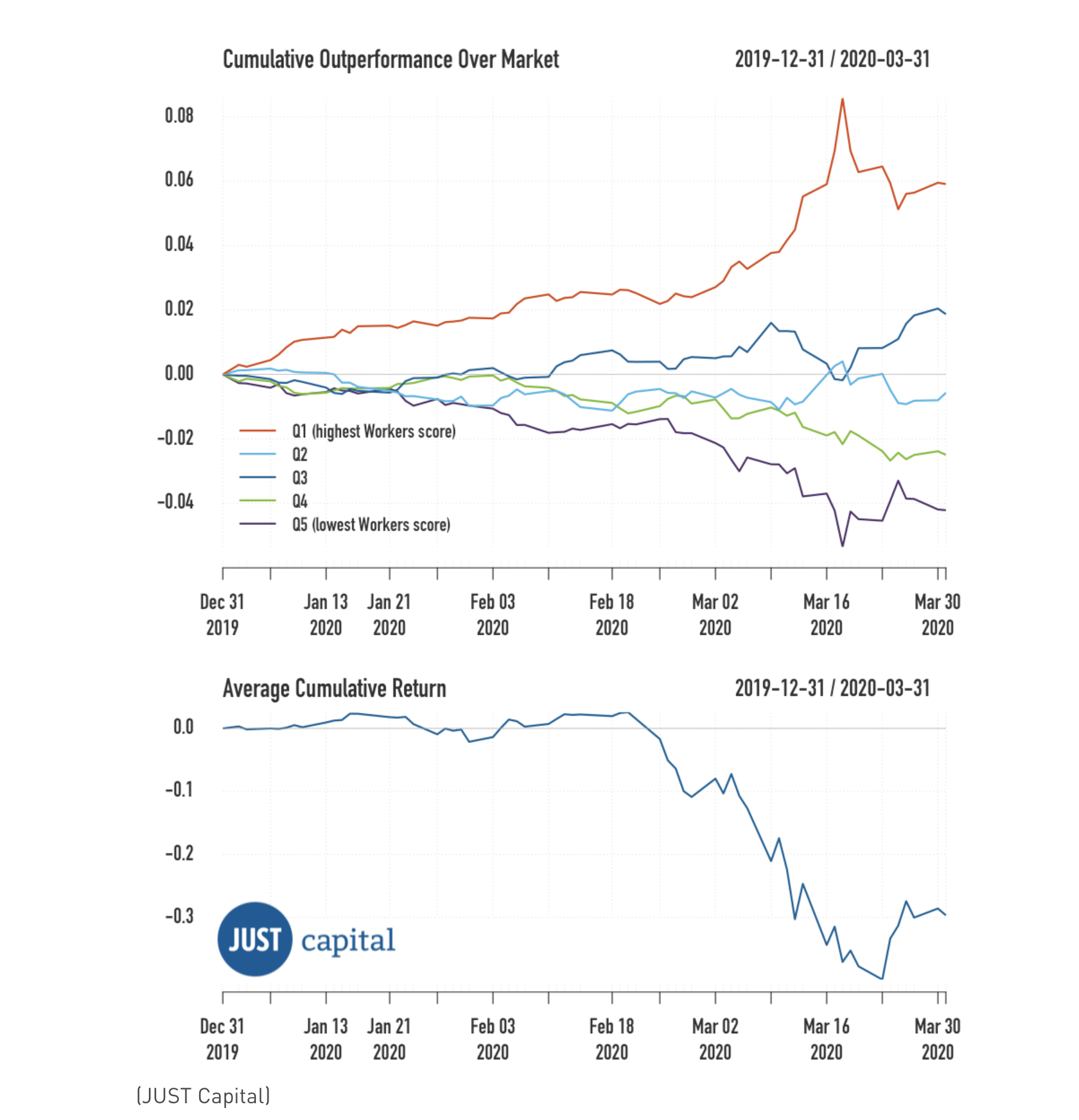
Importantly Just Capital reports that the companies that have been supporting their workers have been outperforming their peers during the crisis. Companies that are demonstrating leadership and caring for their employees’ health and safety will be better positioned for the long term, it says.
Truvalue Labs, which uses AI to analyse the impact of the coronavirus crisis on ESG issues for companies, has produced a “response signal” that it says could be a helpful tool in identifying new investment opportunities. The signal shows among other things the industries that have stepped up their operational response to the crisis, and Truvalue Labs says the companies leading the charge in these industries could have under-appreciated intangible value.


Not all good news

But while there are some examples of corporations making changes to policies to positively impact their workers, supply chain issues pose a significant problem.

The global garment value chain is one example of the potential deep and sustained impact the crisis could have on millions of workers. The combination of widespread retail closures, layoffs and furloughs, mandated factory shutdowns and slowing consumer demand has resulted in the cancellation of orders through the value chain and left some suppliers unable to pay workers. The impact of this is particularly pertinent in emerging countries. In response to this employers, unions and major brands together with the International Labour Organsiation have signed a call for action to support the garment industry.

The signatories have agreed to work with governments and financial institutions to mobilise sufficient funding to enable business continuity among manufacturers so wages can be paid.

General secretary of the International Trade Union Confederation, Sharan Burrow, says emergency funds are needed to protect workers.

“We cannot afford the human and economic devastation of the collapse of our global supply chains and millions more in developing economies thrown back into poverty,” she says. “Jobs, incomes and social protection are the dividends of business continuity and this statement calls for emergency funds and social protection for workers to guarantee industry survival in the poorest of our countries. Leadership and cooperation from all stakeholders are vital to realise a future based on resilience and decent work.”

Wespath’s Zellner says fair labour practices are an important element of achieving its sustainable economy framework which also includes supporting strong local communities.

“Corporations have an important role to play in supporting local communities,” he says. “It is in this spirit that Wespath has signed on to the Investor Statement for Coronavirus Response.”

In mid-March, Wespath responded to the outbreak by transitioning the vast majority of employees to a remote, work-from-home model.   Moreover, it regularly provides workers with updates from senior leadership about the benefits available to employees including paid time off flexibilities, employee assistance programs to support mental wellness  and information regarding federal COVID-19 legislation.

It also supports the local community by coordinating an employee-giving campaign for healthcare workers at local hospitals, first responders, and other frontline workers.

We urge companies, banks and investors to come together to help position the economy for a quicker recovery, that is sustainable over the long term,” Zellner says. “Wespath’s experience investing for over 100 years as a steward of investment assets has meant we have weathered many crises as an institution. This perspective has informed our focus as a fiduciary on long-term, sustainable growth and our belief in the sustainable global economy.”


The current coronavirus crisis has created investment governance challenges for Australia’s superannuation funds – with regard to liquidity requirements – that are relevant to any DC scheme which invests in illiquid assets. It highlights the potential impact of agency issues on decision-making during a crisis environment.

The Australian superannuation system is a fascinating case study monitored by pension experts around the world. The current coronavirus crisis has identified new challenges relevant to other countries with an interest in defined contribution (DC) pension models.

Australia’s circa A$3trillion superannuation system is predominantly DC with a reasonable level of mandatory employer contributions (9.5 per cent of income), high representation, and member choice (of fund and investment strategy).

Assets are managed institutionally (by around 200 registered superannuation entities) or can be self-managed (there are around 600,000 self-managed super funds accounting for more than 25 per cent of assets). Institutional funds vary along multiple dimensions including their financial model (profit-for member or commercially operated), membership focus (some funds focus on a specific cohort of the population such as an industry) and investment strategy, notably the degree of illiquid assets which typically ranges between 0 and 40 per cent.

Prudential regulation of superannuation largely resides with APRA (Australian Prudential Regulatory Authority) while ASIC (Australian Securities & Investments Commission) focuses on consumer protection and accordingly, the behaviour of super fund trustees.

It is important to note that much of APRA’s regulatory model for superannuation funds is principles-based rather than prescriptive. In areas such as liquidity risk management APRA is only prescriptive in saying that a super fund should have a policy which details how liquidity risk is modelled and managed. Much of the detail is left to trustee discretion, and APRA reviews each fund’s policies and assessment and provides feedback to those with weak policies.

The current crisis, a health pandemic which has triggered economic and financial market crises, provides a unique stress test of Australia’s superannuation industry.

The financial market crisis has generated stress events such as volatile and falling equity and credit markets, market liquidity challenges, and a fall in the Australian dollar. These challenges are normal and should be accommodated in stress testing and scenario analysis. The same applies to the behavioural reactions of consumers which has resulted in elevated levels of member switching out of higher risk investment options into cash. All of these issues to date largely sit within stress tests provided by the GFC (Global Financial Crisis).

Every crisis is different and can throw up new stress not considered previously. In this crisis unique issues have emanated from the nature of the health-related economic event, its impact on the economy, and the government policy response. From a plan perspective, isolation strategies resulted in a near-instant unprecedented spike in unemployment, along with a mirror image impact on super fund contributions.

This has impacted some industry sectors, like retail and hospitality, more than others. From a market’s perspective, unlisted assets, notably property and infrastructure (such as airports and toll roads), appear to have been more adversely impacted than in previous crises, with initial markdowns in the order of 7.5 to 10 per cent. And as part of an unparalleled fiscal response the government has allowed economically impacted people to withdraw up to $20,000 from their (preserved) superannuation accounts. Again, the likely impact will be greater on some population cohorts (young to middle-aged, specific industry sectors).

These new stress scenarios have provided a range of investment governance challenges for Australian super funds which are relevant to any DC scheme which invests in illiquid assets.

Much of the media focus in Australia has been on liquidity, strictly the ability to meet cash requirements as they fall due. I don’t expect any liquidity failings of this nature. Rather there are three second order, but equally important issues to focus on.

The first issue is, whether in meeting liquidity requirements, remaining portfolio quality becomes impaired. Impairment could mean many things, with some obvious examples being a portfolio which is well outside its SAA ranges, or a portfolio left with insufficient liquidity to meet a subsequent next possible round of liquidity events. Is there a point at which trustees of super funds need to freeze member redemptions because they would be creating an impaired portfolio for remaining members? The main challenge for some Australian funds will be whether they are now unacceptably overweight unlisted assets, despite recent markdowns.

The second issue relates to equitable unit pricing. Sharp market falls can create stale pricing challenges for funds with illiquid assets, which remain at a fixed valuation until the next periodic valuation. In a sharp falling market, super fund unit prices are likely overstated and vice versa. In the current crisis a number of funds took the step to conduct out-of-cycle revaluations of their illiquid assets to address this very issue. Prior to these revaluations it appears that balanced option unit prices were overstated by 2-3 per cent, with much greater misplacing for some single sector options such as property.

The final issue is the cost incurred to raise liquidity and maintain portfolio shape. The costs of providing liquidity to one member is borne by all members of a fund. The costs of raising liquidity, even in public markets, can increase significantly in a crisis environment. In Australia transaction spreads can be incorporated into unit prices, but these tend to be fixed not variable.

These issues are complex. There are no prescriptive standards. This places the onus back on super fund trustees to address these difficult questions. For instance: how do you define acceptable portfolio quality? What is a tolerable level of suspected stale pricing (‘suspected’ because one can only estimate the market movement in unlisted assets)? And when does the performance impact of providing liquidity become unreasonable? Having clear policies prior to a market crisis removes the potential impact of agency issues on decision-making during a crisis environment.

These issues also generate reflections on the regulatory model. For complex but important issues such as these, would a more prescriptive regulatory approach be merited? I think so, as it sets a baseline and removes interpretation. It would also provide the regulator with better aggregate information on these issues.

The current crisis has shone a light on some complex second-order issues for DC pension funds and the complicated investment governance challenges they face. Hopefully funds and regulators around the world take the opportunity to consider the issues and reflect on the opportunity to make their retirement systems more robust.

David Bell is executive director of the Conexus Institute

For more stories on Australian superannuation funds visit www.investmentmagazine.com.au


ESG data provider, Fair Supply Analytics, has produced technology that maps the impact of COVID-19 on global supply chains, and can be used by investors to measure their investment portfolios exposure to the sectors and countries most effected.

Fair Supply Analytics, which can model issues related to the Sustainable Development Goals and has 30 clients using its modern slavery reporting, has remodelled its multi-regional input output table to measure supply chain disruption due to COVID-19.

Using an industrial mathematical approach, disruptions to the economy and related supply chains to a level of 10 tiers, can be measured at a global scale.

The supply chain data has been collected over the past 10 years – originally for an academic research project looking at environmental assessments – and measures about 99 per cent of global GDP.

About five billion supply chains can be modelled across 189 countries, according to chief technology officer, Arne Gerschke, with 16,000 economic sectors measured over a time series for each year tracking back to 1990.

The model reveals vulnerabilities in global supply chains and can help investors measure those exposures to potential disruptions, says executive director of the tech startup, Kim Randle.

“Using the technology, investors can analyse if they rely on certain economies to function,” she says.

There are a number of examples where there are very limited sources of raw materials, for example coltan used in the electrical components of mobile phones is only found in central Africa.

“Toothpaste has a very strange supply chain. It is manufactured in China but contains whitening pigment from South Africa. A very specific raw material, ilmenite, is used in the pigment and that is only available in Madagascar. If that country gets impacted by COVID-19 that will dry up,” Gershke says.

“Products gain value as they travel through the supply chain and each node or stop in the global supply chain is provided by people. For example turning steel into a car, it’s cheaper to pay for the parts than the final product because you need people to work on the parts. These things come to a grinding halt when an economy shuts down. We can calculate the percent of value generated in each country in the value chain, and how that percent is affected. If the supply chain shows a small contribution from a country then there’s probably an alternative supply chain. But if it is a large contribution from a particular country then there is something unique from that country and the impact could be large.”

Randle says that supply chain transparency has never been more important.

“In times of COVID-19 induced disruptions, the availability of value adds are restricted in many countries due to political measures such as lockdowns or mandatory self-isolation. As a result, essential value-added components such as skilled labour or the availability of capital are limited. This not only disrupts the economy locally, it severely impacts supply chains on a global scale,” she says. “Our new tool provides governments and corporations with the visibility they require to prudently navigate the immense disruptions resulting from COVID-19.”

As lockdowns around the world continue, stockpiles will be used up and certain goods and services will experience shortages due to disrupted supply chains. By measuring the TiVA across the entire supply chain, organisations have the exposure data that they need to begin long term contingency planning as a result of COVID-19.


The coronavirus is an unprecedented test for the United Kingdom’s eight Local Government Pension Scheme asset pools. Set up over the course of the last five years to improve governance and reduce costs across the sector, in the last month the new asset pools have had to navigate unforseseen market turmoil and ensure the resilience of their young structures, processes and relationships.

The London Collective Investment Vehicle, the pooling manager for the pension assets of London’s 32 boroughs or councils has lost around 14-15 per cent off the value of its portfolio for the month following a slight recovery, and chief executive officer Mike O’Donnell says ensuring liquidity and diversification are priorities in the months ahead.

Amid the virus fallout, O’Donnell also remains focused on key areas in CIV’s development. Namely growing assets under management and offering a broader range of investment opportunities for CIV’s client pension funds. So far CIV has £18 billion assets under management across a variety of externally managed funds, but the organisation has the potential to manage £36 billion once client funds re-allocate all their assets to the pool’s management.

“We are half-way there,” says O’Donnell. “Our focus is on increasing our assets under management and ensuring we have the right funds in place for our clients.”

CIV’s part-way progress comes despite the organisation being the first pool out of the starting blocks. CIV was established on a voluntary basis before the government made pooling among its local authority pension funds statutory in 2015.

“I have always been a strong advocate of stronger collaboration. The idea of doing this 32 times over without any collaboration or pooling is just barking. It is for these reasons and the desire for greater collaboration that London local authorities established London CIV, originally on a voluntary basis,” says O’Donnell.

However, creating the right strategic requirements for its diverse 32 London borough clients has been challenging. Although all the funds share hefty allocations to global equity, a mix of passive and active allocations and a fixed income offering, they are also distinct organizations. While other pools typically manage assets for as few as two or up to 12 different pension funds, CIV’s 32 partners makes for a complex brief. “We are significantly over the average,” says O’Donnell.

It means identifying groups of boroughs with the same strategic requirements, and not trying to create a one size fits all. Client funds are also at different stages on their pooling journey. For example, one fund has transferred 80 per cent of its assets, yet another has only transferred its passive allocations, he says.

The right funds

Key to hastening the pooling process is offering the right funds. The London boroughs decide their own strategic asset allocations from a current offering of 14 different funds across equities, multi-assets, fixed income and infrastructure. But O’Donnell says CIV still doesn’t have the full set. One area under development is sustainable investment where CIV is playing “catch up” with O’Donnell referring to a “clear message” from client funds on their climate priorities. CIV is waiting FCA approval to launch an equity exclusion fund, adding to its existing sustainable equity fund based on engagement. Elsewhere the team is in the early stages of planning a renewables fund. “It will offer exposure to standard renewables, but will also consider other potential areas such as investment in battery technologies,” he says.

In an innovative development, it is also planning an impact fund. Working with sister pools the Local Pensions Partnership (LPP) and the London Pensions Fund Authority (LPFA), CIV is planning a new impact fund called the London Fund focused on housing and infrastructure in the capital.

It’s the first time CIV has worked with another pool in an initiative driven by client funds’ enthusiasm for local impact, says O’Donnell.

“Impact investment is probably still quite niche, but we have seen some interest from pension fund committees in focusing investment in local housing and infrastructure, while still maintaining returns.” Reflecting the responsible investment push, CIV has just added a head of responsible investment to its team.

Away from sustainable investment, O’Donnell is also planning an inflation fund to add diversification – all the more pressing in current markets. “Traditional diversification hasn’t worked well recently. In times like these, everything correlates,” he says.

CIV will also look at establishing private debt and property funds, and quicker ways for its client funds to integrate ESG via passive allocations. “Our job is to have the right funds ready for our partners as they become clearer about their longer-term intentions,” he says. However, he has no plans to fill the alternatives allocation although he notes it is a gap in CIV’s offering. “Investments in, for example, hedge funds are a relatively small element of the allocation of partner funds so building out the offering is not something we have in our immediate pipeline.”

No plans to in-house

Nor does he have any plans to bring investment in house. While other pools have set up internal teams and bought management in-house, O’Donnell says London’s borough pension funds have little history of in-house management because their assets under management have been too small at around £1-1.2 billion each. Outsourcing the whole portfolio and buying in expertise and research from external experts will remain the norm. “This is our inheritance,” he says.

It’s turned the focus on other ways to cut costs in line with one of the key rationale’s behind the pooling process. Saving money was relatively easy in the beginning, says O’Donnell. “Around five or six of our funds came on a lift and shift basis whereby CIV took on existing managers and mandates. When we brought them onto our platform, we worked with those managers to negotiate fee reductions.”

However, looking ahead he notes challenges around benchmarking progress on cost saving. “Once we move beyond the original lift and shift transfer of assets from partner funds to the pool, how we demonstrate the achievement of savings can be a challenging question because there is no direct benchmark in terms of fees the individual funds have previously paid. We are planning some further work this year to benchmark the London CIV cost base so that we can continue to show that we are delivering good value for money.”

All 14 funds are single manager funds. On top of this, CIV oversees two significant passive equity mandates run by BlackRock and LGIM in allocations that count towards CIV’s pooling targets. It’s an area CIV is keen to do more. “We are trying to get an extension from the FCA to give us greater ability to be more active in supporting the management of these funds and to offer alternative models to facilitate investments by our partner funds” he says.

More choice

Elsewhere he is keen to ensure partner funds have more of a role in choosing their asset managers, working more closely with them through the selection process. He says it will require CIV being open to new managers, as well as bringing partner funds on board with new investment ideas. “There will be a number of partner funds who are interested in a mandate, but we need to make sure they are ready to invest. It requires being open and transparent and involving partner funds throughout the process.”

Once the core part of the COVID-19 crisis is behind us, leading market participants will continue to engage with the long-term imperative. Major asset owners have asserted their long-term view and the stakeholder approach seems likely to accelerate given the shape and impact of this current crisis.

In practice, especially in a time of uncertainty and disruption, we know that the “long-term” is a place that’s often easy to talk about but harder to operationalise in capital markets that can seem hooked on right now and the next quarter.

The SEC’s guidance this week recognises that forward-looking information can be hard, but is highly valued, particularly during this crisis. But what is true during this crisis is surely true the rest of the time. To understand a company’s value proposition requires a real sense of its ability to innovate and be a source of disruption (not its victim). That requires a rounded view of the forward story and an assessment of key ESG issues and mega-trends.

We think there are a few simple principles to help shape disclosure towards decision-relevant information on long-term strategy that avoids the worst examples of impression management, virtue signaling and boilerplate. CEOs and their teams can engage with these as they experiment with the emerging practice of talking in greater detail about long-term strategy to the capital markets – an imperative now more than ever.

Forward-looking for the long term

We know that corporate disclosure abounds with backward-looking information and much of the forward-looking information that corporations do provide is in-quarter or in-year (across a narrow range of financial metrics). You can’t drive a car if you can only see 10 feet in front of the windshield. Institutional investors have asked for issuers to talk about a period of at least three to five years forward across financial, operational and strategic metrics and milestones (as appropriate to the relevant sector).

Management can signal a long-term outlook by talking about the mega-trends that are going to impact the business and how management assesses the balance of risks and opportunities these present.

If you have a substantial GHG footprint, TCFD is a critical tool for reporting on your alignment with the transition to the low carbon economy – and its inclusion of scenario analysis (which well advised companies should not fear doing and disclosing).

Science-based targets will become table-stakes to receive investor support, irrespective of the federal regulatory stance. Capital allocation is also ripe for a robust forward-looking treatment, enabling companies to explain, for example, whether they have the balance sheet resilience to ride out a future crisis. As the COVID-19 period has revealed, flawed short-term thinking around capital distribution and indebtedness can imperil ostensibly successful companies. As ever, past is not prologue; investors need to be able to understand how corporations are thinking through and responding not just to current but emerging risks.

Materiality

Management can use materiality to show how it is thinking through complex current and emerging risks and prioritising such issues in strategy and capital allocation.

A key part of these disclosures are the financially material ESG issues that are the precursors of financial performance. Corporations can use the rigorous framework provided by the Sustainability Accounting Standards Board (SASB) to identify, organise, and disclose on key themes in a way relevant to investors. Corporations should also engage with materiality as a forward-looking concept; seeking to identify not just the issues that are material today, but those issues that may become material potentially impairing profitability and causing license to operate issues (think plastic waste as an issue five years ago and what it looks like today, or indeed pandemic response as zoonotic diseases become more common).

Integrated reporting

As companies get their arms around ESG issues they have to integrate them across their reporting ecosystem. Unfortunately, many companies when they are asked for ESG disclosures seem to hear CSR and start talking about citizenship awards and do-goodery; that is part of a corporation’s story, but only a fractional part.

For a start, issuers can talk about the internal processes they have put in place to oversee and monitor ESG: clear reporting lines to board and management, ESG working groups, collaborations between IRO and CSO, robust and on-going materiality assessments. Demonstrate that the core functions have at least started on the journey; investors don’t expect perfection.

Context

As with any capital markets presentation, the long-term value narrative can’t be a recitation of good news stories. A CEO may want to highlight key initiatives within the business that are aligned with societal expectations, such as the increasing use of electric vehicles. However, to avoid being dismissed as impression management, such initiatives have to be contextualised to help investors assess their significance within the business. What per cent of fleet are EVs? How will that change over time? When will the fleet be all EV? Why has the company prioritised this “green” investment over others? Absent context, such disclosures will always have credibility and usefulness issues.

The existing reporting ecosystem tends to have a relatively short-term focus. Investors are increasingly asking for a greater understanding of a corporation’s long-term value story. Corporations have an opportunity to layer a long-term outlook and a broader set of value themes into their disclosures. This is particularly urgent at a time when the social implications of corporate practices are under renewed scrutiny. This is the start of a journey that will paradigmatically change corporate disclosure over time.  More companies need to get started in order to not get left behind.

For further information on these disclosure principles click here

Brian Tomlinson is director of research, Chief Executives for Corporate Purpose