Barbara Zvan started her job last week as the inaugural CEO and president of UPP, the new pension fund that will pool three existing Canadian university pension funds. She talks to Amanda White about the plans for the fund including the mix of internal and external management.

One week into the job as the inaugural CEO and president of the University Pension Plan (UPP), Canada’s newest pension plan, and Barbara Zvan has to call me on her husband’s cell phone. I’m in Australia and her personal phone can’t make international calls. It’s a reflection of just how raw this startup is, but she’s energised and talkative and ready for the challenge.

“My first hire will be someone in the finance and operations function,” Zvan says. “We need a bank account, we don’t have any infrastructure. I’m the first employee.”

Zvan has a history of being part of the building of a pension organisation. She started at the Ontario Teachers’ Pension Plan – now considered one of, if not the best pension plan in the world – back in 1995 as assistant portfolio manager and took on increasing responsibilities as she rose to become its chief risk and strategy officer and leader of the strategy and risk team.

“At OTPP when I first started we didn’t have a lot. I built their first asset liability model, we didn’t have a lot of infrastructure,” she says.

UPP was established on January 1 this year and is a new defined benefit jointly-sponsored pension plan, initially for three universities pension plans – Queen’s University, University of Guelph and University of Toronto – but eventually it will be offered more broadly to other Canadian universities.

Five pension plans from the three universities will roll into the UPP umbrella, with combined assets of C$10 billion.

The organisation will take over managing the funds on July 1 next year, and between now and then there is plenty to do. Zvan says the new entity has been many years in the making, with the three universities trying to figure out how to bring their pensions together.

“The new plan is jointly sponsored so members share in the risk and cost, and can appoint a trustee. It brings much more member involvement, it’s reminiscent of OTPP when it was set up,” she says.

“I’m excited to build a pension plan that members are proud of and will use that frame for all the decision making. It is exciting to be able to build something, with a solid foundation that will stay for generations. The board is very engaged and all employee and employer groups have reached out and are enthusiastic. They’ve all done a lot of work to get it going.”

The governance structure includes both an employer and employee sponsor committee that makes decisions around benefits and contributions; UPP, which Zvan heads, will make decisions around the investment strategy, member services and valuation of the plan.

“Over the fall we will decide what we want from an investment view point,’ she says. “We need to decide as an organisation what people we want internally, what skills we want, and what we want managed externally. This is a big exercise.”

The largest of the three plans to roll into UPP is the University of Toronto pension plan, which manages around C$5.3 billion. It is currently managed by University of Toronto Asset Management, which also manages the endowment, and has the most complicated asset allocation of the three including private equity, commodities and hedge funds. It has many external investment manager relationships. The MER for the University of Toronto assets was 0.93 per cent in 2019.

The C$2.44 billion Queen’s University pension plan has a much lower fee structure at 0.43 per cent and 13 fund managers across equities, fixed income, real estate and infrastructure with an asset allocation of Canadian equity (16 per cent), global equity (36 per cent), fixed income (37.3 per cent), real estate (5.7 per cent), infrastructure (4.8 per cent) and cash (0.2 per cent).

The University of Guelph has three pension plans, the largest of which is a C$1.14 billion fund.

“We are going through the process of deciding the investments. This will be the first time that people have looked at all the liabilities together and decided what the asset mix should be. By the end of the year we will have a plan, and build the capabilities in the following six months.”

The three universities have three different investment approaches – some are fully outsourced and some are partly internally managed.

“At assets of $10 billion it becomes a cost benefit analysis. If you want to manage internally then you have to have the talent and that is expensive. It is hard for example to do internal private equity at that asset size,” Zvan says.

“On July 1 the UPP is the fiduciary, so we will have a full transition plan including the asset mix and what managers we will use. One rule of thumb is that we don’t need three of anything. The three funds have very little overlap in external managers. There will be change,” she says.

In Canada, 15 universities just signed the “Investing to Address Climate Change” charter  and the three funds within UPP were part of that. Zvan has had a long history working in sustainability and was appointed to the Government of Canada’s Expert Panel on Sustainable Finance, and played a significant role in creating the G7 Investor Leadership Network. She was also on the advisory committee for the charter, which sets out how the universities will incorporate sustainability into their investment portfolios including measuring their footprints, incorporate ESG into investment practices, and evaluating managers on ESG integration.

“Sustainability is part of building a good pension plan. The charter demonstrates this is already top of mind for these investors,” she says.

The UPP’s joint sponsors are the unions and faculty associations representing the members, and the three founding universities. The board of trustees is made up of six trustees selected by the employer sponsor, six by the employee sponsor, one by non-unionised members and a chair selected jointly by the sponsors. The idea is that the UPP’s joint sponsorship and shared governance and risk means there is a high degree of accountability and transparency, and the interests of plan members are at the centre of every decision the board of trustees makes.

Zvan’s colleague and boss and former boss at OTPP, Ron Mock, is one of the 14 board members. Gale Rubenstein as the inaugural chair.
 

Oxford University’s COVID-19 vaccine has passed another test this week, with trials showing the injection led to the making of antibodies and T-cells that can fight coronavirus. We had the inside running on this. Professor Adrian Hill, who is the director of the Jenner Institute which developed the vaccine spoke at our Fiduciary Investors Global Symposium last month. You can watch the video recording of his description of the vaccine process, and his positive outlook on the results here.


Adrian Hill, Professor of Human Genetics and director of the Jenner Institute Jenner the largest university based vaccine institute in the world, was positive about the development of a vaccine.

“This looks to me as if this is very doable,” he told delegates in June. “It doesn’t mean we will be successful first time. It might take a combinate of two vaccines or multiple doses. But all that has been assessed very rapidly around the world.

“Looking at the overall picture it would be surprising if by the end of the year there wasn’t pretty good evidence that one or more vaccines were working. This looks like a do-able vaccine.”

“This is a good news message, this is doable and looks like some time later this year, ideally September there will be evidence the vaccine works,” he said. “What is quite extraordinary here, and I’ve never seen anything like it is the willingness of funders, and governments and companies to invest money at risk.”

AstraZenaca, which is manufacturing the Oxford-developed vaccine, is aiming to make two billion doses, to do that it has to start before the vaccine has been shown to work.

“There is a lot of money spent at risk, that’s good because it will save much more than that in economic benefit if we can shave a month or two or three off the deployment time. It’s worth pointing out that is an extraordinary vote of confidence in vaccine technology by well-informed agencies.”

“If ours works, several other will as well,” he said adding that the process isn’t competitive. The number of people to vaccinate means no one company has ever made a vaccine on this scale before.

Conceivably there are billions of people to vaccinate, but Hill pointed out that no one has ever made a vaccine beyond a 500 million scale. There are currently 150 vaccines in development with 12 already in the clinic, and all of them are philanthropic.

“We are trying to develop a vaccine for two billion people with AstraZeneca. This is a huge challenge for them and will manufacturing in seven countries and needs to be quick. It will need an unprecedented effort to do what we are aiming for.”


The Fiduciary Investors Symposium Digital looked at the extreme uncertainty of the global economy including the changing geopolitical dynamics and the potential unravelling of globalisation; the unprecedented fiscal and monetary policy responses and the implications for investments; how investors are positioning portfolios and managing short and long term risks; supply chain risks and responsible capitalism; and what a sustainable recovery looks like and how investors can ensure it happens. It brought together more than 300 institutional investors from around the world. Other speakers included Larry Summers, Stephen Kotkin and Esther Duflo. Click here for more video recordings of the sessions.

With financial markets grappling with the disruption of commerce due to the coronavirus, high yield corporate bonds have sold off dramatically. Option-adjusted spreads for US high yield are above 700 basis points (bps), a stress event threshold only breached four other times in the last two decades. While in each of the prior stress events, spreads have widened further, the total drawdown and the duration have not been consistent.

With this in mind, we examine four core considerations for an investor looking at high yield at these elevated spreads: (1) current valuations versus history, (2) the range of return outcomes in prior stress events, (3) the path investors had to experience in reaching those outcomes, and (4) the impact of implementation timeliness on returns.

Current valuations look attractive

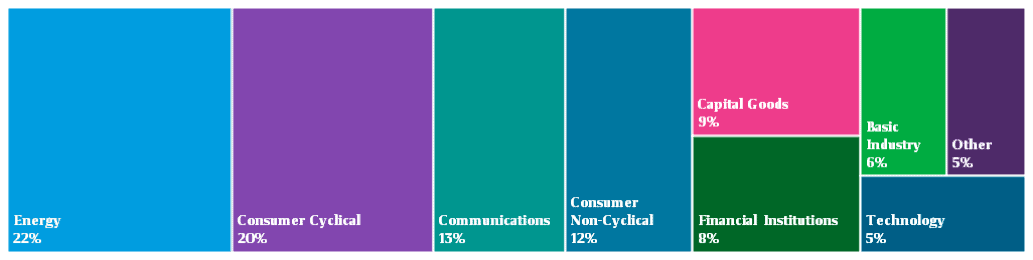
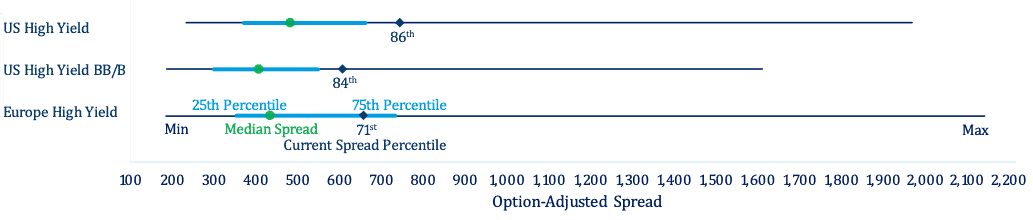
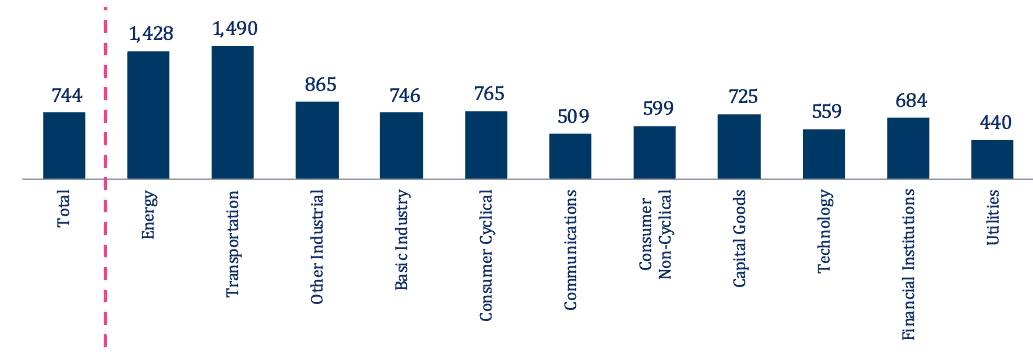
Currently over 700 bps, US high yield spreads are in the 86th percentile since 2000 (see figure 1). While the sell-off has so far hit the energy sector the hardest (see figure 2), the general disruption of economic activity has put pressure on high yield spreads more broadly and overall sources of spread are relatively diverse (see figure 3).

What is equally noteworthy to the level of spreads is how quickly valuations changed. US high yield entered 2020 with a little over 330 bps of spread, only about 30 bps above the tightest levels post-Global Financial Crisis, and spreads were under 350 bps in mid-February. The over 600 bps of spread widening observed over the subsequent 30 days was the sharpest month-over-month spread change in index history.

Despite a strong relief rally on the back of Federal Reserve measures, for the year to April 30, 2020, US high yield is still down by a painful 9 per cent. Given the uncertainty surrounding the path of COVID-19 and the economic damage from shutting down large segments of the economy, it is quite possible that spreads will widen again. The goal of this analysis is not to time the bottom of the market, but rather to look to the past for guidance on how spreads have behaved after breaking the 700 bps mark.

Figure 1 – Range of spreads since January 1, 2000

Bloomberg Barclays Indices. Data to April 30, 2020 (which is the “current” date of high yield spreads).

Figure 2 – Spreads (bps) by sector

Source: Bloomberg Barclays US High Yield Index, as of April 30, 2020.

Figure 3 – Sources of index spread

Source: Bloomberg Barclays US High Yield Index, as of April 30, 2020. “Other” includes transportation, utilities and other industrials.


Prior paths through the fog

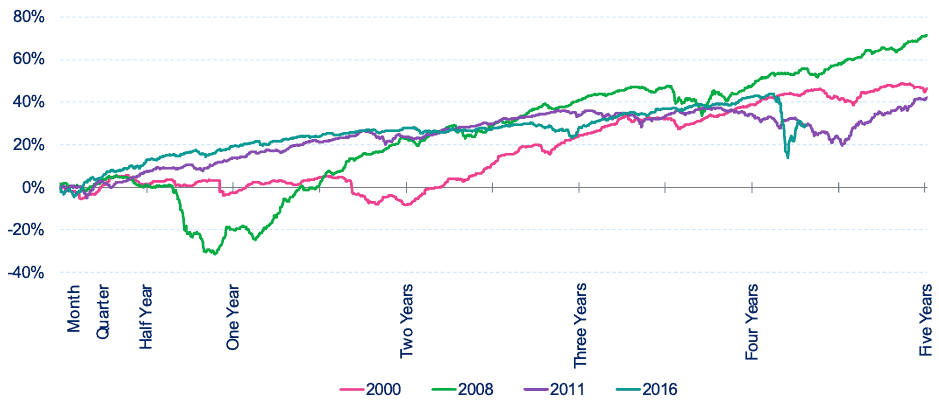
Since 2000, US high yield spreads have broken through the 700 bps barrier four other times:

  • Dot com bubble in 2000
  • Global financial crisis in 2008
  • European financial crisis in 2011
  • Oil price war in 2016

While each incident has its unique characteristics, it can be instructive to look at how high yield debt performed from the outset of stress. This is in many ways the most conservative way to assess returns, as we assume investment exposure throughout the crisis.

Figure 4 – Chart of cumulative high yield returns after hitting 700 bps of spread

Source: Bloomberg Barclays US High Yield Index. Data to April 30, 2020.

Figure 5 – Table of cumulative high yield returns after hitting 700 bps of spread

Date Quarter 1 Half
year
Year
1
Year
2
Year
3
Year
4
Year
5
Maximum drawdown
October 19, 2000 +1% +1% -3% -8% +24% +39% +46% -8%
January 22, 2008 +3% +1% -20% +23% +41% +48% +71% -31%
August 9, 2011 +3% +7% +14% +24% +34% +33% +42% -5%
January 12, 2016 +5% +13% +19% +28% +28% +43% -4%


Source: Bloomberg Barclays US High Yield Index with calculations by Mercer.
Notes: figure 5 is for informational and illustrative purposes only. Cumulative total return is calculated using the percentage change in the index value, which includes reinvestment, from the start date to the end date. The start date is determined by when the index first pasts the 700 bps OAS threshold used to determine a stress event. The end date is a fixed length of time from the start date as described in the table. Time periods have been selected with the benefit of hindsight based on actual historical data and not based on assumptions. Past performance is no guarantee of future results. It is not possible to invest directly in an index. Index returns are gross of fees, transaction costs, or other expenses and include reinvestment of coupon income.

In all periods shown, cumulative absolute returns were meaningfully positive by the third year, despite the losses associated with defaults and the potential impact of fallen angels. However, what is important to mention is the volatility that comes with investing early in a credit cycle downturn. In all cases, there were more losses yet to come, with the maximum total losses another 4 to 31 per cent away. To reap the reward of the elevated level of spreads, investors will have be prepared to endure meaningful volatility and drawdowns.

Being realistic about implementation

Even if one is convinced that high yield will win out over the long run, the question remains of how timely an investor needs to be. With competing investment priorities, governance processes, and the general fear of the unknown, it can be easy to delay on a given investment. Whilst past performance is no guide to the future, we show in figure 6 how the cumulative returns of the initial three-year time period would have been impacted by a variety of delays to the investment.

Figure 6 – Impact of delayed investment on cumulative three-year returns (relative to no delay)

Date/Delaying by One
month
One
quarter
Two
quarters
Three
quarters
One
year
October 19, 2000 +2% -1% -1% -1% +3%
January 22, 2008 0% -5% -1% +37% +35%
August 09, 2011 -1% -4% -9% -13% -16%
January 12, 2016 +6% -6% -14% -18% -21%

Source: Bloomberg Barclays US High Yield Index with calculations by Mercer.
Notes: figure 6 is for informational and illustrative purposes only. Cumulative total return is calculated in a similar manner to figure 5, except rather than fixing the start date, the end date is fixed at three years from when the index first passes the 700 bps OAS threshold used to determine a stress event. The start date is modified by the amount specified in the table from the date when the index first passes the 700 bps OAS threshold. Time periods have been selected with the benefit of hindsight based on actual historical data and not based on assumptions. Past performance is no guarantee of future results. It is not possible to invest directly in an index. Index returns are gross-of-fees, transaction costs, or other expenses and include reinvestment of coupon income.

The impact of delaying investment has been mixed, which is not surprising since we start the clock near the beginning of a credit downturn. In the two most recent cases, delaying the investment by more than one quarter had a meaningful impact on results, as the initial snap back in spreads was missed. However, in the global financial crisis, the depths of the crisis were not reached until around a year after spreads reached 700 bps.

History is only a guide not a guarantee

While staring into the unknown can be daunting for any investor, the past may provide perspective on future outlook. What this piece has aimed to provide, historical perspective, is only a single puzzle piece in constructing an investment thesis for high yield at elevated spread levels. Investors will still need to consider the unique circumstances of the current sell-off as well as the suitability for their own portfolio needs and risk tolerance.

Nathan Struemph is a fixed income asset class specialist at Mercer.


In the wake of the global COVID-19 pandemic, retirees, along with those hoping to retire someday, have been shocked into a new awareness of the need for better risk management tools to handle longevity and ageing. This paper by Wharton’s Olivia Mitchell, offers an assessment of the status quo prior to the spread of the coronavirus; evaluates how retirement systems are faring in the wake of the shock; examines insurance and financial market products that may render retirement systems more resilient for the world’s ageing population; and looks at the potential role for policymakers.

Read the paper here – Building Better Retirement Systems in the Wake of the Global Pandemic

We assess the potential for a more sustainable recovery from the latest global crisis.

  • After the global financial crisis, quantitative easing (QE) led to an economic recovery, but governments broadly missed the chance to encourage funding for environmental and social issues.
  • As we seek to recover from the global pandemic, the European Union’s Green Recovery Plan and initiatives such as that pledged by the city of Amsterdam give us some optimism that this recovery may be more focused on sustainability.
  • The United Nations (UN) Sustainable Development Goals (SDGs) provide a framework for how a renewed focus on environmental and social issues might make the latest recovery a broader, more equitable and more sustainable one.

Will the Covid-19 coronavirus crisis profoundly change the way we tackle social and environmental challenges? The answer to that will depend on our ability to learn from the mistakes made following the global financial crisis a decade ago. As the world recovered from that crisis, a reliance solely on market forces and cheap borrowing only compounded the challenges for many; the chance for a more inclusive economic recovery that recognized the long-term benefits of tackling pressing social and environmental issues was largely missed.

Missed Opportunity

While the arrival of quantitative easing (QE) in 2008 led to an economic recovery, governments broadly missed the opportunity to place incentives in the system that would encourage a flow of capital to areas of need rather than merely to bolster corporate profits – often at the expense of social and environmental challenges.

Today, as we start to slowly emerge from the global pandemic, the European Union’s (EU) planned Green Recovery Plan will provide a stimulus package focused on renovation, clean mobility, hydrogen and renewable energy. While we still await full details of the plan, it shows an ambition by some governments to use the crisis to accelerate the energy transition to a lower-carbon world and to recognize the importance of shared social resources such as hospitals, schools, social housing and public transport.

Embracing ‘Doughnut Economics’

The city of Amsterdam also represents a sign of optimism that more inclusive, cleaner growth can be placed at the center of the recovery from the economic and social pain caused by the Covid-19 pandemic. The city is officially embracing the sustainable development framework created by the Oxford economist, Kate Raworth, which has become known as ‘doughnut economics’.[1] Amsterdam is aiming to emerge from the crisis by balancing the needs of people without harming the environment: an ambitious commitment – and something of an experiment – but precisely the sort of new thinking we believe is needed if we are to prevent ourselves from merely reinforcing the broken paradigms of the past.

Sustainable Development Goals

A central part of Raworth’s doughnut economic model is the inclusion of the United Nations (UN) Sustainable Development Goals (SDGs) for 2030. These are an ambitious set of objectives created to deliver shared prosperity for all and to safeguard the wellbeing of the planet through their focus on unmet needs.

The goals were first launched in 2015 with the ambition of eliminating global poverty. The 17 SDGs were ostensibly designed for governments to work in partnership with broader civil society to improve health and education, to reduce inequality, and to spur inclusive economic growth, while also tackling climate change and preserving the health of our biosphere. They represent a truly ambitious set of universal objectives, to which 193 countries have signed up.

High Cost

Looking at the SDGs through the lens of the Covid-19 crisis reinforces the potentially powerful role they can play in delivering an economic recovery with enduring benefits for the wellbeing of people and the planet. Yet the scale of the expenditure needed to deliver on the goals runs to trillions of dollars.

For many, the original cost was seen as an uneconomic burden that countries could ill afford, at a time when they were still suffering from years of austerity following the global financial crisis. For the optimists, the scale of the opportunity was seen in a different light: achieving the overarching goal of eliminating global poverty and securing the health of the planet would provide larger and more resilient markets in a way that social and environmental activists, alongside investors and companies, could agree upon. In our view, the very human cost of the Covid-19 crisis illustrates vividly that achieving these objectives represents an alternative vision of recovery to the free market’s ‘winner takes all’ mentality of the last 40 years.

Meeting Future Needs

As we look at the scale of the stimulus packages put in place to haul the battered global economy out of its slump, the size of the funding for meeting the ambitions of the UN’s SDGs suddenly seems far more achievable. As we flirt with near-universal negative interest rates, enlightened authorities have been granted an opportunity to embrace sustainable development as the cornerstone of a broader economic recovery at the lowest financing cost on record.

Aspirations such as no poverty (SDG1), good health and wellbeing (SDG3), decent work and economic growth (SDG8), sustainable cities (SDG11), and responsible consumption and production (SDG12), are all central planks of a strong, vibrant economic system that is fit to meet our future needs, and is resilient to the inevitable shocks that will assail us periodically. We believe that any civil society that aspires to peace, justice and strong institutions (SDG16), should automatically aspire to deliver an economic plan that embraces these goals.

History has delivered to us severe economic conditions that became social crises before. The Great Depression of the 1930s and the recovery from the devastation of the Second World War required coordinated action between nations and between civil society and corporations. At his commencement speech at Oglethorpe University in May 1932, in the depths of the Great Depression, US President Franklin D. Roosevelt made a rousing speech that marked the beginning of his ‘New Deal’ plan. There was a line in that speech that presaged the importance of the SDGs and the central importance of sustainable development in tackling a slump: “…to inject life into our ailing economic order, we cannot make it endure for long unless we can bring about a wiser, more equitable distribution of the national income.”

Importance of Engagement

Thinking on sustainability is not new: the seminal Brundtland Report, published in 1987,[2] remains the benchmark for a peer-reviewed, science-based approach to delivering a sound economy based on the principles reflected almost three decades later in the UN SDGs. Increasingly, the term ‘stakeholder capitalism’ is being touted as the successor to the shareholder-centric model that grew out of the economic malaise of the 1970s. If we are to achieve this transition, governments, regulators and corporations need to fully embrace the opportunity represented by Brundtland’s definition of sustainability: “…development that satisfies the needs of the present without compromising the capacity of future generations, guaranteeing the balance between economic growth, care for the environment and social wellbeing.”

The Covid-19 crisis is a very human experience. It has dislocated the lives of hundreds of millions of people across every continent. The pandemic has exposed a fragility in many health systems – even in the prosperous developed economies – that has undermined the health and future wellbeing of many (SDG3), and is likely to leave scars for years to come.

While investors cannot easily address the failings of individual health-care systems, they can influence better outcomes for all countries by actively engaging with companies to recognize the benefits of supporting the wellbeing of their workforce. For many workers, the absence of a societal or corporate safety net for health care has come at considerable personal expense, especially for the low-paid.

A Sustainable Recovery?

The lens of sustainable development, and even the UN SDGs, is ultimately about good capitalism: it is about deploying capital to areas that tackle the under-served needs of global society – a call option on future prosperity – hence identifying secular areas of growth.

With tens of millions of people likely to lose their jobs, their livelihoods and potentially their wellbeing as a result of the pandemic, we collectively need to support a recovery that is intolerant of poverty (SDG1) and one that is backed by a vision that sustainability is a view of a possible future that brings multiple benefits for society and the world in which we dwell. To achieve this vision requires civil society to value the aspirations enshrined in the 17 SDGs and to recognize the shared benefits now and for future generations of such an approach.

Working in partnership (SDG17) will be central to this outcome if we are to ensure that a better future for the many is delivered. In our view, the SDGs, along with environmental, social and governance (ESG) considerations, are not a label of convenience to signal virtue; they are aspirations for the future that require action now.

It is not certain that the future path we follow as societies will follow these lines, as there is a tendency for free-riding and self-interest to become the default in times of economic stress. Yet there are signs of hope that a better way of managing our future destiny is emerging that just requires us to try to cut loose from the anchors of past behavior.

Sources

[1] https://www.weforum.org/agenda/2020/05/doughnut-model-amsterdam-coronavirus-recovery/

[2] https://www.britannica.com/topic/Brundtland-Report

Important information and disclosures

Any reference to a specific security, country or sector should not be construed as a recommendation to buy or sell this security, country or sector. Please note that strategy holdings and positioning are subject to change without notice.

Important Information

This is a financial promotion. Issued by Newton Investment Management Limited, The Bank of New York Mellon Centre, 160 Queen Victoria Street, London, EC4V 4LA. Newton Investment Management Limited is authorized and regulated by the Financial Conduct Authority, 12 Endeavour Square, London, E20 1JN and is a subsidiary of The Bank of New York Mellon Corporation. ‘Newton’ and/or ‘Newton Investment Management’ brand refers to Newton Investment Management Limited. Newton is registered in England No. 01371973. VAT registration number GB: 577 7181 95. Newton is registered with the SEC as an investment adviser under the Investment Advisers Act of 1940. Newton’s investment business is described in Form ADV, Part 1 and 2, which can be obtained from the SEC.gov website or obtained upon request. Material in this publication is for general information only. The opinions expressed in this document are those of Newton and should not be construed as investment advice or recommendations for any purchase or sale of any specific security or commodity. Certain information contained herein is based on outside sources believed to be reliable, but its accuracy is not guaranteed. You should consult your advisor to determine whether any particular investment strategy is appropriate. This material is for institutional investors only.

In Canada, Newton Investment Management Limited is availing itself of the International Adviser Exemption (IAE) in the following Provinces: Alberta, British Columbia, Ontario and Quebec and the foreign commodity trading advisor exemption in Ontario. The IAE is in compliance with National Instrument 31-103, Registration Requirements, Exemptions and Ongoing Registrant Obligations.

Personnel of certain of our BNY Mellon affiliates may act as: (i) registered representatives of BNY Mellon Securities Corporation (in its capacity as a registered broker-dealer) to offer securities, (ii) officers of the Bank of New York Mellon (a New York chartered bank) to offer bank-maintained collective investment funds, and (iii) Associated Persons of BNY Mellon Securities Corporation (in its capacity as a registered investment adviser) to offer separately managed accounts managed by BNY Mellon Investment Management firms, including Newton and (iv) representatives of Newton Americas, a Division of BNY Mellon Securities Corporation, U.S. Distributor of Newton Investment Management Limited.

Unless you are notified to the contrary, the products and services mentioned are not insured by the FDIC (or by any governmental entity) and are not guaranteed by or obligations of The Bank of New York or any of its affiliates. The Bank of New York assumes no responsibility for the accuracy or completeness of the above data and disclaims all expressed or implied warranties in connection therewith. © 2020 The Bank of New York Company, Inc. All rights reserved.

Newton Investment Management is a global investment management firm, providing, in partnership with its parent company BNY Mellon Investment Management, a focused range of investment strategies to public funds, corporations, and individuals.

We run a broad range of multi-asset, fixed-income and equity strategies, and have particular expertise in absolute-return, income-focused, high-conviction and sustainable investing. We use a global thematic approach to help achieve long-term perspective. Our themes inform both the rigorous fundamental analysis carried out by our experienced global research analysts, and the construction of portfolios designed to meet our clients’ requirements.

In addition to financial measures, we evaluate factors such as environmental impacts, social standards, and the effectiveness of people in charge. We believe this ‘purposeful ownership’ approach allows us to better manage risk and make more informed investment decisions, helping investors worldwide meet their desired investment outcomes.

www.newtonim.com/us-institutional/

www.newtonim.com/canada/

For more information:

James Blake

Head of Global Consultant Relations Manager

Newton Investment Management

James.Blake@newtonim.com

+1 212 922 6055

Gerry Cosgrove

Head of US Sales and Consultant Relations,

Newton Investment Management North America LLC

Gerald.Cosgrove@newtonim.com

+1 617 248 4666