Three investors reflect on the what lies ahead highlighting a buoyant 2021 but challenges beyond. Their suggestions include allocations to real assets and diversifying out of traditional fixed income.

There is a solid backdrop for risk assets ahead, said a group of expert panellists speaking at FIS 2020 Digital. Fundamentals around earnings expectations, price momentum and valuations has left investors like State Street Global Advisors underweight fixed income and overweight equities, particularly in the US where SSGA’s Dan Farley, executive vice president and chief investment officer, investment solutions group, sees real economic growth.

Meanwhile, increased allocations to gold and credit are providing a hedge against unexpected risk he said, predicting an above average economic recovery in 2021 followed by a tailing off to pre-pandemic levels.

Elsewhere, Canada’s Ontario Teachers’ Pension Plan holds a similar view. Millan Mulraine, chief economist at the fund which he joined in 2016 where he oversees macro-oriented research to inform the fund’s investment decisions, told delegates that 2021 is shaping up to be “a good year” as markets reap the vaccine premium.

However, Mulraine is cautious about what lies beyond 2021. He said that Central Banks are close to being out of the fiscal and monetary ammunition they need to manoeuvre, while the challenges impacting markets before COVID remain. Investors can look forward to a burst of growth, but it has been “bought forward from the future” by lower interest rates and government leverage. “How are we going to grow going forward if we don’t expand global production capacity,” he questioned, casting a wary eye on below trend growth coming down the track, lower yields and all the challenges of designing a portfolio therein.

USS Investment Management, the UK’s largest pension fund, is similarly concerned. Bruno Serfaty, head of dynamic asset allocation and senior portfolio manager in the multi-asset allocation team since 2015, said the fund’s focus is on a post-COVID world, and the impact of the vast policy response.

Although the pandemic is relatively short term in the context of the pension scheme’s long-term investment strategy, the impact of unprecedented government spending will reverberate for years to come. “The scale of the policy response is unprecedented, particularly given the fact we started with a high level of debt before COVID. The debt overhang is not going to go away.” He said fiscal stimulus combined with monetary policy left a highly liquid environment and fierce competition for real assets.

Inflation

Next panellists turned their expertise to inflation. SSGA’s house view is that inflation will remain low for the next few year. However, Farley warned that the market is susceptible to an “inflation shock,” whereby a spike in prices catches participants unprepared. He also noted that inflation proofing portfolios must go beyond inflation-linked bonds because of their poor return. Instead, SSGA’s focus is on real estate, infrastructure, commodities and gold.

“There is a lot of money chasing these investments and you have to be discriminate,” he warned. “If we get an inflation shock, it will put pressure on price multiples and equity markets, and having that hedge is really important: a total portfolio context vital.”

Inflation expectations are also key to informing OTPP’s view on returns and asset performance going forward.

“If you can answer the inflation question, you have a much better view on asset returns and the policy response,” said Mulraine. It led him to reflect on how accommodative policy over recent decades has supressed inflation but, like SSGA, warned an inflation surprise to the upside could be in the offing. It has prompted an extra focus on diversification across geographies, natural hedges and real asset allocations that insulate the portfolio, he said.

“If inflation goes up, we know real yields will be depressed and we consider this when navigating the environment over the next five years.”

Inflation has benefits and a negative side, USS’s Serfaty acknowledged, noting how the positive impact of inflation on asset prices, stoked by monetary policy, has benefited the pension fund.

“Asset owners have benefited disproportionately from this – relative to economic activity,” he said. Inflation’s dark side appears when costs and wages start to rise and impact corporate profitability. He also flagged how tariffs (in the context of both US and China, and Brexit) will also push costs up.

“Tariffs have an impact on costs and profitability, and we need to be prepared for this.”

Panellists also reflected on the challenges of diversifying their portfolios and building defensive allocations when bond yields are so low. Their advice is to keep hold of fixed income as a diversifier, but also innovate and adopt a total portfolio view. Alongside government bonds and gold, other assets providing downside support include low volatility equities or options hedge, they suggested. However, Farley flagged these strategies come with a cost.

OTPP’s Mulraine warned that there is no easy alternative to owning government bonds or obvious escape from yields languishing close to zero. Alternative allocations come with constraints on leverage, limited depth and liquidity. However, he noted how some large asset owners are increasingly looking at alternatives like Chinese bonds and gold.

Serfaty urged delegates to think afresh at their reasons for holding bonds. Are they a source of diversification from growth assets, or are you holding them because you think inflation will remain low, they provide a good real return and store of value, he asked.

“If you decompose the reasons why you own bonds, you can try and find alternatives,” he said. He said that credit opportunities also exist as a hedge against equities in case of a risk event, and that governments’ mass printing of money threw into question whether bonds are actually the safest store of money. Gold or currencies provide alternatives, he suggested.

“We have built a matching asset portfolio at USS and have found real assets in private market or the credit space that will match these long-term liabilities.”

As for where the most promising returns lie, Farley highlighted interesting opportunities in emerging markets, particularly Asia (ex-Japan) because of the Chinese halo effect. He also flagged that emerging market debt provides a diversifying source within fixed income, although warned this market “isn’t as deep” as others. Elsewhere, real estate coming out of COVID provides opportunities for long term investors alongside inflation protection.

At OTPP the focus is on private assets in geographically diverse locations. Mulraine also espoused the importance of internal management given it allows investors to “ride out the business cycle,” enabling smoother returns by selling assets and benefiting from the upside. He said the strategy was an important part of OTPP’s revenue generation, concluding that OTPP has “pensions to pay” and can’t “just play in public markets” or “sit in its hands.”
The final session of FIS Digital 2020 allowed investors to ‘meet’ and share ideas via private networking groups using a breakthrough technology

The final session of FIS Digital 2020, Conexus Financial’s last digital event of the year attended by 185 asset owners with a collective $11 trillion assets under management, marked another milestone in the company’s innovative event delivery.

FIS Digital 2020 delegates were able to network with peers in a simulation of a live roundtable discussion. Investors joined private chat rooms with peers using special networking technology to discuss the key themes of the conference in “rooms” or “tables.”

Each discussion was chaired by a different asset owner or manager speaker. Richard Williams, CIO of the United Kingdom’s £25 billion ($33 billion) RMPI Railpen, Jaap van Dam, principal director, investment strategy at the Netherland’s €268 billion ($325 billion) PGGM which manages assets for more than 2.5 million Dutch participants, and Mark Walker, CIO of the UK’s £21 billion ($27 billion) Coal Pension Trustee led and coordinated the discussions, adding their own experiences from a tumultuous year.

For Walker this included a heightened focus on idea generation and new sources of income producing assets.

For Railpen the focus has been on seeking out investment opportunties and drawing on a cash pile built up especially for the kinds of opportunities crises trigger, while for PGGM the focus has been on a green recovery.

In year when sharing and collaboration in person, a vital lifeblood to investment, has been impossible FIS 2020 Digital was able to offer a valuable alternative.

For more than 10 years conexust1f.flywheelstaging.com has brought you case studies of best practice in global investment management focusing on governance and decision making, portfolio construction and efficient portfolio management, fees and costs, and sustainable investing.

The current health and economic crisis, and the volatility of 2020, has revealed the vulnerabilities in the global economy and highlighted the need for capital to be allocated in an efficient and sustainable way. It has prompted us to think of our role in guiding the industry to best practice.

Given the changing nature of the global economy it is a good time to question whether the status quo processes and behaviours that investment professionals undertake to tackle risks and opportunities, and meet their fiduciary obligations, will be sufficient in the future.

This crisis has prompted us to be more explicit in expressing what we stand for, what we have always stood for – to be a catalyst for reformed fiduciary thinking.

You can expect the same access and detail about how CIOs from around the world are thinking about their responsibilities and allocating capital, but we will remind you of what we will be actively campaigning for to ensure the industry is allocating capital for the best possible outcomes for individuals and for the world.

This is what we stand for:

Premise: Diversity and inclusion drive better investment outcomes
Campaign: Top1000funds.com will drive diversity in the investment industry

Premise: Sustainability is a core responsibility of investors
Campaign: To campaign for sustainability to become a core part of investing for all asset owners

Premise: Principal-agent problems dominate the investment industry
Campaign: Top1000funds.com will campaign for more transparency in the institutional investment industry, more collaboration and more innovation

Premise: Costs matter
Campaign: Top1000funds.com will campaign for more efficient allocation of capital, lower fees, and more aligned investment management fees and relationships between investment managers and asset owners

An example of putting these campaigns into action is the February launch of the Global Pension Transparency Benchmark in partnership with CEM Benchmarking, which is a world first global benchmark for transparency of pension disclosure, bringing a focus to transparency in a bid to improve pension outcomes for members.

The GPTB ranks 15 countries on public disclosures of key value generation elements for the five largest pension fund organisations within each country. The overall country benchmark scores will look at four factors: governance and organization; performance; costs; and responsible investing, which are measured by assessing hundreds of underlying components.

These campaigns will also be present in the programs at our events next year including those in the first half:

·       Sustainability Digital March 9-10, 2021

·       Fiduciary Investors Symposium, May 25-26, 2021

You will hear more from us in the first quarter of 2021 about how we will be putting these campaigns  into action, and we’ll be calling on you to be part of it.

I look forward to hearing your feedback on these initiatives and working together in a bid for continuous improvement in the industry and a focus on better outcomes for stakeholders.

0

Rebecca Patterson, Bridgewater’s director of investment research, says MP3 is the new backdrop that will influence all outcomes in 2021 with the medium term characterised by low interest rates and the possibility of higher inflation.

The backdrop to financial markets in the years ahead will be characterised by fiscal and monetary policy working hand in hand, low interest rates and the likelihood of higher inflation, said Rebecca Patterson, director of investment research, Bridgewater Associates.

Speaking at FIS Digital 2020, she told delegates that so-called MP3 whereby monetary and fiscal policy work in tandem, will continue to impact growth and permeate into economic outcomes across all asset classes.

“MP3 will be here for some time; it is the new backdrop that will influence all outcomes in 2021 and beyond,” she said.

Gone are the days of straight forward interest rate adjustments or the QE/asset purchases governments introduced when interest rates hit zero. The arrival of the pandemic has seen Central Banks move to a policy regime where fiscal stimulus is an even bigger lever. Elsewhere, she pointed to the growing consensus that short term US interest rates will remain on hold through to 2023 – or longer.

“US interest rates influence so many assets around the world,” she said. Elsewhere, the Federal Reserve is also changing how it addresses inflation, seeking to encourage it and change entrenched low inflation expectations.

She said that the Biden presidency will take away the policy uncertainty that defined the Trump presidency. His administration will have a more orthodox set of players allowing companies to base their hiring decisions or M&A activity on a known playing field.

However, she said unknows still exist around fiscal policy and questions around the approval of the next pandemic relief package. The other big unknown impacting future fiscal policy is the outcome of the Senate run-offs in Georgia.

“If the Democrats win both, there are greater odds to getting Biden’s policies through and the probability of greater fiscal spending in the years to come with an impact on asset classes.”


She also noted how Central Banks cannot cut interest rates to make servicing debt cheaper. Now debt levels can only be tackled with a combination of monetary and fiscal policy she said, forecasting fiscal stimulus will go into infrastructure spending, broadband, R&D and green endeavour.

Government spending could also help tackle populism. In a nod to the growing force of populism, Bridgewater has created an index of populist pressure. She noted that government spending in these areas could help ease alienation and people feeling failed by government.

She outlined scope for real yields to fall further given the pressure on Central Banks to keep rates low and reflate their economies. It will mean investors need to increasingly look to other stores of wealth like gold. She also flagged that very little inflation is priced in by the markets.

“Breakevens have risk but US inflation is still around 2 per cent.”

Although she didn’t think there is scope for “a huge rise” in inflation, she said the scope for a spike in inflation is higher than in the past given the combination of monetary and fiscal stimulus.

She also highlighted how the vaccine will impact different sectors of the equity market. The sectors hardest hit by the pandemic like travel and leisure have reacted positively to its roll out and seen investors rotate out of defensive stocks that have done well in the crisis. However, she counselled that in a zero rates world, investors need to allocate to equities with bond like characteristics.

“Defensive names do offer these attributes; a zero-rate world is good for equity markets as investors still need allocations to equities with bond like characteristics for diversification.”

For investors seeking to replace nominal bond exposure with bond-like returns from the public equity market, she said to focus on companies with stable cashflows as well as low vol equities.

“There is a world where you can reduce nominal bonds and get the bond-type returns and diversification you need as an investor,” she said, adding that geographic diversification is more important than ever.

As for the impact of Brexit on UK assets, she said the impact was either “bad” or, in the case of No-Deal, “really bad”. However, she said much of the impact has already been factored into valuations.

“The good news is that since this is a slow movie, a lot has been baked into the price.” Anxiety about the UK’s external financing needs, rock bottom real yields and future tariffs will impact the pound, however.

PGIM’s chief economist and head of global macroeconomic research, Nathan Sheets, outlines what Biden’s priorities will be and how his key appointees will lead their departments. He also explains why he believes inflation will remain low and that investors will increasingly move into risk assets.

Expect the Biden government to invest strategically in infrastructure, healthcare and efforts to combat climate change, said Nathan Sheets, the former Under Secretary of the Treasury for International Affairs representing the US government on international economic policy, and now chief economist at PGIM Fixed Income.

Speaking to FIS delegates, Sheets said Biden’s new appointees have years of experience and are not a team of rivals, but cautioned that a sleek administration will face headwinds getting ambitious spending plans through Congress.

One of the most experienced of Biden’s appointees is treasury secretary ex-Federal Reserve chair Janet Yellen.

Sheets said her principled independence will ensure she “leaves the Fed to pursue its policies” and said her overwhelming focus will be on steering the economy back to health after the pandemic. Here her particular focus will be on the labour market.

“The issue of getting people back to work is critical for the administration, and her experience is so useful. No-one knows the US labour market as well as she does,” he said, telling delegates to expect fresh ideas and approaches that will put the US in a strong position as the recovery takes hold.


Next he mentioned Brian Deese, former head of sustainability at Blackrock, tapped by Biden to lead the National Economic Council where he will lead the battle to counter climate change. He predicted that Deese’s “deliberate and smooth” style would be behind the scenes, rather than front of house talking to the press on policy.

Again, he flagged the challenges of getting climate policies through Congress and suggested the focus will be on executive orders and an administrative focus, alongside emphasising policies that focus on fuel efficiency.

As for Biden’s China policy, Sheets said Biden will also view China as a strategic competitor but the new administration’s methods of dealing with China will differ from Trump.

“US China policy will stay strategically tough, but the tactics will be different,” he said. While Trump’s focus was unilateral and focused on trade, Biden will work on a multilateral basis seeking allies and alliances in a negotiation process that will span opening up the Chinese economy and respecting foreign technology.

“Many of America’s concerns are shared in Japan, Australia and Europe,” he said. “Expect a tactically different approach, but there will be tensions in the US/ China relationship under Biden.”

Describing himself as in the “low inflation camp,” Sheets downplayed the likelihood of inflation spiking in the wake of the pandemic.

Drawing on his knowledge of low inflation after the GFC, a time when many people thought it would surge given the liquidity in the system, he said the same could be the case this time around. Back then structural forces in the economy like an aging demographic and automation kept inflation low, and these structural forces are still in play today.

“Automation is progressing and more so coming out of the pandemic, while high levels of debt are likely to impact demand,” he said, forecasting soft to moderate growth, low inflation and low rates in the years ahead. “It is possible during the process of getting back to normal that we see shortages and bottlenecks of higher inflation, but it will be a temporary phenomena.”

Reflecting on the impact of low rates and low inflation on asset classes, Sheets said investors would increasingly “reach for yield” in a trend that is positive for risk assets.

“Investors need to take on risk to to hit their expected return objectives,” he said, predicting investors will increasingly move into high quality stocks and out of government securities. Navigating currency risk will remain tough he said, predicting the dollar will depreciate not against the yen or Euro but against the renminbi and emerging market currencies as the global recovery takes hold.

“Currencies will be toughest asset class,” he concluded.

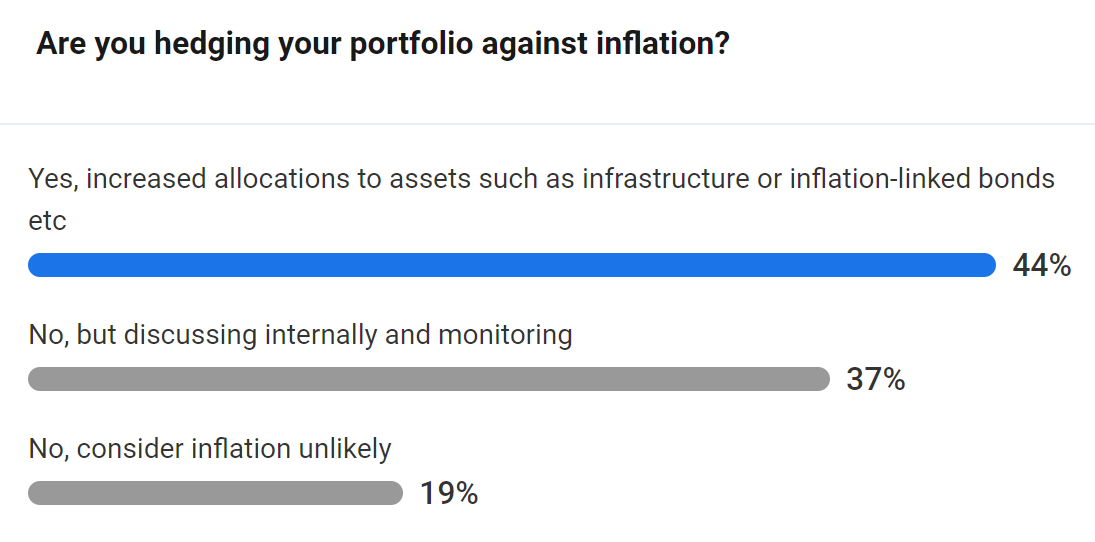
Asset owners from 23 countries are reacting differently to inflation expectations, with almost half already hedging their portfolios but 20 per cent consider inflation is unlikely.

When asked if they were hedging their portfolios against inflation, the 185 investors from 23 with a combined AUM of $11 trillion who participated in a special edition of the Top1000funds.com event series’ The Fiduciary Investors Symposium, the results were very evenly split.

Of the respondents 44 per cent said they were hedging their portfolio via increased allocations to assets such as infrastructure and inflation linked bonds. A further 37 per cent said they were not currently hedging but were discussing it internally and monitoring it. And 19 per cent said no, they were not hedging their portfolios and considered inflation unlikely.

In latter sessions Nathan Sheets, chief economist and head of global macro economic research at PGIM Fixed Income who formerly served as President Obama’s Under Secretary of the Treasury for international affairs, and Rebecca Patterson, director of investment research at Bridgewater Associates both said inflation was unlikely in the medium term. However Patterson also said with prices on the hedges lower than they have been, and the likelihood of inflation higher than it has been, it is a good time to put some protection on portfolios.


The event specifically looked at issues relating to:

  • Coronavirus and its impact on global health and the global economy
  • The US election and the impact on markets and the geopolitical landscape
  • And the outlook for 2021 including big issues around inflation, asset class correlations and whether we are in fact entering a new investment paradigm.

As always, the cornerstone of the conference was the power of global fiduciary capital and how you are critical in investing into a better future

Investors were also asked to vote on where they thought that US economy policy should be focused. Overwhelmingly investors thought that ensuring inclusive growth should be the focus (51 per cent) followed by managing unemployment (24 per cent), rescue packages to SMEs (14 per cent), managing inflation (8 per cent) and continuing QE (3 per cent).